

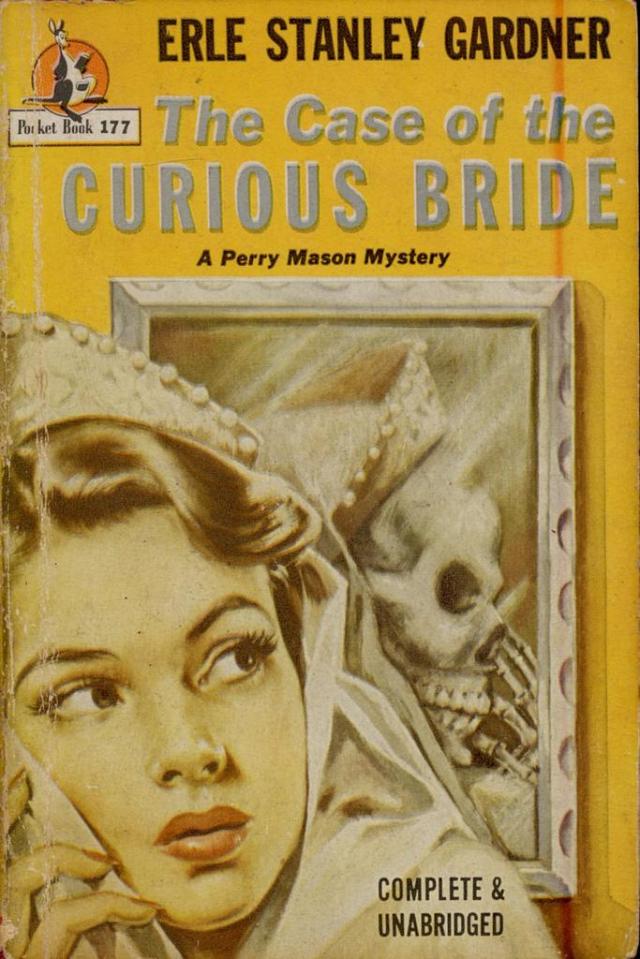
The case of the curious.., p.7
The Case of the Curious Bride,
p.7


Montaine drew himself up once more. “The police,” he said, “are going to know about it.”
“What makes you so positive?” Mason inquired.
“Because,” Montaine said, “I am going to tell them. It is my duty. I don’t care if she is my wife, I can’t conceal facts. I can’t stand between her and the law.”
“Suppose she’s innocent?”
“Of course, she’s innocent,” Montaine flared. “That’s what I’m telling you. It’s this man, Millsap, that’s guilty. You can put two and two together. She was out. He was out. Moxley was murdered. She’ll try to protect him. He’ll sell her out. The police must be notified and …”
“Look here, Montaine,” Mason interrupted, “you’re jealous. That makes your mental perspective cockeyed. You’d better forget Millsap. Go to your wife. Get her explanation. Don’t say a word to the police until …”
Montaine got to his feet, stood very dignified and very reserved, his heroic manner marred somewhat by the mop of hair which was slumped down over his forehead. “The very thing Millsap would want,” he said. “He has primed my wife with a lot of lies. She’d try to keep me from notifying the police. Then when the police did discover about the keys, where would I be? No, Counselor, my mind is made up. I must maintain my integrity. I will be firm with my wife, firm but sympathetic. To Millsap I shall be an avenging fury.”
“For God’s sake,” Mason exploded, “quit that damned posing and come down to earth. You’ve sympathized with yourself so much that you’ve gone goofy and built up a mock heroic attitude …”
Montaine interrupted, his face flushed. “That will do,” he said with the forceful dignity of one who is saturated with self-righteousness. “My mind is made up, Counselor. I am going to notify the police. I feel it is for the best interests of all concerned that I do so. Millsap can dominate my wife. He can’t dominate the police.”
“You’d better go easy on that Millsap business,” Mason warned. “You haven’t a thing against him.”
“He was out—at the very time the murder was being committed.”
“He may have been out on a call. If you insist on telling the police about your wife, that’s one thing. But you start spilling stuff about Millsap and you’ll find yourself in a jam.”
“Very well,” Montaine agreed, “I will think over what you say. In the meantime you will represent my wife. You may send me a bill for your services. And please don’t forget about my father. I want you to protect him in every way you can.”
“I can’t divide my allegiance,” Mason said grimly. “I’ll represent your wife first. If Millsap gets in the way, he’ll be smashed. I don’t see where your father needs any protection. But if I’m going to represent your wife I’m not going to have my hands tied. What’s more, I’m going to make your father come across with some coin. This business about ‘sending a bill’ doesn’t sound good to me.”
Montaine said slowly, “Of course, I can see how you feel. … My wife must come first … that’s the way I want it.”
“Before your father?” asked Mason.
Montaine lowered his eyes, said very faintly, “If it comes to that, yes.”
“Well, it won’t come to that. Your father isn’t mixed up in it. But he does control the purse strings. I’m going to make him pay me for what I do.”
“He won’t. He hates Rhoda. I’ll get the money somewhere, somehow. He won’t pay a cent.”
“When are you going to notify the police?” Mason asked, changing the subject abruptly.
“Now.”
“Over the telephone?”
“No. I’m going to see them personally.”
Montaine turned toward the door, then, suddenly remembering something, spun about and approached Mason’s desk with outstretched palm. “My key, Counselor,” he said. “I almost forgot that.”
Perry Mason heaved a sigh, picked up the key from the desk and reluctantly dropped it into Montaine’s palm. “I wish,” he said, “you’d hold off doing anything until …” But Montaine marched to the corridor door, his manner oozing self-righteous determination.
Chapter 7
Perry Mason frowningly consulted his wristwatch, jabbed an impatient thumb against the bell button. After the third ring he turned away from the door and looked at the houses on either side. He saw the surreptitious motion of lace curtains in the adjoining house. Mason gave the bell one more try, then, when he heard no response, crossed directly to the house where he had detected the flicker of interest back of the curtain.
His ring was followed almost immediately by the sound of clumping steps. The door opened and a fleshy woman stared at him with glittering eyes. “You ain’t a peddler?” she asked. Mason shook his head. “And if you were one of those college boys getting magazine subscriptions, you wouldn’t wear a hat.”
The lawyer let his smile become a grin.
“Well,” she said in a voice that trickled effortlessly from the end of a glib tongue, “what is it?”
“I’m looking,” said Perry Mason, “for Mrs. Montaine.”
“She lives next door.” Mason nodded, waiting. “Did you try over there?”
“You know I did. You were staring out at me from behind the curtain.”
“Well, what if I was? I’ve got a right to look out of my own window, haven’t I? Look here, my man, this is my house, bought and paid for….”
Perry Mason laughed. “No offense,” he said. “I’m trying to save time, that’s all. You’re a woman with an observing disposition. You saw me over at Montaine’s. I’m wondering if, perhaps, you didn’t see Mrs. Montaine when she left?”
“What’s it to you if I did?”
“I’m very anxious to get in touch with her.”
“You’re a friend of hers?”
“Yes.”
“Ain’t her husband home?”
Perry Mason shook his head.
“Hmm,” said the woman. “Must have gone out this morning a lot earlier than usual. I didn’t see him, so I thought he was still in bed. They’ve got money, so he doesn’t have to do anything he doesn’t want to.”
“Mrs. Montaine?” asked Perry Mason. “How about her?”
“She was his nurse. She married him for his money. She went away in a taxicab about half an hour ago, maybe a little less.”
“How much baggage?” Perry Mason asked.
“Just a light bag,” she said, “but there was an expressman came about an hour ago and got a trunk.”
“You mean a transfer man?” asked Perry Mason.
“No, it was the express company.”
“You don’t know when she’ll be back?”
“No. They don’t confide their plans to me. The way they look at me, I’m just poor folks. You see, my son bought this house and didn’t have it all paid for. That was when times were good. He had some kind of a life insurance loan that paid off the house when he died. That was the way Charles was, always kind and thoughtful. Most boys wouldn’t have thought of their pa and ma and taken out insurance …”
Perry Mason bowed. “Thank you,” he said, “very much. I think you’ve given me just the information that I want.”
“If she comes back, who should I say called?” asked the woman.
“She won’t be back,” Perry Mason said.
The woman followed him to the edge of the porch. “You mean won’t ever be back?” she asked. Perry Mason said nothing but strode rapidly to the sidewalk. “They say his folks don’t approve of the match. What’s her husband going to do if his father cuts him off without a cent?” the woman called after him.
Mason lengthened his strides, turned, smiled, raised his hat and rounded the corner. He caught a cab at the boulevard. “Municipal Airport,” he said. The driver snapped the car into motion. “If,” said the lawyer, “there are any fines, I’ll pay them.” The cab driver grinned, nursed his car into speed, slipped in and out of traffic along the boulevard with deft skill.
“This is as fast as the bus goes?” asked Perry Mason.
“When I’m driving it, it is.”
“There’s a good tip if you get me there in a rush, buddy.”
“I’ll get you there just as fast as it’s safe to drive,” the cab driver rejoined. “I’ve got a wife and kids and a job. …”
He broke off as he slammed his foot on the brake pedal, twisted the steering wheel sharply, as a light sedan whizzed around a corner. “There you are,” he called back over his shoulder, “that’s what happens when you try to make time, and they don’t give us any breaks in the home office. The cab driver is always wrong. We’ve got to drive our car, and we’ve got to drive the other fellow’s car for him, too. When we get in a smash, we’re laid off, and … Say, buddy, do you know you’ve got a tail?”
Perry Mason straightened to rigid attention. “Don’t look around,” warned the cab driver. “He’s commencing to crowd up on us. It’s a Ford coupe. I noticed it a ways back, just after you got in, and I didn’t think anything of it, but he’s been sticking pretty close to us all through the traffic.”
Perry Mason raised his eyes and tried to see the road behind him in the rear-view mirror. “Wait a minute,” the cab driver said, “and I’ll give you a break.”
He took advantage of a clear stretch in the traffic to raise his hand and adjust his mirror so that Perry Mason could watch the stream of traffic in the road behind him.
“You watch the rear. I’ll keep an eye on the front,” the driver told him.
Perry Mason’s eyes narrowed thoughtfully. “Boy,” he said, “you need a quick eye to spot that fellow.”
“Oh, shucks,” the cab driver protested, “that’s nothing. I have to see what’s going on in this racket, or the wife and kids would starve to death. You’ve got to have eyes in the back of your head. That’s all I’m good for, driving a cab, but that’s one thing I am good for.”
Perry Mason said slowly, “A Ford coupe with a dented fender on the right. Two men in it. … Tell you what you do, you swing to the left at the next corner and figure-eight around a couple of blocks. Let’s just make it sure.”
“They’ll figure we’ve spotted them if you figure-eight,” the driver said.
“I don’t care what they figure,” Perry Mason rejoined. “I want to smoke them out in the open. If they don’t follow us, they’re going to lose us. If they do follow us, we’ll stop and ask them what it’s all about.”
“Nobody that’s likely to start throwing lead around, is it?” the driver inquired apprehensively.
“Nothing like that,” Mason said. “They might be private dicks, that’s all.”
“Trouble with the wife?” the driver inquired.
“As you so aptly remarked,” Perry Mason said, “you’re an excellent cab driver. That is one of the things that you are good at. In fact, I believe you said that was the one thing you were good at.”
The driver grinned. “Okay, chief,” he said, “I’ll mind my own business. I was just being sociable. Hang on. Here we go to the left.”
The cab lurched into a fast turn, slid down a side street. “Hold everything, buddy, we’re making another turn to the left.” Once more the cab screamed into a wide turn.
“They went by,” Perry Mason said. “Pull in close to the curb and stop for a minute. Let’s see if they circle down the other street. I was watching them in the mirror. They slowed down at the intersection. They got there just as we made the second turn to the left. They acted for a minute as though they were going to make the turn, and then they passed it up.”
The cab driver turned in his seat, chewed gum with rhythmic monotony as he peered through the window in the rear of the cab. “All the time we stand here, we’re losing time,” he said. “You going to take a plane?”
“I don’t know,” Perry Mason said, “I want to get some information.”
“Uh huh. … They ain’t coming down any of these side streets.”
“Suppose we run down to another boulevard and try for the airport along it. You could run down to Belvedere, couldn’t you?”
“Sure, we could. You’re the boss.”
“Let’s go,” Mason said.
The driver straightened back in the seat and readjusted the rear-view mirror. “You won’t want this any more, buddy,” he told Perry Mason.
The cab once more clashed through its gears and rattled into speed. The lawyer sank back in the cushions. From time to time, he turned to look thoughtfully back at the road behind him. There was no sign of pursuit.
“Any particular place?” asked the cab driver, as the car turned in to the airport.
“The ticket office,” Mason told him.
The cab driver nodded his head in a gesture of indication and said, “There’s your boy friends.”
A Ford couple with a dented fender was parked beside the curb at the place where signs painted in red announced there was, “No parking.”
“Police, eh?” asked the cab driver.
Mason stared curiously. “I don’t know, I’m sure.”
“They’re dicks or they wouldn’t park there,” the cab driver remarked positively. “You want me to wait, buddy?”
“Yes,” Mason said.
“I’ll have to drive down there for a parking place.”
“Okay. Go down and park. Wait for me.”
Perry Mason walked through the door to the lobby of the airport ticket office, took half a dozen quick strides toward the ticket window, then abruptly halted as he caught sight of a brown coat with a brown fur collar. The coat was catching sunlight in a small enclosed space next to a swinging gate. Beyond this gate was a big tri-motored plane glistening in the sunlight. The propellers were clicking over at slow speed. Perry Mason pushed his way through the door. A uniformed official strode toward the gate. A stewardess climbed down from the plane and stood by the steps leading to the fuselage. Perry Mason moved up behind the coated figure. “Don’t show any surprise, Rhoda,” he said in a low voice.
She seemed to stiffen perceptibly, then slowly turned. Her eyes, dark with apprehension, flashed up at him. There was a quick intake of breath, then she turned away. “You,” she said in a voice that would have been inaudible for more than ten feet.
“There are a couple of dicks looking for you,” Mason went on in a low voice. “They probably haven’t a photograph—just a description. They’re watching the people getting aboard the plane. After the plane leaves, they’ll search the airport. Go over to that telephone booth. I’ll follow you in just a minute.”
She slipped unobtrusively from the crowd at the gate, walked with rapidly nervous steps to the telephone booth, entered, and closed the door.
The uniformed attendant slid back the gate. Passengers started to board the plane. Two broad-shouldered men appeared from behind the fuselage, scanned each of the passengers with shrewd appraisal. Perry Mason took advantage of their preoccupation to walk with swift strides to the telephone booth. He jerked open the door. “Drop down to the floor, Rhoda,” he said.
“I can’t. There isn’t room.”
“You’ve got to make room. Turn around facing me. Get your back flat against the wall under the shelf that the telephone’s on. … That’s it. … Now double up your knees. … That’s fine.”
Perry Mason managed to pull the door closed, stood at the telephone, his eyes making a swift survey of the lobby of the building. “Now listen,” he said, “and get this straight. Those dicks either had a tip that you’re taking this plane, or else they’re covering all exits out of town—airports, railway stations, bus depots and all of that. I don’t know them, but they know me, because they recognized me when I left your house and picked up a taxicab. They figured I was going to join you. They tried to tail me for a while, but I shook them, and they came out here. When they see me here, they’ll figure that I was to meet you and give you some last minute instructions before you got on the plane, that you missed the plane and I’m telephoning, trying to locate you. I’ll let them know after a while that I’ve seen them and keep in the telephone booth as though I was trying to hide. Do you get the sketch?”
“Yes,” she said, her voice drifting up from the floor in mumbling acquiescence.
“All right, they’re starting to look around now,” Mason said. “I’ll be talking over the telephone.”
He removed the receiver from the hook but did not deposit a coin. He held his mouth against the mouthpiece of the telephone and talked rapidly, ostensibly to some party on the other end of the wire, in reality, giving swift instructions to Rhoda Montaine. “You were a little fool to try to get away on a plane,” he said. “Flight is an indication of guilt. If they’d caught you boarding that plane with a ticket to some other city, they’d have strengthened the case against you. Now you’ve got to work things in such a way that they can’t prove you were guilty of flight.”
“How did you know I was here?” she asked.
“The same way they did,” he said. “You left your house with some light articles of baggage. You shipped a trunk by express. If you’d been going on a train, you’d have checked the trunk.
“Now you’re going to surrender, but not to the police. You’re going to surrender to some newspaper that will get an exclusive story.”
“You mean you want me to tell them my story?”
“No,” Mason said. “We’ll simply let them think you’re going to tell them your story. You’ll never have a chance.”
“Why?”
“Because the detectives will grab you just as soon as you put in an appearance and before you have a chance to talk.”
“Then what?”
“Then,” he said, “keep silent. Don’t tell any one anything. Tell them that you won’t talk unless your attorney is present. Do you understand?”
“Yes.”
“All right,” he told her, “I’m going to telephone the Chronicle. These birds have got me spotted now, but they don’t know that I’ve seen them. I’m going to telephone the Chronicle, and then I’m going to let them know that I’ve seen them and torn my back pretending to hide. That’ll make them think I’m expecting you here, and waiting for them to leave before I go out of the booth. They’ll get some place where they can watch me and stick around waiting for me to come out, or for you to join me.”















