

The case of the curious.., p.19
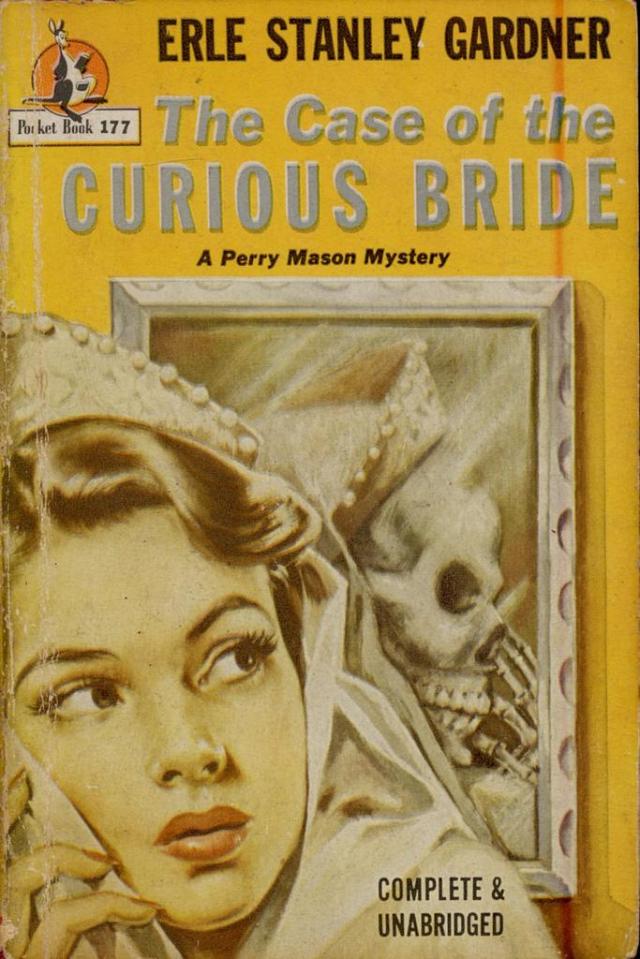
The Case of the Curious Bride,
p.19


“What time did the defendant leave your service station?”
“At exactly ten minutes past two o’clock in the morning.”
“Did you check the time in any manner?”
“I did, yes, sir. The time was checked in a book that I keep for entering repair work that is to be done by the day shift.”
“And the defendant told you that she had an appointment to keep?”
“Yes.”
“Did she say what time the appointment was for?”
“Two o’clock in the morning.”
“Did she say where?”
“No.”
John Lucas turned to Perry Mason with a sarcastic gesture. “Have you any questions of this witness?” he asked.
Perry Mason looked up at the witness, did not so much as move his body, but filled the courtroom with the booming resonance of his voice as he said, “The defendant drove into your station at one forty-five?”
“Yes.”
“Exactly one forty-five?”
“Almost on the minute. It might have been a few seconds one way or the other. I looked at the clock when she drove in.”
“She left at two ten?”
“On the dot.”
“During the interval between one forty-five and two ten she was in your service station?”
“Yes.”
“Watching you work?”
“Yes.”
“Was she ever out of your sight?”
“No, she was there all the time.”
“Is there any chance you’re mistaken in your identification?”
“None whatever.”
“You’re positive?”
“Absolutely.”
“That’s all,” said Perry Mason.
John Lucas called Ben Crandall to the stand. “Your name?”
“Benjamin Crandall.”
“Where do you reside, Mr. Crandall?”
“At the Bellaire Apartments, 308 Norwalk Avenue, in this city.”
“You resided there on June 16th last?”
“Yes.”
“Were you in your apartment from midnight until two thirty on that date?”
“Yes.”
“Are you familiar with the apartment known as Apartment B in the Colemont Apartments at 316 Norwalk Avenue?”
“Yes.”
“I’ll show you a diagram purporting to show the Colemont Apartments and also the Bellaire Apartments, and will ask you to designate your apartment on this diagram and also the position of Apartment B in the Colemont Apartments, with reference to your apartment.” Lucas glanced up at Judge Markham. “I will state, your Honor, that I will subsequently connect up this map as far as its accuracy is concerned.”
“No objections to the map or the questions,” said Perry Mason.
“Proceed,” said Judge Markham.
The witness pointed out the location of the two apartments. John Lucas produced a scale from his pocket. “There is, therefore,” he said, making an elaborate show of extreme accuracy in applying the scale to the map, “a distance of less than twenty feet between your apartment and Apartment B in the Colemont Apartments, measuring in an air line.”
Perry Mason shifted slightly in his chair. His deep voice rumbled across the courtroom. “That, your Honor,” he said, “is acting, first, upon the assumption that the map is correct, and, secondly, upon the assumption that there is no difference in elevation between the two apartments. In other words, this map shows only a projected distance. It measures an air line between two apartments, so far as lateral distance alone is concerned; but does not take into account any slope or elevation between the windows of the two apartments.”
Judge Markham looked across at John Lucas. “You have some side elevation map or sketch, Counselor?” Judge Markham asked.
Lucas but his lip. “I’m afraid, your Honor,” he said, “that I do not have such a map.”
“The objection is sustained,” said Judge Markham.
“Can you tell us how far it is, of your own knowledge?” asked John Lucas of the witness.
“Not in just so many feet or so many inches,” said the witness.
There was a moment of silence. “It is about twenty feet?” asked John Lucas, plainly nettled.
“Objected to as leading and suggestive,” said Perry Mason.
“Sustained,” Judge Markham snapped.
John Lucas paused for a thoughtful moment. “Your Honor,” he said, “I will withdraw that question. I will ask at this time that the jury be taken to view the premises so that they may see for themselves.”
“There will be no objection on the part of the defense,” said Perry Mason.
“Very well,” said Judge Markham, “you may examine this witness as to any other matters and at three thirty o’clock the jurors will be taken to view the premises.”
John Lucas smiled triumphantly. “Mr. Crandall,” he said, “could you hear anything which took place in Apartment B in the Colemont Apartments early in the morning of the sixteenth day of June of the present year?”
“Yes.”
“What did you hear?”
“I heard a telephone ring.”
“Then what did you hear?”
“I heard a conversation, some one talking into a telephone.”
“Do you know who was talking?”
“No, I only know that there was the sound of a voice—a man’s voice—that it was coming from Apartment B in the Colemont Apartments.”
“What was said in the telephone conversation?”
“He mentioned the name of a woman—Rhoda, I’m pretty sure the name was. He pronounced the last name so that I couldn’t get it, but it had a foreign sound, ending with ‘ayne’ or something like that—the way he pronounced it made it sound like a foreign name, but I’m not sure. He said that this woman was to call on him at two o’clock in the morning and give him some money.”
“What did you hear after that?”
“I dozed off, and then I heard peculiar sounds.”
“What sort of sounds?”
“The sounds of a struggle, a scraping and banging, the sound of a blow and then silence. After that I thought I heard whispers.”
“Did you hear anything else at that time?” asked Lucas.
“Yes, sir.”
“What was it?”
“The steady, persistent ringing of a doorbell.”
“Was it repeated?”
“Yes, it was repeated.”
“Can you tell me how many times?”
“No, it was repeated several times.”
“When did that ringing take place, with reference to the sound of struggle?”
“During the time of the struggle, during the time the blow was being struck.”
John Lucas turned to Perry Mason. “Cross-examine,” he snapped.
Perry Mason straightened slightly in his chair. “Now, let’s get this straight,” he said. “You first heard the ringing of the telephone bell?”
“Yes.”
“How did you know it was a telephone bell?”
“Because of the manner in which it rang.”
“Just how was that?”
“It rang mechanically. You know how a telephone rings—a ring for a second or two, then two or three seconds of silence, then another ring.”
“That woke you up?”
“I guess so. It was a warm night. The windows were open. I was sleeping very lightly. At first I thought the telephone was ringing in my apartment. …”
“Never mind what you thought,” Perry Mason said. “What did you do and what did you see and what did you heart? That’s all we’re interested in.”
“I heard the ringing of a telephone bell,” said the witness belligerently. “I got up and listened. Then I realized the telephone was ringing in the apartment house to the north—the Colemont Apartments. I then heard the sound of a voice talking over the telephone.”
“Then later on,” said Perry Mason, “you heard the struggle?”
“That is right.”
“And during the struggle you heard the doorbell?”
“That is correct.”
“Wasn’t it the telephone bell that you heard?”
“No, sir, absolutely not.”
“Why are you so certain that it was not?”
“Because it was not the sound of a telephone bell—it was an entirely different type of bell. In the first place, there was more of a whirring sound to it. In the second place, it rang at longer intervals than a telephone bell rings.”
Perry Mason seemed much disappointed by the answer. “Could you swear,” he said, “that you were absolutely certain it was not the telephone?”
“I am swearing it.”
“You are swearing that it was not the telephone?”
“Yes.”
“You are as positive that it was not the telephone as you are of any other testimony you have given in this case?”
“Absolutely.”
“Do you know what time this was?” asked Perry Mason.
“It was somewhere in the vicinity of two o’clock in the morning. I don’t know exactly. Subsequently, when I became more wide awake, I notified the police. It was then two twenty-seven A.M. There had been an interval of perhaps fifteen or twenty minutes—I don’t know exactly how long—I had been dozing.”
Perry Mason slowly got to his feet. “Don’t you know,” he said, “that it is a physical impossibility for one who is in Apartment 269 of the Bellaire Apartments to hear the doorbell ringing in Apartment B in the Colemont Apartments?”
“It isn’t an impossibility. I heard it,” said the witness truculently.
“You mean you heard a bell ringing. You don’t know that it was the doorbell.”
“I know it was the doorbell.”
“How do you know it?”
“Because I recognized the sound of the ring. I know it was a doorbell.”
“But you don’t remember ever having heard the doorbell ringing in that apartment before?”
“No, this was a very hot night. It was a quiet, still night. There were no noises. The windows were all open.”
“Answer the question,” said Perry Mason. “You never heard the doorbell ring in that apartment before?”
“I can’t remember.”
“And you haven’t listened to the doorbell since, in order to tell whether it was the doorbell that you heard or not?”
“No, I haven’t. I didn’t do it because I didn’t have to do it. I know a doorbell when I hear one.”
Perry Mason dropped back in his chair, smiled at the jury, a smile which was a scornful comment upon the testimony of the witness, but a smile, by the way, which brought no answering expression to the eyes of the jurors. “That,” he said, “is all.”
John Lucas took the witness for redirect examination. “Regardless of the measurements in feet and inches,” he said, “you may state whether the distance is too great for you to have heard a doorbell.”
Perry Mason was on his feet. “Objected to, your Honor,” he said, “as not proper redirect examination, as argumentative, as assuming facts not in evidence, as leading and suggestive. This witness has stated that to the best of his knowledge he never has heard a doorbell in this apartment. Therefore, it is not proper for him to state whether a doorbell could or could not have been heard. This is the conclusion for the jury to draw. Never having heard a doorbell ring, it is obviously impossible for him to tell whether he could have heard a doorbell ring. It is only a surmise on his part.”
Judge Markham nodded thoughtfully, and said, “The objection is sustained.”
Lucas frowned, and then said after a moment, “You were able to hear the telephone bell when it rang?”
“Yes.”
“Was that bell distinctly audible or faintly audible?”
“It was distinctly audible. It sounded so plain that I thought it was my own telephone.”
“In your experience,” asked Lucas hastily, “are telephone bells and doorbells about equally loud?”
“Objected to,” Perry Mason said, “as leading, suggestive, calling for a conclusion. …”
Judge Markham nodded and said decisively, “Counselor, the objection is sustained. The question is improper.”
John Lucas thought for a moment, leaned toward one of the deputies at his side, and whispered for several seconds. A look of cunning was on his face. Once or twice, as he whispered, he smiled. The deputy nodded. Lucas straightened in his chair, and said, “That’s all.”
“Recross-examination?” asked Judge Markham.
Perry Mason shook his head.
“It is approaching the time heretofore fixed for an examination of the premises by the jury,” Judge Markham said. “We will, therefore, take a recess at this time and we will proceed to the premises which will be shown to the jury. During such time no testimony will be offered or taken. Counsel can agree, themselves, as to certain matters which are to be pointed out to the jurors. The jurors will inspect those things and observe the premises. We will then return to court for further testimony. Cars are in readiness to transport the jury and the court officials to the premises. The Court will endeavor to do its part by having the trip made expeditiously, so that the case may continue its usual rapid progress.” Judge Markham turned to the jurors. “During the trip which we are about to make,” he said, “you gentlemen will remember the previous admonition of the Court and not discuss the case or allow any one to discuss it with you. Nor will you form or express any opinion as to the guilt or innocence of the defendant.”
Chapter 19
Officials from the sheriff’s office had paved the way for the examination of the premises by the jurors. The jurors stood in a body on the sidewalk, looked at the space between the two apartment houses. Upon stipulation of counsel, a deputy sheriff pointed out the windows of the Crandall apartment and also the windows of Apartment B in the Colemont Apartments. The jurors were taken up to the apartment where the murder had been committed. Deputies had previously arranged with Sidney Otis to have the apartment open for inspection.
John Lucas motioned to Judge Markham, drew him off to one side and beckoned to Perry Mason. “May we point out the door bell and press the button?”
“No objection,” said Perry Mason.
A deputy sheriff pointed out the bell button. He pressed the button. The faint ringing of the bell could be heard in the upper apartment.
“Now,” Perry Mason said, “if tests are being made with that doorbell, it should be removed, properly identified, and introduced in evidence.”
John Lucas hesitated a moment. “We will do that,” he said, “when we return to court.”
He turned to the deputy sheriff. “What’s the name of the present tenant of the apartment?” he asked.
“Sidney Otis.”
“Slap a subpoena on him,” ordered John Lucas in the majestic manner of a king who is accustomed to command and receive implicit obedience. “Bring him into court. And disconnect that doorbell and bring it into court.
“And now,” said John Lucas in an undertone, “we’ll take the jurors up to Apartment B in the Colemont Apartments, so they can look across into the windows of this upstairs apartment.” He turned to the deputy sheriff, stared significantly at him. “You,” he said, “can be disconnecting that doorbell while we’re up there.”
It took two trips of the elevator for the jurors to reach the Crandall apartment, the elevator being packed to capacity both times. When the jurors had all been assembled and had crowded to the windows, which were open, and were staring across the space into the apartment where the murder had been committed, a whirring bell exploded the silence. There was an interval and then the bell rang again, long and insistent.
Perry Mason grabbed John Lucas by the arm, rushed him across to confront Judge Markham, said, out of earshot of the jury, “Your Honor, that is manifestly unfair. There was no stipulation that the doorbell was to be rung while the jurors were assembled here. That’s equivalent to the taking of testimony.”
John Lucas kept his face innocent and guileless. “This,” he said, “comes as very much of a surprise to me. I certainly didn’t know that the bell was going to ring. I did instruct a deputy to disconnect the doorbell. Doubtless, in disconnecting it he pressed the button which caused it to ring.”
Perry Mason said thoughtfully, “And I noticed you were engaged in a whispered conversation with him when the question was brought up in court as to whether it was possible for a witness to have heard the doorbell ring across the intervening space. And I noticed, further, that you gave the deputy a very significant look just before you left the other apartment house.”
“Are you making an accusation?” Lucas flared.
Judge Markham said slowly, “That will do, gentlemen. We’ll discuss the matter later. You have raised your voices, and it is possible for the jurors to hear what we are discussing.”
“I am going to move,” Perry Mason said in a low voice, “to have the jury instructed to disregard the ringing of that doorbell.”
Lucas laughed, and his laugh was triumphant.
“You might strike it out of the records,” he said, “but you’d never strike it out of the minds of the jurors.”
Judge Markham frowned at him, stared at Perry Mason, and said in a low voice, “I’m very sorry it occurred, but undoubtedly the deputy district attorney is correct. Having occurred, there’s nothing in particular that can be done about it. You can’t erase from the minds of the jurors what they have heard.”
“I had the right,” Perry Mason said, “to use that as a point in my defense, to argue that it was a physical impossibility for the ringing of a doorbell to have been distinctly audible.”
Despite his attempt to keep his features politely expressionless, there was a glint of triumph in John Lucas’s eyes. “You can, of course,” he said, “still argue the point.”
Judge Markham shook his head firmly. “Gentlemen,” he said, “this discussion will terminate immediately. If there should be any further discussion, it will take place in court.”
John Lucas nodded, moved away. Perry Mason hesitated. The doorbell rang once more in the apartment where the murder had been committed, remained ringing for several seconds. John Lucas ran to the window and shouted, “Shut off that doorbell. The jurors weren’t supposed to have heard it ring.”















