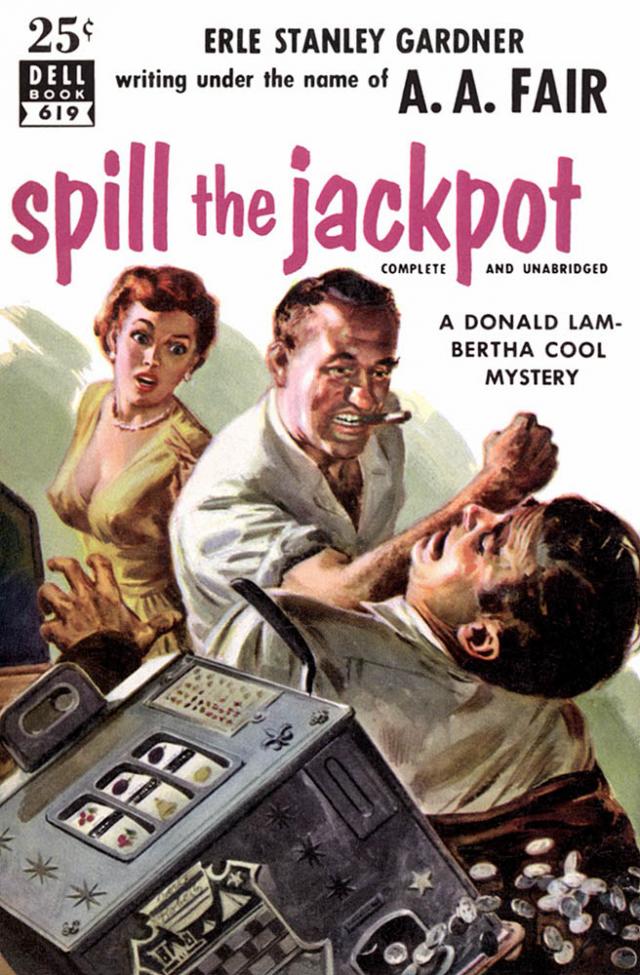
Spill the jackpot, p.15
Spill the Jackpot,
p.15


I said, “I’ve got a little dough saved up, Louie. Breckenridge says he’ll give you a thirty-day layoff. How about really putting me in condition?”
“You mean for a fighter?”
I nodded.
His eyes lit, up. “That’s the talk! We could really do something with you. You’ve got what it takes. You willing to go in the ring?”
“No. I just wanted to learn something about fighting.”
“That’s swell—but—”
“I’ve got this dough saved up, Louie. I’ll pay you just what you’re getting here. You won’t be out anything, and your job will be here when you get back.”
He said, “I could take you on right here. We could fix up a place down in the basement, and I could give you a little instruction every day, and—”
“No. I’m run down. I want to get out where I can be completely away from everyone. We’ll go somewhere and put up a little training camp—some place up around Reno, perhaps. There’d be a girl with us.”
“A girl!”
“Uh huh.”
He blinked at me for a minute, then grinned in snaggletoothed appreciation. “When do we start?”
“Right away,” I said. “I’m going to pick up a secondhand car that will hold the outfit. We’ll camp along the road, and take it easy. It won’t cost us much.”
“Say,” he said, “I’m a swell camper. That’s one of the things I’m good at, camp cooking.”
I said, “Get your things together. We’ve got to get started in a hurry. I have an idea the cops may try to stop us if we don’t get the jump on them.”
For a moment, there was a flicker of fear in his eyes, then he said, “You can’t get started too quick to suit me, buddy. I got some gloves, but they’re pretty light. We’ll want to get a heavier set for training. And we’re goin’ to need a punchin’-bag. I sold mine when I left Los Angeles, but we can get a good one for—”
“We’ll pick it up in Reno,” I told him.
Chapter Thirteen
I KNEW Bertha would be laying for me at the hotel. So I never went back. What money I had saved up was in the form of traveler’s checks, and I bought an ancient jalopy, picked up a heavy woolen shirt, some overalls, and a leather coat at one of the stores, purchased some bedding, a gasoline stove, cooking-pots, threw in a few canned goods, and was ready to leave by three-thirty that afternoon.
We looked like a typical bunch of dust-bowl refugees as we went rattling out of town. No one tried to stop us. We passed a carload of cops who looked us over and let us go on by.
We rattled out on the Beatty road, the car turning out a consistent thirty-seven miles an hour.
Along in the late afternoon, I pulled off on a crossroad which ran out into the desert, a pair of twisting ruts cut into the sand. After we were a couple of hundred yards from the main highway, I pulled out, picked my way through clumps of sagebrush, and stopped on a bare stretch of wind-blown desert.
“How about it?” I asked Louie Hazen.
“It’s a swell place, buddy.”
Helen Framley got out without a word, started lifting things out of the car.
“You got enough blankets,” she said to me.
“We’ll need them.”
Her eyes met mine. “Two beds or three?”
“Three.”
“Okay.”
She spread the blankets down on the desert. Louie lifted the gasoline stove out of the carton in which it had come, set it up on the running-board, filled the fuel tank, and in a few minutes had a hissing blue flame under a coffeepot. “What can I do?” I asked.
“Nothin’,” he said. “Just stick around. You’re the man of the family, the big boss. Ain’t that right?” he asked, looking over at Helen Framley.
“That’s right.”
“What do I call you when it’s time to come to meals?”’ he asked, giving her that snaggle-toothed grin.
“Helen.”
“Okay. I’m. Louie. There ain’t no hard feelin’s because of that slot-machine business?”
“Not a bit,” she said, and pushed out her hand.
He folded his battered fist around her slim fingers, grinned once more, and said, “We’re gonna get along.”
He started moving around, picking out pots and pans, reaching, into the grub box. There wasn’t so much as a wasted motion. He didn’t seem to be particularly in a hurry, but he accomplished things in an incredibly short time.
Helen and I tried once or twice to help, but he brushed us aside impatiently. “This ain’t goin’ to be no feast,” he said. “We ain’t goin’ to set no table or have no style. We ain’t got enough water to do a lot of dishwashin’, and there ain’t goin’ to be many dishes, but the grub’s goin’ to stick to your ribs.”
A few moments later, a breath of desert wind wafted an odor of beans over to our nostrils, beans with a touch of garlic and the smell of fried onions.
“Louie,” I asked, “what is that?”
“That there,” he said with pride, “is a dish of my own invention. You cut up a couple of onions fine, put ‘em in a little water, and let ‘em boil down to a dry pan. Then you add a little grease and fry ‘em up. Put in a little garlic, then open a can of beans, and put in some syrup. That there grub will stick to your ribs, and it ain’t goin’ to taste bad.”
Helen and I sat side by side on the blankets watching the western sky as some invisible artist went about painting a desert sunset, working swiftly with vivid colors, and a bold brush.
We were still watching the colors when Louie pushed steaming plates into our hands. “Here you are,” he said, “all dished up. You eat it on the one plate, arid what I mean is you clean it up.” And he grinned at us.
We went to work on the grub. It tasted better than any cooking I’d had for months, with fresh sourdough French bread to sop up the gravy that was left in the plate after we’d cleaned out the mixture of beans, onions, and garlic. .
Helen sighed. “I think that’s the best food I’ve ever tasted. Donald, why didn’t you think of this sooner?”
“I don’t know. I guess I’m dumb,” I said.
The afterglow faded from the west. Blazing stars came out to hang in the sky overhead.
Helen said, “I’ll do the dishes.”
Louie was insulted. “What does a nice girl like you know about doin’ dishes? Not camp style, anyway. Look, sister, out here in the desert we don’t have much water, see? I’ll show you how it’s done.”
He took the dishes out to a place about fifteen yards in front of the car, turned on the headlights, squatted on his heels, and scooped up sand. He piled sand in the plates and started rubbing. By the time he’d finished, the sand had soaked up everything that had been left on the plates and scoured them clean. Louie poured boiling water over the dishes, just a few spoonfuls to each dish. The water cleaned off what was left of the sand, and left the dishes bright and clean.
“There you are,” Louie announced proudly, “a lot cleaner than you coulda got ‘em with a whole dishpan full of water. Now we’ll stack ‘em up on the running-board and be all ready for breakfast. What time you want to roll out?”
“I’ll let you know,” I told him.
Louie said, “I thought I’d pull my blankets over here and—”
“This is all right,” Helen said. “I’ve got the three beds made, side by side.”
Louie waited for a few minutes, then said, “Okay.”
We sat around on the blankets for a while.
“How about a campfire?” Louie asked.
I said, “Someone might be looking for us along the road.”
“Yes. I suppose so. How about a little music?”
“Got a radio?” I asked.
“Somethin’ better,” Louie said.
He pulled a harmonica from his pocket, tenderly wrapped his warped fingers and battered knuckles around the instrument, and raised it to his mouth.
It wasn’t the sort of playing I’d expected. I’d been prepared for Home Sweet Home and some of the harmonica classics, but Louie gave us everything. The music which poured forth from that harmonica seemed somehow to blend in with the calm tranquility of the desert night. It became a part of the darkness, the stretches of silent sand, and the steady stars.
Helen came over to lean against my shoulder. I slipped an arm around her waist. I could feel her steady, regular breathing, the warmth of her cheek, could smell the fragrance of her hair. Her hand stole into mine, slender and soft. I felt her shoulders heave as she took in a deep breath, then gave a long sigh. within The night was still warm. Twice within an hour we heard the distant snarl of approaching automobiles. Headlights danced vaguely up and down the main highway, casting weird shadows. The sound of the approaching car grew to a whine, then rapidly faded as the glare of the brilliant headlights gave place to the glowing red of a receding taillight. There were only those two cars within more than an hour. For the rest, we had the desert to ourselves.
Louie’s music had the majesty of organ music. It was, of course, due in part to the environment, the desert, and the steady stars, in a sky which looked as though it had been freshly washed and polished by some cosmic housekeeper. Louie played by ear, but he was an artist, and he made that harmonica accomplish things one would have thought impossible.
Then, after a while, Louie quit playing, just let the music fade into silence, and we sat there, looking up at the stars, out at the dim outlines of the automobile, of the sagebrush against the sand of the desert, feeling the eternal silence.
Helen said softly in a half whisper, “It’s close to heaven out here.”
I could feel the warmth of her body through her clothes and mine, could feel the weight of her head settling down against my shoulder. Once or twice her muscles gave involuntary little twitches, as the nerve tension relaxed, and her body surrendered itself to drowsiness.
After a while, a breeze so faint as to be all but imperceptible stole over the desert, but that breeze was cold. The warmth simply vanished. The breeze grew stronger. You could feel the air moving now. Helen snuggled closer. She doubled her legs, and pushed her knees hard against my leg. For a moment, warmth returned, then the breeze came again, and Helen straightened with a shiver.
“Gettin’ cold,” Louie said.
“Bedtime,” Helen announced. “Mine’s the end bed. Donald, you sleep in the center.”
She moved over to her blankets, slipped out of her outer clothes. It was too dark for details, but the starlight showed the general contours of her figure as her outer garments slipped down her smooth limbs. I watched her without curiosity and without self-consciousness. It was as though one were seeing a beautiful piece of statuary by starlight.
She slid under the covers, twisted and turned for a moment, slipping out of her underclothes, then sat up in bed to pull pajamas on and button them around her neck.
“‘Night,” she said.
“Good night,” I called.
Louie, slightly embarrassed, kept silent, pretending to think she had been talking only to me. She raised herself on one elbow. “Hey, Louie,” she called.
“What?”
“ ‘Night.”
“Good night,” he mumbled self-consciously.
We waited a few minutes until she had settled herself in her blankets, then Louie and I got out of our clothes and snuggled down into our covers in our underwear.
I wondered how cold it was going to get. I could feel the tip of my nose getting cold. The stars were hanging in the sky directly above me. I wondered if one of them might fall, and if so whether it would hit me—then suddenly I opened my eyes, and an entirely different assortment of stars was in the heavens. The ground was hard underneath, and my muscles were cramped, but the clear fresh air, keen with the tang of dustless cold, had purified my blood, sucked the poisons out of me, and left me feeling as relaxed as though I’d been sleeping for a month.
I closed my eyes again. Once I woke up just before dawn to see the frosty glitter of bluish green where the sky was just beginning to take on color above a band of pale orange. I watched the orange grow vivid, saw a little cloud leap into crimson prominence. Listened to the rhythmic breathing of the girl on one side, heard Louie’s placid snoring—thought about getting up at the “crack of dawn,” and then snuggled down into the warmth of my blankets.
When I woke up, the sun was over the horizon, casting long shadows from the greasewood and sagebrush. A series of rippling contortions of the blankets next to me showed that Helen Framley was getting dressed. Louie was bent over the stove on the running-board of the car, and the fragrance of coffee stung my nostrils.
There has never been anything quite as soul-satisfying, quite as filled with the promise of life as the smell of coffee out in the open when the fresh air has done its work, and you realize that you’re ravenously hungry.
Helen Framley came up out of her blankets, to stand slim and graceful. The golden rays of the early-morning sun touched the youthful lines of her figure with reddish orange. She glanced at me, saw I was looking up at her, and said naturally, “‘Lo, Donald.”
“ ‘Lo,” I said.
Louie turned around at the sound of her voice, then whirled back to bend over the stove.
There was quiet amusement in her eyes. “Hello, Louie,” she called.
“Hello,” he called back over his shoulder.
She finished her dressing, and said, “I could go for this in a big way. I wonder why someone didn’t invent it sooner.”
“It’s been here longer than we have,” I remarked.
She stood facing the east, the sun illuminating her features. Abruptly, she flung out her arms toward the sun in an impulsive gesture, then turned, sat down, and slipped on her shoes.
Louie said, “Half a basin of water apiece, and that’s all, and breakfast’ll be ready in five minutes.”
We washed up, cleaned our teeth, sat on our blankets, while Louie gave us scrambled eggs, coffee that was golden clear, bacon cooked somehow so that it had a nutty flavor, crisp without being brittle. He had a little wood fire going, had let it die down to coals, and a screen propped on some small rocks over these coals was the grate on which he had browned thin slices of the French bread into golden-crisp toast with butter glistening on it.
Every mouthful of food seemed deliciously flavored strength. I felt as though I didn’t need boxing lessons, that I could stand up to any man on earth and blast him to the ground with my bare fists.
We sat around for a few minutes after breakfast, smoking cigarettes, soaking up the warmth of the sunlight. We finished our cigarettes. I looked at Louie. We looked at the girl. She nodded. We started rolling up the blankets, fitting them into the ancient jalopy. No one spoke much. We had no need for words.
Half an hour later, with dishes all done and put away, the car neatly packed, we were on our way, rattling across the desert, the motor full of piston slaps and bearing knocks, but managing to deliver its thirty-seven miles an hour. The sun rose higher. The shadow cast by the automobile shortened. The warmth gave place to heat. The right rear tire developed a puncture. Louie and I changed it. We didn’t find it particularly annoying. We weren’t nervous, and we weren’t hurried. Everything went like clockwork—entirely different from those occasions when I’d been dashing around in Bertha Cool’s agency car trying to get somewhere in a hurry. Then a tire would go flat, and nothing would work. The car would roll off the jack. The nuts would get cross-threaded, on the bolts, and the rim never seemed to fit right on the wheel.
We didn’t hurry. We had all the time in the world. Occasionally, we’d stop to just soak up the scenery.
We traveled all that day, camped at night on the desert, and got to Reno around noon the following day. “Okay,” Louie said, “here we are. What’s the orders, skipper?”
The jalopy was covered with desert dust. I needed a shave. Louie had black whiskers sprouting all over his chin. All three of us were burned from the desert sun and wind, but I had never felt so serenely relaxed.
“An auto camp,” I said, “while we get cleaned up, and find out what’s to be done.”
We found an auto camp. The woman let us have a cabin which had two rooms and three beds. We scrubbed under the shower. Louie and I shaved, then I left them in the cabin while I went out to reconnoiter. - I rang up the telephone company and inquired if Mrs. Jannix had a telephone. She didn’t. I rang up all the hotels, asked them if a Mrs. Jannix was registered with them. She wasn’t. I rang up the public utilities. They didn’t want to give out any information.
I went back to the auto camp, picked up the other two, - and we went out looking for a place to stay.
I finally found one just about dark, a place which was ideally suited for what we wanted. A man had a little filling station about seven miles out of town. He’d started to put up an auto court, but his finances had run out, and all he had was one big cabin back about a hundred yards from the highway.
We loaded the jalopy with provisions, and moved in that night. Louie played on his harmonica, waltzes, and Helen and I danced for a while. There was a little wood stove in the place, and we kept the cabin filled with that comfortable warmth which comes only from a wood stove in a kitchen. - Louie pulled me out of blankets early the next morning. It was time, he explained, for road work.
Helen smiled at me sleepily, said, “Have a good time,” rolled over, and went back to sleep. I put on rubber-soled tennis shoes, tightened my belt, took a drink of hot water with a little lemon juice in it, and followed Louie out into the cold. The sun was just getting up. The air stabbed through my thin clothing.
Louie saw me shiver. “You’ll be all right in a minute. You’re too light to do much sweating. Come on now, here we go.”
He started off at a slow jog. I fell in behind him. A hundred and fifty yards, and the cold gave way to tingling warmth.
I realized there was quite an elevation here. My lungs began to labor for air. Louie, however, kept slogging along. We were On the pavement now. The steady kloop—kloop—kloop of his rubber-soled shoes grew monotonous.
“How much longer?” I asked.