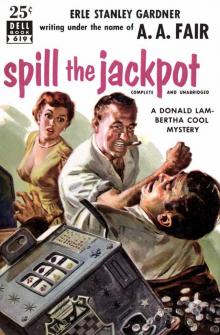
Spill the jackpot, p.17
Spill the Jackpot,
p.17


“No.”
“And it’s because you didn’t want to take something under false pretenses that you’ve told—”
I nodded.
“And has it occurred to you that you’ve never even kissed me?”
“Naturally,” I said.
Her eyes were on mine now, and there was a steady, shining light I hadn’t seen in them before. She said, “I guess this is where we hit the jackpot, Donald.”
Chapter Fourteen
ABOUT two o’clock in the afternoon I found Louie. He was sitting at a table in the back room of one of the cheaper side street places. A bottle half full of bar whisky was on the table in front of him. The knuckles of the hand which held the glass were skinned and bleeding. His eyes were heavily glazed and staring with fixed intensity. He was mumbling as I came up to the table.
He looked up at me. “Oh, there you are,” he said thickly.
I pushed the bottle of whisky to one side. “How about coming home, Louie?”
He frowned. “Say, thash right. I got a home, ain’t I? I—Oh, my God.” He stood up and plunged his hand into his trousers pocket, brought out two one-dollar bills and some chicken feed.
“You know what I done, buddy?” he asked, his glazed eyes surveying me with that fixed glassy stare. “I shpent that money you gave me—all that was left from the groceries ‘cept this—booze. That’s my failin’. I feel the cravin’ comin’ on every so often, and when it hits me, I can’t—”
“Who was it you socked, Louie?” I asked.
He looked down at his knuckles and scowled. “Now thash funny. I thought I hit somebody, and then I thought it was jusht sort of an idea a man’ll get when he’s been drinkin’. It might ‘a’ been the last time. Wait a minute. Let me think.
“I’ll tell you who it was. It was Sid Jannix. Was in line for a title once. A good boy—plenty good, but I give him the old one-two. Lemme show you how it goes, the old Hazen shift. I won the championship in the Navy—it musthave been the championship—sure, it was in Honolulu inlet me see now. Was it—”
“Come on, Louie, we’re going home.”
“You ain’t sore about that money, kid?”
“No.”
“You understand how it is?”
“Sure.”
“You’re the besh pal a guy ever had. The first time I socked you, I knew I liked you, jush like shakin’ hands with a guy, shock him on the jaw an—awrigh’, let’s go home.”
I got him out to the sidewalk, steadied him down the street, and into the jalopy. Halfway out to the cabin, the enormity of his embezzlement struck him. He wanted to get out of the car. “Lemme out, buddy. I ain’t fit to ride in the same car with you. I can’t face Miss Helen. Know what I did? I stole your money. I knew you didn’t have much, too—just some money you’d saved up—an’ I stole it. I wanna get out—serves me right if I hit my head and die. I ain’t no good. I been hit too much anyway. I ain’t got no—ain’ got no self-control.”
I put my hand on the arm that was over on the side nearest the door. His hand was fumbling with the catch. “Forget it, Louie,” I said, driving the rattling car with one hand. “We aren’t any of us perfect. I’ve got my faults, too.”
“You mean you forgive me?”
“Sure.”
“No hard feelings?”
“No hard feelings.”
He started to cry, then, and was immersed in lachrymose repentance when I got him to the cabin. Helen and I put him to bed. “Well,” she said, after we’d tucked him in and put a big pitcher of water beside the bed, “now what?”
“I’ll stay with him,” I told her. “You take the car, go uptown, and get your hair fixed at that beauty shop you were talking about.”
She looked at me, hesitated a moment.
I said, “I’ll have to give you a traveler’s check. I—” She laughed up at me. “Forget it. I’ve got money.”
“All you need?”
“Sure. I lit out with Pug’s bank roll. And listen, Donald, if you get short, I can stake you. I know you’re paying for this show, and I know you’re going to come out on it all right when you’ve finished up, but in case you find the shoe pinching, just let me know.”
“Thanks, I will.”
“ ‘By,” she said.
“Be seeing you.”
She started for the door, turned back to me, took my face in her hands, looked down into my eyes, and then kissed me. “The landlord was over while you were gone,” she said casually. “He was calling me Mrs. Lam. So don’t destroy his illusions. By-by.”
She breezed out of the door. I sat down at the kitchen table, took a telephone directory, and made up a list of the places I wanted to call. I found some old magazines, read for a while, and then began to feel the effects of my unaccustomed exercise. I dozed off into a light sleep, waking occasionally just enough to realize that I should go in and see how Louie was getting along. But getting up out of the comfortable chair seemed too great an effort, and I’d drift off to sleep again.
I finally woke up enough to look in on Louie. He heard the door open. He opened bloodshot eyes, looked up at me and said, “Hello, buddy, how about some water?”
“In that pitcher right by your bed.”
He picked up the pitcher, disdained the glass, and drank about half of the contents.
“You know I’m a heel,” he said, putting down the pitcher and avoiding my eyes. “An’ I know I’m a heel.”
“You’re all right.”
“I wish you wouldn’t be so damn nice about it.”
“Forget it.”
“I’d like to do some little thing for you, buddy—like a murder or something.”
I grinned down at him. “How’s the head?” I asked. “Aching?”
“It always aches. I guess that’s why I take up the booze. I’ve had a headache so long now I’m used to it. I always tried to give the customers a run for their money. I’d stay in there and swap punches when I should have been down on the canvas, listenin’ to the birdies. And now here I am, a drunken bum with a headache all the time.”
“You’ll feel better after a while. Want to go back to sleep again?”
“No. I’m goin’ to get up and drink lots of water. What happened to the rest of that bottle of whisky?”
“I left it in there.”
“It was paid for,” he said regretfully.
“It’s better in the saloon than in you.”
“You’re right,” he said, “if I can get my mind off’n it, but I’m afraid I’ll be thinkin’ of that half bottle of whisky —you’d better kick me out, pal, before I get you in a spot. I ain’t worth it.”
“Snap out of it. You’ll feel better when you get your stomach back into shape.”
His bloodshot eyes stared up at me. “Tell you one thing,” he said, “I’m going to teach you everything I know, every little trick of the ring. I’m going to make you a fighter.”
“Okay. Now listen, I’m going to take a walk. Helen’s in town. She’ll be back in a couple of hours. You feel like keeping an eye on the place?”
“Sure.”
“You won’t leave?”
He said, “Where’s my pants?”
“Over there on the chair.”
“Turn the pockets inside out, take all the dough out, then I won’t leave.”
I said, “You gave me the change—what was left of it.”
He heaved a sigh. “Okay then, that’s fine. Go ahead.” He punched the pillows back into shape behind his head, said, “Gimme a cigarette, buddy, and I’ll be all right as soon as that water quits sloshin’ around in my stomach.”
I gave him a cigarette, and walked out to the highway. I hadn’t gone over half a mile when a car stopped and gave me a ride to town.
A newsstand featured papers from all the principal cities. I found a Las Vegas paper. The police made much over the disappearance of Helen Framley. They had finally traced her to an apartment where she had been in hiding since the night of the murder. She had disappeared, and police, checking up on the activities of one Donald Lam, a private investigator who had been employed on another angle of the case, were convinced that she, an ex-prize fighter by the name of Hazen, and Lam had all left town together. The police were inclined to believe that Helen Framley had either been implicated in the murder or had highly significant information, and that the private detective, seeking to steal a march on police, was offering her a chance to escape in return for such information as she could give. There was a strong intimation that the officials would consider this a serious matter, and that Lam might well find himself prosecuted for compounding a felony. Hazen, it seemed, was also implicated. He’d positively identified the body as that of a former pugilist named Sidney Jannix.
Evidently, the police hadn’t as yet linked me with the purchase of the secondhand automobile.
I rang up a few more places, handed them my regular line, cut out the article from the Las Vegas paper, left the rest of the newspaper in a telephone booth, and started back for the cabin.
I had to walk nearly a mile before I caught a ride. Helen returned about an hour after I got back. Louie got the dinner, washed and wiped the dishes. The three of us went to a movie, and then went to bed.
Louie Hazen was pulling me out of bed before I hardly realized I’d been asleep. The air was filled with cold dawn. “Come on,” he said. “Get this road work in while it’s cool. I don’t want you to sweat.”
I sat up on the edge of the bed, rubbed my eyes. “It’s not cool, it’s cold,” I protested.
“You’ll be all right when you get out.”
He slipped a hand under my arm, lifted me to my feet. My legs all but buckled, the muscles were so sore.
“Gosh, Louie, I can’t take it this morning. I’ll have to rest.”
“Come on,” he said, and started pushing me around. “Oh, forget it, Louie. I’m not training for any fight or anything. After all, we can—”
He opened the window, pulled off the screen, dropped it to the ground, tossed out my running-shoes, pants, and light sweater, and then, before I realized what he was intending to do, picked me up as though I had weighed precisely nothing, and tossed me out after them. Then he closed and locked the window.
The door was locked. It was cold out there on the ground. I picked up my clothes and moved around to the side of the house away from the highway, dressed in shivering silence, took a deep breath, and started jog trotting after Louie along the road. Every step was agony.
Louie kept watching me over his shoulder, looking at the expression on my face, the way I was moving my legs. He seemed to know exactly when the soreness began. to leave me, and then again knew exactly when the breathlessness became acute.
We walked all the way back, taking deep breaths. I suddenly picked up Louie’s trick of breathing with my diaphragm, sucking air way down, squeezrng out every last bit of it before taking another deep breath.
Louie, watching me, nodded approvingly.
We went back to the house and put on the stiff set of fighting-gloves. Louie said, “I’m going to train you to throw a hard punch this morning. Now swing one right at this glove. Put everything you’ve got right behind it. No, no, no. Don’t draw back.”
It seemed interminable hours that we worked out there in the sunlight, and then Louie had me under the shower, was kneading and pounding my muscles again, and by the time I was up and dressed, Helen Framley had the kitchen full of the fragrance of steaming coffee.
Later that morning I got a lead.
A retail-credit association member had delivered groceries to a Mrs. Sidney Jannix in an apartment on California Street.
I went out to the place, parked the jalopy, climbed stairs, and pressed a buzzer.
The woman who opened the door was Corla Burke. “May I come in?” I asked.
“Who are you?”
“A friend of Helen Framley.”
She frowned at me. For a moment, there was quick alarm in her eyes. “How did you find me?”
“That,” I said, “is something of a story. Do I tell it out here, or inside?”
“Inside,” she said, and held the door open so I could come in.
I sat down by the window. Corla Burke, seated across from me where the light etched expression on her face, played into my hands by opening the conversation. “I, simply couldn’t have taken advantage of Miss Framley’s offer,” she said. “I wrote and told her so.”
I adopted an attitude of being somewhat aggrieved.“I don’t see why.”
“It wouldn’t have been fair.”
“I think it would have been a lot better than what you did do.”
I could see that shot struck home.. She said, “I didn’t know, of course, what— Well, I couldn’t, look into the future myself,” and she laughed nervously.
“Miss Framley felt she tried to do the square thing by you and that you hadn’t been—well, suppose we say appreciative.”
“I’m sorry. How did you happen to come here?”
“Why, this was the logical place to look for you.”
“Why did you want to find me?”
“I thought perhaps something could be done to straighten things out.”
“No, not now.”
“I still think so.”
“I’m afraid you’re overly optimistic. Please thank Miss Framley for me and tell her that I certainly don’t want her to think I was ungrateful, and I guess—well, I guess that’s about all there is to tell her.”
I glanced around, saw that a suitcase was open, that folded garments were placed on a table and on two of the chairs. On a small table in the corner by the window was a woman’s hat, gloves, and purse. A stamped envelope lay on the corner of this table.
“Mind if I smoke?”
“Certainly not. I’ll have one—”
I gave her a cigarette, held a match, managed to move so that I was at the edge of the table as I reached for an ash tray, and then grabbed for the letter.
She saw what was happening and flung herself at the table. I got my hands on the letter first. She clawed at it. I said, “If it isn’t postmarked-Las Vegas I’m not interested. If it is, I’m going to read it.”
She redoubled her efforts, grabbed at my arm. I pushed her away. I managed to avoid her, pulled the sheet of paper out from the envelope.
It was a hasty scrawl and read: Donald Lam a private detective is on the job. He’s contacted Helen Framley. Helen’s boy friend, man by the name of Beegan, was murdered last night. You aren’t safe in Reno. Hunt a deep hole somewhere else.
The letter was signed simply with the initials “A. W.” I said, “Let’s be frank with each other and save time. I’m Lam. Arthur Whitewell hired me to find you—and saw that Philip knew all about it, of course. Now suppose you tell me your story.”
She just stared at me, all of the fight had left her. She !ooked trapped and beaten.
I said, “I have a theory. I can outline it if it would help start the ball rolling.”
She still didn’t say anything, simply stood looking at me as though I was what was left behind after a cyclone.
I said, “I think Arthur Whitewell didn’t want his son to marry you. He thought Philip could make a more advantageous marriage. But Philip was very much in love with you, and Whitewell is something of a psychologist. He knew that, after all, there wasn’t much he could do about it. Philip was inexperienced and callow in some ways, but very much of a man in others. His father had never fully understood him, but he did realize there was a gap he had never been able to bridge. He knew that any attempt to come between you two would bring about a permanent estrangement. And then something happened to play right into his hands. He had the opportunity he’d been looking for. He manipulated things in such a way that you simply stepped out of the picture and left Philip to recuperate as best he could.
“And then,” I said, “Philip took it so much worse than his father had anticipated that something had to be done. It wasn’t just an ordinary heartbreak. Philip is sentimental, sensitive, in his feelings and perceptions. He’s never learned that people sometimes can’t be taken at their face value. It was all too much for him.”
She was crying now, crying quietly. She didn’t try to say anything. She couldn’t have talked.
I walked over to the window, looking down on a drab back yard which was pretty well filled with a litter of old boxes. A clothesline sagged dispiritedly between two poles. Little puddles reflected sunlight. A child’s tin pail and shovel were standing on a pile of damp sand. I kept my back turned to the room so that she could have her cry out and regain her composure without feeling I was watching.
It was several minutes before she had herself sufficiently under control to speak. “Do you think that Mr. Whitewell expected you would find me?” she asked.
“I don’t know. All I know is that he employed us to find you.”
“But he stipulated with me that I must arrange my disappearance so that I could never be found. That was one of the things he insisted on.”
“Exactly.”
“Then hiring you would be just a gesture to pacify Philip?”
“That’s it.”
I could see she was clinging to a straw of hope. “But it costs real money to hire a good detective, doesn’t it?”
“Yes.”
“And you must be good—skillful?” It was her party. if she wanted to kid herself along, it was okay with me. I said, “We think we’re good.”
“Can’t you tell me something that would give me a clue as to how Mr. Whitewell really feels now?”
“Not until after you’ve told me what happened. Then I can put things together and perhaps find an answer.”
“But you seemed to know. You knew all about Helen Framley.”
“No, just that she’d written you a letter. I had to surmise what was in it.”
“What did you think was in it?”
“I thought it was a trap.”
“Set by this Helen Framley?”
“I don’t think Helen Framley ever wrote the letter.”
“But she must have.”
“Suppose you tell me everything you know, and let me draw my own conclusions.”