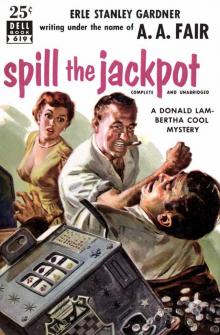
Spill the jackpot, p.7
Spill the Jackpot,
p.7


I grinned and said, “I’ll tell my boss. She’ll tell our client. Our client will use the information any way he damn pleases. I don’t care what he does with it. He pays Bertha Cool, and Bertha Cool pays me money. That’s all there is to it.”
Pug said, “It’s like I tell you, babe. Everybody in this world is on the make. You’ve got to take it where you can find it.”
She grinned across at me. “Pug thinks I’m developing a conscience.”
“On the slot-machine racket?”
“Uh huh.”
Pug said, “Forget it, babe.”
She said, “The machines are all dishonest. They’re stealing from the customer. Why shouldn’t we lift some from the machine?”
“It ain’t stealing,” Pug said. “It’s just taking back some of the public’s investment—and we’re the public, ain’t we? As far as the slot machine is concerned, we are. They use mechanical devices to keep the machines from paying off, and we use mechanical devices to make ‘em pay off. It’s fifty-fifty.”
I said, “I think this man, Kleinsmidt, is going to be laying for you. He—”
“Oh, sure,” Pug said. “We’ve got to blow. They always told me never to try working Nevada with all the protection they’ve got here, but I had to have a crack at it. California’s different. Take Calermo Hot Springs for instance. You can always get a good play there. That’s the worst of it. Good play means competition. I remember one time we tried to work a resort right after another gang had pulled out. The owners had been checking up on the machines, and when they found how small the take was, they had some private detectives come down to see what was happening, and who was doing it.”
Helen Framley laughed nervously, and said, “That’s where I got my complex on private detectives. They almost nailed us.”
“It wouldn’t have done ‘em any good,” Pug said. “They might have made a lot of trouble.”
“They could have talked,” Pug admitted, “but that’s all.”
“Well, I don’t like it, Pug. I wish you’d get something else lined up.”
“This is plenty good, babe, plenty good.”
I said casually, “I’m going to have to get back to Los Angeles.”
Pug said, “You’re acting awfully funny about this thing. You wouldn’t by trying to hand us no line, would you?” I shook my head.
Pug frowned and stared at me with his eyes sharp with suspicion. Abruptly, he said, “Get your things together, babe.”
“What do you mean?”
Pug’s eyes grew hostile. “There’s just a chance this guy’s trying to stall us along until the law can get us spotted.
Where you got those coins?”
“In my—you know.”
“Okay,” Pug said, “beat it out and get ‘em changed. If they raid the joint, we don’t want to have a lot of dimes and nickels and quarters on hand. And you, buddy, you better be going. Like you said, you’ve got a lot of things to do.”
“I’d like to ask a few more questions.”
Pug got to his feet, came over, and put his hand on my shoulder. “I know you would, but we’re busy. We’ve got things to do. You know how it is.”
“Now, Pug, don’t you hurt—”
“Forget it, babe. Get that stuff together and get it changed into currency. This guy’s leaving right now, and you’ve got work to do.”
Her eyes studied Pug for a minute, then came over to mine. Abruptly she smiled, walked over, and gave me-her hand. “You’re one swell guy,” she said. “I like guys with nerve. You sure have plenty.”
“Go on. Get in that bedroom and get that stuff together,” Pug said sharply.
“On my way.”
Pug started me toward the door. ” ‘By,” I said to Helen Framley, “and thanks. Where can I reach you if I want to get in touch with your It was Pug who answered the question, and his eyes were cold. “That, buddy, is the thing I was going to tell you when I got you outside, but I might as well tell you now. You can’t.”
“Can’t what?”
“Can’t get in touch with her.”
“Why not?”
“For two reasons. One of ‘em is that you won’t know where she is, and the other one is I don’t want you to. Get me?”
Helen said, “Pug, don’t be like that.”
Pug said, “On your way,” and gripped his fingers around my elbow. The push which he exerted was gentle but insistent. Over his shoulder, he said, “You get into that bedroom, babe, and make it snappy.”
Pug opened the door. “So long, guy,” he said. “Nice meeting you. Don’t come back. Good-by.”
The door slammed.
I looked at the door of the adjoining apartment and saw that there was a ribbon of light coming out from under the door.
I tiptoed gently down the stairs.
I walked out and stood in a doorway, watching the sidewalk, and waiting. The street lights were on now.
After a while, I saw Helen Framley walking down the street, a neat little package that would attract attention anywhere.
I sauntered along behind.
She went into one of the casinos, and started playing the wheel of fortune long enough to register with the gang around the place as one of the players. Then she went over to the cashier’s desk, opened her purse, pulled out an assortment of nickels, dimes, and quarters and got them changed into currency. She came out, crossed the street, ‘ went to another casino, and repeated the operation. When she came out of that place, I was waiting for her.
“Hello,” I said.
There was sudden fear in her eyes. “What are you doing here?”
“Standing here.”
“Well, you mustn’t be seen talking with me.”
“Why not? I have a couple of questions I wanted to ask you privately.”
“No, no, please. You can’t.”
“Why not?”
She looked around her apprehensively. “Can’t you understand? Pug’s jealous. I had an awful time with him after you left. He thinks I—thinks I was too nice to you, that I was trying to protect you.”
I fell into step at her side. “That’s all right. We’ll walk along the street and—”
“No, no,” she said, “not this way. Here, walk the other way if you’ve got to walk. Turn to the right at the corner. Get down that dark side street. Gosh, I wish you wouldn’t take chances like this.”
I said, “You wrote a letter to Corla Burke. Why and what did you say?”
“Why, I never wrote her in my life.”
“You’re certain?”
“Yes.”
“You didn’t send her a letter a couple of days before she disappeared?”
“No.”
I said, “She was blond. I don’t think, she was the type to do things on impulse exactly. Like to see her picture?”
“Gosh, yes. You got one?”
I guided her into a lighted doorway and took the pictures from my pocket. They were a little cracked where Louie had pushed wrinkles in my coat when he jerked it back from my shoulders and down my arms.
“See. She looks quick on the trigger, but she’s a thinker:”
“How can you tell that?”
“From the lines of her face.”
She said, “Gosh, I wish I knew things like that.”
“You do. You unconsciously size up a person’s character as soon as you meet him. Perhaps you know someone with thin nostrils and—”
“Yeah, but I size ‘em up wrong about half the time. Gosh, the double crosses I’ve had handed me, just because I play wide open. I take a good look at ‘em and either like ‘em or don’t. If I like ‘em, I go the whole hog. Say, listen—Your name’s Donald, isn’t it?”
“Yes.’
“Okay. Now listen, Donald, we’ve got to cut this out. Pug’s awfully mean when he gets jealous, and he certainly is on the prod tonight. The way he was feeling when I left, he’s almost certain to get restless and start following us. That’s the trouble with Pug. He won’t stay put. When he gets nervous, he gets all excited.”
“Where can I get in touch with you, Helen?”
“You can’t.”
“Isn’t there some way I could reach you, some friend to whom I could write—”
She was shaking her head emphatically.
I gave her one of my cards. “There’s my address,” I said. “Will you think it over and see if you can’t figure out some way I could keep in touch with you? Some place I can get you in case it should be important, to have your testimony?”
“I don’t want to give any testimony. I don’t want to be dragged into the limelight and have a lot of questions asked me.”
“You can trust me. If you shoot square with me, I’ll play square with you.”
She slipped my card in her purse. “I’ll think it over, Donald. Perhaps I can drop you a card, letting you know where you can get in touch with me.” -
“Do that little thing, will you?”
“Perhaps—Donald, can I tell you something—and have you play ball?”
“What?”
“I wasn’t telling you all the truth up there.”
“I was afraid of that.”
“Listen, I want to go some place where we can talk, and Pug may be down any minute.”
“The hotel lobby or—”
“No, no, some place right close. Here, come over in this—Now listen, Donald, I want to know exactly why you thought I was holding out.”
I said, “I just thought so. And 1 have evidence that you sent a letter to Cora Burke.”
“I haven’t lied to you. I just haven’t told you all the truth. I’m going to give you a break. I wanted to up there, but I couldn’t on account of Pug. I didn’t know what to do. I finally decided that if you had the nerve to be waiting for me when I came out, I’d tell you—maybe.”
“What is it?”
“She did write to me.”
“That’s better. When?”
“The day before she disappeared, I guess it must have been.”
“And you’d written to her?”
“No, I hadn’t. Honest and truly. I’d never seen her in my life. I didn’t know anything about her.”
“Go ahead.”
“Well, that’s just about all there is to it. I had this letter delivered to me. It was addressed to Helen Framley, General Delivery, Las Vegas. The post office just happened to catch it, knew that I had an apartment here, and changed the address so that it was delivered to this address.”
There was a night light in a grocery store on a side street. It gave sufficient illumination to see things—more or less clearly. I stopped her in front of the window. “Let’s see it.”
“If Pug ever knew—”
“What business is it of his?”
“Really,” she flared, “it isn’t. I told him at the start it was just a business partnership. He’s insanely jealous. Of course, he keeps wanting more—and then he hates the law. He says that it’s very evident there was some other Helen Framley in Las Vegas, just passing through, and that I got a letter intended for her. I don’t know. I can’t make it out, but Pug says I mustn’t stick my neck out.”
“The letter.”
“You promise you won’t—”
“Hurry up,” I said. “You haven’t got all night. Neither have I. Let’s see it.”
She opened her purse, took out an envelope, and handed it to me.
I put it in my pocket.
“No, no, you mustn’t do that. I’ll need the letter. Pug will ask me about it as soon as I get back. He’ll want to burn it.”
“I’ll have to go where I can read it and study it for a clue.”
“Donald, you can’t. You’ve got to just glance at it. I can tell you what’s in it. I— Oh, my God!”
I looked up, following the direction of her startled eyes. Pug was standing on the corner of the main thoroughfare, looking up and down the street.
She grabbed my arm. “Quick. Get back here—” Pug turned, looked down the side street, saw us, took a dubious step forward as though trying to see better, and then came rapidly toward us.
“What will we do?” she asked. “You run. I’ll slick it out. Run fast around the corner, and I’ll delay things until— No, no, you can’t. Donald, he’s dangerous. He’s half. crazy. He—”
I held her arm as I walked toward him.
I couldn’t see his face clearly. The hatbrim shaded the expression in his eyes. The light on the side street was dim. A car swung around the corner behind us. Its lights illuminated his face in a harsh glare of white light. The features were hard with hatred.
Helen Framley saw that face and pulled back at my arm, twisting me half around.
Pug didn’t say anything. His eyes were on my face. He reached out with his right hand, caught the girl by the collar of her jacket, and sent her spinning across the sidewalk.
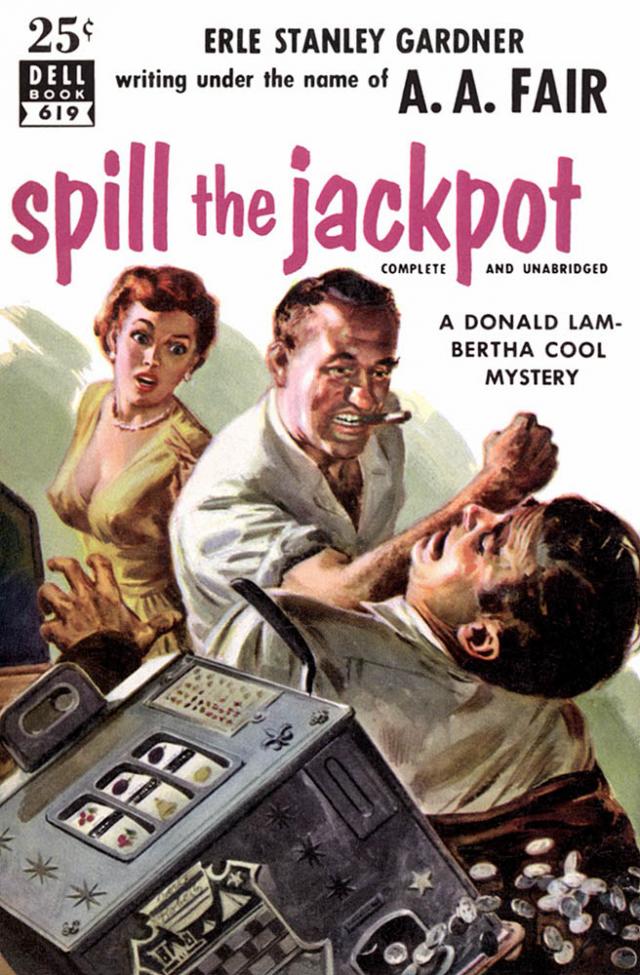
I swung for his jaw’ I don’t know whether it was the poor light or whether he was too mad to see what 1 was doing, or sufficiently disdainful not to care. He didn’t try to block or dodge. My . blow caught him on the chin. Unconsciously I’d remembered something of what Louie had told me about throwing my body muscles into a blow. I hit him so hard I thought my arm was broken.
It didn’t even jar his head back on his neck. It was as though I’d swung on the side of a concrete building. He said, “You double-crossing, two-timing stool pigeon—” His fist crashed into my jaw.
It was his left. It jarred me back on my heels. I knew his right would be coming across. 1 tried to get out of the way and stumbled, off balance, which threw my shoulder up. His right caught me on my shoulder and sent me out across the sidewalk into the gutter.
The car swerved. Headlights blazed at us. I thought the machine was going to run over me. I got up and Pug was coming toward me, not hastily, just with a quiet deadliness of purpose.
The car was stopped now. I heard a door slam, steps behind me. A voice said, “No, you don’t!”
Pug didn’t pay any attention to the voice. His eyes were only on me.
I thought I saw an opening and lashed out.
The big bulk of a body moved past me. I heard the thudding impact of a fist against flesh, and then Pug and a big man were whirling around in a tangled circle. The big - man’s shoulder hit against me and flung me off to one side. Before I could get back, Pug had broken free. I saw his shoulders-weave, then the broad back and huge shoulders of the big man interposed themselves between me and Pug.
Something sounded like a fast ball thudding into a catcher’s glove. The big man came back hard, and took me down with him.
I heard people shouting. A woman screamed. There were steps—running toward us.
Someone bent over us. I squirmed to get free. The automobile lights showed Pug’s face, still hard with cold hatred, bending over. He jerked the inert body of the big man to one side as though it had no weight. He leaned over me. His left hand grabbed my shirt and necktie. He started to lift me.
Someone was back of him. I saw a club making a glittering half circle, and heard the thud on the back of Pug’s skull. The hand that was holding my shirt loosened its grip. I fell back against the bumper of the car.
By the time I straightened, there was a swirl of activity back in the crowd. I heard the sound of grunting breaths, the sound of another blow, then feet running, this time away from me.
The big man who had gone down and taken me with him struggled to his knees. His right hand swung back to his hip. I saw blued steel glittering in the light reflected by the automobile headlights. I caught the man’s profile as he raised the gun and turned his head. It was Lieutenant Kleinsmidt.
A man pushed through the little crowd. “Everything all right, Bill?” he asked.
Kleinsmidt said thickly, “Where is he?”
“He got away. I gave him a full swing with the club, but it didn’t stop him.”
Kleinsmidt struggled to his feet.
I was tangled up with the bumper of the car. I had to get a hand on it to pull myself up. Kleinsmidt grabbed me, spun me around, and said, “Oh!”
I said, “I’m sorry, Lieutenant,” and added with a flash of inspiration, “I tried to hold him for you.”
“You sure have guts,” he told me, and rubbed his jaw. “What you want him for, Bill?” the man with the club asked.
“Slot-machine racket,” Kleinsmidt said, and then added as an afterthought, “Resisting an officer.”
“Well, we can get him.”
Kleinsmidt said to me, “Know where he lives?”
I brushed dirt off my clothes. “No.”
“Which way did he go?” Kleinsmidt asked.
Half a dozen people were eager to volunteer information. Kleinsmidt looked back at the car for a moment as though hesitating, then started out on foot, and took the other man with him. The little crowd went streaming along behind to see the fun.
I limped away into the darkness. Seven o’clock, and Bertha would be waiting.
Chapter Five
I WENT over to the Apache Hotel, drifted into the lobby, found a seat, took the letter Helen Framley had given me from my pocket, and looked it over carefully.
It was written on a good quality stationery, but the sheet was an odd size. The top edge held hale irregularities so small as to be almost imperceptible unless you looked for them carefully. The paper spilled a faint trace of scent. I couldn’t tell what kind it was. There was a certain suggestion of cramped angularity about the handwriting.
The letter read: Dear Helen Framley: I’m grateful for your letter, but it’s no use. I can’t go through with the marriage now. It wouldn’t be fair to him. The thing you suggest is unthinkable. I’m getting out of the picture. Good-by.
Corla Burke I studied the envelope in which the letter had been enclosed. It was a stamped, air-mail envelope. The General Delivery address on the outside was in that same handwriting as the body of the letter. Someone at the post office had crossed this out and written in the street and number of Helen’s apartment.
I put the letter back in the envelope, put it in my pocket, then thought better of it. I took the letter back out of the envelope, put it in my inside coat pocket, put the envelope in the outside pocket on my coat, and walked back to the Sal Sagev Hotel.
Bertha said, “Donald, what the hell have you been doing?”