Spill the jackpot, p.3
Spill the Jackpot,
p.3


She came toward me, smiling graciously.
She was a woman who was still in the running. She’d taken care of her figure and her face. She might be in the late forties, perhaps in the early fifties, but she might have been in the thirties. She knew the pinch of self-denial, this woman. She didn’t eat everything she wanted and try to keep her figure by wrapping her body with elastic. She had kept her figure by self-discipline—by going hungry.
She was brunette with eyes that glittered like polished, black marble. Her nose was long and straight, and the nostrils were so thin they seemed almost transparent.
She said, “How do you do, Mr. Lam. Anything we can do for a friend of Arthur Whitewell will be a privilege.
Won’t you make our house your headquarters while you’re in Las Vegas?”
It was one of those invitations that was a symbol. If I’d said yes, someone would have had to sleep on the back porch, I wasn’t expected to say yes. I said very gravely, “Thank you very much. I’ll probably be here only a few hours, and I’ll be busy. But I appreciate your invitation.”
The girl came in then. It was as though they’d been standing outside the door, timing their entrance, each one careful not to interfere with the impression the others would make.
Mrs. Dearborne went through the formula. “Eloise, I wish to present Mr. Lam of Los Angeles, the person Mr.
Whitewell telephoned about”
Eloise was unmistakably the daughter of her mother.
She had the same long, straight nose. The nostrils weren’t quite as paper thin. Her hair was a deep auburn. Her eyes were blue, but there was the same hard leanness, the same purpose of living, the same impression of self-discipline.
These women were hunters, and they had just that feline touch which the woman hunter always has. A cat, sprawling out in front of the warmth of a fireplace, looks as softly ornamental as the fur thrown about a woman’s throat. The padded feet move noiselessly, and softly. But the claws are there, and it’s because they’re kept sheathed, they’re so deadly dangerous. A dog doesn’t conceal his claws, and they’re only good for digging. A cat sheathes its claws, and they possess needlesharp efficiency in the problem of sustaining life by death.
“Won’t you sit down?” Mrs. Dearborne asked when I had muttered the conventional formula.
We all sat down.
You could see that whatever was discussed was going to be discussed jointly—not that they distrusted Ogden’s ability to report, but these people weren’t the kind to trust anyone else. They wanted firsthand information. They’d all come to attend the conference. They’d planned it that way.
I said, “I’ll only stay for a minute. I want to find out about Helen Framley.”
“I really know virtually nothing,” Ogden said.
“That’s good. Then you won’t have to skip over any of the details.”
He smiled. “Well, I went up—”
“I think, Ogden, Mr. Lam would like to have you begin at the beginning.”
“Yes,” Eloise said, “your call from Arthur Whitewell.”
He didn’t even bother to communicate his acceptance, simply adopted their suggestion as a matter of course, something that went without saying. “I received a call from Arthur Whitewell. He was calling from Los Angeles. We’ve known the family for some time. Eloise met Philip in Los Angeles a year ago. He’s called at the house several times. She’s been entertained in Los Angeles. Arthur, you know, is Philip’s father. He’s—” Ogden flashed a quick glance at his mother, evidently failed to get a go-ahead signal, so said instead, “He comes through here quite frequently and drops in to spend an evening.”
“What did he say over the telephone?” I asked..
“Said that a someone named Framley had sent a letter to Corla Burke. He wanted me to find this Framley and ask about what was in it. Said it had seemed to upset Miss Burke.
“I didn’t have anything whatever to work on. It took me half a day to locate this party. She’s living in an apartment, has only been here for two or three weeks. She said she didn’t know anything about it, that she didn’t know any Corla Burke, that she hadn’t sent any letter, and, therefore, couldn’t help me in the least.”
“Then what?”
“That’s all there is.”
“Did Miss Framley seem frightened or evasive?”
“No, just frankly told me she didn’t know anything at all about it. Seemed rather bored.”
“Do you know Corla?” I asked.
His eyes shifted, not to his mother this lime, but to Eloise. “I’ve met her. Philip introduced me.”
“You knew, of course, that she and Philip were planning on getting married?”
Ogden said nothing. Eloise said, “Yes, we knew.”
I said, “Whitewell gave me the address of Miss Framley’s apartment. I presume he got that from you?”
“Yes.”
“Do you know whether she’s still there?”
“I believe she is—at least as far as I know. I haven’t seen her since that time, but she gave me the impression of being settled.”
“When did Arthur—Mr. Whitewell get to town?” Mrs.
Dearborne asked.
“He came in on the plane with me this afternoon.”
“Oh.”
Eloise asked, “Do you know if Philip was planning to join him?”
“I haven’t heard.”
Mrs. Dearborne said confidently, “Arthur will be down after dinner.”
There was just a subtle accent on the word dinner. “What about Helen Framley herself?” I asked Ogden. He said, “She’s typical,” and then gave a little laugh. “Of what?”
“Of a type you’ll find here in town.”
“What sort of type?” - He hesitated as though trying to find words.
Eloise said promptly, “A tart.”
Ogden said, “A man came in while I was talking with her. I think—well; he doesn’t seem to be her husband but—”
“He’s living with her,” Eloise interposed. “Is that what you are trying to tell Mr. Lam, Ogden?”
“Yes,” he blurted.
“After all, Ogden, Mr. Lain has to have the facts, you know.”
“He’s got them now,” Ogden said, embarrassed.
I looked at my watch, said, “Well, thanks a lot. I’ll see if I can get anything out of her.”
I got up.
They all three arose. I had neither the time nor the inclination to go through the polite patter.
I said, “Well, thanks for the help. I’ll talk with her,” and started for the door.
Ogden let me out.
“You don’t know how long Arthur Whitewell intends to be here?”
“No.”
“And you didn’t hear him mention whether Philip was coming?”
“No.”
“If there’s anything I can do, I hope you’ll let me know. Good night.”
“Thank you, I will. Good night.”
It was four-thirty when I climbed the steps to Helen Framley’s apartment and rang the bell. I rang a couple of times, then tried the apartment next door. A woman pushed her head out so quickly that I knew she’d been standing at her door listening. Evidently, she could hear Helen Framley’s bell over in her apartment.
“I beg your pardon,” I said. “I’m looking for Helen Framley.”
“She lives in that apartment next door.”
“I know, but she doesn’t seem to be home.”
“No. She wouldn’t be.”
The woman was somewhere in the forties. Her glittering, black eyes had the fidgets. They darted to my face, then away, then back, then made a quick survey of the hallway, and came back to me again.
“Know where I might find her?”
“Do you know her when you see her?”
“No. I’m investigating her nineteen-thirty-nine income. tax.”
-“Can you fancy that—” She half turned and called over her shoulder, “Paw, did you hear that? That woman pays an income tax!”
A man’s voice from the inside of the apartment said, “Uh huh.”
The woman moistened her lips, took a deep breath. “Well, Lord knows as how I’m not the one to pry into a neighbor’s business. Live and let live, that’s my motto. Personally, I don’t care what she does as long as she’s quiet about it. I was telling my husband just the other day. The Lord knows what the world is coming to when a girl like this Framley girl can turn night into day, have men friends calling at her apartment, and stay until all hours of the night. Heaven knows what she does! She certainly doesn’t work, and she’s never up before eleven or twelve in the morning. And I don’t think there’s a night in her life she goes to bed before two o’clock. Of course, you understand I’m not saying anything against the girl, and heaven knows she’s decent-appearing enough, perfectly quiet, and all that. But—”
“Where can I find her?”
“Well, mind you, I’m not one to say anything. Personally I can’t afford to play those slot machines. They tell me they’re so arranged that it’s just like throwing money away. Yet three afternoons now when I’ve walked past the place, I’ve looked in and seen that girl standing in front of the slot machines at the Cactus Patch, dropping one coin after another, working the handles just as fast as she could pump her hand up and down.
“She hasn’t a job, and I don’t know as she’s ever had. a job. But for a girl to live a life like that—such a nice, decent-appearing girl, too—and then you tell me she pays an income tax! Well, Ah-h-h-h-I declare! How-much-did-she-pay?”
That last question was shot out at me so fast the words all ran together.
I heard steps behind the woman. A man with round shoulders, a shirt open at the neck, an unbuttoned vest flaring away from the hollow chest, pushed reading glasses up out of the way onto his forehead, and stared at me owlishly. “What’s he want?” he asked the woman.
, He was holding a newspaper between his thumb and forefinger. It was open at the sporting page. He had a little drooping, black mustache, and seemed comfortable and relaxed in his bedroom slippers.
“He wants to know where he can find that Framley girl.”
“Why don’t you tell him?”
“I am telling him.”
He pushed her to one side, and said, “Try the Cactus Patch.”
“Where’s that?”
“On the main stem, a casino, big bank of slot machines. You can’t miss it. Come on, Maw, mind your own business and let the girl mind hers.”
He pushed the woman to one side and slammed the door.
I didn’t have any difficulty finding the Cactus Patch. It preserved a fiction of having the bar and the casino in two different establishments; but both opened on the street through wide doorways, and there was a glass partition between the two. The casino had a big wheel of fortune right up in front, then a couple of roulette wheels, a crap table, and some stud poker games. There was a bingo parlor in back of that. Over on the right was a whole bank of slot machines, a double row standing side by side and containing possibly a hundred machines in all.
There were a few scattering customers here and there. It was too early as yet for the bulk of the tourist trade to come in, but the crowd was the mixture that can be found only in a Nevada town.
Here were professional gamblers, panhandlers, touts, and some of the higher-class girls from the red-light district. A couple of the men at the bar were probably miners. Three chaps who were at the wheel of fortune might be engineers from the Boulder Dam. A small sprinkling of auto tourists wandered aimlessly around the place.
Some of these tourists were from the west and more or less familiar with Nevada. Some of them ere seeing it for the first time, and their reaction to the wide-open gambling, the shirt-sleeved camaraderie of the crowd was one of gawking wonderment.
I got a dollar changed into nickels, went over to the slot machine, and started playing. It seemed as though every time the wheels clicked to a stop a lemon would be staring me in the face.
A woman was playing a two-bit machine halfway down the bank of machines. She was in the thirties, and her face was touched up like a desert sunset. She didn’t register as Helen Framley. I was down to my last nickel, when two cherries clicked coins into the metal pay-off cup. Just then, a girl came in.
I said to the machine in a voice loud enough to be distinctly audible to the girl, “Don’t get generous now.”
She turned, looked me over, walked past without saying anything, and dropped a dime in the ten-cent machine. She got three oranges, and dimes cascaded into the cup in a jingling tune.
I could have made her Helen Framley; but she stood looking at the machine with a dazed expression of “What-do-I-do-next?” so I decided at once she was no old hand at the game. She played another dime.
A jaunty chap with quick, restless eyes and head that, seemed perfectly poised on a muscular neck paused in front of the quarter machine. I watched his hands as he dropped the coin and slammed down the lever. Not a wasted motion. Everything was as smoothly graceful as though his arms had been pistons working in an oil bath.
The girl over at the dime machine called, “Oh, I must have broken something.”
Her eyes shifted over toward me, but the other chap was nearest. He beat me to it. “What’s the matter?”
She said, “I dropped a dime in the machine. And I guess I must have broken something. Dimes spilled out over everything—all over the floor.”
He laughed easily, and moved over toward her. I noticed particularly the broad, supple shoulders, the straight line of his back, and the thin waist and narrow hips.
“You didn’t break the machine—not yet. But if you keep on being lucky, maybe you will. Ion just won a jackpot.”
He glanced over at me, and winked.
“Wish she’d show me how it’s done,” I said.
She laughed uncertainly.
The young chap got down on his hands and knees, picked up a couple of dozen dimes, scooped a handful out of the cup, arid said, “Now, let’s make certain there aren’t any back up in there.”
His fingers explored the cup.
“Nope. Everything’s swell.”
I caught the reflection of light gleaming from a dime on the floor’. I picked it up, handed it to her, and said, “Don’t - overlook this one. It may be lucky.”
She thanked me with a swift smile, said, “Well, I’ll see if it is.”
I felt someone watching me, turned around, and saw an attendant, wearing a green apron with change pockets in it, eyeing us in scowling suspicion.
The girl dropped the dime into the machine, and jerked the handle. The woman who had the gaudy face was walking out past us. She coughed as she caught the eye of the green-aproned attendant.
Apparently, it was a signal.
He came walking swiftly toward us as the whirling dials of the slot machine went “clack”-“click”-“bang”-“chunk”
“jingle”! A tinkling shower of dimes spilled into the metal cup and overflowed into her hands.
The attendant busied himself at a machine right behind us.
The young man said, “That’s the way.” His laugh was easy. “Go to it, sister. You’re playing a run of luck. Only you don’t know it. I’ll see what I can do on the two-bit Machine while you tickle the dimes.”
He dropped another quarter in the two-bit machine, spun the lever, and called to me, “How you doing, stranger?”
I said, “I’ve got this machine fed up to a place where it’s bound to start paying off. It’s so full of nickels now, it’s ready to bust.”
I put in a nickel and pulled the lever.
The three discs whirled in a bewildering kaleidoscope. With a click the left-hand disc stopped. A half second later, the middle one snapped into position.
I saw two bars.
The third one jarred to a stop.
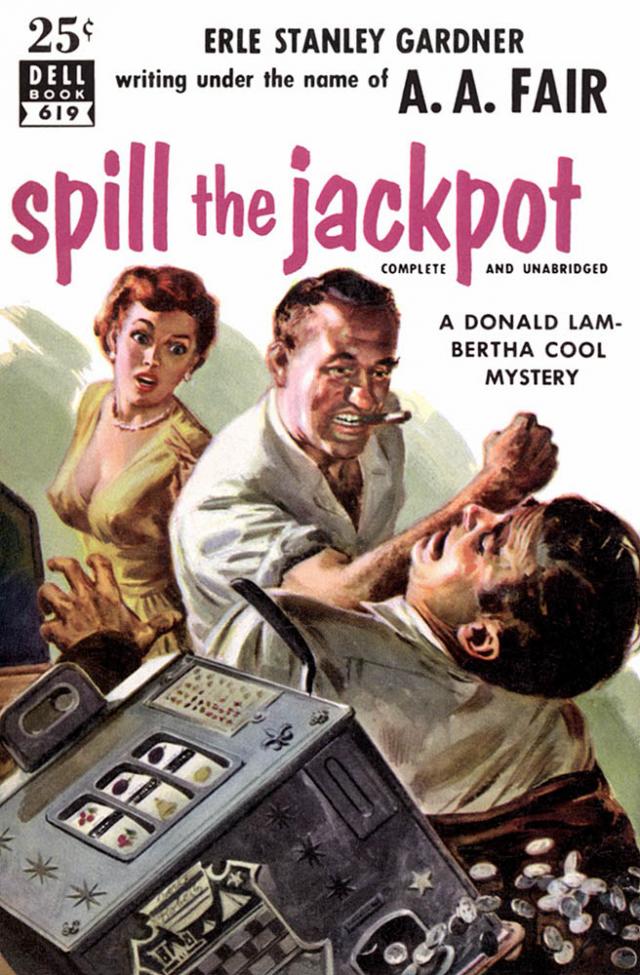
A metallic click emanated from the inside of the machine, and the floodgates opened. Nickels poured out into the cup, out from the jackpot, dancing a merry jig as they spilled over my hands and dropped to the floor.
I grabbed a double handful, but they kept coming. I pushed coins down into my side pockets, cleaned out the cups, and then started looking for nickels on the floor.
The attendant said, “Perhaps I can help.”
He leaned over me. Suddenly his hands shot out, and his fingers gripped my wrists.
“What’s the idea?” I asked, and tried to fight free.
He said, “Come on, buddy. The manager wants talk with you.”
“What are you talking about?”
“Do you want to come the easy way, or do you want to come the hard way?”
I tried to shake myself loose and couldn’t. I said, “I’m going to get these nickels on the floor. They’re mine.”
“Just a minute,” he said.
His fingers slid up my sleeve, felt around my forearm.
I jerked one arm free and made a swing. He brushed the blow aside, stepped in and grabbed the lapels of my coat, pushed down so that my coat was halfway down my arms, holding them pinioned. For the moment, I was helpless. The weight of coins in the side pockets became swinging pendulums of weight which struck against me as I moved.
Back of me I could hear sounds coming from a machine, and a light tinkle as a shower of dimes hit the metal cup. A moment later, there was another clack, and this time twenty-five-tent pieces cascaded out.
The attendant twisted his fingers into my coat collar, and, getting his weight behind me, gave me a push which sent me over toward the other machine.
“Okay, buddy,” he said to the man, “I’ll take a look up your coat sleeves.”
“Mine?” the young chap said.
“Yours.”
I said, “What’s the matter with this guy? Has he gone crazy?”
The man who was standing at the two-bit machine weaved slightly back and forth, just an inch or two at a time as he shifted his weight, on the balls of his feet.
The girl said, “I’m going to quit,” and started for the door.
The attendant said, “Just a minute, sister,” and grabbed. She eluded him. People were crowding around.
The attendant said, “You three crooks are going to get yours right now. The law has a date with you.”