

The case of the long leg.., p.15
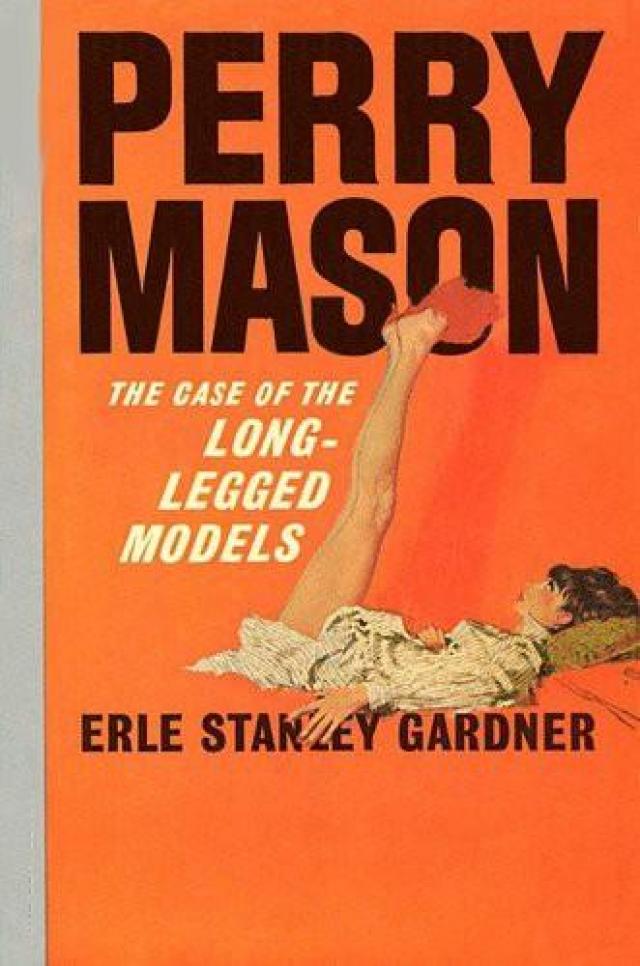
The Case of the Long-Legged Models,
p.15


“I am showing you herewith a certain Colt revolver of .38 caliber, and I will ask you if you have seen that gun before?”
“Yes, sir. I have.”
“When did you first see it?”
“On the eighth of October, around eleven-forty-five o’clock of that day.”
“Where did you first see it?”
“In the apartment of Stephanie Falkner, the defendant in this case.”
“Where was it in that apartment?”
“Lying upon a table near the center of the room.”
“Did you take or did you cause a photograph to be taken of the apartment?”
“I did, yes, sir.”
“And does that photograph show where the gun was found?”
“Yes, sir.”
“Do you have a print of that photograph with you?”
“Yes, sir.”
Sergeant Holcomb produced a photograph.
“We ask that it be received in evidence,” Hendrie said.
“Just a moment,” Mason said, “I would like to ask a question of the witness in connection with this photograph.”
The jurors, impressed by the fact that this was the first attempt Mason had made to cross-examine a witness, turned to regard him with considerable interest.
“This photograph shows a weapon on the table, Sergeant,” Mason said.
“Yes, sir.”
“Is that the same weapon which you have identified?”
“Yes, sir.”
“Is that weapon in the same position in which you found it?”
“Yes, sir.”
“Then the photograph must have been taken before the weapon was moved?”
Sergeant Holcomb hesitated a moment, crossed his legs. “Well, the weapon was picked up, examined, and then returned to the same place where it had been found.”
“Who examined it?”
“I did.”
“Anyone else?”
“Lieutenant Tragg of Homicide was with me at the time.”
“And of what did the examination consist?”
“We broke open the cylinder, we saw that there was an empty cartridge directly underneath the firing pin, we smelled the barrel.”
“Did you dust it for fingerprints?”
“Yes.”
“And then what?”
“Then the weapon was returned to the exact position in which it had been found so that it could be photographed.”
“And then this photograph was taken?”
“Yes, sir. That is right.”
“Now if you know,” Mason asked, “was any attempt made to connect the fatal bullet in this case with this weapon?”
“Just a moment,” Hamilton Burger said. “That is going to be proven by my next witness. I will have the ballistics expert on the stand, and he can be cross-examined.”
“That’s quite all right,” Mason said. “AH I am asking this witness is whether such an examination was made.”
“Yes, sir.”
“When?” Mason asked.
“Shortly after the weapon was recovered. I don’t know exactly the time, but it was within a few hours.”
“What do you mean by a few hours?” Mason asked.
“Just a short time, a very brief interval.”
“As much as twenty-four hours?” Mason asked.
The witness hesitated.
“As much as forty-eight hours?” Mason asked.
“No, it wasn’t forty-eight hours.”
“It could have been twenty-four hours?”
“It could have been. I think it was much less.”
“Who put the weapon back on the table in the exact place where it was found?”
“I did.”
“How did you know where that exact place was?”
“I remembered it.”
“Did you mark it in any way?”
“No.”
“Now when you entered the room,” Mason asked, “and found this weapon, was the muzzle pointing toward the door or was it pointing away from the door?”
“It was on the table as shown in that photograph.”
Mason, holding the photograph so the witness couldn’t see it, repeated, “Was the muzzle pointed toward the door or away from the door?”
“At this moment, I can’t remember. I knew at the time. The photograph will show its exact position. I replaced the gun within five minutes of the time I picked it up and while its position was fresh in my mind.”
“Thank you,” Mason said, “these are all the questions I have in regard to the photograph, if the Court please.”
Hendrie said, “I now wish to offer the photograph in evidence.”
“No objection,” Mason said.
Hendrie turned to the witness. “Did the defendant make any statement to you with reference to the gun?”
“Yes, I asked her about the gun, and she said Mr. Homer Garvin had given it to her.”
“Did you have any further conversation with her?”
“Yes, I asked her about the discharged shell in the gun and she said she knew nothing about it, that the weapon was in the same condition as when she had received it.”
“We ask that the weapon be marked for identification.”
“So ordered,” the Court ruled. “It will be People’s Exhibit Number 30, and the photograph is in evidence as People’s Exhibit Number 29.”
“You may inquire,” Hendrie said.
“Did she say whether or not she had received the gun from Homer Garvin, Sr., or Homer Garvin, Jr.?” Mason asked.
“Just that she had received it from Homer Garvin. That was all she said.”
“Did she say when she had received it?”
“No, sir. She didn’t.”
Hamilton Burger said, “If the Court please, we expect to connect up the time element. However, in that connection, I will ask Sergeant Holcomb one question. What time did you arrive at the defendant’s apartment, Sergeant?”
“It was almost exactly eleven-forty-five.”
“No further questions,” Mason said.
“Call Alexander Redfield,” Hendrie said.
Redfield, the ballistic expert, who had been cross-examined by Mason in several other cases and who had learned to be very wary indeed of Mason’s ingenuity on cross-examination, took the oath and settled himself cautiously on the witness stand.
From Hendrie’s manner, it was apparent that there was a certain feeling of exasperation on the part of the prosecuting attorneys toward Redfield, that Redfield, on the other hand, knowing Mason’s ability as a cross-examiner and his knowledge of the subject of ballistics, was determined to give only such evidence as was completely unassailable.
“I show you People’s Exhibit Number 30, the weapon which has just been received in evidence. Are you familiar with that weapon?”
Redfield took the exhibit in his hands, studied it carefully, checked the serial number, then said, “Yes, I am familiar with it.”
“I show you a bullet which has previously been introduced in evidence as People’s Exhibit Number 14, the fatal bullet. Are you familiar with that bullet?”
The witness took a magnifying glass from his pocket, carefully inspected the base of the bullet, then said, “Yes, sir, I am familiar with that bullet. It has my secret mark on it.”
“That bullet has already been identified as the fatal bullet,” Hendrie said. “Now can you tell us whether or not that bullet, Exhibit 14, was fired from the gun, Exhibit 30?”
“Yes, sir, that bullet was fired from this gun,” the witness said.
“Could it have been fired from any other gun?”
“No, sir. It was fired from this gun.”
“You may cross-examine,” Hendrie said.
“No questions,” Mason announced.
“Call Paul Clinton,” Hendrie said.
Paul Clinton came forward, took the stand and identified himself as a scientific investigator in the employ of the police department. He qualified himself as an expert in the science of developing and comparing fingerprints, in making chemical tests for bloodstains, in the grouping of blood, in making various types of analysis.
“Did you have occasion to search the apartment occupied by the defendant in this case?” Hendrie asked.
“Yes, sir.”
“When?”
“On the ninth day of October.”
“Of this year?”
“Yes, sir.”
“Did you find any wearing apparel in the apartment of the defendant which was stained with blood?”
“I did. Yes, sir.”
“What article did you find?”
“I found a left shoe with blood on the sole and on the heel.”
“Were you able to get enough blood to type the stain?”
“No, sir.”
“Were you able to get enough blood to determine that it was human blood?”
“No, sir. The shoe had been carefully and thoroughly washed, but chemical tests gave a typical blood reaction.”
“Do you have that shoe with you?”
“I do, yes, sir.”
“Produce it, please.… This is the shoe which you found in the defendant’s apartment?”
“Yes, sir.”
“Is there anything distinctive about that shoe?”
“Yes, sir, the sole is of a certain patented composition.”
“I will ask you if you found any soiled towels in the Casselman apartment?”
“I did, yes, sir. I produce herewith one towel which I consider especially significant.”
“Why?”
“It had blood smears on it. It had been used to wipe off some bloodstained object. In addition to the bloodstains or smears, there was a very small bit of foreign matter adhering to the towel. Spectroscopic analysis showed that bit of foreign matter to have exactly the same component parts as the sole of this shoe.”
Hendrie said, “I ask to have the shoe introduced in evidence as People’s Exhibit Number 31, the towel as People’s Exhibit 32.”
“No objection,” Mason said.
“So ordered. They will be received in evidence,” Judge Decker ruled.
“Now I’m going to call your attention to the photograph, Exhibit Number 12, which has been received in evidence. I am going to ask you if you have made a careful study of that photograph.”
“I have. Yes, sir.”
“What did you find from your study?”
“I found that there are evidences in this color photograph of two footprints. There is the evidence of a shoe with a fairly high heel which has been covered with a metal plate held in place by four brads.
“Subsequent investigation convinced me that this heel plate bore the number ‘thirty-three.’ In part, the numbers which had been stamped into this plate are obliterated but in this photograph which I hold in my hand, it is possible to detect faint traces of the number thirty-three. This footprint made with the heel print bearing the number thirty-three has been almost obliterated by the footprint of a man wearing a much larger shoe and this footprint had been superimposed upon the other print at a time considerably later than the making of the first print.”
“Can you tell how much later?”
“I would say probably two or three hours later.”
“Referring now to the article of wearing apparel, the shoe which you found in the defendant’s apartment, and which has been received in evidence as Exhibit Number 31, have you been able to determine whether this particular shoe which you hold in your hand made the bloody print which you have testified to finding underneath the print made by the larger shoe?”
“If the Court please,” Mason said, “I object to that question as calling for a conclusion of the witness in a manner which invades the province of the jury. It is for the jury to determine whether this shoe made that print, if it should appear there is any print there, and the witness is not testifying purely to a figment of the imagination.
“This witness can testify as to what he has found. He can testify as to an opinion in connection with the legitimate field of expert evidence, but he cannot invade the province of the jury.”
Judge Decker said, “Let me see that photograph and the shoe please.”
The judge studied the photograph and the shoe for some seconds, then said, “The objection will be sustained. The jurors can and will draw their own conclusions. This witness can testify only as to the facts from which such conclusions can be drawn.”
The prosecution took the ruling with poor grace. “If the Court please,” Hamilton Burger said, ponderously getting to his feet and frowning with displeasure, “this witness has qualified himself as an expert.”
“He may give his opinions as to collateral matters,” Judge Decker ruled. “He may set forth the various factors in this case, but on the question of whether this identical shoe made this identical print which the witness claims he has been able to decipher from the photograph, the Court feels it would be invading the province of the jury to permit an answer to the question.
“The Court may point out that, while the witness contends there were two footprints visible in the photograph, that very point may be contested by the defense.”
Hamilton Burger slowly sat down.
Hendrie resumed the examination. “You have testified that the second print, the one made with the man’s shoe, and which covers the first print, was made some two hours later?”
“I would say approximately two or three or perhaps four hours later.”
“How can you determine?”
“There are certain changes in blood which take place when the blood leaves the body. Blood will coagulate in some three minutes or less. After it has coagulated or clotted, it can be restored to liquid form by pressure or by certain types of agitation. In this case, it is my opinion that the person wearing the man’s shoes stepped in the pool of blood after it had coagulated and that the track which was made thereafter shows distinctly certain characteristics which indicate the condition of the blood, a condition which, in my opinion, would probably indicate an interval of some time, probably two or three hours.”
“Have you examined a man’s shoe which could have made the covering track shown in this photograph?”
“I have.”
“Do you have that shoe with you?”
“I do.”
“Will you produce it please?”
The witness delved into his bag and produced a shoe.
“Is there something distinctive about this shoe?”
“There is.”
“In what way?”
“There is a relatively new rubber heel on the shoe and there is a little defect in that rubber heel which can be noticed here and the same defect in exactly the same place can be seen in this photograph of the track.”
“Have you tested this shoe for blood?”
“I have. Yes, sir.”
“Did you find blood on it?”
“Yes, sir. My chemical tests showed the presence of blood.”
“Those tests are responsible for the discoloration of the shoe?”
“That is right.”
“Where may I ask did you get this shoe?”
“From a suitcase, the property of Homer Garvin, Sr.”
Hendrie said, “May we have this shoe marked People’s Exhibit Number 33 for identification. Now, Mr. Clinton, did you examine the Casselman apartment for latent fingerprints?”
“I did.”
“What did you find?”
“The doorknobs of all doors had been carefully wiped by someone so that there were no latent fingerprints on any of the knobs with one exception.”
“And that exception?”
“The back door. There was a left thumbprint on that back door without anything else in the line of a latent fingerprint appearing on it.”
“Do you know whose fingerprint it was that was found on the door of this apartment?”
“Yes, sir.”
“Whose was it?”
“The fingerprint of Mr. Homer Garvin.”
“Cross-examine,” Hendrie said turning to Perry Mason.
Mason said, “How do you know that the room had been wiped clean of fingerprints?”
“Because normally there are fingerprints in every room. There are latent fingerprints some of which are smudged, some of which can be developed so that they can be identified. But when one finds a complete absence of fingerprints, it indicates that someone has removed all fingerprints, particularly from objects like doorknobs.”
“When was this done?” Mason asked.
“I can’t tell you when it was done.”
“You found a fingerprint on the knob of the back door?”
“Yes, sir. A left thumbprint.”
“And you were able to identify that?”
“I did. Yes, sir. It was the left thumbprint of Homer Garvin.”
“Senior or Junior?”
“Senior.”
“When was it made?”
“I can’t tell you.”
“Was it made before the murder was committed?”
“I don’t know. I do know that it was made after the knobs had been wiped clean of fingerprints, and since there was only the one fingerprint on all the doorknobs, I know that the cleaning of these objects for fingerprints must have been done while Mr. Garvin was in the room.”
“How do you know that?”
“Because there were no other fingerprints. If he had entered the room after the knobs had been cleaned, there would have been fingerprints on the knobs where he had entered the room, where he had touched the doors, but, since there was only the one absolutely perfect fingerprint, which had been made by pressure of the thumb against the knob of the door, I know that the articles had been wiped clean at a time when he was in the room.”
“This fingerprint was on the knob of the back door?”
“Yes, on the knob of the back door.”
“Wasn’t it possible that someone could have wiped the fingerprints from the inside of the knobs and that Mr. Garvin, coming up the back stairs of the apartment and finding the apartment door slightly open, had decided to close it, that he had reached in and, in doing so, had touched his thumb to the knob in this manner?”
“No, sir. That fingerprint was deliberately left on the doorknob. It was not in a position where a person would have normally placed his hand to close the door.”
Mason said, “Someone could have reversed the doorknobs, could they not?”















