

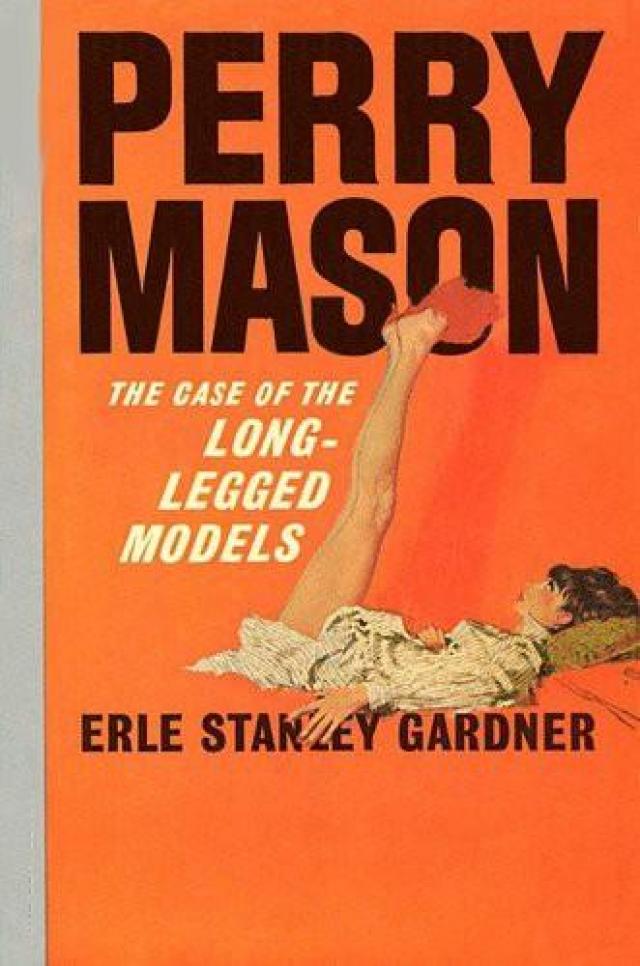
The case of the long leg.., p.8
The Case of the Long-Legged Models,
p.8


“Hell, no!” Mason said. “I’m studying salesmanship.”
Homer Garvin laughed.
Mason drove for several minutes then swung the car into a side street.
Garvin said suddenly, “Hey! Wait a minute! What’s happening here?”
Mason braked the car to a stop in front of the Lodestar Apartments.
“We have a job to do.”
“Now just a—Wa-i-i-i-i-i-t a minute!” Garvin said. “I don’t know what you have in mind, but the answer is no.”
“Come on,” Mason told him.
“I’m a married man,” Garvin told him.
“How does it feel?” Mason asked him.
“I don’t know yet. It’s a thoroughly enjoyable experience so far, but … I can see where it has advantages and disadvantages. However, I do have the most wonderful girl in the world, and I’m not going to do anything to jeopardize her happiness or mine.”
“I wouldn’t want you to,” Mason said. “Come on along.”
“What do you have in mind? Are you going to ask me to make some sort of a statement or …”
Mason said, “I want you to keep your mouth shut. I want you to listen. If you feel like it you can nod your head.”
“And if I don’t feel like it?”
“Just stand there and take it.”
Garvin said, “Mason, I hope you know what you’re doing.”
“I hope I do too,” Mason told him, “and we haven’t much time to do it. Now let’s get started.”
Mason led the way into the apartment house, up to Stephanie Falkner’s apartment. The lawyer tapped on the door of the apartment. There was the rustle of motion from the other side of the door, then the door opened a crack.
“Who is it?” Stephanie Falkner asked.
She saw Mason and said, “Oh, Mr. Mason!” She threw the door open, then her eyes widened as she saw Homer Garvin, Jr. standing just behind Mason.
“Now get this straight, Stephanie,” Homer Garvin said. “Whatever this is all about, it’s Mr. Mason’s idea. None of it is mine.”
“Shut up,” Mason told him. “Come in. Keep quiet!”
Stephanie Falkner fell back. Mason escorted Garvin into the apartment, kicked the door shut behind him.
“Congratulations, Homer!” Stephanie said.
“Shut up, both of you,” Mason snapped. “We don’t have much time. Stephanie, Homer Garvin has been concerned about your safety. Despite his recent marriage, you remain a very dear friend. In view of what happened to your father and because he has learned through me that negotiations are again pending with what is probably the same syndicate, he feels that you should have something for your protection.”
“For her protection!” Garvin asked.
“Shut up,” Mason said. “Give her the gun.”
Garvin hesitated a moment, then reached in his pocket and pulled out the gun.
“Take it, Stephanie,” Mason said.
“What do I do with it?”
“You might try putting it under the pillow,” Mason told her.
Garvin said, “One shot has been fired. Mr. Mason—”
“Quiet!” Mason said. “You told me you didn’t intend to say anything and now you want to do all the talking.
“Stephanie, Homer Garvin is very much concerned about your safety. He wants you to have a weapon so that you can protect yourself. There is no secret about this. There’s no reason for any deception. If anyone asks you where you got the gun, you can tell them that it is a gun you received from Homer Garvin, and conversely if anyone asks you where the gun is you got from Homer Garvin, there is no reason why you shouldn’t hand over this gun.
“You will note that one shot has been discharged from this weapon. That was the condition of the weapon when it was given to you. You have no idea as to who discharged the cartridge, where or when. If anyone wants to know the answer to those questions, it will be necessary for them to check with Horner Garvin.
“Thank you very much for your courteous attention and I think it was a splendid gesture on the part of Mr. Garvin to see that you were protected.
“That’s all. Come on, Homer.”
Mason opened the door of the apartment. Stephanie Falkner regarded them with puzzled eyes. The gun lay on the table in the middle of the room.
Homer Garvin said, “I’d have told you about it before you read it in the papers, Stephanie, only I—”
“You don’t have to explain, Homer,” she said. “I understand perhaps a lot more than you think. I understand your restless nature, your ceaseless attempt to make over your environment. After all, there’s no reason why we can’t be friends.”
Homer pushed past Mason, stepped forward and extended his hand. The two shook hands.
Mason, holding the door of the apartment open, said, “Homer Garvin, if you don’t get out of here, I’ll call a taxi and ride back in that.”
“That does it, honey,” Homer Garvin said. “I’m selling the sucker a car.”
“More power to you,” Stephanie Falkner said. And then added, “You may need it.”
Garvin stepped into the hall, and Mason shut the door of the apartment.
They took the elevator to the ground floor and were starting across the lobby when Mason suddenly grabbed Garvin’s arm and said, “This way, please.”
Mason led Garvin over to the seats by a table covered with reading matter. He grabbed a magazine, pushed Garvin down on the seat, shoved the magazine in his hands, picked up a newspaper and sat down beside him.
The door of the apartment house opened.
Lieutenant Tragg of the Homicide Squad accompanied by Sergeant Holcomb and the taxi driver who had driven Mason earlier in the morning, approached the desk. They talked briefly with the attendant, then entered the elevator.
“All right,” Mason said, “let’s go, and let’s hope they didn’t notice that sports car out front.”
“What the hell do you mean, didn’t notice it?” Garvin said. “That’s like suggesting a banker doesn’t notice the steam calliope in a circus parade as it goes by during a directors’ meeting.”
“That,” Mason said, “is what I’m afraid of. If you’re going to do business with me on an automobile, you’ll have to get something dark, quiet, and conservative.”
“I have just the thing for you,” Garvin said.
“What is it?”
“A secondhand hearse. It’s only had one owner.”
Chapter 9
At two-fifteen the telephone in Mason’s private office rang and Della Street said, “Marie Barlow is on the phone, says it’s rather urgent.”
Mason nodded, took the telephone, said, “Hello, Marie. This is Perry Mason.”
“Oh, Mr. Mason, I’m so glad I caught you. Two officers of the Homicide Squad are here, Lieutenant Tragg and Sergeant Holcomb. They have a search warrant authorizing them to search Mr. Garvin’s office for bloodstains, bloodstained garments, or other evidentiary matters in connection with the perpetration of a homicide in connection with the death of one George Casselman. What do I do?”
“Dust off the chairs,” Mason said. “Invite them to make themselves at home. Tell them to search all they damn please. Have them give you an inventory of anything they take from the office. Give Sergeant Holcomb my compliments, and ask him to try to refrain from leaving burning cigarettes on the office tables and desks so they leave burnt smudges.”
“That should do it,” she said.
“That will do it,” Mason told her. “Telephone me when they leave.”
Mason hung up the phone, said to Della Street, “Well, here’s where trouble starts. I’m going down the hall to see Paul Drake. Call me there if anything breaks.”
Mason walked down the corridor, pushed open the door of the entrance office on which a sign read “DRAKE DETECTIVE AGENCY.” He said to the receptionist, “Paul in?”
She nodded.
“Busy?”
“No, Mr. Mason. Go right on down. Want me to announce you?”
“No need unless there’s someone with him.”
“He’s alone.”
Mason pushed open the gate which led to a corridor flanked by small, cubbyhole offices each just big enough to interview a witness in privacy or where an operative could prepare a typewritten report.
Drake’s office was down at the end of the corridor and was slightly larger, having room for a desk and a couple of extra chairs. Four telephones were arranged in a row on the desk.
Drake was checking a report as Mason pushed open the door.
“Hi, Paul.”
“Hi, Perry.”
“Want a job?”
“Sure.”
“George Casselman.”
“He was murdered last night,” Drake said.
“You keep up on your murders, don’t you?”
“So do you, if I may say so.”
Mason grinned. “I’m particularly interested in the time of death, any suspects the police may have, any information they may uncover, anything you can get on the background of Casselman.
“I’d suggest you grub around in Las Vegas, because I think he has a Las Vegas background. I don’t know how long he’s been living in the apartment where the body was found. I want to get everything. The works.”
“I can give you some information right now,” Drake said. “Casselman was a penny-ante racketeer.”
“Gambler?” Mason asked.
“Not so much gambler as petty rackets.”
“Okay,” Mason said. “See what you can find out. I can give you one tip.”
“What?”
“You remember a man who was killed here a few months ago, fellow by the name of Falkner—Glenn Falkner?”
“Oh yes, gangster killing, wasn’t it?”
“It was not,” Mason said. “That is, I don’t think it was, although the police have listed it as a gangster killing, and as a result not too much was ever done on it.
“Because Casselman had some connections in gambling circles and Glenn Falkner did too, police have made a check on Stephanie Falkner, the daughter of the man who was murdered a few months ago.”
“You representing her?” Drake asked.
“I’m looking out for her interests, Paul.”
“Okay, I’ll get busy. What is this? Big, medium-sized, or small job?”
“Whatever is necessary to get the information. Start out-easy and finish up hard.”
Drake reached for a telephone. “Okay, Perry, I’ll start some men on it right now. I have a man down in the pressroom at headquarters who gets stuff as fast as it’s available for the papers.”
“Have him keep an ear cocked,” Mason said, “and shoot the information down to the office as soon as you get it.”
“Okay,” Drake said, “I’m started.”
Mason walked back to his own office, heard steps in the corridor behind him, turned and saw Stephanie Falkner hurrying down the corridor.
“Well,” Mason said, “what brings you here?”
“Oh, Mr. Mason, I’m so glad I found you. May I see you a moment?”
“Come on in this way,” Mason said, fitting a latchkey to the door of his private office.
He opened the door, said, “We have company, Della,” and ushered Stephanie Falkner into the office.
“What’s new?” he asked.
“The police came to my apartment within a few minutes after you left. The gun was still on the table. I forgot about it for the moment and then tried to hide it by throwing a scarf over it when they came in. I’m afraid I was a little clumsy.”
“What happened?” Mason asked.
“They grabbed the gun. They smelled it, broke it open, wanted to know where I got it.”
“And what did you tell them?”
“I told them Homer Garvin had given it to me for protection, that he thought perhaps my life was in danger.”
“You didn’t tell them whether it was Senior or Junior?” Mason asked.
“Was I supposed to?”
“I wouldn’t know,” Mason said.
“Well, from the manner in which the whole situation developed, I … well, I just told them so much and then didn’t tell them any more. They asked me about when I had last seen Mr. Garvin.”
“And what did you tell them?”
“Told them that I had seen him that morning. That seemed to excite them a lot and they put through a couple of phone calls, then left in a hurry.”
“No further questioning?”
“No further questioning.”
“All right,” Mason said, “they’ll question you again. When they do, I want you to do something.”
“What?”
“Tell them that you won’t answer any more questions unless I am present.”
“But, Mr. Mason, isn’t that equivalent to … ? Well, doesn’t that … I mean, isn’t that virtually an admission of guilt?”
“They may think it is,” Mason said, “but we’re playing for big stakes in a no-limit game. Don’t answer any more questions. Don’t even give them the time of day. Don’t tell them what the weather is, or where you were born. Think you can do that?”
“I can, if you want me to.”
“I do. Garvin asked me to protect your interests.”
“Mr. Mason, I— There’s one thing I thought I should tell you. Homer Garvin came back last night.…”
“Now do you mean Senior or Junior?”
“The father.”
“All right,” Mason said, “he came back. What happened?”
“He said he couldn’t sleep. He wanted to talk to me. We had a nice long talk.”
“What time did he leave?”
“That’s the thing that—Well, it was around midnight when he left.”
“That’s fine,” Mason said. “Don’t answer any questions. Just don’t be too available.”
“What do you mean by that?”
Mason nodded to Della Street, said, “Do you like this dress on her, Della?”
“Very much indeed,” Della Street said.
“I don’t,” Mason said. “I don’t think it’s photogenic. I don’t think she’ll take good pictures in that dress.… How long would it take to pick out a dress which would have good striking black and white lines that would photograph well? Something with a deep V in front and white lines that emphasize the figure?”
“It might not take long,” Della Street said, then at the expression on Mason’s face, hastily said, “Again it might take quite a while to get exactly what you have in mind.”
“You see,” Mason said to Stephanie Falkner, “you’re going shopping.”
“When?”
“Now. Got any money?”
“Yes.”
“Then shop. Make yourself conspicuous when you shop. Try on a lot of dresses. Be difficult. Have it so the salesgirls will be sure to remember you.”
“Then what?”
“Then,” Mason said, “keep in touch with me by telephone. If you want to reach me at any time and the office is closed, telephone the Drake Detective Agency, tell them who you are, and leave a message. I want to know where I can get in touch with you at all times.”
“The Drake Detective Agency?”
“That’s right. That’s the one down the hall. Give her one of Paul Drake’s cards, Della.”
“And I’m not to talk with the police?”
“Not with the police. Not with the newspaper reporters. Not with anyone unless I am present. Don’t absolutely refuse to talk, simply refuse to talk with anyone unless I am present. Can you do that?”
“Yes.”
“Where’s the other gun?”
“It’s in a place where no one will ever find it.”
“You’re sure?”
“I’m absolutely positive.”
“All right,” Mason told her, “get started on your shopping tour. That will probably keep you pretty well occupied until the stores have all closed.”
Stephanie Falkner went out. Della Street eyed Perry Mason quizzically. “It’s a crime to conceal evidence?” she asked.
“Oh, definitely,” Mason said. “But it’s no crime to advise a client not to talk. And it’s a breach of ethics for a lawyer to fail to protect the best interests of his client.”
Della Street studied the expression on his face for a moment, then burst out laughing.
Chapter 10
The telephone on Della Street’s desk rang sharply.
Mason picked up the instrument, said, “Yes, Gertie, what is it? Della’s out. Oh, Marie Barlow? Put her on.”
Marie Barlow’s voice said, “Hello.”
“How’s everything coming?” Mason asked.
“All right.”
“The search finished?”
“Yes.”
“Did they take anything?”
“Not a thing. They prowled around, seemed terribly disappointed, and left.”
“It may be a trap,” Mason warned. “How’s the office?”
“I’ve never seen such an unholy mess in all my life!”
“What do you mean, a mess?”
“I mean a mess. I don’t think this girl had the faintest idea about how the business was handled, or how the files were kept. I have already found duplicate files. I have found correspondence filed in the wrong places. I can’t find any system to the way she handled bills payable.”
“Such as what?” Mason asked.
“Take that apartment house out on Seaforth Avenue, for instance, the one that Mr. Garvin bought just before I left. There have been electrical repair bills on it for over three thousand dollars, and that’s just too darn much.”
“Perhaps television was installed in the different apartments,” Mason said.
“Well, I’m checking on it, but after the way I left things, it’s certainly an Alice-in-Wonderland situation now.”
“Okay,” Mason told her, “straighten things out the best you can. Keep in touch with me. And tell Garvin I want to see him if he calls in.”
“Should I tell him about the search warrant if he calls in over a public telephone?”
“Sure,” Mason said. “Give him all the information you have.”
“I was thinking that he might be calling on a party line of some sort, or there might be a leak over a public telephone.”
“There’s apt to be a leak over any telephone,” Mason told her. “You have to take that chance.”















