

The symphonies that you.., p.1
The Symphonies That You Are: A Gay Spring Romance,
p.1
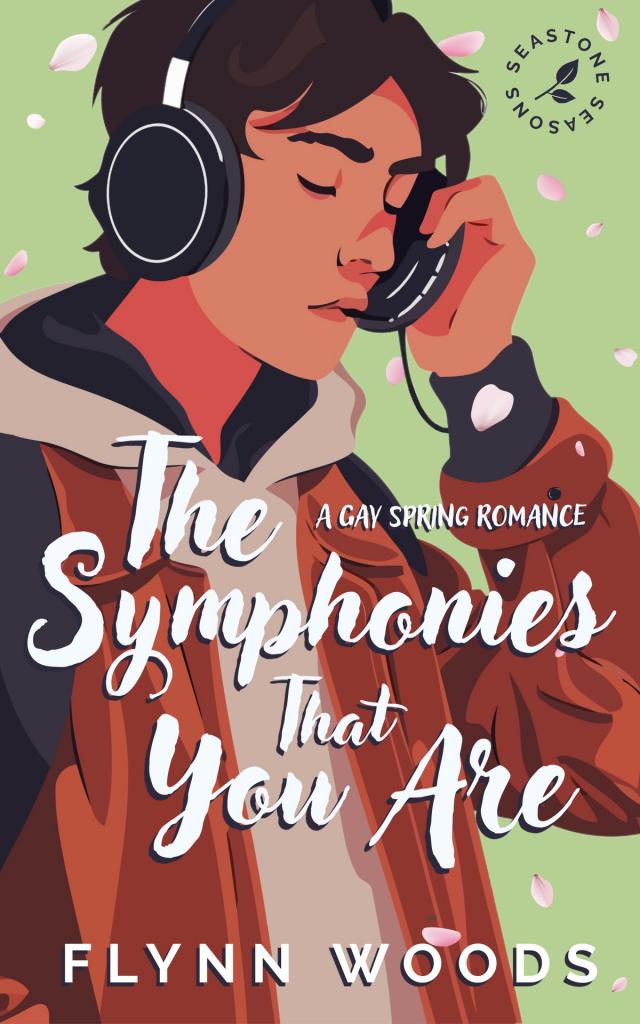


THE SYMPHONIES THAT YOU ARE
A GAY SPRING ROMANCE
SEASTONE SEASONS
BOOK 3
FLYNN WOODS
© 2026 by Flynn Woods
Kindle Edition
All rights reserved.
This book or any portion thereof may not be reproduced or used in any manner whatsoever without the author's or publisher's express written permission, except for the use of brief quotations in a book review.
This is a work of fiction. Names, characters, businesses, places, events, and incidents are either the products of the author's imagination or used in a fictitious manner. Any resemblance to any actual persons, living or dead, or actual events is purely coincidental. The cover image is used for illustration purposes only and does not represent any character described in the book.
This book contains material that is intended for mature adult audiences. Reader discretion is advised.
Content Notes
The story contains mature themes and elements, such as the following: Descriptions of anxiety and panic attacks, abandonment, mentions of homelessness, and explicit sexual content involving a gay relationship between two consenting adults, including oral, anal, and unprotected sex.
CONTENTS
Prelude
1. The Song Of The Lost Son
2. The Song Of A Heavy Chest
3. The Song Of Two Candles
4. The Song Of Potato Salad
5. The Song Of Sneaking Away
6. The Song Of Two Guys In The Mountains
7. The Song Of Connection
8. The Song Of Reality
9. The Song Of Devin
10. The Song Of Nora and Raul
11. The Song Of Distance
12. The Song Of Three Hours
13. The Song Of Spring Break
14. The Song Of Doom
15. The Song Of Alex
16. The Song Of Distraction
17. The Song Of A Headache
18. The Song Of I Love You
19. The Song Of Being A Son
20. Silence
21. The Song Of Being A Family
22. The Song Of What You Made Me Do
23. The Song Of Las Vegas
24. The Song Of Doing It Together
25. The Song Of Us
Thank you
It’s hard to move forward when you’re still looking back.
PRELUDE
ALEX
I never found out whether the problem was my brain or my ears, but one thing was clear: one or the other didn’t process sound the same way as it did for everyone else. For as long as I could remember, every sound I heard demanded my attention, as if it were the only one in the world. That wouldn’t be a problem in itself if there weren’t so many competing noises fighting for my limited attention.
My first real realization of this came a few days before my sixth birthday. My mom brought home a new set of dinnerware. She had talked about buying it for months, so when the day finally came, she prepared a special three-course dinner for the two of us so we could break in all six plates in one memorable meal.
All of the dishes were made of the same white porcelain. They were all the same size, with a flower pattern printed in the center. One thing my five-year-old brain noticed, though, was that none of them sounded alike when we set the table. The first one clanked against the tabletop as if it hated being in our kitchen. The second one reverberated so strongly that it seemed ready to hurt me if I looked at it wrong. But the sound of the third one changed my life. When it met the wooden surface, it produced a warm ring so pleasing that, for the first time ever, it drowned out every other sound.
From then on, I insisted on using that plate for every meal. My mom thought I was crazy, and I thought the same about her. She insisted that all of the dishes were the same. When I pointed out how different they sounded, she made a face as if an alien had replaced her son.
The next day, I complained so much about her serving food on one of the “mean” plates that she put me in charge of setting the table—a job I happily took on.
It wasn’t until I started school later that year that my hearing became a real problem. Before then, I had spent most of my time inside our apartment, which shielded me well enough from outside noise. Now I was in a building full of the brashest, most earsplitting people five days a week, and I could hear everything: every playful scream, every whisper, every cry when someone stumbled over their own feet. Once I learned the patterns of their footsteps, I could tell which teacher was coming around the corner. I could tell which of my classmates was having a hard time concentrating by the way they breathed, even if they were sitting on the other side of the room. I could even tell what song was playing in the music room down the hall. Sounds that other people tuned out, like breathing, the hum of the air conditioner, or cars passing by, were always present to me.
That was when the headaches began. As soon as I stepped outside the apartment, a throbbing pain shot through my head, making it impossible to concentrate. It only subsided when I got home. As a result, my grades were terrible. My mom was called into school several times. At first, they asked if I had been bullied. But when I tried to explain, no one would listen. They got so frustrated when I wouldn’t budge from my story that they started scolding me. “You don’t want to become a problem,” my principal said.
Things only changed when one of my mom’s boyfriends moved in, halfway through first grade. I don’t remember his name, but I liked him because he always had headaches, too. One Thursday night after dinner, he joined me in the living room. He sat me down in front of his CD collection and put a pair of headphones over my ears. I still remember his words: “Promise me you won’t take ‘em off until I get back, and you can listen to every single one of my CDs.”
The guitar-heavy songs were an epiphany. I was consumed by the music. The world around me disappeared. It was just me and the rhythm of whatever was playing. There were no neighbors walking upstairs, no hammering in Mom’s bedroom, and no planes flying over the apartment complex. Compared to the rest of the world, the music was structured and offered me a kind of peace unlike anything I had ever experienced. With the headphones on, life suddenly became harmonious.
I slept like a baby that night. The music was still playing on repeat when Mom woke me up for school the next morning. That gave me an idea. I hid the headphones and the portable CD player in my bag, took them to school, and didn’t think twice about the fact that everyone would notice them on my head. Of course, my teacher scolded me when she saw them. She made me take them off amid my classmates’ laughter. But that didn’t stop me from forming a plan.
I started doing my homework and studying for tests while listening to music. For the first time, I could concentrate easily, and what I learned actually stuck. Two weeks later, I received my first B, the best grade I had ever gotten. My mom praised me. A week after that, I got my first A, and she praised me even more.
Every night after dinner, Mom’s boyfriend would tell me to put my headphones on as he and Mom went to bed. As if I would have taken them off on my own. I would have kept them on all the time if wearing them to school or during dinner hadn’t gotten me in trouble. Because I had finally found an answer to my problem.
Around that time, I also started singing to myself. Whenever I couldn’t listen to music, I made my own. I wasn’t a good singer, but it helped me stay focused. Soon, I realized there were even more options. I started sneaking into the music room during breaks to play the piano. I didn’t know what I was doing, but the sweet sound of the instrument soothed me more than my own rough voice ever could.
One day, a teacher caught me, but instead of scolding me, he listened as I played. Then he smiled and offered to talk to my mom about it.
Before long, that teacher became a frequent visitor to our home. He gave me a small piano keyboard to practice on, and within a week, composing my own music had become my entire world. The keyboard was predictable. Every note I played always sounded the same. My teacher even offered to cover the costs of piano lessons. Mom quickly signed me up for two hours every afternoon.
I learned to think of the world’s noise as music, which helped me understand why certain sounds bothered me more than others. People, animals, and objects all make sounds at different pitches. Some were perfectly harmonious, while most clashed so intensely that they hurt my head. I learned to cherish even that. They still gave me headaches, but thanks to my growing skill, I could now play the sound my favorite plate made on my piano. I composed my first song. It was about Mom setting the table—a discordant shanty, but at least more organized and predictable than she was.
This became my thing.
Whenever I couldn’t wear my headphones, I would listen to the sounds and patterns around me, and when I got home, I would turn them into music. The song of my classmates taking a test. The song of the old lady upstairs doing her laundry. The song of a dog peeing against a streetlight. The song of my teacher and my mom’s boyfriend yelling at each other. The song of my mom crying at night. The song of my mom’s new boyfriend. The song of blowing out candles at my eighteenth birthday party. The song of my first kiss with the boy from the laundromat. The song of my first college lecture on sound design in film. The song of becoming a sophomore. The song of my mom’s wedding. The song of my stepdad catching me kissing my boyfriend behind the house. The song of my clothes being thrown
out the window. The song of my mom not answering my calls. The song of sleeping on a park bench. The song of being turned away from class because the checks bounced. The song of my empty stomach grumbling. The song of searching for jobs. The song of the couple who offered me a roof over my head in exchange for helping them around the house. The song of hitchhiking to a small mountain town. The song of Seastone.
ONE
THE SONG OF THE LOST SON
ALEX
For twenty minutes, I had been staring at the door, thinking of excuses to leave. My head was buzzing, and my ears were ringing from all the noise. This kitchen might have been spacious enough for twenty-two people, but it definitely wasn’t built for them all to talk at once. The combination of floor tiles, a relatively low ceiling, and a wooden interior amplified the voices of the Draper family, making them sound even louder than they already were.
Still, the misery I found myself in was no one’s fault but my own. Over the last two years of living with Laura and Daniel (or Dany, as everyone calls him), I had met all the family members separately—except for their son Devin, who hadn’t bothered to come here in years for reasons no one talked about—and each of them had already been lively enough on their own. I should have known how it would end if you threw them all into a room together.
Instead of risking burst eardrums, I could have been in a nice, quiet hotel room in Ashbourne, taking a steamy shower and playing records at full volume. All I would have had to do was thank Laura and Dany for the invitation and decline, like I had the year before.
But now the day was here, and that ship had sailed.
All I could do was get through it, second by second, focusing on my breath and the task at hand: cleaning the dishes. Once that was done, I could sneak outside into the restoring silence of the surrounding mountains and trees.
I raised the sponge from the warm water and squeezed it slowly and purposefully, closing my eyes to listen to the dribble as it hit the surface. Each drop played in the sink as if it were the keys of a piano, offering me exactly what I needed—a moment of focus to help me ignore all the noise—until the sponge was empty and all the sounds around me came rushing back. The coffee machine gargled as it sucked the last drop of water from the tank. Two cows mooed in the shed behind the house. An engine howled on the other side of the valley. Behind me, a hearty laugh was joined by two others, together forming a perfect C major chord. I glanced over my shoulder.
Dany, the head of the family, owner of this house, and therefore, my boss and landlord, held his shaking belly. To his right, his muscular brother-in-law leaned closer, swinging an arm around him. On his left, his sister-in-law tucked her long blonde hair behind her ear as her face flushed red.
“Why did the weatherman’s cheeks turn pink?” she asked, keeping her voice low, probably so the other family members wouldn’t overhear the slightly inappropriate conversation. “Because he saw the climate change!”
Their shared laughter rose above everything else like a trombone trio enjoying its moment in the spotlight. Each chuckle pierced my eardrums like an icepick.
My eyes wandered to the older man in the corner, staring absentmindedly out the window while a woman in her forties bombarded him with words, seemingly unaware that he wasn’t listening. Right next to them, a kid was hunched over his phone. The sound of machine guns from whatever he was playing cut through the noise, only to be interrupted by a woman’s squeak on the other side of the room as someone hugged her from behind. The walls closed in as I clenched my jaw, the shrill chuckles of everyone around me zooming in as if their only goal was to torture me.
I knew none of them actually wanted to. They were friendly people—kind enough to take me in, give me a roof over my head, and treat me like part of their family, even though I was just a hired hand helping around the house. But try telling that to my freaking sensitive ears.
“Alex,” a friendly voice called out. “You don’t have to do the dishes right now.” Laura—Dany’s wife and therefore my other boss and landlord—placed another dirty cup on the counter.
I tried to smile back at her, but another laugh from the trio behind us made me wince instead.
Laura squeezed her eyes shut. “All this noise must be agony for you.”
“It’s okay.” I clenched my teeth, grabbed the dirty cup, and dropped it into the soapy water. “I’m almost done.”
“You’re too conscientious for your own good.” She straightened her blonde ponytail—that distinctive shade she and her sister shared—and pulled a dish towel from the hook next to the oven. “I can’t just stand here and watch you suffer. Come on. Give your ears a break.” She bumped her hips into mine, nudging me to the side with a grin. “No arguing.”
“No, really, I’m—”
“Alex.” Her eyes narrowed, and her voice dropped to that stern tone only a boss or a mom could pull off, the kind that makes chills run down your spine and makes you obey. “Take a breather.”
I sighed. Leaving this room was what I had been daydreaming about for almost half an hour now. The headache building at the back of my head screamed at me to go. Besides, Laura certainly wasn’t someone I should argue with, especially after she had just handed me a get-out-of-jail-free card like this.
“Thanks,” I said, my normal voice sounding like a whisper compared to everyone else’s.
Laura winked at me as she took over washing the cups. I dried my hands and slipped past the dining table into the foyer. My eyes went to the staircase leading upstairs to my room, but the chatter from the kitchen followed me, so I headed to the front door instead. I needed to get out of the house for a few minutes, just until the buzzing in my ears stopped.
The pine trees in front of the building rustled in the first warm breeze of the year. I eased the door shut behind me, stepped off the porch, and sank onto the wooden steps, my head dropping between my knees as my hands folded over my ears. I let the sounds of nature wash over me.
If I hadn’t already lived with these sensitive ears of mine for twenty-four years, I might have cursed them, but then again, that wouldn’t have changed anything.
Five minutes later, I could think clearly again. The family’s chatter was still audible, but mostly contained inside the house. A few birds chirped in the trees beside me. Their singing was the central motif—until a quiet hum gently took over, a distant, enchanting melody that captured my full attention in seconds.
The voice of whoever was humming was unlike anything I had ever heard. The timbre was strong yet unafraid to be vulnerable. It was beautiful and honest, yet hidden behind closed lips. The well-trained baritone didn’t belong to any of the Draper men who had been around the house that day.
I craned my neck and turned my head until I could pinpoint the source of the sound. It was coming from behind the trees that shielded the main entrance from the driveway. Whoever was humming was still out of sight but getting closer. Footsteps on the gravel road leading up to the house blended with the hum, as if they were the bass drum of the song. For a moment, everything else faded away. The hum held my undivided attention. If I were to go deaf now and this were the last thing I ever heard, it would play on in my head forever, and I wouldn’t mind at all.
The owner of the beautiful voice stepped around the corner, his song ending abruptly when he set eyes on me.
His blonde undercut tried to obscure who he was, with the front so long that it almost seemed as if he didn’t care if people could see his eyes. Still, I knew who he was immediately. I had seen his face in the pictures scattered throughout the house every day since I moved in.
He tilted his head, letting his hair fall to the side and giving me a better view of his face as he narrowed his eyes. “Who are you?” he asked, his deep voice vibrating through his chest.
A cool breeze moved through the treetops, and the rustling leaves brought me back to earth. “I, uh… I live here?”
He took a step back and looked at the house as if to make sure he hadn’t come to the wrong place.
“This is still the Draper residence,” I said. “You’re in the right place, Devin.” His name wasn’t used often, but whenever it echoed through the house, it was followed by a moment of silence.


