Blend, p.13
Blend,
p.13


“Among my kind, perhaps. But yours?”
Meera didn’t touch that one.
“Kip’s looking forward to it. Besides, I need this. We all do.” She dropped her voice to a whisper. “If we get him out and about, he’ll be more sharing.”
Arliss kissed her with a quiet tenderness. They’d made their way back to each other, almost as good as the first years with one notable difference: Meera liked it rougher, more dangerous. At the height of their passion, she begged Arliss to make full use of his kinetic servos. He obliged.
He counted it on his shortlist of successes.
Kip burst from his room, hair freshly streaked with yellow dye. Wearing a black mesh bodysuit, the boy moved with a nervous energy that reminded Arliss of himself at that age.
“We going or what?” Kip asked. “The Gardens cycle over at midday. The early-day mist makes everything look crimp.”
He’s slipping into Blend-cant slang.
Meera added on.
“Your son’s right. It’ll be nice to tend the plot without rushing. I’ve got the day completely free. First time in ages without having to supervise field crews.” She handed Kip a nutrient bar. “Eat this before we go.”
Arliss watched the easy interaction between them, the rhythm they’d developed without him. They functioned as a unit, while he remained the awkward appendage grafted onto their life.
“The plot was your idea,” Meera reminded Arliss. “Remember? Before ...”
Before prison. Before Kip joined a gang and became a thief.
“Yeah,” Arliss nodded, forcing conviction into his voice. “Time we did something normal.”
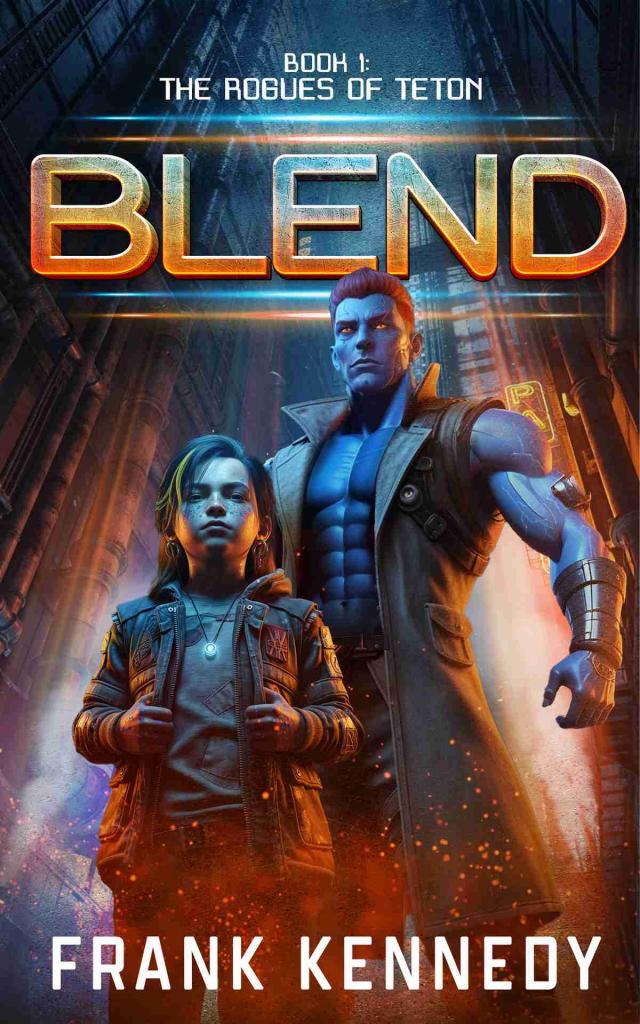
Normal. As if a blue-skinned ex-con, his Tetonian wife who’d abandoned her privileged life, and their Patchie son could ever be normal in a city where this family dynamic was a rare sight.
Kip was already at the door, bouncing on the balls of his feet.
“C’mon. I heard the park added new specimens from the Eastern Reach. Plants that glow when you touch, for true.”
For the first time that morning, Arliss saw a genuine smile form. His son’s enthusiasm pierced through the cloud of doubt that had followed since his return. Yet Arliss wasn’t convinced it was sincere. Kip had not left their sight in three days. Was his boy using this opportunity as a launching pad for a greater escape?
“Fair enough. Let’s see these glowing plants.”
***
They boarded a crowded lift, sharing space at first with an observant array of Blends. As they rose through the levels of the Mega, Arliss noticed how Kip’s posture changed – shoulders hunched, eyes down – whenever Tetonians boarded. The boy had developed his own survival mechanisms.
Prison teaches you to make yourself small. Seems the Servo District taught him the same.
The transport climbed past Level 120, where the air freshened. When they disembarked at Level 135, Arliss felt the subtle shift in atmosphere: Less industrial, more cultivated. The corridor leading to the Sky Gardens featured actual wood paneling and living plants in recessed alcoves.
“ID check,” announced a uniformed attendant at the entrance, her eyes widening at the sight of a mixed family. As she studied the credcards, Arliss anticipated the inevitable scrutiny.
“Garden plot number?” she asked, voice cooler than when she addressed the pale-skinned family ahead of them.
“Section 17-B,” Meera answered. “Dubai family plot.”
The attendant ignored Arliss and Kip, zeroing in on Meera with a raised brow.
“Keet. Any relation to the Wind Reader?”
Meera’s spine stiffened.
“The plot is registered properly. We’ve maintained it for seven years.”
The attendant waved them through with a forced smile and frustrated tone.
“Enjoy your visit.”
The doors parted to reveal a vast vertical terrace spanning four levels, engineered into a self-sustaining ecosystem. Translucent panels of hyper-glazed lights simulated natural sunlight to stream down while automated filters adjusted the spectrum for optimal plant growth.
A complex latticework of hydroponic tubes and nutrient delivery systems snaked along each level, their soft blue glow pulsing as they fed precise amounts of water and minerals to thousands of garden plots.
The air was humid, the automated misting systems releasing timed bursts that created a fine vapor cloud hovering between levels. Each breath filled Arliss’s lungs with the sweet scent of flowering plants and rich soil, a staggering contrast to the recycled, stale atmosphere of Block D-17.
His ears registered the gentle hum of circulation fans and the soft trickling of water through the hydroponic channels. Below, the commons area spread out like a miniature park, with scattered tables and open-air cafés where Tetonians and the occasional Blend gathered among sculpted ornamental trees, their conversations rising in a pleasant murmur that echoed through the vast space.
Kip’s transformation was immediate. His hunched posture vanished as he sprinted ahead, seeking a vacant Glide – a personal hover pod that ferried gardeners to their plots, where they tended beds and harvested fresh greens. Now, only a few were in use.
“He’s missed this place,” Meera said, falling into step beside Arliss. “We couldn’t come as often after my urns increased.”
“And the fees? How much did they go up?”
“A chee a week. Time was more of an issue.”
Their plot sat near the near edge; at three units wide and a unit deep, it was smaller than most but bursting with practicality. Meera focused on plants and herbs suitable for both her and Kip’s needs. Arliss hadn’t eaten fresh greens since year one of this plot.
They took a Glide together, Meera manning the nav arms. When they reached 17-B, three levels up, Meera tapped the diagnostic panel to examine soil composition and moisture needs. These were perfunctory tasks; the Sky Gardens achieved agricultural symmetry long before she was born.
She asked Kip to help her prune and shape where needed. He grabbed a tool in the auto-dispensary and went about his business with the cool demeanor of a veteran. Arliss stood back and studied their teamwork.
“My mother taught me about plants,” she explained to Kip. “She knew a woman could never become a Wind Reader, so she thought an expertise in agronomy might be useful.” She pointed to a collection of tall, thin herbs. “Check the underside of the moonleaf for parasites.”
“Why’d you become an engineer instead?” Kip said.
Meera didn’t answer straightaway, and Arliss knew why. The story would take too long and enter a territory Kip wasn’t ready for.
“I’m good with my hands, Son. And we would not be able to afford so big a flat on an agronomist’s chee.”
Arliss expected his son to follow with a simple response stating how the boy also loved working his hands, a trait he learned from Mom. Instead, Kip surprised them both.
“Yeah. Big flat. I oughta carry my weight. Been thinking maybe I get a job. Straight up, I mean. No thieving, for true.”
Meera wiped her hands free of a few dirt specks.
“That’s very admirable. Your father and I certainly hope your life of crime has taken its final bow. As for a job, we’ll have that conversation in two years. You’re a bit young to …”
“What?” Kip swiveled about, addressing both parents. “Plenty of kids my age work. Runners in the Market Strip. For starts.”
“Are they also attending school?” Arliss entered the dialogue.
“That ain’t-a my business. But … I got skills. I could be an apprentice. Then when I’m fourteen, I’ll have a perm credcard and shoot out the gate.”
Arliss wanted to be encouraged. At least Kip had shifted the conversation to practical concerns and, as Meera predicted, had opened up. But instinct said the sudden shift in attitude felt much too rehearsed. He could not let go of having watched his boy beg and sob after being caught with the med supplies. Kip had seemed desperate, like his happiness depended on others’ approval.
Has this much changed in three days of lockdown?
Did Meera also suspect? Or did Kip know how to edge inside her blind spot?
She answered Arliss’s concern by changing the subject.
“I have an idea.” She pointed to the empty shelf above them. “Now that your father’s home and we’ll have two wage earners, I think we can afford to expand the plot. Maybe you two could even design the contents.”
Kip shrugged.
“Yeah. Sure. But if we had three wage earners …”
She waved him quiet.
“No, no. Let’s do this. We’ll lower the Glide, and I’ll step into the fulfillment office to see about an extra shelf. You two can spend the time debating what to plant.”
Well done, Arliss thought. Smooth transition, Meercat.
“I’m up for it,” Arliss said. “I’m no agronomist, so I’ll need help.”
Kip put up a nice front, but he couldn’t disguise his understanding of what was taking place. Surely, he knew his mother’s tactics better than anyone.
Meera stowed her tools in the shelf’s dispensary and piloted the pod to a safe landing. She left them on their own.
They walked in silence through winding paths of one of only two more-or-less green spaces in the Mega. Kip maintained a careful distance between them, lips pursed.
Fine. She gave me an opening. Let’s find a good way in.
“Suggestions on what to grow?” Arliss asked, desperate to break the silence.
Kip shrugged.
“Ain’t-a clue.”
“I see. So, if I wanted three units of oorna sprouts and bean blooms, you’d be good with it?”
Kip responded as he looked across the open spaces, disinterested.
“I’m just a kid. I ain’t-a got pift.”
“Huh. Pift. Never heard that one. Blend-cant?”
The kid crinkled his lips into a disgusted frown.
“No. It’s like … normal talk. You been gone too long.”
“True. I’m not caught up to the latest slang. Is that how friends speak? Or did you learn it at Education Bank?”
He scoffed.
“Don’t learn slag from those null-jacks.”
That Arliss understood.
“When’s the last time you attended in person?”
Now he gathered his son’s attention. Much to his surprise, Kip did not shy away from an answer.
“Twenty days ago.”
The moment had arrived. Arliss could choose many reactions: Indignance, shock, dismay, shame, disappointment.
No. Kip was daring his father to react predictably.
Let’s try this another way.
“I was the worst student. I attended, but only because I had to be somewhere. Back then, the monitors were stricter. They hunted down delinquents. And they used shock batons.”
Kip froze.
“You ain’t-a serious.”
“Had the scars to prove it. Luckily, my servos accelerated the regrafting. And I was big for my age. The prefects lost interest in challenging me.”
“Fringing slags,” he spat. “You laid hands to them?”
There was the incident with Horry Jull. More blood than he’d ever seen. No, Arliss steered away from that tale.
“I stayed clean, more or less. But it was tempting. If I didn’t stay in control, I’d have ended up on Rogue much sooner. Never met your mother. Never …”
He wanted to hug his son then and there, but Kip would’ve been mortified, and Arliss didn’t know how. The last time they shared a moment so close was at the spaceport before Arliss entered penal custody.
“I made it through, Son. Didn’t leave until they kicked me out at fourteen. I had my perm credcard and enough skills to find a passable job. It may seem worthless now, but EdBank can be …”
“A slag-heap?” Kip kicked at a pebble on the path. “Not like they’ll let me reach Level Red anyway. Ain’t-a one Patchie ever graduated.”
The bitterness in his voice cut through.
“That’s not necessarily …”
“It is true,” Kip interrupted. “I know every Patchie in Sinquin. Ain’t-a but ten like me. Em says education is just another way they control us. Tets get to study whatever they want and walk straight into good jobs. They leave the scraps for our kind.”
Em. From those Pikers, maybe?
“Who is Em?”
“My best friend. I think we’re in love.”
Don’t smirk. He’s not joking.
“Then you must see her often. Does she belong to the same gang?”
His lips puckered into predictable rage.
“We’re not a gang. We’re a …” Hands to his hips, Kip bowed his head and took a deep breath. “I told you and Mom both: I ain’t-a talking about them until you take me for serious.”
“Of course. They’re like a … you called them your flow-family. Yes?”
“You wouldn’t understand. Is this why we’re really out here? Loosen me up so I’ll spill the slag on my friends?”
Arliss dared not pursue the subject. Kip was one wrong question from shutting down again.
Fine. A new tactic.
He spied an open-air cafe and considered how much chee he had on his credcard.
“Let’s try a reset, Kip. Mom says your favorite flavor of fruitcreme is axleberry. How about a cup?”
Kip looked past his father to the same cafe and dropped his defenses.
“Yeah. Sure. I could do that.”
“Display says it’s real fruit, not sim.”
“Ain’t-a had the real thing in forever. Sure it’s not too much chee?”
“For you? Never.”
To Arliss’s pleasant surprise, the fruitcreme excited his senses. He used to hate axleberry. Too tart. Must have been the sim variety.
This? Arliss would have gone with “Stars above!”
But Kip said it best:
“Fringing holla!”
They found a table away from the prying eyes of Tetonians. Arliss waited until Kip savored the last of his cup, boasting the first ebullient smile of the day. One of the few since he returned home.
“Good stuff?”
“Real juke.” Kip caught himself. “That means top shelf.”
“That bit I understood. Believe it or not, some Blend-cant passes down through generations. I’m not ancient. Only sixteen years older.”
He assumed Kip might have asked Meera if he could have simps, but likely worried that Arliss lacked the chee. His concern would not have been misplaced.
“You seem ancient.” Kip snickered, a positive sign. “I remember some of the slag you tried to teach me before … well, before prison. Like history and science. I guess you’re gonna say you learned it at EdBank, and that’s why I oughta stick to it.”
“No, actually.” He prepared to make a dicey admission which would play into Kip’s hands. “Most of what I know about those subjects I taught myself. Borrowed data cubes, old-fashioned books when I could find them.” Arliss scanned the vicinity, as he did often since the attack. “You’re right about something, Kip: The EdBank’s curriculum leaves much to be desired. And I assume it’s probably worse now than when I attended.”
The boy’s eyes held to his father this time. For the moment, the shift in tactics appeared to work.
“How far back do your history classes go?”
Kip shrugged.
“From what I remember, when I was awake, they don’t bother much before the First Generation.”
Yeah, sounds right.
“Think about that. One century. Do you have any idea how old this civilization is? When they first settled Teton?”
Kip sat up.
“Wait, what? What do you mean settled?”
“The first colonists landed here about eight thousand years ago. Teton wasn’t always like this, you know.”
“What do you mean?”
“We were once a major trade hub. Ships from seven star systems docked here. The atmospheric degradation hadn’t escalated, people actually lived in the tropical zones, and mod technology was celebrated, not vilified.” Arliss watched his boy’s eyes blossom with the revelation any twelve-year-old should have learned long ago. “The Breath was just one of many belief systems.”
“Wait. We traded with other races in the galaxy?”
“High times.”
“What happened?”
Arliss had no idea. Was this level of shit education common only to Blends, or did disregard for the past extend across the city?
“The climate collapse accelerated. They designed my ancestors, and we were heroes for about three generations. But we didn’t solve the problems that the Tetonians created, so guess where the blame shifted?” Arliss’s voice dropped. “You weren’t taught the distant past because it conflicts with popular narrative.”
“So that’s what he meant,” Kip mumbled.
“Who meant?”
“Oh. Uh. Nothing. Just what a friend said. Ain’t-a matter.”
“I guess my point is that education is critical, Kip. I wouldn’t have been curious to learn more if I didn’t realize how little the school was teaching. I wasn’t trying to rebel or join some insurgent movement. I learned these things because I’m a man and a citizen. Because understanding what was helps us imagine what can be. And because I have self-respect, even when those slags try to stamp it out of me.”
A new fire lit in Kip’s eyes.
“Now you’re juicing like my friends.”
“Is that a compliment?”
“Yeah. Sure.”
Little victories, one at a time.
***
Meera was taking longer than expected to finish her business with the admin office, but Arliss suspected she was in no hurry. He appreciated the gift of time. The moment felt fragile, like a sheet of ice that might crack, but Arliss cherished it, this first real connection since his return.
“What was it like?” Kip asked as they strolled the southern end of the green space. “In prison.”
Arliss’s steps faltered. He’d prepared answers for this inevitable question, sanitized versions that wouldn’t burden his son with the reality of Rogue 19. But standing here, watching Kip’s face open with genuine curiosity, those prepared responses felt hollow.
Tell him enough truth to understand, not enough to haunt him.