Blend, p.30
Blend,
p.30
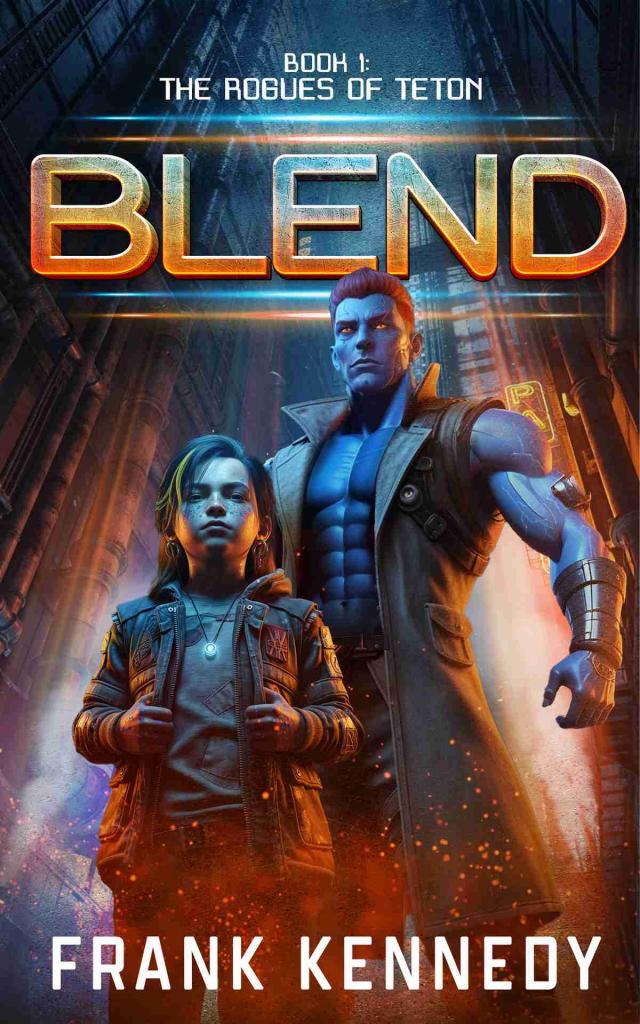


They knocked fists, peered through the open door, heard the alarms which were now louder, and made a mad dash. Discussion of using the guns never arose. Kip wondered if Scar also wasn’t sure they were loaded.
Then they ran.
They neared a pair of Tets who also moved with urgency, but whose eyes ballooned at the sight of a Blend and a Patchie on the move. Not something they’d see up here on a normal day. Yet the Tets did not call for enforcers; instead, they cowered against the wall and allowed the boys to pass.
The Pikers reached the maintenance ladder and descended with a skill that suggested they’d been born to it. The shafts narrowed to cramped passages when they reached 104. The duo ran, crawled, ducked, and dived down three more levels, communicating through hand signals and knowing glances.
They almost ran straight into a three-man patrol at a Y-junction on 101. They waited, breaths held, until the enemy passed. Soon, they reached another ladder in the shaft that might lead them to safe territory. Unfortunately, it wasn’t lit. They regretted leaving the porta-lamps behind.
Yet the alternatives would take too long and provide too many opportunities for exposure.
The three-level descent required blind faith. One slip and …
Kip’s hands found each rung by instinct, his body remembering what his eyes couldn’t see. As they descended, more sounds of chaos filtered through the walls – klaxons, shouts, the whine of Enforcement Q communicators.
Level 98 – residential units for lower-ranking Tets. Level 97 – mixed housing where a few progressive Tets lived alongside Blends. Some called it the unofficial border leading into the Servo District. Safety lay near, but even that rode on the assumption that EQ had not continued its assault down-Mega.
The ladder ended near a water processing and testing facility, beyond which they would find a service lift used mostly by Blend workers: Their first opportunity to settle in among the public.
Scar dropped from the ladder, landing in a crouch, the pipe-gnasher slipping out from his jacket and clanking to the floor. They exchanged a quick glance – frustration burying their anticipation of escape. The pair were almost home.
Outside, an empty corridor stretched before them. A hundred units to the service lift. The path was laid.
Yet neither boy bolted toward potential sanctuary.
It was too easy.
“What choice we got?” Scar said, acknowledging the silence outside.
When Kip failed to present an alternative, they advanced, running on furtive footsteps.
Thirty units.
Forty.
Fifty.
The attack came without warning.
Uniformed enforcers materialized from recessed doorways. Three of them, blocking the path forward, weapons drawn.
“Not another een!” The command echoed against metal walls.
No. It can’t end like this. We were so close.
Scar grabbed Kip’s arm and squeezed.
“Scatterbox, String. Go.”
Scar pushed Kip back the way they’d come. As Kip stumbled, he saw Scar reach inside his jacket and reveal a flashgun.
No, Scar. Don’t.
Scar aimed and pulled the trigger.
Nothing happened.
He tried again, the weapon dead in his hands.
“Scatterbox, String.”
As he repeated those orders, a hole opened in Scar’s back just under his right shoulder. Blood exited. Scar stumbled and lost his balance. The useless gun clanked to the floor.
“Scatterbox.”
Kip ran. He heard the enforcers bark additional orders and glanced back to see one push past in pursuit. Scar had fallen to his knees. One pressed a neural disruptor against his neck, and Scar’s body went rigid, a strangled cry escaping his lips.
“Nowhere to run, Patchie,” another shouted.
Instinct took over. Kip’s mind raced through memorized schematics – vent shaft, maintenance tunnel, service corridor – mapping escape routes even as panic threatened to overwhelm him. There had to be another way down.
He remembered a small air shaft near the base of the last ladder. If the vent came off with ease, it might be large enough for him to shimmy through.
As he grabbed the vent, Kip had another idea.
He threw if off, ran around the nearest corner and grabbed the lowest rungs of the ladder.
Maybe those slags will buy it.
He climbed, the sound of pursuit echoing below. Kip pushed himself to stay in rhythm, flush sacs burning as his arms ached during the rapid ascent.
Level 97. Level 98. Level 99. Each ascent took him farther from capture but also farther from help. Kip wasn’t a fool: If the enforcers wanted him, they’d find him. He’d narrowed their search options.
As he climbed in the darkness, thankful he had not discarded the utility gloves along with the hood, Kip allowed too many questions to cloud his planning for the next moves.
Why did Scar give himself up? Was TimBob captured? Killed? What of the rest of his flow-family?
Em. Why did you do it?
His heart raged at the very notion of her betrayal, which now seemed likelier than ever.
Kip paused at a junction, lungs burning, legs trembling with exhaustion. The pursuit had fallen behind, but for how long? They had resources he couldn’t match, communications he couldn’t intercept.
The weight of failure crushed down upon him. They’d been playing at revolution, children against a system generations in the making. TimBob’s passionate speeches, the careful planning, their dreams of changing Vandress – it seemed childish now, up against EQ.
Home felt distant. Would he ever see his parents again? Would Arliss and Meera even know what happened to him, or would he disappear like others who were never acknowledged?
Alone in the bowels of the Mega, Kip faced the truth: They moved too soon. The enemy was too strong.
They couldn’t even trust each other.
He found some respite at L101 after he shimmied into the vent system near the levtrain station. Kip slumped against a cold metal wall, the distant wail of alarms punctuating his ragged breathing. The lateral shaft stretched before him, leading to a Y-junction where he’d have to choose a fresh course – neither a clear path to safety.
His hands trembled as he removed a flashgun from his jacket. The weapon felt heavier than before, a useless chunk of metal that had failed when Scar needed it most. The image of his friend convulsing under the neural disruptor burned in his mind.
“Why didn’t you work?”
He turned the weapon over in his hands. His fingers traced the sleek casing, analyzing the contours of enforcement-grade tech. Though he’d never been able to dig into anything of this design, Kip knew enough mechanical principles. This one must be loaded – the weight, the balance – yet it had failed.
Kip stowed his panic and imagined himself back in his bedroom with all his various bits and bobs. Urns of grease and toil spent innovating and reconfiguring. When a whole other world awakened inside him.
He examined the power cell indicator: It was dark, though the cell itself felt warm against his palm. Not dead, then.
Disabled.
Kip grabbed his prized multi-tool and pried open the port beneath the handgrip. Even in this dim light, Kip could tell the circuitry looked intact, but a small cylindrical device attached to the power coupling caught his eye.
“Remote kill switch,” he muttered.
If this was a setup, the Enforcers allowed them to take the weapons knowing they could be deactivated remotely. They’d walked straight into a trap, stealing what they thought was their key to victory.
Kip ejected a snip-blade from his multi-tool and wedged the tip beneath the kill switch. One wrong move could fry the entire weapon or worse, trigger a feedback pulse that would leave him as helpless as Scar. He held his breath, applying gentle pressure until the device popped free.
The power indicator remained dark. Not enough. He traced the circuitry with expert eyes, finding where the kill switch had interrupted the power flow. Two small contacts needed reconnection. He pulled a thin wire from his utility cuff and bent it into shape, bridging the gap.
The flashgun hummed to life, its indicator glowing blue.
A harsh voice echoed down a nearby corridor.
“101-D clear. Moving to Sec-E.”
Was he their sole target now? If so, they were trying to box him in. After they cleared the public spaces, they’d tighten their grip inside the hidden infrastructure. The usual escape routes would be covered – maintenance ladders, service lifts, ventilation shafts. They knew how Blend and Patchie kids moved.
Kip tucked the active flashgun into his belt and scanned his surroundings.
His gaze fell on a narrow utility pipe running along the ceiling. Not a path, but maybe ...
He climbed onto a junction box, stretching to reach the pipe. His fingers found the maintenance tag, a small metal plate with identification numbers. He twisted it counterclockwise, revealing the emergency release valve behind it.
The valve turned with surprising ease. Steam hissed from the pipe, filling the corridor with billowing white clouds. Within simps, visibility dropped to near zero. Automatic environmental sensors would trigger, report a rupture, and suggest containment protocols.
Perfect.
Kip dropped back to the floor and moved deeper into the steam cloud, his flush sacs resisting the heat. The Enforcers would have to investigate the rupture, giving him precious minups to slip past their perimeter. He navigated by memory and touch, one hand trailing along the wall as he advanced through the blinding fog.
The steam masked his heat signature and confused the motion sensors, but it also disoriented him. After twenty units, he paused, trying to recall the schematic of this level. The industrial waste processing unit should be nearby – every levtrain station had one. Its network of pipes offered a new if not filthy path for descent.
He froze.
No. Can’t be. They wouldn’t …
A shadow loomed through the mist. Kip froze, hand moving to the flashgun. The shadow solidified into an enforcer, helmet visor glowing as it compensated for the poor visibility. One of them had ventured into the hidden infrastructure already. Maybe the one who had been pursuing him all along?
“I’ve got movement in Sec-E,” the officer reported into his comm. “He’s close.”
Kip drew the flashgun, its weight reassuring in his palm. One shot would drop the man, but the discharge would alert every officer in the vicinity. He hesitated, finger hovering over the trigger.
The enforcer moved closer. Five units away. Three.
Kip aimed above the man instead, firing a short burst. The flashgun discharged with a high-pitched whine, its energy beam striking a cluster of pipes overhead. Metal shrieked as super-heated steam cascaded down from the damaged junction, the bulk consuming the officer.
The enforcer staggered backward, blinded and screaming. Kip darted around, keeping the steam cloud between them as he ran. The enforcer’s shouts faded behind him as Kip rounded a corner, finding himself facing the massive waste unit he’d been seeking.
Its cylindrical tanks stretched from floor to ceiling, connected by a network of pipes and catwalks. Workers used the maintenance shafts inside to access hard-to-reach components, shafts built with Blend physiology in mind.
Kip pried open an access panel and squeezed through, pulling it closed behind him. The space inside was tight but navigable, warm from the processing unit’s operations. He climbed laterally through the machinery, using handholds meant for maintenance workers.
Ahead, he saw the outline of a hatch leading down to L100. The next stages were going to be ugly, and he’d come out the other end smelling a fright, but EQ slags would never follow him through.
He was almost there when voices echoed nearby from the facility below him. More enforcers.
Fring it all!
He reached the hatch, and his fingers closed around its handle, twisting with desperate strength.
It didn’t budge.
If he tried too hard, they’d hear the creaking.
Kip pressed his forehead against the hatch, exhaustion and despair washing over him. So close. He thought of his parents: His mother’s worried face when she left that morning, his father’s attempts to show him true love despite the years of separation.
His hand brushed against the flashgun at his belt. He took a deep breath, visualizing the outcomes, and grabbed it anyway.
Kip held still, back against the wall. The flashgun felt slick in his palm, his fingers cramping from the death grip he maintained on the weapon.
Then something changed in the demeanor of those enforcers. Their voices lacked urgency. Instead, they moved away.
Was it possible he dodged them again?
New voices entered the fray; Kip slid himself into a corner where he couldn’t be seen should anyone look up. Where had they …?
Four enforcers approached the waste incinerator.
They weren’t alone.
One dragged Scar, hands bound behind his back, his upper right chest shrouded in blood. And he wasn’t the only Blend.
Ghost. Pixel.
The Piker most known for his stealth had been caught, along with Scar’s little sister, the youngest of the group. Both their faces were bloodied. The slags forced all three to their knees.
An enforcer walked away from the contingent and spoke into his comm.
“This is Darrick. Still looking for confirmation, HQ.”
After a few simps, static preceded another voice.
“Identities check. Racoon Chett, Sarah Chett, Yin Park. Running bios now. Hold.”
Are they talking about Scar, Ghost, and Pixel? Are those their real names?
Piker Rule No. 1: No birth names inside the nest.
Tears arrived along with an icy sensation coursing through his blood.
No …
The enforcer with the comm received another message.
“Confirmed. All three are unlinked.”
Kip knew that term. It was the Tets’ sanitized word for orphaned Blends.
“Protocol?” The enforcer asked.
“Commander Drace orders you to quicken them.”
“Very good. Consider the streets cleaned.”
The man turned to his fellow officers and ordered them to remove the cuffs. After they did, he crouched and addressed the trio of prisoners.
“No one taught you how to know your place. Their mistake. But the way these things go, it’s never the smart ones who suffer. I am sorry.”
He backed away and nodded to the three enforcers behind Kip’s dear friends.
“Flow true,” Scar said.
“Flow true,” Ghost and Pixel answered.
The men raised their guns and fired.
Kip slapped a hand over his mouth to stifle a scream as he watched three of his flow-family fall forward, holes in the back of their skulls.
The enforcer who identified himself as Darrick turned away from the bodies and toward the incinerator.
“Bring the big one first,” he told the others.
Two men dragged Scar across the floor, leaving a thin blood trail behind.
Kip refused to watch. He buried himself in that corner while his body shook, praying he did not make a sound.
Three of his flow-family gone. Executed like vermin.
He did not leave until after the incinerator room went silent, no one else remained, and even Scar’s blood trail had been cleaned. Then Kip took a moment, finally, to cry.
15
ARLISS
THE WEIGHT OF FUTILITY and exasperation took their toll on Arliss. He massaged the back of his neck and sighed. Four agonizing urns produced nothing. He had moved from level to level – twenty in all – slipping inside the hidden infrastructure where Kip was a master at hiding.
Even the route TimBob might have taken after their confrontation turned up nothing.
Why did I ever trust that slag? What did Kip see in him?
The bastard reneged on a promise. He better pray we never cross paths again. If they did, Arliss intended to hit the kid first with his left. No point delivering a mere stinger. Straight to the blow that would change TimBob’s life forever ... if not end it.
Arliss reemerged into the public spaces. Relative solitude had settled over the Servo District, with most vendors of the Crosstrots Hub having retired for the night. But a few outlets catered to fourth-shift Blend workers. Arliss was once a creature of the night himself, handling the unsavory jobs Offante threw his way.
So, he knew the makeup of this crowd. Which meant he recognized something was off. Blends huddled in small, nervous groups inside vendors and stayed clear of the crossways. The Swing was empty of children.
Curious. Even the fourth-shifters usually brought their kids along.
No enforcers, either. What happened to the patrols?
The larger picture cleared once he ingratiated himself with strangers and heard a series of consistent rumors. There’d been a so-called “terrorist” event against Enforcement Q. The city stream had yet to announce it, which struck Arliss as peculiar. But the rumors felt credible: The fourth-shifters heard from Blends or sympathetic Tets who lived near the affected levels.
They spoke of security breaches, alarms, enforcers chasing Blends through the uppers, weapons fire. And a theft of the EQ armory.
What was stolen? Who was involved? Had anyone died?
Nothing confirmed.
Yet the news shifted Arliss from a man pulsing with anger to a father who feared the worst.
He pulled out his tagger and prepared to call Meera. But what would he tell her? She spent urns crafting a late rendezvous with Legate Muryll Steath to discuss their next steps. If he dared intimate Kip’s involvement in something that happened at least forty levels above without evidence …
I won’t do that to her. I brought this on myself.
In that moment, his prospects changed.
Arliss spotted a familiar figure descending from the Market Strip. Ven Rowen’s thin frame was unmistakable even at this distance. He moved with purpose, shoulders hunched forward.