Blend, p.21
Blend,
p.21
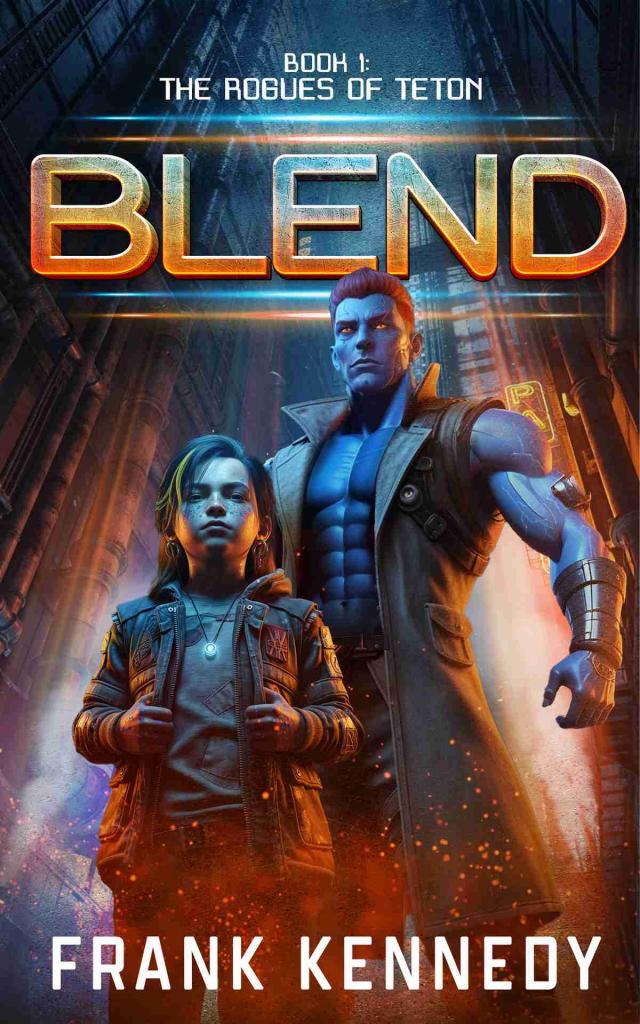


Directly up and behind them, Sinquin reached toward oblivion like a pyramidal mountain of light and shadow, its upper levels disappearing into low clouds.
“Dad. It just keeps going. We live way up there?”
“On the opposite side, but a good two parsels up.”
The sky stole Kip’s breath.
“Are those actual stars?”
City lights and the weather shields muted the effect somewhat, but distant suns and galaxies pockmarked the night.
“We’re so fringing small. Everybody should see this.”
“It’s a hard sell, Kip, especially for Tets.”
Wild vegetation clung to life in the shadows of the massive structure, stubborn remnants of Teton’s most feisty ecosystems.
“Come on, Son. There’s more to see out here. Plenty underfoot.”
They ventured further from the Mega’s shadow, their headlamps cutting twin beams through the darkness. Kip’s excitement manifested in quick, darting movements as he investigated everything in reach.
“Watch your step,” Arliss warned, pointing his light at the ground where dense patches of vegetation spread like living carpets between rock formations.
The plants weren’t the delicate, leafy specimens cultivated in the Sky Gardens. These were survivors: Low-growing, thick-stemmed tangles with waxy surfaces that reflected their headlamps with an almost metallic sheen. Most grew in tight spirals, their purple-black foliage coiled around central stems. When disturbed by Kip’s curious touch, some retracted with surprising speed.
“Pressure-sensitive,” Arliss explained. “They’ve adapted to fold inward during storms. Human touch has a similar effect.”
Between rocky outcroppings, clusters of crystalline growths caught the light, their transparent structures housing colonies of bioluminescent organisms that pulsed with faint blue-green light.
“These weren’t in any of my lessons,” Kip said, crouching to examine a patch of what looked like miniature silver umbrellas sprouting from cracks in the stone.
“Most Tets and Blends have never seen them. These plants have adapted to high mineral content and radiation levels that would kill standard vegetation. The Breath teachers call them ‘corruptions,’ but they’re actually perfect examples of adaptation.”
Just like us.
Arliss directed Kip’s attention to where the Mega disappeared into the ground.
“What you’re seeing is just the visible portion. The foundation extends another three hundred units below us, anchored to the bedrock. Without that stability, the entire structure would topple in the first major storm or minor quake.”
They walked along what appeared to be a maintenance road, its surface worn smooth by service vehicles.
“The water systems are even more impressive,” Arliss continued. “Deep wells tap into underground aquifers, while purification facilities process everything that flows out. The sewage and water networks stretch out for nearly seven parsels in every direction.”
Kip pointed toward distant lights moving across the landscape.
“What are those?”
“Maintenance crews. Blends. They monitor the external systems, repair weather damage, test soil and water quality.”
“Do they ever find anything weird out here?”
Arliss thought about the rumors: Strange phenomena beyond the city perimeter, unexplained readings that maintenance crews reported but officials dismissed.
“Sometimes. The planet has its secrets. Listen to a Pure Breather, and you’d think it’s much more.”
They paused at the crest of a small rise. From this vantage point, the true scale of Sinquin Mega became apparent: A colossal monument to human determination and engineering, yet still dwarfed by the vastness of Teton’s night sky.
“It’s beautiful,” Kip whispered. “Scary, but beautiful.”
Arliss nodded, watching his son’s face illuminated by starlight. The boy wiped away tears.
Maybe there’s hope for us yet.
Arliss found a nice flat stone on which to take a break.
“What do you think? Glad I brought you out here?”
Kip reacted like Arliss never expected. The boy grabbed his hand. Not since he was what? Five? Six?
“I can’t hardly breathe, Dad.”
“Wait. You’re not …”
“No. I mean, look at it! It’s like a fringing dream.”
“Your ancestors had a big hand in making it happen. I don’t want you to ever forget, Kip. They died for this city.” He pointed to the suspended levtrain rails a quarter parsel above them. “Two thousand of our people died to link the Megas by train. They’d be alive today if Tet engineers designed practical, ground-based transports. But they insisted on honoring the past.”
Kip’s grip intensified, and his tone deepened.
“It oughta be ours.”
“What’s that?”
“What TimBob says. The Mega oughta be ours. We earned it.”
The name must have slipped through the boy’s defenses in his zeal. TimBob.
Arliss knew that name. And the face.
“This, uh, TimBob. He’s a friend you hang out with?”
Kip must have realized his mistake; he shook his head.
“Uh, no. Just a friend of a … some guy I met on the Market Strip.”
“Unusual name. I met a TimBob at Offante Ruhl’s store. Long red ponytail?”
“It don’t matter, Dad. Just forget it.”
“Yeah. Sure. But I’m curious. What did he mean by ‘the Mega ought to be ours’? Does he advocate for a takeover? A revolution, maybe?”
Kip broke contact and closed his arms around his chest.
“He’s just a big talker. A random null-jack. He thinks there’s strength in numbers, and we outnumber them eight to one in Sinquin. He says we oughta rise up. That’s all.”
“And what do you think? Should we take the Mega?”
“Makes sense.” Kip shrugged. “We’d have our own city. We earned it.”
TimBob’s got his hooks in deep.
“It’s a tempting concept, but the reality is more complicated than a would-be revolutionary would tell you.”
“But Dad, wouldn’t it be worse if we did nothing?”
Arliss watched his son’s face, illuminated in the glow of his lamp. He saw the same fierce determination Arliss carried at that age, before reality had beaten it out of him. Before prison taught him the true cost of defying order.
How do I protect him without breaking his spirit?
“The strongest resistance isn’t always the loudest,” Arliss said. “Sometimes it’s surviving. Building. Teaching others to survive. And, when enough people on both sides are willing to talk …”
“Talk? Can we wait that long? The Pure Breathers are getting stronger.”
“But they’re not the strongest voices yet. It’s tempting to think we can somehow fight our way up the Mega and change the world. But let me ask you this: When it comes to fighting, do you know who will stand with you and behind you? And will they still be there when the fight looks hopeless? Kip, revolutionary talk is dangerous. It can get you disappeared, and you wouldn’t be the first.”
Kip’s face hardened.
“We’ll never know if we don’t try.”
It was a simple truth shielding a much bigger lie. Arliss didn’t have the time or inclination to explain complexities a twelve-year-old couldn’t yet comprehend.
“Kip, I made a promise. If you allowed me to be your teacher, you could have free time while your mother and I worked. When we get back home, you’ll have about six urns on your own. That’s enough time for you to get into trouble saying the wrong things. Do you see where I’m going?”
“Yeah. Sure. Keep my hole shut about revolution.”
“Or anything else that would be considered subversive. The EQ is on edge about these missing men. If you hear TimBob or other friends saying these things, I’m asking you to walk away. Can you do that?”
His son’s answer didn’t matter. If he was already half-lost to TimBob’s anarchist ideas, lying about it would be easy. But retreat from the pact so soon? Arliss dared not risk it.
He’d have a word with Offante.
***
A short while later, they returned inside and handed over their headlamps. The never-ending hum of machinery resonated once more. As they neared the first lift, Arliss glanced at Kip, who still seemed lost in thought, processing their earlier conversation.
“I hope you learned a few things today,” Arliss said, trying to infuse a sense of normalcy into his tone.
“Can we go outside another time?”
“Of course.”
Waiting for their lift, Arliss took a deep breath, forcing himself to push away thoughts of failure and danger. But when the doors slid open, a familiar face exited, catching his eyes.
“Ven?” he called out.
His new co-worker, an associate in Offante’s network, offered a crooked smile as he stepped out, nodding toward Arliss.
Kip must have noticed the shift in his father’s demeanor.
“Who is it?”
“A friend from Praxis Load.”
Ven waved him over with a casual motion that belied the intensity of their circumstances.
“Arliss! Now this is what I call fortuitous timing.”
“What are you doing down here? Aren’t you on shift about now?
“Hit my quota. Jagged off. And this one must be Kip?
Ven shook the boy’s hand but shifted his eyes to Arliss.
“How long until you’re due?”
“An urn.”
“Perfect. Look, friend, I’m meeting a couple of associates from work. Join us.”
“What about? I’d hate to be late. It’s my first week.”
“Fellowship. Nothing more. Please join.”
Arliss hesitated for a moment before glancing back at Kip, who peered at them with expectant eyes.
“It’s good, Dad. I know my way home.”
Arliss wanted to say so much more but settled on a simple:
“Stay clear of trouble. Understood?”
Kip winked.
“I’ll be a ghost.”
Arliss followed Ven but kept looking back until he no longer could see Kip.
Ven, with shaggy red hair, led Arliss down a poorly lit corridor off the main service lanes. They navigated narrow passageways lined with exposed pipes and emergency lights casting shadows on rusted metal walls. The air grew thicker as they moved deeper into the underbelly of the Mega, a place where whispers carried the weight.
“Fellowship, you say?” Arliss pressed. “Where are we going?”
“Trust me.”
They reached a set of heavy doors reinforced with thick steel bars. Ven flashed a coded passkey against a scanner embedded in the wall close by.
The doors creaked open to reveal a seamy bar filled with muted chatter. A neon sign flickered above them: The Transit. The name made Arliss’s heart race. He heard rumors about this place growing up but never stepped inside. Then again, he rarely ventured into this region of the Mega.
Rows of makeshift tables crafted from reclaimed materials sprawled across uneven floors. The air buzzed with an electric mix of music from battered speakers perched atop crates.
Arliss caught sight of several faces who jogged his memory, for better or worse. Old associates and competitors who also once fought for survival instead of acceptance. His stomach tightened as the past flooded back; each face held stories etched in pain and resilience alike. He’d hurt some of them, and others had a fair go at Arliss.
Blends shared drinks and laughter amidst nervous glances, but none lingered on Arliss.
“Fellowship,” Ven said with a chuckle, leading Arliss toward a secluded booth. “Glad you could join us.”
Ven gestured for Arliss to sit, exuding a casual authority that only someone deeply connected could maintain amid the chaos.
“What’s this really about?” Arliss asked, cutting straight to the point as he settled into a corner of the booth.
“I know you spoke to our mutual friend about helping out.” Ven leaned forward, as if sharing confidential secrets was meant only for those who dared to be ambitious. “He suggested we offer some work opportunities.”
“I spoke to Offante, especially after the raid outside Praxis. But we never discussed details. It was a feeling out. I don’t seek trouble.”
“No one is suggesting otherwise,” Ven assured him. “But sometimes trouble finds us regardless.” He paused before continuing: “We need someone like you – someone who understands both worlds – to help connect our efforts more directly.”
After everything he’d just told Kip, was he willing to take a meeting like this in a dark corner of the Mega?
Arliss slid his back to the wall where he could watch the entire room. Old habits. His muted servos hummed beneath his skin as three unfamiliar Blends joined them, each offering a polite nod: A woman with silvery circuits visible along her neck, a heavily modified Blend with muscle-packed arms that dwarfed Arliss, and a slender young Blend with no distinctive mods.
“This is Arliss Dubai,” Ven said, his voice dropping to match the low hum of the bar. “The one I told you about.”
The woman extended her hand.
“Ines. I run logistics for Offante’s southern network.” Her grip was firm, calculated. “This is Dox and Tallon.”
Dox, the heavily modified one, nodded. Tallon, the younger one, leaned forward with obvious interest.
“You were the enforcer during the Quadrant riots? Keeping the supply chain safe from the neediest?”
So that’s how they remember me. Not as a father or husband. As muscle.
“That was a long time ago,” Arliss replied, keeping his expression neutral. “Before prison.”
“Your reputation survived even Rogue,” Ines said, sliding a glass of brown liquid toward him. “We need someone with your skills.”
Arliss left the drink untouched.
“I’m not looking for old work.”
“This isn’t about breaking legs for black market dealers,” Ven countered. “Offante’s building something bigger. Something that matters. And it’s come a long way while you were breaking blackstone.”
Dox spoke, his voice soft for his size.
“EQ is setting the stage for a big move. We don’t know when or where, but it’s coming. You’re not blind. You know what we mean.”
“I do, and I intend to keep my family safe from it.”
Dox twisted a smile, as if he found humor in Arliss’s response.
“Exactly what we’re proposing.”
Tallon pulled out a small holographic projector, activating it beneath the table. A three-dimensional map of the district appeared, with several points highlighted in red.
“These are safe houses,” he explained. “Places where our people can go when the raids start. But they need protection, people who know how to secure a location, move others safely through the district, and handle themselves as needed when trouble shows its face.”
Ven came clean.
“Look, Arliss. Running into you at the lift was a happy accident, but Offante did ask me to loop you in first chance. I’ll be straight: You’re not ripe on the list of most popular Blends. I have friends who wished you had died on Rogue. But they’re smart. They left their resentment in the past where it belongs. They want you back in service but working for us this time.”
Reassuring, he supposed. Arliss hadn’t thought about his old enemies during the transport flight home. He had hoped raw memories would fade.
“There aren’t many of us with combat servos,” he told the foursome. “You want meat who can go up against EQ head-on.”
Dox shrugged.
“Play to your strengths. That’s what my parents taught me.”
“We could use someone who knows both sides,” Tallon added. “Someone who understands EQ tactics but has skills to counter them.”
The weight of their words settled over Arliss. He thought of Kip, of Meera, of their cramped apartment in a district that could become a death trap if the worst case arrived.
“I have a family to protect,” he said.
“That’s exactly why you should help us,” Ines countered. “When the purge starts, your family will need somewhere to go. People they can trust.”
Arliss’s fingers tapped against the table, his enhanced senses cataloging every exit, every potential threat. The skills that kept him alive in prison and made him valuable to black market dealers before that, now hummed beneath his grafted skin.
“I won’t be involved in anything violent,” he stated. “I won’t give them an excuse to take me away from my family again.”
“We’re not asking you to fight,” Ven assured him. “We’re asking you to protect. To teach others what you know about staying alive when the system wants you dead.”
Talon deactivated the projector.
“Offante says you’re the best at what you do. Says you can move through this city like a ghost when you need to.”
A skill his son had developed as well.
Arliss felt the dangerous comfort of being valued for his skills rather than feared for his differences. For five years, he’d dreamed only of returning to his family. Now that he was back, the world conspired to pull him away again.
“I’ll think about it,” he said, pushing back from the table, cognizant of how long he’d need to reach Praxis Load on time. “I make no promises.”
Ines narrowed her eyes.
“Don’t think too long, Arliss. The storm’s brewing.”
Arliss slipped out through a service exit that deposited him into a narrow maintenance corridor reeking of machine oil and mildew. The darkness felt almost comforting, a physical manifestation of the moral gray area he now navigated.
They want the old Arliss. The one who knew how to hurt people.
Arliss thought of the damage he leveled upon those enforcers before the impossible duo arrived to kill them all. He never murdered anyone, but he could have left a trail of bodies behind with ease.
He emerged into a crossway and set course for the second lift.
I promised Meera I’d stay clear of trouble. I promised Kip I’d be there for him.