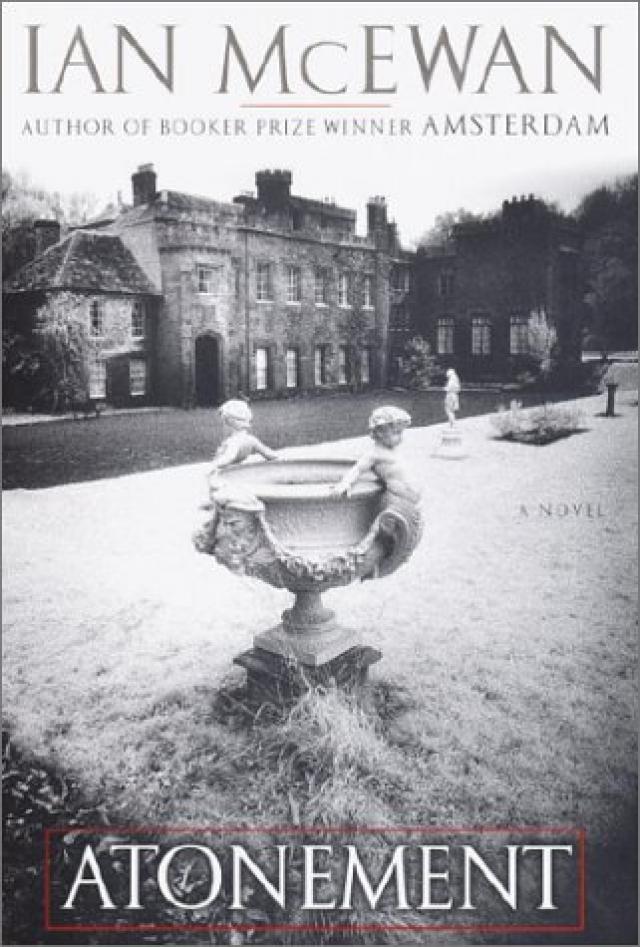
Atonement 1987, p.20
Atonement (1987),
p.20


Jean-Marie refilled the glasses. The account, with Turner’s running translation, had taken almost an hour. All the food was eaten. He thought about telling them of his own single, haunting detail. But he didn’t want to add to the horror, and nor did he want to give life to the image while it remained at a distance, held there by wine and companionship. Instead, he told them how he was separated from his unit at the beginning of the retreat, during a Stuka attack. He didn’t mention his injury because he didn’t want the corporals to know about it. Instead he explained how they were walking cross-country to Dunkirk to avoid the air raids along the main roads.
Jean-Marie said, “So it’s true what they’re saying. You’re leaving.”
“We’ll be back.” He said this, but he didn’t believe it.
The wine was taking hold of Corporal Nettle. He began a rambling eulogy of what he called ‘Frog crumpet’—how plentiful, how available, how delicious. It was all fantasy. The brothers looked at Turner.
“He says French women are the most beautiful in the world.”
They nodded solemnly and raised their glasses.
They were all silent for a while. Their evening was almost at an end. They listened to the night sounds they had grown used to—the rumble of artillery, stray shots in the distance, a booming far-off explosion—probably sappers blowing a bridge in the retreat.
“Ask them about their mum,” Corporal Mace suggested. “Let’s get that one cleared up.”
“We were three brothers,” Henri explained. “The eldest, Paul, her firstborn, died near Verdun in 1915. A direct hit from a shell. There was nothing to bury apart from his helmet. Us two, we were lucky. We came through without a scratch. Since then, she’s always hated soldiers. But now she’s eighty-three and losing her mind, it’s an obsession with her. French, English, Belgian, German. She makes no distinction. You’re all the same to her. We worry that when the Germans come, she’ll go at them with a pitchfork and they’ll shoot her.”
Wearily, the brothers got to their feet. The soldiers did the same.
Jean-Marie said, “We would offer you hospitality at our kitchen table. But to do that, we would have to lock her in her room.”
“But this has been a magnificent feast,” Turner said.
Nettle was whispering in Mace’s ear and he was nodding. Nettle took from his bag two cartons of cigarettes. Of course, it was the right thing to do. The Frenchmen made a polite show of refusing, but Nettle came round the table and shoved the gifts into their arms. He wanted Turner to translate.
“You should have seen it, when the order came through to destroy the stores. Twenty thousand cigarettes. We took whatever we wanted.”
A whole army was fleeing to the coast, armed with cigarettes to keep the hunger away.
The Frenchmen gave courteous thanks, complimented Turner on his French, then bent over the table to pack the empty bottles and glasses into the canvas bag. There was no pretending that they would meet again.
“We’ll be gone at first light,” Turner said. “So we’ll say goodbye.”
They shook hands.
Henri Bonnet said, “All that fighting we did twenty-five years ago. All those dead. Now the Germans back in France. In two days they’ll be here, taking everything we have. Who would have believed it?”
Turner felt, for the first time, the full ignominy of the retreat. He was ashamed. He said, with even less conviction than before, “We’ll be back to throw them out, I promise you.”
The brothers nodded and, with final smiles of farewell, left the dim circle of the candle’s glow and crossed the darkness toward the open barn door, the glasses chinking against the bottles as they went.
§
FOR A LONG TIME he lay on his back smoking, staring into the blackness of the cavernous roof. The corporals’ snores rose and fell in counterpoint. He was exhausted, but not sleepy. The wound throbbed uncomfortably, each beat precise and tight. Whatever was in there was sharp and close to the surface, and he wanted to touch it with a fingertip. Exhaustion made him vulnerable to the thoughts he wanted least. He was thinking about the French boy asleep in his bed, and about the indifference with which men could lob shells into a landscape. Or empty their bomb bays over a sleeping cottage by a railway, without knowing or caring who was there. It was an industrial process. He had seen their own RA units at work, tightly knit groups, working all hours, proud of the speed with which they could set up a line, and proud of their discipline, drills, training, teamwork. They need never see the end result—a vanished boy. Vanished. As he formed the word in his thoughts, sleep snatched him under, but only for seconds. Then he was awake, on his bed, on his back, staring at the darkness in his cell. He could feel he was back there. He could smell the concrete floor, and the piss in the bucket, and the gloss paint on the walls, and hear the snores of the men along the row. Three and a half years of nights like these, unable to sleep, thinking of another vanished boy, another vanished life that was once his own, and waiting for dawn, and slop-out and another wasted day. He did not know how he survived the daily stupidity of it. The stupidity and claustrophobia. The hand squeezing on his throat. Being here, sheltering in a barn, with an army in rout, where a child’s limb in a tree was something that ordinary men could ignore, where a whole country, a whole civilization was about to fall, was better than being there, on a narrow bed under a dim electric light, waiting for nothing. Here there were wooded valleys, streams, sunlight on the poplars which they could not take away unless they killed him. And there was hope. I’ll wait for you. Come back. There was a chance, just a chance, of getting back. He had her last letter in his pocket and her new address. This was why he had to survive, and use his cunning to stay off the main roads where the circling dive-bombers waited like raptors.
Later, he got up from under his greatcoat, pulled on his boots and groped his way through the barn to relieve himself outside. He was dizzy with fatigue, but he was still not ready for sleep. Ignoring the snarling farm dogs, he found his way along a track to a grassy rise to watch the flashes in the southern sky. This was the approaching storm of German armor. He touched his top pocket where the poem she sent was enfolded in her letter.
In the nightmare of the dark,
All the dogs of Europe bark.
The rest of her letters were buttoned into the inside pocket of his greatcoat. By standing on the wheel of an abandoned trailer he was able to see other parts of the sky. The gun flashes were everywhere but the north. The defeated army was running up a corridor that was bound to narrow, and soon must be cut off. There would be no chance of escape for the stragglers. At best, it would be prison again. Prison camp. This time, he wouldn’t last. When France fell there would be no end of the war in sight. No letters from her, and no way back. No bargaining an early release in return for joining the infantry. The hand on his throat again. The prospect would be of a thousand, or thousands of incarcerated nights, sleeplessly turning over the past, waiting for his life to resume, wondering if it ever would. Perhaps it would make sense to leave now before it was too late, and keep going, all night, all day until he reached the Channel. Slip away, leave the corporals to their fate. He turned and began to make his way back down the slope and thought better of it. He could barely see the ground in front of him. He would make no progress in the dark and could easily break a leg. And perhaps the corporals weren’t such complete dolts—Mace with his straw mattresses, Nettle with his gift for the brothers.
Guided by their snores, he shuffled back to his bed. But still sleep would not come, or came only in quick plunges from which he emerged, giddy with thoughts he could not choose or direct. They pursued him, the old themes. Here it was again, his only meeting with her. Six days out of prison, one day before he reported for duty near Aldershot. When they arranged to meet at Joe Lyons teahouse in the Strand in 1939, they had not seen each other for three and a half years. He was at the café early and took a corner seat with a view of the door. Freedom was still a novelty. The pace and clatter, the colors of coats, jackets and skirts, the bright, loud conversations of West End shoppers, the friendliness of the girl who served him, the spacious lack of threat—he sat back and enjoyed the embrace of the everyday. It had a beauty he alone could appreciate.
During his time inside, the only female visitor he was permitted was his mother. In case he was inflamed, they said. Cecilia wrote every week. In love with her, willing himself to stay sane for her, he was naturally in love with her words. When he wrote back, he pretended to be his old self, he lied his way into sanity. For fear of his psychiatrist who was also their censor, they could never be sensual, or even emotional. His was considered a modern, enlightened prison, despite its Victorian chill. He had been diagnosed, with clinical precision, as morbidly oversexed, and in need of help as well as correction. He was not to be stimulated. Some letters—both his and hers—were confiscated for some timid expression of affection. So they wrote about literature, and used characters as codes. At Cambridge, they had passed each other by in the street. All those books, those happy or tragic couples they had never met to discuss! Tristan and Isolde, the Duke Orsino and Olivia (and Malvolio too), Troilus and Criseyde, Mr.
Knightley and Emma, Venus and Adonis. Turner and Tallis. Once, in despair, he referred to Prometheus, chained to a rock, his liver devoured daily by a vulture. Sometimes she was patient Griselde. Mention of ‘a quiet corner in a library’ was a code for sexual ecstasy. They charted the daily round too, in boring, loving detail. He described the prison routine in every aspect, but he never told her of its stupidity. That was plain enough. He never told her that he feared he might go under. That too was clear. She never wrote that she loved him, though she would have if she thought it would get through. But he knew it.
She told him she had cut herself off from her family. She would never speak to her parents, brother or sister again. He followed closely all her steps along the way toward her nurse’s qualification. When she wrote, “I went to the library today to get the anatomy book I told you about. I found a quiet corner and pretended to read,” he knew she was feeding on the same memories that consumed him every night, beneath thin prison blankets.
When she entered the café, wearing her nurse’s cape, startling him from a pleasant daze, he stood too quickly and knocked his tea. He was conscious of the oversized suit his mother had saved for. The jacket did not seem to touch his shoulders at any point. They sat down, looked at each other, smiled and looked away. Robbie and Cecilia had been making love for years—by post. In their coded exchanges they had drawn close, but how artificial that closeness seemed now as they embarked on their small talk, their helpless catechism of polite query and response. As the distance opened up between them, they understood how far they had run ahead of themselves in their letters. This moment had been imagined and desired for too long, and could not measure up. He had been out of the world, and lacked the confidence to step back and reach for the larger thought. I love you, and you saved my life. He asked about her lodgings. She told him.
“And do you get along all right with your landlady?”
He could think of nothing better, and feared the silence that might come down, and the awkwardness that would be a prelude to her telling him that it had been nice to meet up again. Now she must be getting back to work. Everything they had, rested on a few minutes in a library years ago. Was it too frail? She could easily slip back into being a kind of sister. Was she disappointed? He had lost weight. He had shrunk in every sense. Prison made him despise himself, while she looked as adorable as he remembered her, especially in a nurse’s uniform. But she was miserably nervous too, incapable of stepping around the inanities. Instead, she was trying to be lighthearted about her landlady’s temper. After a few more such exchanges, she really was looking at the little watch that hung above her left breast, and telling him that her lunch break would soon be over. They had had half an hour.
He walked with her to Whitehall, toward the bus stop. In the precious final minutes he wrote out his address for her, a bleak sequence of acronyms and numbers. He explained that he would have no leave until his basic training was over. After that, he was granted two weeks. She was looking at him, shaking her head in some exasperation, and then, at last, he took her hand and squeezed. The gesture had to carry all that had not been said, and she answered it with pressure from her own hand. Her bus came, and she did not let go. They were standing face to face. He kissed her, lightly at first, but they drew closer, and when their tongues touched, a disembodied part of himself was abjectly grateful, for he knew he now had a memory in the bank and would be drawing on it for months to come. He was drawing on it now, in a French barn, in the small hours. They tightened their embrace and went on kissing while people edged past them in the queue. Some card squawked in his ear. She was crying onto his cheek, and her sorrow stretched her lips against his. Another bus arrived. She pulled away, squeezed his wrist, and got on without a word and didn’t look back. He watched her find her seat, and as the bus began to move realized he should have gone with her, all the way to the hospital. He had thrown away minutes in her company. He must learn again how to think and act for himself. He began to run along Whitehall, hoping to catch up with her at the next stop. But her bus was far ahead, and soon disappearing toward Parliament Square.
Throughout his training, they continued to write. Liberated from censorship and the need to be inventive, they proceeded cautiously. Impatient with living on the page, mindful of the difficulties, they were wary of getting ahead of the touch of hands and a single bus-stop kiss. They said they loved each other, used ‘darling’ and ‘dearest,’ and knew their future was together, but they held back from wilder intimacies. Their business now was to remain connected until those two weeks. Through a Girton friend she found a cottage in Wiltshire they could borrow, and though they thought of little else in their moments of free time, they tried not to dream it away in their letters. Instead, they spoke of their routines. She was now on the maternity ward, and every day brought commonplace miracles, as well as moments of drama or hilarity. There were tragedies too, against which their own troubles faded to nothing: stillborn babies, mothers who died, young men weeping in the corridors, dazed mothers in their teens discarded by their families, infant deformities that evoked shame and love in confusing measure. When she described a happy outcome, that moment when the battle was over and an exhausted mother took the child in her arms for the first time, and gazed in rapture into a new face, it was the unspoken call to Cecilia’s own future, the one she would share with him, which gave the writing its simple power, though in truth, his thoughts dwelled less on birth than conception.
He in turn described the parade ground, the rifle range, the drills, the ‘bull,’ the barracks. He was not eligible for officer training, which was as well, for sooner or later he would have met someone in an officers’ mess who knew about his past. In the ranks he was anonymous, and it turned out that to have been inside conferred a certain status. He discovered he was already well adapted to an army regime, to the terrors of kit inspection and the folding of blankets into precise squares, with the labels lined up. Unlike his fellows, he thought the food not bad at all. The days, though tiring, seemed rich in variety. The cross-country marches gave him a pleasure that he dared not express to the other recruits. He was gaining in weight and strength. His education and age marked him down, but his past made up for that and no one gave him trouble. Instead, he was regarded as a wise old bird who knew the ways of ‘them,’ and who was handy when it came to filling out a form. Like her, he confined his letters to the daily round, interrupted by the funny or alarming anecdote: the recruit who came on parade with a boot missing; the sheep that ran amok in the barracks and could not be chased out, the sergeant instructor almost hit by a bullet on the range.
But there was one external development, one shadow that he had to refer to. After Munich last year, he was certain, like everyone else, that there would be a war. Their training was being streamlined and accelerated, a new camp was being enlarged to take more recruits. His anxiety was not for the fighting he might have to do, but the threat to their Wiltshire dream. She mirrored his fears with descriptions of contingency arrangements at the hospital—more beds, special courses, emergency drills. But for both of them there was also something fantastical about it all, remote even though likely. Surely not again, was what many people were saying. And so they continued to cling to their hopes.
There was another, closer matter that troubled him. Cecilia had not spoken to her parents, brother or sister since November 1935 when Robbie was sentenced. She would not write to them, nor would she let them know her address. Letters reached her through his mother who had sold the bungalow and moved to another village. It was through Grace that she let her family know she was well and did not wish to be contacted. Leon had come to the hospital once, but she would not speak to him. He waited outside the gates all afternoon. When she saw him, she retreated inside until he went away. The following morning he was outside the nurses’ hostel. She pushed past him and would not even look in his direction. He took her elbow, but she wrenched her arm free and walked on, outwardly unmoved by his pleading.
Robbie knew better than anyone how she loved her brother, how close she was to her family, and how much the house and the park meant to her. He could never return, but it troubled him to think that she was destroying a part of herself for his sake. A month into his training he told her what was on his mind. It wasn’t the first time they had been through this, but the issue had become clearer.