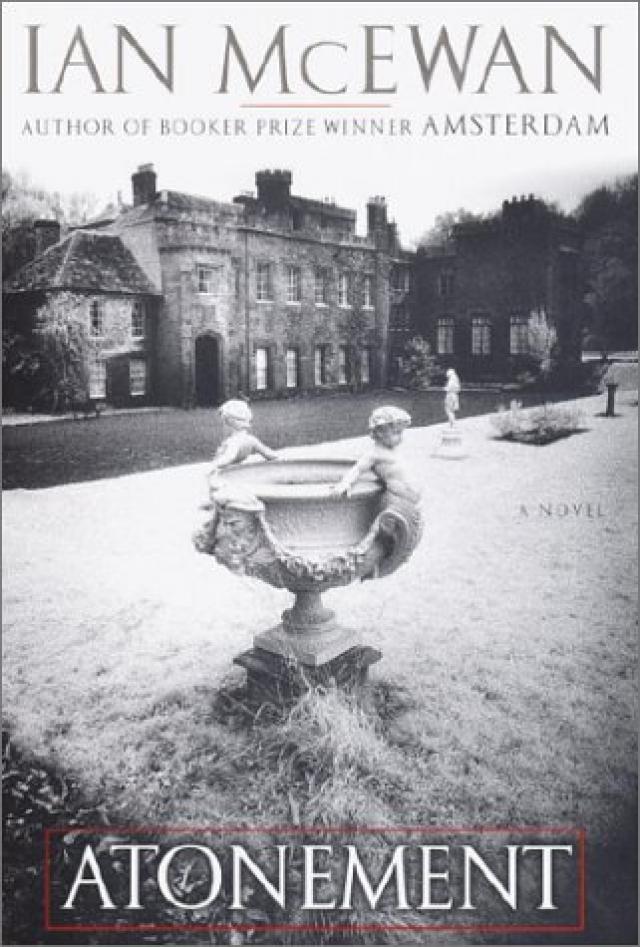
Atonement 1987, p.23
Atonement (1987),
p.23


But there was one part in all this that he could not think through, one indistinct shape that the shambles twelve miles outside Dunkirk could not reduce to a simple outline. Briony. Here he came against the outer edge of what Cecilia called his generous spirit. And his rationality. If Cecilia were to be reunited with her family, if the sisters were close again, there would be no avoiding her. But could he accept her? Could he be in the same room? Here she was, offering a possibility of absolution. But it was not for him. He had done nothing wrong. It was for herself, for her own crime which her conscience could no longer bear. Was he supposed to feel grateful? And yes, of course, she was a child in 1935. He had told himself, he and Cecilia had told each other, over and again. Yes, she was just a child. But not every child sends a man to prison with a lie. Not every child is so purposeful and malign, so consistent over time, never wavering, never doubted. A child, but that had not stopped him daydreaming in his cell of her humiliation, of a dozen ways he might find revenge. In France once, in the bitterest week of winter, raging drunk on cognac, he had even conjured her onto the end of his bayonet. Briony and Danny Hardman. It was not reasonable or just to hate Briony, but it helped.
How to begin to understand this child’s mind? Only one theory held up. There was a day in June 1932, all the more beautiful for coming suddenly, after a long spell of rain and wind. It was one of those rare mornings which declares itself, with a boastful extravagance of warmth and light and new leaves, as the true beginning, the grand portal to summer, and he was walking through it with Briony, past the Triton pond, down beyond the ha-ha and rhododendrons, through the iron kissing gate and onto the winding narrow woodland path. She was excited and talkative. She would have been about ten years old, just starting to write her little stories. Along with everyone else, he had received his own bound and illustrated tale of love, adversities overcome, reunion and a wedding. They were on their way down to the river for the swimming lesson he had promised her. As they left the house behind she may have been telling him about a story she had just finished or a book she was reading. She may have been holding his hand. She was a quiet, intense little girl, rather prim in her way, and this outpouring was unusual. He was happy to listen. These were exciting times for him too. He was nineteen, exams were almost over and he thought he’d done well. Soon he would cease to be a schoolboy. He had interviewed well at Cambridge and in two weeks he was leaving for France where he was to teach English at a religious school. There was a grandeur about the day, about the colossal, barely stirring beeches and oaks, and the light that dropped like jewels through the fresh foliage to make pools among last year’s dead leaves. This magnificence, he sensed in his youthful self-importance, reflected the glorious momentum of his life.
She prattled on, and contentedly he half listened. The path emerged from the woods onto the broad grassy banks of the river. They walked upstream for half a mile and entered woods again. Here, on a bend in the river, below overhanging trees, was the pool, dug out in Briony’s grandfather’s time. A stone weir slowed the current and was a favorite diving and jumping-off place. Otherwise, it was not ideal for beginners. You went from the weir, or you jumped off the bank into nine feet of water. He dived in and trod water, waiting for her. They had started the lessons the year before, in late summer when the river was lower and the current sluggish. Now, even in the pool there was a steady rotating drift. She paused only for a moment, then jumped from the bank into his arms with a scream. She practiced treading water until the current carried her against the weir, then he towed her across the pool so that she could start again. When she tried out her breaststroke after a winter of neglect, he had to support her, not easy when he was treading water himself. If he removed his hand from under her, she could only manage three or four strokes before sinking. She was amused by the fact that, going against the current, she swam to remain still. But she did not stay still. Instead, she was carried back each time to the weir, where she clung to a rusty iron ring, waiting for him, her white face vivid against the lurid mossy walls and greenish cement. Swimming uphill, she called it. She wanted to repeat the experience, but the water was cold and after fifteen minutes he’d had enough. He pulled her over to the bank and, ignoring her protests, helped her out.
He took his clothes from the basket and went a little way off into the woods to change. When he returned she was standing exactly where he had left her, on the bank, looking into the water, with her towel around her shoulders.
She said, “If I fell in the river, would you save me?”
“Of course.”
He was bending over the basket as he said this and he heard, but did not see, her jump in. Her towel lay on the bank. Apart from the concentric ripples moving out across the pool, there was no sign of her. Then she bobbed up, snatched a breath and sank again. Desperate, he thought of running to the weir to fish her out from there, but the water was an opaque muddy green. He would only find her below the surface by touch. There was no choice—he stepped into the water, shoes, jacket and all. Almost immediately he found her arm, got his hand under her shoulder and heaved her up. To his surprise she was holding her breath. And then she was laughing joyously and clinging to his neck. He pushed her onto the bank and, with great difficulty in his sodden clothes, struggled out himself.
“Thank you,” she kept saying. “Thank you, thank you.”
“That was a bloody stupid thing to do.”
“I wanted you to save me.”
“Don’t you know how easily you could have drowned?”
“You saved me.”
Distress and relief were charging his anger. He was close to shouting. “You stupid girl. You could have killed us both.”
She fell silent. He sat on the grass, emptying the water from his shoes. “You went under the surface, I couldn’t see you. My clothes were weighing me down. We could have drowned, both of us. Is it your idea of a joke? Well, is it?”
There was nothing more to say. She got dressed and they went back along the path, Briony first, and he squelching behind her. He wanted to get into the open sunlight of the park. Then he faced a long trudge back to the bungalow for a change of clothes. He had not yet spent his anger. She was not too young, he thought, to get her mind around an apology. She walked in silence, head lowered, possibly sulking, he could not see. When they came out of the woods and had gone through the kissing gate, she stopped and turned. Her tone was forthright, even defiant. Rather than sulk, she was squaring up to him.
“Do you know why I wanted you to save me?”
“No.”
“Isn’t it obvious?”
“No, it isn’t.”
“Because I love you.”
She said it bravely, with chin upraised, and she blinked rapidly as she spoke, dazzled by the momentous truth she had revealed.
He restrained an impulse to laugh. He was the object of a schoolgirl crush. “What on earth do you mean by that?”
“I mean what everybody else means when they say it. I love you.”
This time the words were on a pathetic rising note. He realized that he should resist the temptation to mock. But it was difficult. He said, “You love me, so you threw yourself in the river.”
“I wanted to know if you’d save me.”
“And now you know. I’d risk my life for yours. But that doesn’t mean I love you.”
She drew herself up a little. “I want to thank you for saving my life. I’ll be eternally grateful to you.”
Lines, surely, from one of her books, one she had read lately, or one she had written.
He said, “That’s all right. But don’t do it again, for me or anyone else. Promise?”
She nodded, and said in parting, “I love you. Now you know.”
She walked away toward the house. Shivering in the sunlight, he watched her until she was out of sight, and then he set off for home. He did not see her on her own before he left for France, and by the time he came back in September, she was away at boarding school. Not long after, he went up to Cambridge, and in December spent Christmas with friends. He didn’t see Briony until the following April, and by then the matter was forgotten.
Or was it?
He’d had plenty of time alone, too much time, to consider. He could remember no other unusual conversation with her, no strange behavior, no meaningful looks or sulks to suggest that her schoolgirlish passion had lasted beyond that day in June. He had been back to Surrey almost every vacation and she had many opportunities to seek him out at the bungalow, or pass him a note. He was busy with his new life then, lost to the novelties of undergraduate life, and also intent at that time on putting a little distance between himself and the Tallis family. But there must have been signs which he had not noticed. For three years she must have nurtured a feeling for him, kept it hidden, nourished it with fantasy or embellished it in her stories. She was the sort of girl who lived in her thoughts. The drama by the river might have been enough to sustain her all that time.
This theory, or conviction, rested on the memory of a single encounter—the meeting at dusk on the bridge. For years he had dwelled on that walk across the park. She would have known he was invited to dinner. There she was, barefoot, in a dirty white frock. That was strange enough. She would have been waiting for him, perhaps preparing her little speech, even rehearsing it out loud as she sat on the stone parapet. When he finally arrived, she was tongue-tied. That was proof of a sort. Even at the time, he thought it odd that she did not speak to him. He gave her the letter and she ran off. Minutes later, she was opening it. She was shocked, and not only by a word. In her mind he had betrayed her love by favoring her sister. Then, in the library, confirmation of the worst, at which point, the whole fantasy crashed. First, disappointment and despair, then a rising bitterness. Finally, an extraordinary opportunity in the dark, during the search for the twins, to avenge herself. She named him—and no one but her sister and his mother doubted her. The impulse, the flash of malice, the infantile destructiveness he could understand. The wonder was the depth of the girl’s rancor, her persistence with a story that saw him all the way to Wandsworth Prison. Now he might be cleared, and that gave him joy. He acknowledged the courage it would require for her to go back to the law and deny the evidence she had given under oath. But he did not think his resentment of her could ever be erased. Yes, she was a child at the time, and he did not forgive her. He would never forgive her. That was the lasting damage.
§
THERE WAS MORE confusion ahead, more shouting. Incredibly, an armored column was forcing its way against the forward press of traffic, soldiers and refugees. The crowd parted reluctantly. People squeezed into the gaps between abandoned vehicles or against shattered walls and doorways. It was a French column, hardly more than a detachment—three armored cars, two half-tracks and two troop carriers. There was no show of common cause. Among the British troops the view was that the French had let them down. No will to fight for their own country. Irritated at being pushed aside, the Tommies swore, and taunted their allies with shouts of ‘Maginot!’ For their part, the poilus must have heard rumors of an evacuation. And here they were, being sent to cover the rear. “Cowards! To the boats! Go shit in your pants!” Then they were gone, and the crowd closed in again under a cloud of diesel smoke and walked on.
They were approaching the last houses in the village. In a field ahead, he saw a man and his collie dog walking behind a horse-drawn plow. Like the ladies in the shoe shop, the farmer did not seem aware of the convoy. These lives were lived in parallel—war was a hobby for the enthusiasts and no less serious for that. Like the deadly pursuit of a hunt to hounds, while over the next hedge a woman in the backseat of a passing motorcar was absorbed in her knitting, and in the bare garden of a new house a man was teaching his son to kick a ball. Yes, the plowing would still go on and there’d be a crop, someone to reap it and mill it, others to eat it, and not everyone would be dead…
Turner was thinking this when Nettle gripped his arm and pointed. The commotion of the passing French column had covered the sound, but they were easy enough to see. There were at least fifteen of them, at ten thousand feet, little dots in the blue, circling above the road. Turner and the corporals stopped to watch, and everyone nearby saw them too.
An exhausted voice murmured close to his ear, “Fuck. Where’s the RAF?”
Another said knowingly, “They’ll go for the Frogs.”
As if goaded into disproof, one of the specks peeled away and began its near-vertical dive, directly above their heads. For seconds the sound did not reach them. The silence was building like pressure in their ears. Even the wild shouts that went up and down the road did not relieve it. Take cover! Disperse! Disperse! At the double!
It was difficult to move. He could walk on at a steady trudge, and he could stop, but it was an effort, an effort of memory, to reach for the unfamiliar commands, to turn away from the road and run. They had stopped by the last house in the village. Beyond the house was a barn and flanking both was the field where the farmer had been plowing. Now he was standing under a tree with his dog, as though sheltering from a shower of rain. His horse, still in harness, grazed along the unplowed strip. Soldiers and civilians were streaming away from the road in all directions. A woman brushed past him carrying a crying child, then she changed her mind and came back and stood, turning indecisively at the side of the road. Which way? The farmyard or the field? Her immobility delivered him from his own. As he pushed her by the shoulder toward the gate, the rising howl commenced. Nightmares had become a science. Someone, a mere human, had taken the time to dream up this satanic howling. And what success! It was the sound of panic itself, mounting and straining toward the extinction they all knew, individually, to be theirs. It was a sound you were obliged to take personally. Turner guided the woman through the gate. He wanted her to run with him into the center of the field. He had touched her, and made her decision for her, so now he felt he could not abandon her. But the boy was at least six years old and heavy, and together they were making no progress at all.
He dragged the child from her arms. “Come on,” he shouted.
A Stuka carried a single thousand-pound bomb. The idea on the ground was to get away from buildings, vehicles and other people. The pilot was not going to waste his precious load on a lone figure in a field. When he turned back to strafe it would be another matter. Turner had seen them hunt down a sprinting man for the sport of it. With a free hand he was pulling on the woman’s arm. The boy was wetting his pants and screaming in Turner’s ear. The mother seemed incapable of running. She was stretching out her hand and shouting. She wanted her son back. The child was wriggling toward her, across his shoulder. Now came the screech of the falling bomb. They said that if you heard the noise stop before the explosion, your time was up. As he dropped to the grass he pulled the woman with him and shoved her head down. He was half lying across the child as the ground shook to the unbelievable roar. The shock wave prized them from the earth. They covered their faces against the stinging spray of dirt. They heard the Stuka climb from its dive even as they heard the banshee wail of the next attack. The bomb had hit the road less than eighty yards away. He had the boy under his arm and he was trying to pull the woman to her feet.
“We’ve got to run again. We’re too close to the road.”
The woman answered but he did not understand her. Again they were stumbling across the field. He felt the pain in his side like a flash of color. The boy was in his arms, and again the woman seemed to be dragging back, and trying to get her son from him. There were hundreds in the field now, all making for the woods on the far side. At the shrill whine of the bomb everyone cowered on the ground. But the woman had no instinct for danger and he had to pull her down again. This time they were pressing their faces into freshly turned earth. As the screech grew louder the woman shouted what sounded like a prayer. He realized then that she wasn’t speaking French. The explosion was on the far side of the road, more than a hundred and fifty yards away. But now the first Stuka was turning over the village and dropping for the strafe. The boy had gone silent with shock. His mother wouldn’t stand. Turner pointed to the Stuka coming in over the rooftops. They were right in its path and there was no time for argument. She wouldn’t move. He threw himself down into the furrow. The rippling thuds of machine-gun fire in the plowed earth and the engine roar flashed past them. A wounded soldier was screaming. Turner was on his feet. But the woman would not take his hand. She sat on the ground and hugged the boy tightly to her. She was speaking Flemish to him, soothing him, surely telling him that everything was going to be all right. Mama would see to that. Turner didn’t know a single word of the language. It would have made no difference. She paid him no attention. The boy was staring at him blankly over his mother’s shoulder.
Turner took a step back. Then he ran. As he floundered across the furrows the attack was coming in. The rich soil was clinging to his boots. Only in nightmares were feet so heavy. A bomb fell on the road, way over in the center of the village, where the lorries were. But one screech hid another, and it hit the field before he could go down. The blast lifted him forward several feet and drove him face-first into the soil. When he came to, his mouth and nose and ears were filled with dirt. He was trying to clear his mouth, but he had no saliva. He used a finger, but that was worse. He was gagging on the dirt, then he was gagging on his filthy finger. He blew the dirt from his nose. His snot was mud and it covered his mouth. But the woods were near, there would be streams and waterfalls and lakes in there. He imagined a paradise. When the rising howl of a diving Stuka sounded again, he struggled to place the sound. Was it the all-clear? His thoughts too were clogged. He could not spit or swallow, he could not easily breathe, and he could not think. Then, at the sight of the farmer with his dog still waiting patiently under the tree, it came back to him, he remembered everything and he turned to look back. Where the woman and her son had been was a crater. Even as he saw it, he thought he had always known. That was why he had to leave them. His business was to survive, though he had forgotten why. He kept on toward the woods.