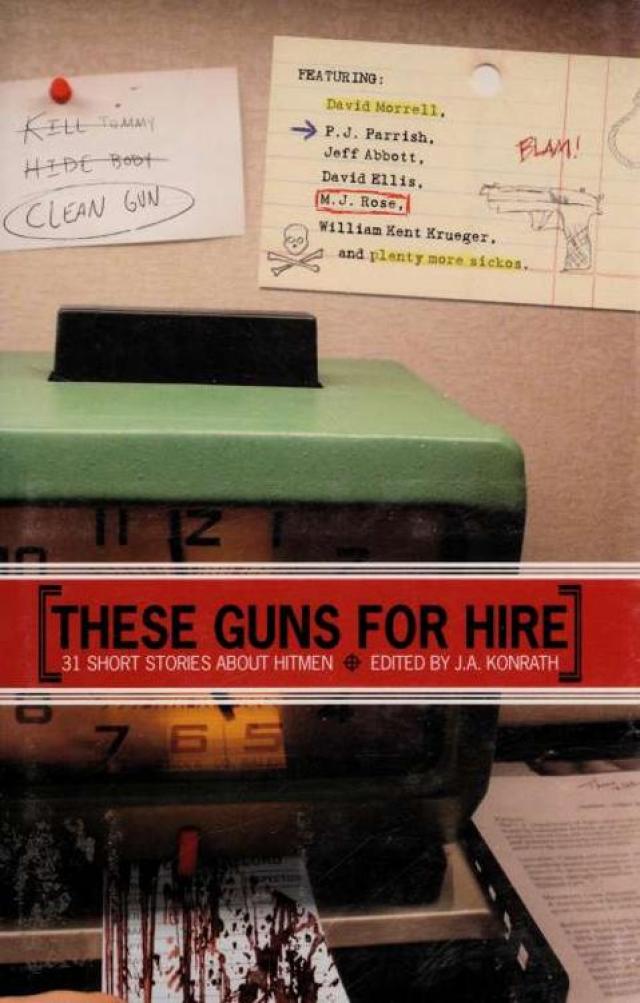
These guns for hire 2006.., p.21
These Guns for Hire (2006) Anthology,
p.21


ROB KANTNER
ROB Kantner is the author of nine novels and numerous short stories in the Ben Perkins PI series, which have won him four Shamus Awards. These days Rob knocks out the occasional short story, tinkers with historical fiction and crime novels, and generally contents himself in peaceful obscurity. Rob lives on a farm near Blanchard, Michigan (pop. 200), with his wife, two kids, a dog, two horses, two cats, and others. His latest is TROUBLE IS WHAT I DO.
On the topic of hitmen, Rob says: “I think most of us of the hard-boiled persuasion are drawn to hitmen because as a class they are about as amoral as it’s possible to be. Though some play around with justification, for most it’s just a job. There’s also a feeling of power at having at your command someone who is quite blithely willing to cross boundaries that most of the rest of us would not. And then there’s the kind of dark thrill of getting away with things that many don’t.”
Visit Rob at www.RobKantner.com.
DEAD LAST
Rob Kantner
FROM UTTER INSENSIBLE blackness grew awareness: Heartbeat. Breathing. Distant ticking of an admiral clock. Remaining absolutely still, allowing himself to ease awake, eyes tight shut, Bobby wondered: How sick am I?
Mentally he took inventory of his sensations: head, chest, abdomen. All quiet.
Another day, then?
So far, so good.
Opening his eyes, Bobby slid back the silk sheet, swung his thin legs off the bed, stood, padded stiffly into the bright pastel bathroom. How different this getting-up ritual was, he reflected, from earlier days. A nice good-morning hump with the girl of the moment, a quiet first cigarette (the best of the day), a mug of rich black coffee, TV news, a quick phone call with Mister S, and then on into the day, to do his boss’s bidding.
Today, he thought as he brushed his teeth, there was no girl. No smoke. No joe. No boss, and no job. And, as evidenced by his reflection in the mirror, no hair. All of that, like the penthouse overlooking the East River, the rambling cottage on Block Island, long behind him.
Now, his day started with the first piss (today blessedly strong and free of discomfort), shower, shave, dress, and on to the kitchen to breakfast on some bland lumpy gruel, to scan indifferently the sports pages, and to plot the day’s moves. Will it be Live with Regis and Kelly, a nap, and then Oprah? Or a walk around the development, Oprah, then a nap?
Bobby shaved, unflinchingly navigating the straight razor across the deep indentation in his lower jaw. His scarred scalp showed silver stubble; he needed to see Maricela at the strip mall again—she had the most delicate touch with the razor, and he knew she knew he enjoyed the warmth of her young round hip against his shoulder. It was a quiet reminder of better days, and of his losses, which, like most men his age, Bobby cataloged almost daily. The babes, the booze, the big fast cars. The way strong men’s heads snapped his way as he entered rooms. Most especially, the action, the [click] moment. He’d traded all that for golden years in the Nevada sun, which he, like most retirees, felt had been promised to him—only to be betrayed by his body. [click]
But even that, Bobby thought, pulling on khaki shorts, had had its benefits. Many formerly unacceptable situations had become irrelevant. Goals he’d striven for and never achieved seemed not to matter now. Possessions—and people—he’d lost, turned out to be unimportant. And unsettled scores that formerly burned inside him like a bleeding ulcer now lay inert. Bobby’s world, once boundless, had gotten very small. And all that was okay.
Interesting thing, a close brush with death. Gets your attention. Not to be underestimated.
In its wake, in these quiet, golden, one-at-a-time days, Bobby felt, for the first time in his life, peace.
And he was grateful.
“TONI PASSED,” Grace said, peering into the screen of her laptop computer. Bobby looked up from his bran-and-skim. Good Morning America prattled from the TV on the counter. Filtered desert sun gleamed through the white blinds of the big round-topped breakfast nook window. Grace sat at the computer desk, in half-profile to him. She was short and full-bodied in her snug blue housedress, her rich dark hair coifed to perfection and rigorously lacking in gray.
“Toni?” he echoed. Then, in realization: “Schiavone?”
“Rosario,” she corrected, sounding annoyed.
“Still with him?”
“That’s what Trixie says.”
Antonia Schiavone Rosario, Bobby thought. Gone. This meant something, but exactly what it meant hung back behind a veil of mental gray just now. “The last of them, gone,” he murmured.
“Well, there’s still Alexa, maybe, who knows,” Grace said casually.
Just like the baby of the brood, always throwing darts. Bobby let it pass.
“How’d Toni go?”
“Stroked out,” Grace said, with the matter-of-fact casualness of the indestructible. “She was a year behind me at St. Anselm’s.”
“Ahead of you.”
“Behind.”
Bobby let it go. “Sweet girl,” he murmured.
“Such a joy. And what a saint,” Grace exclaimed, “staying with Sixto all these years.”
“He’s still with us, then.”
“Threw himself on her coffin, says Trixie,” Grace said, tapping the laptop screen with a long red fingernail.
Always the ham-actor, Bobby thought darkly. “She went to the funeral?” he asked.
“No, no. Her Teddy went, to represent the family. Who could go all the way down there. Florida,” Grace scoffed.
“It’s a long way from Beechhurst,” Bobby said vaguely.
“Thank God for the email,” Grace prattled. “Where are you going?”
Bobby realized he had stood. “Give me a cigarette.”
She blinked, round face owlish, and in that instant she looked exactly like their mother. Sounding stung, she said, “I don’t have any.”
“Come on, you lying sack of shit,” Bobby said affectionately, “I know you’re sneaking them. Give me one.”
Scowling, Grace padded on her pink flip-flops to a drawer by the Bosch dishwasher, took out a cigarette and Bic lighter, slapped them on the table between Bobby’s pill box and juice glass. “Not in here. My new drapes.” She turned her back on him huffily and resumed her seat at the computer. Out on the grilling patio, Bobby lighted the cigarette—one of those skinny brown menthol jobs. His first toke in six long years went down smooth.
Still in shape.
It was already hot from the burning sun. The blue sky was faintly overlaid by a yellowish brown smutch of smog. Bobby wasn’t supposed to be outside without a hat and sunblock, and he was not supposed to smoke. But there he stood, in the full direct sun, smoking, not so much for enjoyment but for the satisfaction. And, he realized, nothing made him feel so alive as breaking rules.
In the distance he could hear the endless roars of dozers and earthmovers and heavy trucks. But Bobby’s senses were overwhelmed by the power of memory—of the social club. The one in Bayside, that’s right. Where it always seemed to be raining. Where the sidewalk ever teemed darkly with guys practicing their pitches and waiting for an audience.
And where—for the first and only time in three decades of association—he had seen Peter Schiavone cry.
She won’t leave him, Mister S moaned, after the long recitation of sins and offenses. For better or for worse, Antonia keeps saying—keeps to her vows even if he won’t.
So, Bobby had flared, much more of a hothead in those days, let’s fix him, Mister S. Let’s put Sixto down.
And break my sister’s heart? No way can I do that. May God strike me dead.
They had sat there, at the round wood table, alone in Mister S’s back room, glasses of Amaretto dell’Orso untouched, silent, as the boss recovered from the storm that had swept through him. It was then that Mister S fixed Bobby with the fierce hooded-eye stare, his dockworker fists—not arthritic yet—clenched on the table: But after. . .AFTER. . .He raised his index finger and jabbed it toward Bobby, just once.
And Bobby had nodded.
That was, when again? Around the time those four hippie protesters were shot dead in Ohio. Somewhere in there, Bobby couldn’t remember for sure.
But he had nodded. That Bobby remembered clearly.
Inside he resumed his seat, picked at his suety cereal, let a few moments pass. Grace squinted at the computer screen, pecked at her keyboard, clicks labored and intermittent in deference to her long nails. Tone off-hand, Bobby asked: “That contraption, you can buy airplane tickets on there, can’t you?”
She pointedly typed a few more click-click-clicks. “I guess.”
“That Captain Kirk on TV, he says so.”
She swung around. “Where do you think you’re going?” she asked darkly.
“Fort Jackson,” he said, continuing to eat.
“No way.”
“Pay my respects.”
She waved a beringed hand. “She’s dead, in the ground, it’s done, forget about it.”
“Not for her. For Sixto.”
“Send a card.” She tapped the screen. “This ‘contraption,’ it’ll do that too.”
“Not the same.”
Her face wrinkled with scorn. “You never liked him.”
“That’s right.”
“He’s an asshole. If he hadn’t been married to—” She froze, and her dark eyes averted, and in the sudden uplift of eyebrows, purse of red lips, drop of jaw, Bobby saw her connect the dots. “No,” she said.
“Oh yes,” he said, and resumed eating.
“Let it go.”
“He never did. Ever.”
“He’s dead. Been dead since—”
“But I’m not.”
Grace was flushing, eyes reddening. “You men,” she cried, “you men and your rules!”
He nodded, and flicked his bowl back harder than intended. “Look at me, Grazia,” he said, and swept his thin hands about, taking in their surroundings. “What do I have? What else is left?”
The tears were rolling, and she made no effort to stop them. “Don’t give me that shit. You just want to.”
“And I have to. And,” he could not resist adding, “I still can.”
“You’ve been so sick. Haven’t I taken good care of you? Don’t go.”
“What’s the nearest airport to Fort Jackson?”
“ORLANDO,” THE TICKET agent said, and clapped the boarding pass in Bobby’s hand. “Seat 2A. We’ll be boarding in. . .two hours. Have a nice flight.”
Bobby had not been in McCarren International in years. He was alarmed at how vast it had become. The concourses were jammed, of course, as well as the slot machine areas. The security checkpoint was a mob scene, too. Bobby obediently shuffled through the metal detector, triggering no alarm, and the TSA officer laughed as he passed: “Another hardened criminal!”
Haha.
It was a long walk to his gate, and Bobby took his time. He was surprised at the large number of retail shops—the place was like a strip mall now—and the percentage of people, kids even, using cell phones. Bobby had never owned one. Who needed to be that reachable, take calls on the shitter? There were, after all, still pay phones, and he found a bank of them across from his gate. Just eleven P.M. over there, he thought as he dialed, squinting at his phone card.
“Speak to me,” came the answer.
“Jimmy.”
“Bobby! How the hell are ya. What’s it been.”
“Too long. Get you up?”
“Who sleeps at our age? Plenty of time for that later. Besides, Bill Maher is on, he cracks me up, the nasty little shit, fuckin’ foul mouth on him.”
“Yeah. Listen, I need a package.”
Silence. “They said you were done.”
“Special run.”
“Okay. The, uh—the usual?”
“No, a fuckin’ rocket propelled grenade. Yes, the usual.”
“Okay. Deliver where?”
“I land in Orlando at—” Bobby checked the printout Grace had given him—“six fifty-five your time, tomorrow.”
“Night?”
“Morning.”
“Red-eye, huh?”
“Best fare that way. Senior citizen on a fixed income, you know.”
HE’D NAPPED AT HOME, before leaving for the airport. But as the 737 climbed out, Bobby dropped off. And in his dreams he was twenty-eight again, in that upstairs room in Long Island City, very early morning, the only time he and Alexa could sneak away. They’d just finished making love on the foam mattress on the floor, the room’s sole furnishing. Alexa dressed while Bobby, still naked, smoked a cigarette and watched her.
This was his favorite part—well, make that the second favorite. He loved to lie there and admire her long, lush form as she reassembled her blue-suit, English teacher look. Loved to see her go all respectable and solid-citizen in an amazing transformation from the hot, damp, urgent vixen she’d been just moments before.
And then, as she brushed her auburn hair, she told him, with stubborn sad directness, that she needed a “moratorium.” That was exactly the word she used. She could no longer stand the suspense, the fear, of Peter finding out. He was so strict about these things. He had rules, unbreakable rules. Alexa and Bobby were both married to others—both had kids—if Peter caught them— Stricken to his heart, Bobby had argued with Alexa, pleaded with her, but she was immovable. Peter would never harm either of his sisters, she said; for Alexa, the punishment would be disgrace and a period of shunning—bad enough. But for Bobby, the retribution would be far more dire, and, Alexa said, she could not bear the thought of that. . .
When Bobby wrenched awake, the pre-landing announcement was sounding over the intercom. The long-gone ghosts of Alexa fluttered away. He realized he was crying, his left eye leaking tears.
And he had a headache.
BONOMO, READ THE hand-printed sign in the hands of Jimmy, who stood among a pack of others just past the security checkpoint. Bobby strode toward the shorter man with the crew cut and bull shoulders, hand up in a wave, smiling. “What’s with the sign?” he asked. “Think I’d forget what you look like?”
“Hell, man,” came the reply, “You haven’t seen me since I was about seven.” As they shook hands, Bobby realized this had to be Jimmy’s son. Jimmy junior, but they called him Jay. He looked amazingly like his dad had, thirty, forty years before. Square head and squint-eyes and that deep, burnt-in Florida tan.
“Suitcase?” Jay asked as they walked companionably up the concourse toward the exit.
“No.”
“My compadre’s looping the car around,” the kid said. “You can’t just park at the curb anymore.”
“Unless you’re a right-wing nut in a Ryder truck.”
“Yeah, for them, valet parking.”
“Where’s Jimmy?” Bobby asked as they stepped out the glass doors into the stifling Florida humidity.
“He don’t get out much. Here’s my man.” The white Escalade sighed up to the curb and Bobby stepped up stiffly and slid onto the cool leather of the front passenger seat. “This is Bobby Bonomo,” Jay said, climbing in the capacious back seat. “My man Cliffie.”
The driver was squatty and dark-haired, dressed like his boss in a black tee and khaki shorts. He shook hands with Bobby, damn near breaking his bones. “An honor, sir. An honor.”
“Better roll,” Jay said calmly, “place is crawling with laws.”
“National Car Rental,” Bobby said, “if you would.”
“An honor,” Cliffie repeated, easing the blocky Escalade into the flow of traffic. “I gotta ask you,” he burbled, guiding the SUV with practiced gestures, “I gotta ask you—weren’t you the one who done Archangeli?”
Bobby felt a private glow: amazing—somebody remembers. Well, when you do good work. . .“I have some familiarity with that,” he answered.
“Damn,” Cliffie said, “that was so sweet. Shotgun in a rolled-up carpet, walk right past the security guys, and ba-bing!”
From the back seat, Jay tapped Bobby’s shoulder and handed him a notebook-sized soft brown leather case, squarish and zipped-shut and heavy.
“One dead rat,” Cliffie churned on, “and you’re through the kitchen and out the back before he even hits the floor.”
Bobby reached a thick letter-sized envelope from his jacket pocket and handed it over the seat to Jay. He nodded thanks and said, “Planned it down to the second, dincha?”
“Planning is half the formula,” Bobby said. “The other half is brazenness.”
“Awesome.” Cliffie glanced from over the wheel at Bobby. “What happened to your face, man?”
“Hit a door.”
“No, really, your jaw there, look at that.”
From the back Jay said easily, “Don’t matter, Cliffie, okay?”
“Just wondering,” Cliffie grumbled.
They pulled up to the National drop-off. “Wait here,” Bobby said.
“What do you need?” Jay asked.
“Gonna trade with you.” Jay and Cliffie squinted at him. “You take the rental to the dog track, have a nice day for yourselves,” Bobby said. “The extra grand in the envelope, that’s what that’s for. Meet me back here at six.”
“I get it,” Cliffie breathed.
“Yeah,” Jay said, smiling, “little confusion, little pixie dust, huh?”
“Something like that,” Bobby replied.
“I don’t give a shit,” Cliffie said. “Do you give a shit, Jay?”
“I don’t give a shit. Car’s going in the container next week anyways.”
“Yeah,” Cliffie laughed. “Let ’em try to find it in Belarus.”
RELIEVED TO BE freed from the rental car his cheapskate sister had reserved for him, Bobby enjoyed watching it roll away, with the uncomplaining Jay and Cliffie on board. And he enjoyed driving their boxy Caddy monster truck the forty-five miles to Fort Jackson, the thick heavy leather notebook lying on the seat beside him.
The headache lurked like a smoldering ember deep at the base of his skull. An aspirin trio was keeping it at bay. For now.
The Zephyr Estates and Country Club was west of town, along one of the state highways that branched off the freeway. Bobby had committed all the details to memory—this kind of stuff you did not write down—and he drove by the wooded entrance twice, checking it out. There was a white brick wall, row of dense green trees, some low red-tiled buildings beyond, and a security gate. Everything was so lush, so green. Bobby realized how sick he had become of relentless desert tan. But this place here, the humidity would kill him; he had the a/c on full and he was still feeling it.