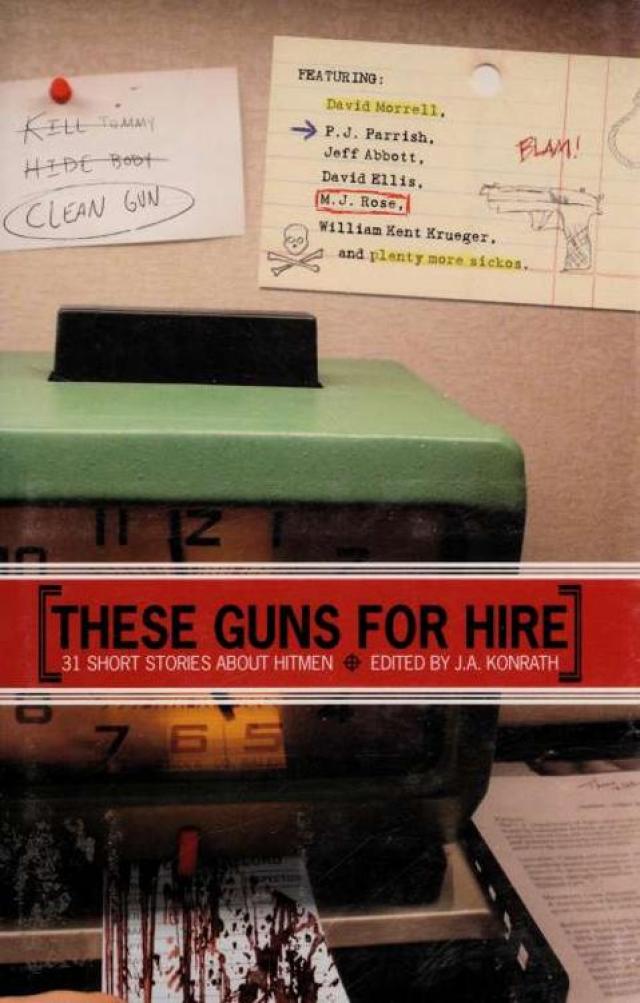
These guns for hire 2006.., p.30
These Guns for Hire (2006) Anthology,
p.30


“Damn. . .ohhh, shit, man, I had a special turtle once myself, name of Gigi. . .when I was just a little tyke.”
“Hey, kill me if you must. . .but don’t fucking mock me. . .You gonna mock what’s real, huh?”
“No, man, seriously. I take that shit serious, OK? Turtle love for a child is too precious.”
“Really?” asked Tino between death gasps.
“When I was like four, maybe five.”
“Damn. . .how about that. Me too. . .same thing. But hey. . .fuck this, shit,” said the Butcher, and he made one final slit across Tino’s throat, taking pity now.
“My turtle’s name was Shane,” came a voice from behind Melvino the Butcher, “named for the part Alan Ladd played in the film. But you know how Shane died? I dissected him alive myself.”
This was what Tino went into eternity with, along with the sure knowledge that the Butcher was at the mercy now of Cowboy Jack from western West Virginia.
And now Tino the Ax Capino awoke in an unmarked grave with a lotta pieces missing. That was his fate, to spend eternity trying to put all the missing pieces—both physical and mental—back together again.
Lying in the dirt, Tino wondered if a search for Loretta out here in the Nether Regions was possible.
He wished Binney Melvino no ill will, and that he might find peace and Gigi again, too.
As to that bastard Cowboy Jack Divine, a man who as a boy would kill his own turtle, Tino had gotten word through the purgatory grapevine that Jack was wanted dead in twenty pieces. Of Sal Capino again had worded the contract placed on Cowboy Jack Divine in the same manner as that put out on Loretta. You see, Sal became pissed at Jack’s unproven results, because Sal had wanted to see all of Tino’s parts for himself before that fool Divine buried them all in a dozen places.
The devil’s in the details.
JOHN GALLIGAN
JOHN Galligan is author of THE NAIL KNOT, THE BLOOD KNOT, and (forthcoming) THE CLINCH KNOT—installments in a fly fishing murder mystery series in which an itinerant trout bum hooked on vodka-Tang, fly casting, and grief tries to take himself out but keeps getting interrupted by other, more interesting deaths.
When asked about assassin fiction, John said: “Hitman stories present both writers and readers some of the most deliciously guilty pleasures in crime fiction. First of all, there is the amorality—the squeaky clean evil—of the hitman’s profession, which when done well comes across as pure refreshment to all of us who live mired in moral complexities. Then, also pleasant, there plays out in these stories a mirror-like inversion of the murder mystery, as we identify for once with the killer and track events up to exactly the point when most other stories start. Finally, here is the guiltiest pleasure of all: In a good hitman story, there comes the chance to revel in pure craft and feel the thrill of a job well done.”
Visit John at www.JohnGalligan.com.
MAN HIT
John Galligan
AS HE DEPLANED at Sea-Tac, Zoichi Oro found himself tempted by many things. He was tempted, at first, to shove through the knot of sluggish Americans laboring up the jetway. This included the temptation to try out some hard-earned Berlitz—excuse me, please—as he elbowed first that fat breast, then that lumpy arm, and finally that wad of crap-ass shoulder luggage that had been twice too big for the overhead bins. But Zoichi Oro restrained himself. He took baby steps. He thought about sex with the sleepy, stumbling college girl who had demanded vegetarian meals. He walked so close behind he could smell her sleepiness, her whiteness—his dry lips wrapped around an unlit Kent.
Then, at last achieving a normal gait in the concourse, Zoichi Oro was tempted by beer and giant sandwiches. But he steered his legs away. At a kiosk, he purchased a green pack of gum, tempted all the while to touch the strange black skin of the hand that made his change. He nearly bought a newspaper-tempted to sit and chew his gum and savor the blocky and simple English of the headlines: Stocks Rise. . .Body Found. . .House Burns, Three Dead. Later, on the airport train, he was tempted to dial his cell phone, call Bando-san maybe, and whisper something about the preposterous size of things, the space, the reckless waste. But instead he gripped the train’s oily silver pole. He loosened his knees just like on the Osaka subway. He set his slim carry-on between his shoes and moved the knuckles of his free hand to within one millimeter of a tall woman’s ass. Shit, she was tall. Taller than a human woman needed to be. Legs like a giraffe. Fine red hairs on the nape of her neck. The woman turned and Zoichi Oro nipped aside the Kent, showing his teeth. He withdrew the hand to his pocket and closed his eyes. If only, he thought. So tedious, Zoichi Oro thought, all the calculations of invisibility and tact, all the disciplines of his dull, dark trade, all the masks of his servant-warrior caste. So strong, the temptation to throw away the idea of a proper and respectable death—the urge to collapse his name to Zorro, buy a nice American gun, and simply shoot the dirty fucker.
Zorro he became then, and in a Tacoma pawn shop the pistol was shockingly easy to buy. But the object seemed unreal for a time, and in the rental sedan, heading east, temptation exchanged itself for the challenge of driving on the wrong side of the car, the wrong side of the road. Zorro settled into five hundred miles of contentment. Delighted with this new kind of danger—trucks as big as Japanese trains, speed limits in the strange and hurtling quantity of miles—Zorro smiled and lit one cigarette with another. He liked any new challenge. He admitted to himself that this property in himself, this rigor, might be lacking in the idea of a pistol blazing at point-blank, a neat bore hole, and instant death. Yes. . .after all, Wakabayashi, his target, would get the clean and artful death he deserved. Annoying as the task might be, Wakabayashi would get his lovely little death poem.
Yet the pistol, as it rode heavily on the seat beside him through Washington, struck Zorro as a beautiful tool. He touched it often. He lifted it—by the handle, then by its long silencer—and then he dropped it back on the seat, enjoying the bounce. Wakabayashi was so simple, he mused, so foolish. Wakabayashi was underclass, the grandson of a comfort woman. He had been a veteran runner, steady and safe. He had carried cash payments from the Osaka road construction contractors to the LDP offices in Tokyo, where the cash had lubricated dam projects and bridge projects and all other manner of costly government make-work. But after twenty years in the business, Wakabayashi had “lost” an envelope. He had claimed he was robbed while waiting for his commuter train. Not long after, though, his ailing mother had replaced her hip and moved into a new, barrier-free mansion in the Saitama countryside, and Wakabayashi had disappeared. Or so the poor fool had thought. Like there was no bounce, mused Zorro, in the working out of things.
Eastern Washington arrived at a pack-of-Kents-and-a-half, and Zorro marveled at the landscape—the almost comic dryland rippling and wrinkling, the purple waves of grain lapping up against the majestic thrust of the Rockies. Finally, he stopped for gas and gum in Idaho and was suddenly, indescribably excited. Never before—never!—had he pumped his own gas. The rush of petroleum thronged through his fist as he stood at the edge of a vast, mountain-rimmed darkness, feeling the weight of the pistol in his jacket pocket, enjoying the smells of gasoline and meatloaf. Once more, keen-eyed Zorro appreciated the headlines of the American newspapers in the boxes across the asphalt. The headlines were short and blunt, accessible to the vocabulary of a junior high school slack like Zorro and unconfused by the hellish grammar of English text books. Stocks Fall. Woman Saved. Mariners Drop Pair. Maybe, Zorro thought, his fascinations were for the boldness, the bluntness, the savage vectors of America herself. He holstered the big gas gun. He started the car. He said to himself Man Drive and smiled.
HE CARRIED A POSTCARD in his breast pocket—from the foolish Wakabayashi to his foolish sister in Gifu. Greetings from Livingston, Montana. The picture amazed him. He had never—never!—so much as heard of a jackalope. And yet there the strange beast was, an enormous homed rodent squatting among stones and shrubbery, just asking to be shot. When he was done gassing up, Zorro parked the car away between the restaurant and a far-off row of train-trucks that idled in soft and looping thrums. He carried the pistol into the dry and hillocky wasteland behind the truck stop. Trash blew. Small birds darted from thick, low grasses. In the chilly twilight, Zorro stalked a hidden draw and flushed a fat, long-tailed bird that flew recklessly into the gathering night. But no jackalopes. Zorro imagined a headline—Man Shoot—and fired six rounds into a dark hump of dirt. He drove on through the night.
In Livingston—this dry and windy place from which stupid Wakabayashi had written his stupid sister—Zorro supplied himself for the job. He bought a fly fishing rod and rubber boots, plus a many-pocketed vest and a hat that embarrassed him. When the clerk made pains to mention a license, Zorro concealed his amusement. There was no license for what he had come to do. He finished his shopping at Yellowstone Ace Hardware: a hibachi grill, charcoal, lighter fluid, petroleum jelly, and a roll of strong silver tape. That afternoon, at the Chico Hot Springs Resort, he rented a room where he could aim the pistol down three floors into the main pool. He felt tempted again. Man Want. He chain-smoked. He chewed gum and spat it out when the taste dimmed. He unpacked—a change of clothes, a cell phone, a carton of Kent filters, and a 1.5-liter bottle of gold-flecked Hana Yama sake from Wakabayashi’s Saitama hometown. By the third night, relief came at last and Zorro was easing into the bath next to his mark, the pistol wrapped in an extra towel that smelled like white clouds and wind over fresh grass. Imagine that, Zorro said to Wakabayashi, two Japanese—and not even real Japanese but the shameful kind, with third-generation Korean passports, the grandchildren of kidnapped whores and slaves—all the way over here, where men could be men, finding themselves in a nice hot bath together. In minutes they were laughing and oath-making and then Wakabayashi, the jolly thief, shared his daily schedule: fish, bathe, drink. Company welcomed at any point.
Umai, said Zorro, resting a hand on the fat, hard towel.
Sweet.
INTO THE INTERSTICES of the following morning leaked temptation again. But Zorro fought like a warrior. He wanted pancakes, meat loaf, mashed potatoes. But he bought gum and stayed slim as a fence rail. He wanted to unzip the smock of the blonde woman behind the gas station register. Instead he took a long and solitary piss on the hillside beside Highway 89, watching cars swoosh by toward Yellowstone Park like targets in a video arcade. It would be so easy. But he settled for another crack at the jackalope. Finding only brush and rocks—Jackalope Hide—he emptied himself with a fast pistol round into a tight little canyon where sparks kicked out and dust flew up and drifted away on the incessant wind.
At last the afternoon arrived and Zorro met Wakabayashi at a bridge on the Shields River. Wakabayashi wanted to play rock, paper, scissors to see who fished upstream and who fished down. Old pros, both men launched scissors. So they went at it again. This time, both rock. Wakabayashi giggled. But in round three, the fool went back to scissors and Zorro smashed him.
“Downstream,” said Zorro.
“Swell guy, you are,” said Wakabayashi.
Zorro, feeling vaguely confused as to what made him swell, or even okay—nothing, he had always heard—went downstream. He flailed the limp rod, getting cigarette smoke up his nose. He hated the way the river pushed him and topped his boots with shocking cold and made him stumble. He saw no fish. For three hours, then, he sat on the rubbled bank, smoking cigarettes from a proper posture and aiming the pistol at skull-sized rocks on opposite shore. By the time Wakabayashi returned to the cars, Zorro waited in the shade under the bridge with the pistol in his pocket and the tall bottle of sake between his knees.
“Now, my friend, we drink?”
He watched Wakabayashi’s eyes light up.
“Yes.”
Zorro had to admit that Wakabayashi was a good drinker. Wakabayashi was a good talker. Wakabayashi was a good man. He hid what should be hidden. He laughed when he should laugh. He emptied his cup like a champion, this sneak-thief who had traded his life for an old woman’s final comforts.
They drank. They drank more. When Zorro looked at Wakabayashi again, he saw a simple man who had simply gotten old. He saw a small-time criminal who had gotten a little tired, a little plump, a little gray—a man who wore his belt right across the middle of a surrendering belly, a man who had attempted to retire, essentially, in a business where there was no retirement. Wakabayashi had slipped the chain, so he thought, of the country that never claimed him.
They drank more still. And yet, in the country that held them, the links owed a debt to the very idea of the chain. There was, therefore, an order to things. And in that order, what Wakabayashi had done could not be tolerated. When at last Wakabayashi closed his eyes and slumped back, Zorro balled a raincoat under his head and made him comfortable among the rocks.
Then, up at the cars, Zorro went to work. He opened Wakabayashi’s door and released the trunk lid. On his back, the trunk latch digging into his spine, Zorro knifed open the seams that held the rear dash panel in place. He exposed the bolts. He twisted off the nuts. When the rear dash was loose, he lifted it into the bright air inside the car. He measured the opening—thumb to pinkie, one and a half spans—and he muttered a prayer of thanks for gum, three weeks of gum—and nothing but.
From his own trunk he removed the hibachi and charcoal. He placed them on the rear floor of Wakabayashi’s car. Carefully, even wistfully, like a man balancing pebbles at a shrine, he prepared the grill. And next was the strong silver tape—all seams sealed except around one back door. He laid a stick across Wakabayashi’s trunk latch, so that not even a strong and sudden wind could shut the lid. And then Zorro returned below the bridge.
Wakabayashi was a good drunk. Outstanding. He trusted Zorro like his own third and fourth legs and he giggled and joked senselessly as they stumbled up through the rocks. Like a child, Wakabayashi curled up on the back seat. He took one look at Zorro—one last grin—and returned to his drunken slumber.
Zorro sat beside him. He touched the pistol in his pocket and reflected soberly that it felt like the plumping of his scrotum. He sighed then. He pulled the door shut and taped the last seam. He removed his shoes and clothes and dropped them through into the trunk. He dropped the tape next, then the lighter fluid. He lit the charcoal and tossed out the lighter. Quickly, taking shallow breaths, he greased himself with petroleum jelly and climbed up into the dash space and pushed and pushed and kinked and strained and at last squirted through with a plop and a cough onto the spare tire. He rolled, reached up and pulled the dash panel down, bolted it back.
Zorro dressed on the edge of the trunk before he closed it. He smelled no smoke. He did not look back at Wakabayashi. But suicide was a nice way to die. Honorable. Real Japanese-style. Taking responsibility for one’s actions. The man’s mother, the silly rest of his family, would be the right kind of sad.
But not Zorro. His sadness bloomed from a seed sowed long ago from a bush ripped and stomped and flung and left to cling and scrap in sidewalk cracks. That was how he and Wakabayashi had been cast, together, against each other. Zorro drove west, drove hard, forgetting to smoke. He felt a strange yearning, a thirst nearly, for the big American rivers that flowed through burgeoning forests, chaining and unchaining beside the highway.
And the temptations came back in force. Zorro was hungry. Zorro was desperately, ravenously hungry. The pistol rode in his fist, but every jackalope resolved into a brush heap, a rock heap, into dead vines around a crumbled fence. Every woman turned lovely and remote under his gaze, cold and safe under glass. Every man loomed big-jawed and aloof and certain of where he had come from and where he went. In the curl of a cloverleaf off the Idaho interstate, Zorro’s guts bent and his head ached. He missed Wakabayashi—a man he didn’t know, a man he had killed—and therefore he knew he must be insane. Therefore he knew he had nothing. No country. No longer any true name, even. Nothing.
It was the same Idaho truck stop, where big trucks idled at a distance and wind pushed fat birds at skidding angles toward the endless western flatlands. Zorro sat in the café and pointed at pictures: meatloaf, mashed potatoes, creamed com, pie. His jacket slung to the right, heavy with the pistol. Baby, he croaked to the waitress, hey you baby. She stared at him, blankfaced, as if he had spoken Korean, or jackalope. But across the room they were smiling his way. They were laughing. Out the window, big bodies slung from big cars and pumped gas and then moved on to home.
Zorro ate. Zorro finished everything and still felt hungry. Zorro went to the restroom and pissed with one hand on his business and one on the pistol in his pocket—and then his circuits connected and the sadness in him fried up hard and hot and in an instant his troubles popped and vanished. It was only three short steps from there to the first of the toilet stalls, and the third of those steps was a high, swift kick above the door latch.
The random traveler inside was too startled to speak. The man sat red-faced and hunched, elbows on thighs, neck tucked between shoulders and a deep furrow in his brow. Zorro aimed for the furrow and hit it perfectly. The pistol coughed through its silencer. The head blew back and the bullet broke tile and the mess slid down.
Zorro closed the toilet door.
He threw the pistol into the big, chaining river.
He drove west. He smoked Camels. He ate pancakes and stayed at Super 8. He understood that he was not going home, that he was in this place now—a newborn man in a new, wide place—and the next morning, under a sky as blue and bright and sharp as ceremony, Zorro’s new papers arrived, framed in a coin-slotted Seattle Times box, amidst the fumes of gasoline and pancakes.
Man Hit.
WILLIAM KENT KRUEGER
WILLIAM Kent Krueger writes the Cork O’Connor mystery series set in Minnesota’s great northwoods. His work has received a number of awards, including the Anthony and Barry Awards for Best First Novel, the Loft-McKnight Fiction Award, and the Minnesota Book Award. Series books include Iron Lake, Boundary Waters, Purgatory Ridge, and Blood Hollow, which received the Anthony Award for Best Novel of 2004.