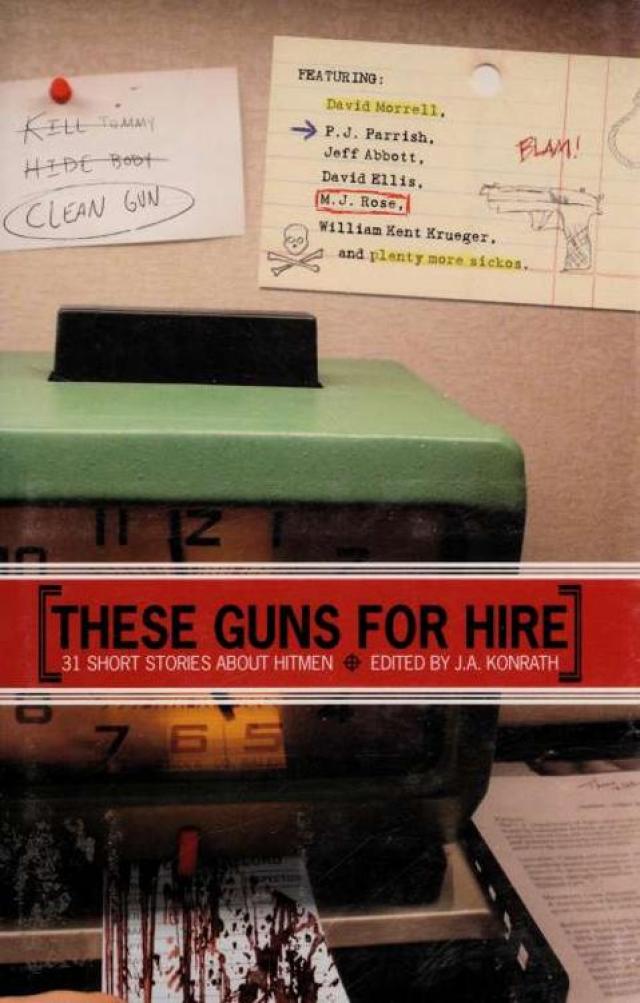
These guns for hire 2006.., p.38
These Guns for Hire (2006) Anthology,
p.38


My back to the woman, I blow the kid a kiss. He winks at me, then forms his hand into a pistol and shoots it at me.
That’s Charlie Watts for you. Always taking a risk. At least he got on the train in time—after getting the call from his colleague, the black kid who was waiting on the train platform for the blonde beauty and me. I assume the woman—whose name is Emily Taylor—wasn’t looking his way when he gestured toward me just now. Charlie always likes to have a little fun, but he’s never blown a job.
WAY I HEARD it, Emily Taylor was a prostitute with a nice, clean-cut suburban white girl’s name. Only Emily wasn’t suburban and wasn’t so clean-cut. She worked as a secretary at a law firm during the day but spent a few evenings a week as a high-class escort, her only client being Victor Cappeletti. You gotta know Victor. He talks. He brags. Especially with the ladies. Point being, he told her things she’s not supposed to know. Things about what he does for a living. Details, too.
They told him—hell, I told him—there are plenty of girls who’d fuck a mobster, stay away from the escorts, the girls who get paid. They’re easier to flip. Emily Taylor was no exception. That’s what the Boss told me, anyway, three weeks ago.
“Feebies got her,” he’d told me. “Probably raided the escort service.”
“How sure are you?” My question had surprised the Boss. That kind of thing usually didn’t matter to me. But they didn’t usually ask me to kill a woman.
When he didn’t convince me, I’d told him, “No, thanks,” and got up and left.
He’d stared at me then, incredulous, maybe offended, too. “No thanks?”
He had someone call me again, two weeks later. “It wasn’t the feds, after all,” the Boss told me, in person, same booth, same restaurant. “It’s the Patanos.”
That changed things. A rival crime family. That meant the woman hadn’t been flipped, hadn’t been forced to work for the government. She’d probably gone to the Patanos, not the other way around, looking to play both sides into a nice payday.
“I don’t want her dead,” the Boss told me. “Just a little action. Put a scare in her.”
That made sense. If she had been working for the G, she could testify at some point and would need to be adiosed. If the Patanos were using her, that wasn’t an issue. An action would be enough.
“You don’t want her dead,” I said. “But you want me?”
“Nobody knows you.” He sat back in the booth. He looked unhappy, having to explain himself. He was the Boss, what he said was the word. But he wasn’t my boss. I flew solo. And that, I realized, was his reasoning. If the Patano family figured out who came down on Emily Taylor, they might come looking for that person. But nobody knew me. Nobody would find me.
“I’ll tell our friend Emily that we know,” I told the Boss, feeling a wave of relief. I wasn’t sure if his decision to scare her, not kill her, was because of my earlier reluctance. I thought that was possible. But I wasn’t sure.
Either way, I was glad.
The Shining Knight felt like the right call. Emily Taylor lived in one of the gigantic apartment buildings on the nearnorth side, so forcing my way into her place wasn’t an option.
And with the Knight, we would let her know how well we knew her routine, how easily we could invade her world.
But the thing I liked most, it kept my options open.
I told the Boss I’d use Charlie Watts. I trusted him, and he knew how to play it.
THE WOMAN AND I walk side by side from the train. She keeps looking behind her, for Charlie and his friend. I keep telling her, the punks aren’t following.
“I really can’t thank you enough.” The woman sighs with relief. “It’s just—something like this happened to me before. I really thought it was going to happen again.”
I don’t follow that up, because I assume that if she wants to elaborate on her history, she will.
“I’ll say this,” she adds. “That’s the last time I take the train.”
She may be right about that. I haven’t decided yet.
“Look, I’ll walk you home, no problem. The guy spooked you. It happens. No need to explain.”
“You have to let me pay you back,” she insists. “I have to give you something.”
We take the steps down off the platform. I say, “You could give me your name.”
The woman eases up a bit, smiles at me tentatively. “Emily,” she says. “Emily Taylor.”
So we’re getting closer on the trust thing.
Diamond Street is all high-rises and taverns, one big agonizing traffic jam of a neighborhood when it’s busy. It’s a Tuesday night so the nightlife is a little slower than usual, but there is still plenty of animation tickling out of the places we pass. Bars are advertising drink specials on stand-up chalkboards or enormous signs across their windows. Some live music blares out of one place, some heavy guitar and a white kid trying to rap. What the hell is a white kid going to rap about? Some bitch at the shopping mall who didn’t put enough sprinkles on his frozen yogurt?
“What do you do?” I ask.
“Oh, I work at a law firm.”
“Oh, so that explains why you’re working so late,” I say. “You’re a lawyer.”
She doesn’t answer. A natural reaction, from her perspective. She just got spooked by a couple of strangers, and now here’s another stranger—albeit her Knight In Shining Armor-asking personal questions.
The shoe-shine patrol is out in force, black kids who throw some polish on your wingtips before you even know it, then charge you five bucks to spread it evenly over your shoes. I sweep my foot away at the last second, avoiding him, and the kid decides I’m not a pushover.
“I’m a lawyer, too,” I say, looking the part in my suit and briefcase. “Walker, Price. You know it?”
Law firms have their own phone directory, to which virtually every law firm subscribes. I did a check and found no law firm named Walker, Price in this city, or anywhere in the state. I stopped counting the number of law firms in this city at five hundred, most of them small, so she shouldn’t be surprised she hasn’t heard of the name.
“We’re small,” I say. “Just ten of us.”
“I’m sorry.” She looks over at me. “I haven’t heard of it.”
“Where do you work?” I ask, knowing that the answer is Addison, Bell, and Myers. A firm of thirty-five lawyers practicing commercial litigation, occupying the nineteenth floor of Bentley Tower.
“Addison, Bell, and Myers,” she tells me. “Actually, I’m only a secretary. My boss is starting a trial next week.”
“Who’s your boss?” I ask, because it seems like the natural thing to ask.
“David Rosencrantz?”
So my research was right. David Rosencrantz was listed as a partner at the firm, and his secretary is Emily Taylor.
“Don’t know him,” I say. “I don’t do much trial work, but I hear you about the late hours.” The only trial work I’ve done is when I was a defendant, and that was twenty-one years ago. One witness had an unfortunate accident, the other a change of memory.
I think about my conversation with the Boss. Just a little action, he’d said. Put a scare in her.
I’d agreed with him then, as he knew I would. He could probably see the relief on my face. I don’t live by too many rules in my profession, and I’ve never set any for my clients. But if I don’t want to do something, I just don’t do it. I’ve never killed a woman and I don’t want to start now. But if what the Boss tells me is true, then this one is bad news. She must have gone to the Patanos, looking for a nice lump of cash in exchange for critical information of some sort. Play in mud, you get muddy.
On the other hand, nothing is black and white. The whole fucking world is gray. I knew a guy with ice in his blood, over a hundred hits to his name, who cried like a baby when his dog had a leg amputated. Tell me that guy was all bad. This one, Emily Taylor, seems nice enough. She had a hand, she played it. It’s not like she was two-timing the Pope. Vic Cappeletti is a mouth-breathing, blood-sucking swine.
But I still haven’t decided what I’m going to do here.
“Oh wait—Addison, Bell, and Myers,” I say, like something just registered. “Jody Franzen works over there. I never met her, but we traded some nasty letters over an employment contract. Boy, she sure was a piece of work. She was tough as nails. How is she to work with?”
Now she should have no doubt about me being a lawyer. Anyone could say that he’s a lawyer. Anyone could make up a phony law-firm name. But who would know a lawyer who works in her law firm?
If she’d asked—which she hasn’t—I’d tell her my name is Jason Conrad. I’ve worked at Walker, Price for the last eleven years. The case I had with Jody Franzen was a potential dispute where I represented a company—I’d rather not say which, thank you—that fired a woman who was friends with Jody Franzen. Jody helped her out as a favor. We avoided litigation by agreeing to a buy-out with a confidentiality clause.
I was feeling pretty good about my story. I’d given it some thought. If I said Jody represented the company, Emily might have asked which one? Companies usually have the same lawyers for years. Emily would expect to recognize the name. So I said I represented the company, and Jody Franzen represented the individual, a friend. The confidentiality clause, too—kept me from sharing details and showing my ignorance.
Hell, I even went so far as to call Jody Franzen, whose phone number was listed in the directory, just to make sure—hanging up, of course, as soon as the lawyer answered the phone.
The wind lifts the hair off my forehead, carries the smell of a barbeque grill. We are getting close to Dillard Street now. Emily Taylor lives at 2459 North Dillard, Apartment 8B. Usually this is when my heart goes cold, because it has to, but this time it escalates, kicking against my shirt.
Emily Taylor has one half of one city block to convince me she should live.
“I don’t know Jody very well,” Emily says to me. “She seems okay, I guess. I live up here.”
“Sure.” My pulse is at full throttle as we turn up Dillard, the frivolous sounds from the bars growing fainter now, the relative darkness of the residential block shrouding us. I work the corner so that when we turn, she’s to my left. While I’m at it, I remove the nine-millimeter, with a silencer, from the back of my belt with my right hand and keep it to my side.
“What would you have done?” she asks me. “If they hadn’t backed down back there?”
“I would have had to defend your honor,” I answer. “I know jujitsu, karate, and a lot of other Asian words.”
She should laugh, but she doesn’t. Maybe she’s still spooked. Maybe I’m not much of a comedian. Wouldn’t be the first time someone told me so.
“I’m over here,” she says, pointing to the brick high-rise near the northeast corner, about twenty floors of condos with a four-stair walk-up and green awning. God, they pack a lot of people into the north side.
We’ve been walking north. Emily Taylor stops at the gate to her building, facing me, as I clasp my hands behind my back. “I’m wondering,” she says. “Maybe you could call me some time.”
I almost laugh. To my right, two guys wearing baseball caps, each holding an open beer can, appear in the doorway of Emily’s apartment building, laughing as they push the door open.
“Great,” I say to Emily, turning a quarter to my right, so the guys coming out don’t know what I have behind my back. I switch the gun to my left hand, tucking my finger behind the trigger.
“Let me give you my card.” Emily reaches into her purse but it spills out of her hands, toppling over on its way to the ground. She squats down as the two guys come out of the building. One guy’s telling the other a joke as they bounce down the steps.
I start with them. I raise the nine-millimeter, with the silencer, and put one between the first guy’s eyes. I kick Emily, who is hunched down, in her shoulder, sending her to the sidewalk. The second guy pulls the same gun as mine out of his jacket but I drop him, too, before he can raise it.
And I’m not even left-handed.
“Stand up,” I tell Emily, the name she’s using. She’s hardly had the chance to react and realizes that any time she had is gone. “And don’t make me nervous with those hands.”
She complies, showing me her palms as she rises. She’s not the shooter, anyway. That’s why she was ducking.
I move close to her face. “Tell me your name, and don’t lie.”
“Bridget,” she says quickly.
“I’m going to let you live, Bridget. You understand? But I want you to tell the Boss a few things. Ready?”
She nods, and says, tentatively, “Ready.”
“One: I turn down any job I want to turn down.”
She says, “You turn down any job you want to turn down,” using the same emphasis, with a little more strength in her voice now. She seems to understand that the messenger gets to breathe.
“Two: Even when I’m putting a scare in someone, I still bring my gun.”
She nods again, repeating it back to me.
“Three,” I say. “Now I’m mad.”
“I can tell.”
I stare at her, then laugh. “Good, Bridget.”
She appraises me, the caution gone from her eyes. “So you’re the man,” she says.
My reputation has preceded me. I imagine she was getting a decent nickel for this job, even as the set-up.
“I’m a man,” I answer. “And so is Jody Franzen.”
I leave her, heading north, wasting no further time. But I swear I see the trace of a smile cross her face before I start running.
J. A. Konrath, These Guns for Hire (2006) Anthology