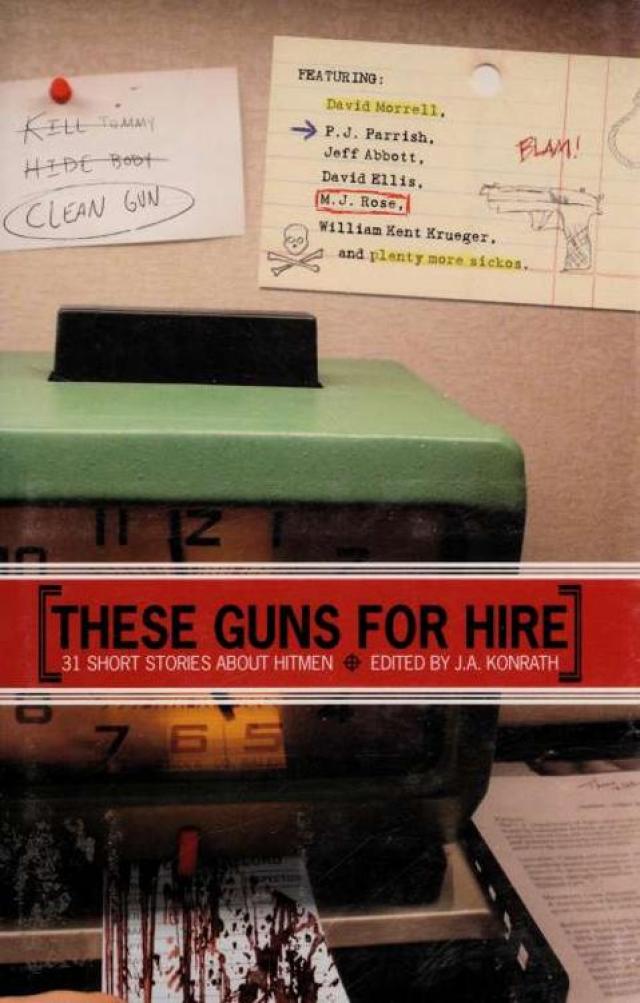
These guns for hire 2006.., p.29
These Guns for Hire (2006) Anthology,
p.29


“That’s what I hear,” Keller said. “He broke a toe.”
“Got his foot stepped on? Is that how it happened?”
“That’s what they’re saying,” Keller said. “He was in a crowded elevator, and nobody knows exactly what happened, whether somebody stepped on his foot or he’d injured it earlier and only noticed it when he put a foot wrong. They figure he’ll be good as new inside of a month.”
“Well, he’s not hurting us now,” the man said, “but Turnbull’s picking up the slack. He really got ahold of that one.”
“Number 398,” Keller said.
“That a fact? Two shy of four hundred, and he’s getting close to the mark for base hits, isn’t he?”
“Four more and he’ll have three thousand.”
“Well, the best of luck to the guy,” the man said, “but does he have to get ’em here?”
“I figure he’ll hit the mark at home in Memphis.”
“Fine with me. Which one? Hits? Homers?”
“Maybe both,” Keller said.
“YOU DIDN’T BRING me one,” the man said.
It was the same fellow he’d sat next to the first time he saw the Tarpons play, and that somehow convinced Keller he was going to see history made. At his first at-bat in the second inning, Floyd Turnbull had hit a grounder that had eyes, somehow picking out a path between the first and second basemen. It had taken a while, the Tarpons were four games into their home stand, playing the first of three with the Yankees, and Turnbull, who’d been a disappointment against Tampa Bay, was nevertheless closing in on the elusive numbers. He had 399 home runs, and that scratch single in the second inning was hit number 2,999.
“I got the last hot dog,” Keller said, “and I’d offer to share it with you, but I never share.”
“I don’t blame you,” the fellow said. “It’s a selfish world.”
Turnbull walked in the bottom of the fourth and struck out on three pitches two innings later, but Keller didn’t care. It was a perfect night to watch a ballgame, and he enjoyed the banter with his companion as much as the drama on the field. The game was a close one, seesawing back and forth, and the Tarpons were two runs down when Turnbull came up in the bottom of the ninth with runners on first and third.
On the first pitch, the man on first broke for second. The throw was high and he slid in under the tag.
“Shit,” Keller’s friend said. “Puts the tying run in scoring position, so you got to do it, but it takes the bat out of Turnbull’s hands, because now they have to put him on, set up the double play.”
And, if the Yankees walked Turnbull, the Tarpon manager would lift him for a pinch runner.
“I was hoping we’d see history made,” the man said, “but it looks like we’ll have to wait a night or two. . .Well, what do you know? Torre’s letting Rivera pitch to him.”
But the Yankee closer only had to throw one pitch. The instant Turnbull swung, you knew the ball was gone. So did Bernie Williams, who just turned and watched the ball sail past him into the upper deck, and Turnbull, who watched from the batter’s box, then jumped into the air, pumping both fists in triumph, before setting out on his circuit of the bases. The whole stadium knew, and the stands erupted with cheers.
Four hundred homers, three thousand hits—and the game was over, and the Tarps had won.
“Storybook finish,” Keller’s friend said, and Keller couldn’t have put it better.
“TRY THAT TEA,” Dot said. “See if it’s all right.”
Keller took a sip of iced tea and sat back in the slat-backed rocking chair. “It’s fine,” he said.
“I was beginning to wonder,” she said, “if I was ever going to see you again. The last time I heard from you there was another hitter on the case, or at least that’s what you thought. I started thinking maybe you were the one he was after, and maybe he took you out.”
“It was the other way around,” Keller said.
“Oh?”
“I didn’t want him getting in the way,” he explained, “and I figured the woman who hired him was a loose cannon. So she slipped and fell and broke her neck in a strip mall parking lot in Cleveland, and the guy she hired—”
“Got his head caught in a vise?”
“That was before I met him. He got all tangled up in some picture wire in Baltimore.”
“And Floyd Turnbull died of natural causes,” Dot said. “Had the biggest night of his life, and it turned out to be the last night of his life.”
“Ironic,” Keller said.
“That’s the word Peter Jennings used. Celebrated, drank too much, went to bed, and choked to death on his own vomit. They had a medical expert on who explained how that happens more often than you’d think. You pass out, and you get nauseated and vomit without recovering consciousness, and if you’re sleeping on your back, you aspirate the stuff and choke on it.”
“And never know what hit you.”
“Of course not,” Dot said, “or you’d do something about it. But I never believe in natural causes, Keller, when you’re in the picture. Except to the extent that you’re a natural cause of death all by yourself.”
“Well,” he said.
“How’d you do it?”
“I just helped nature a little,” he said. “I didn’t have to get him drunk, he did that by himself. I followed him home, and he was all over the road. I was afraid he was going to have an accident.”
“So?”
“Well, suppose he just gets banged around a little? And winds up in the hospital? Anyway, he made it home all right. I gave him time to go to sleep, and he didn’t make it all the way to bed, just passed out on the couch.” He shrugged. “I held a rag over his mouth, and I induced vomiting, and—”
“How? You made him drink warm soapy water?”
“Put a knee in his stomach. It worked, and the vomit didn’t have anywhere to go, because his mouth was covered. Are you sure you want to hear all this?”
“Not as sure as I was a minute ago, but don’t worry about it. He breathed it in and choked on it, end of story. And then?”
“And then I got out of there. What do you mean, ‘and then?’”
“That was a few days ago.”
“Oh,” he said “Well, I went to see a few stamp dealers. Memphis is a good city for stamps. And I wanted to see the rest of the series with the Yankees. The Tarpons all wore black arm bands for Turnbull, but it didn’t do them any good. The Yankees won the last two games.”
“Hurray for our side,” she said. “You want too tell me about it, Keller?”
“Tell you about it? I just told you about it.”
“You were gone a month,” she said, “doing what you could have done in two days, and I thought you might want to explain it to me.”
“The other hitter,” he began, but she was shaking her head.
“Don’t give me ‘the other hitter.’ You could have closed the sale before the other hitter ever turned up.”
“You’re right,” he admitted. “Dot, it was the numbers.”
“The numbers?”
“Four hundred home runs,” he said. “Three thousand hits. I wanted him to do it.”
“Cooperstown,” she said.
“I don’t even know if the numbers’ll get him into the Hall of Fame,” he said, “and I don’t really care about that part of it. I wanted him to get in the record books, four hundred homers and three thousand hits, and I wanted to be able to say I’d been there to see him do it.”
“And to put him away.”
“Well,” he said, “I don’t have to think about that part of it.”
She didn’t say anything for a while. Then she asked him if he wanted more iced tea, and he said he was fine, and she asked him if he’d bought some nice stamps for his collection.
“I got quite a few from Turkey,” he said. “That was a weak spot in my collection, and now it’s a good deal stronger.”
“I guess that’s important.”
“I don’t know,” he said. “It gets harder and harder to say what’s important and what isn’t. Dot, I spent a month watching baseball. There are worse ways to spend your time.”
“I’m sure there are, Keller,” she said. “And sooner or later I’m sure you’ll find them.”
ROBERT W. WALKER
ROB Walker, a graduate of Northwestern University, is the author of forty novels, including the acclaimed Instinct series with FBI Medical Examiner Dr. Jessica Coran, and the Edge series featuring Texas Cherokee Detective Lucas Stonecoat and psychiatrist Meredyth Sanger. He also pens horror fiction under the name Evan Kingsbury. Rob was born in Corinth, Mississippi, and currently resides in Chicago, Illinois. His latest is shadows IN THE WHITE CITY, the sequel to CITY FOR RANSOM.
On the subject of assassins in fiction, Rob comments: “We respond to the individual rugged character of a hitman as the ultimate resourceful soul who lives by his own means, wits, and personal code, eschewing the easy life of rules and regs. Just as we would all like to be Dracula or Superman, capable of superhuman feats, we admire the qualities of those who live on the deep fringes of the outer edge.”
Visit Rob at www.RobertWWalker.com.
PET PROJECT
Robert W. Walker
WHEN TINO THE AX CAPINO looked around in his grave and noticed his missing limbs, ears, nose, genitalia, and other extremities, he said to himself, “What the hell did I do this time?”
It slowly came back to him. Yeah. . .Binney Melvino, aka Binney the Butcher, had played slice and dice with him. He’d begun with Tino’s ears, taking each off one at a time, holding the bloody things up to Tino’s tortured eyes, chanting his name—“Ax. . .Ax. . .the Ax. . .ohhh. . .I’m so scared of the Ax!” Binney then tossed each ear off into the trees. Only justice he saw in this life and it had to be his own body parts being consumed by hungry woodland creatures, from rodents to a red fox that’d made off with one of his feet.
Being a hitman, Tino’s old father used to say, had its bad days, and this was damned bad. It had even started to rain while he was being executed body piece by body piece; hard chinaberry pellets that sting the raw flesh areas.
Sure, he’d brought this down on himself. He recalled pleading with Binney—a useless act of contrition, as good as talking to the bark on the tree that Tino found himself lashed to. Saddest part of all, he was being killed in a vengeance thing that started when he showed a small human spark of pity, an inch of human kindness he’d never before shown. . .pity for a mark.
In all his career as a hitman, no one had ever asked Tino to take out a sniffer dog, a greyhound, a cat, a monkey, a canary, or a horse—or any other animal. But that side of the business had begun to thrive and the money was too good to turn down. These days anything goes, and you couldn’t turn your nose away from the green so easy anymore given the state of the economy.
Tino started out an enforcer, doing odd jobs as a hefty teen while still in Carpenter Elementary. He’d been born with some kind of glandular problem that left him a giant among peers; he’d never fit in, and school simply was not for him. Certainly, not after a third repeat of eighth grade. So he asked his Uncle Sal Capino for full-time work.
Sal took him in, treated him like a son—albeit calling him Quasimodo all the time. Sal sent Tino to another kind of school—The Squash Garden Restaurant, a front for hitman training with an all-assassin faculty. At hitman school, the first thing he learned was to never ever let a single emotion enter into his thinking; he learned to be an automaton able to pull the trigger on anyone anytime anyhow if the bosses handed you a contract to fill.
Tino took to the work like a natural, his only drawback his huge frame—he stuck out in a crowd big time. But he learned to counter this by using his natural gifts, and even his size to throw off a mark. He could work in close when needed. On the surface, he looked the part of a slow, slight retard with a goofy grin no one would take for a mask. But for over fifteen years, he had racked up a record of forty clean kills and seventeen not so clean kills, sending fifty-seven men and a handful of women to their everlasting.
Tino had become highly respected in the business, and the family counted on him whenever a problem arose, until this thing with the iguana came along.
Capino had grown senile, a hitman’s worst nightmare—a boss with senility making bad decisions and taking out contract hits on the basis of unreasonable slights. This time he insisted that Tino take out Carmine Russo’s pet iguana.
Worse yet, he wanted the iguana to die mercilessly and messily—butcher fashion. Piece by piece and all of the bloody remains laid out on Carmine’s bed as a sure warning. Tino had no problem with this, not initially.
But that all changed in one moment; in one blink of emotion. An emotion Big Tino the Ax had not felt since childhood.
Fucking childhood. No matter how far you stray from it, it is always there in the gut of your brain, stuck in your mind like a hard peach pit. It may be covered over, it may be forgotten, unused for what seems forever, but that hard little core, convoluted and unbreakable, is there just waiting for you to reconnect, recall, remember a whiff of a childhood moment of perfection—the perfect starry night, perfect breeze, perfect odor, perfect touch, perfect kiss. And it came that way for Tino—the odor of this iguana filling his brain with memories of Loretta. And startlingly enough, strangely enough, the name on the iguana habitat read Loretta. And how fucking coincidental is that?
At first, he thought it just a cosmic joke, one of those things God did to pass the time—just fucking with us. But then he drew near, and the nearer he got to the iguana’s habitat, the more Loretta overtook his mind. The thing’s odor held pause the huge de-boning knife over his head, and when their eyes met, the liquid beauty of those black eyes were identical to those of the long-remembered, long-bereaved loss.
The fond eyes of Loretta. God how he had loved her; God how he would have sacrificed anything for her. God how he had suffered so much pain on losing Loretta.
Now this dilemma.
He steeled himself. Shake it off, he kept thinking in mantra fashion. This ain’t Loretta. This is a fucking iguana, man, not my lost Loretta from long ago.
“It ain’t nothing personal,” he said to Loretta, but the words were meant for himself; not his today self but his long-forgotten self, that self that remembered. “Can’t let emotions rule. No feelings on the job. It’s just another job.”
He grabbed a willing Loretta, who looked pampered with her pink bow tied about her neck, and in one hand he held her curled, smiling face in the half-light up to his eyes, and their eyes again met. Melting eyes; eyes that had soul. . .eyes that—
He plunged the knife into the creature’s gut as training took over, and those eyes that held him now bulged and pealed back, and an aching keen that sounded like “Whhhy?” escaped Loretta Iguana. Like air slowly exiting a balloon, and the curled smile turned to a crooked sickness, and the seed-lit eyes turned off.
But there was no mutilation. No dismemberment. Tino the Ax gently placed Loretta back in the tank and tucked in her insides.
In doing so he managed to piss off not only Carmine Russo but Uncle Sal Capino, pissed that his Tino, toward whom he’d put so much time and effort, had failed him. Tino hadn’t done the job as told—cut up Loretta in twenty pieces over Carmine’s bed, so the blood spatters would create a kind of Jackson Pollack painting over Carime Russo’s white Russian-made down comforter. Now crazy Uncle Sal had put out a major contract on his nephew’s head—to be filled only if Tino’s carcass were cut into twenty pieces.
Meanwhile, Carmine Russo, pissed that Loretta had been stabbed by someone ballsy enough to get past his bodyguard and into his home, placed a contract out on his life as well.
Chicago, which had always been home for Tino the Ax, a place of familiarity and comfort—like as in comfort zone, as they say-disappeared that night he’d killed Russo’s iguana. He no longer felt at ease in the Windy City. So he had made for parts unknown.
Two hitmen he knew well—Jack Divine, a scar-faced West Virginian who believed John Wayne a Shakespearian actor in cowboy boots and spurs—and Binney Mel vino, the Butcher, who really liked knives and the cleaver. While Tino knew very little of Jack Divine except by reputation as out-of-town muscle, he’d had professional debates over methods and process with Binney. In fact, the two men had an odd, perhaps eerie mutual admiration society going. They appreciated one another’s results.
Thank you, God, it had to’ve been the worst of the two, the Butcher, who had found Tino first.
The Butcher had trained in the same manner as the Ax, and he’d perfected a genuine heartlessness that any sociopath might admire. The Butcher was a hitman’s hitman, a model, a master craftsman, as he felt nothing for anyone, nor for anything animate. He had laughed in Tino’s face as he recounted the pussy thing he had done at Carmine’s when Sal Capino wanted it done in butcher fashion.
“Shoulda offed the fucking Iguana the way you was told, Tino. So tell me, before I kill you, tell me why? Why’d you not slice and dice the damn Iguana like the contract called for? Why, man, why?”
“Why? Why?” Tino spat out blood, amazed he had any left. As Tino heaved up, gasp-driven blood pumped over his lips, yes, but it also pumped from in a hundred rents and tears and little stabs Binney Mel vino had made all over Tino’s body now: genitalia gone, ears, nose, hands gone. “Why, yeah. . .why didn’t I butcher Loretta?”
“The iguana, yeah. . .gotta tell me, Tino. . .why?”
“She reminded me of my own Loretta so damn much, down to how she smelled, man.”
“Whoa. . .really? Reminded you of a woman? I knew it. I told Sal there had to be a woman involved someplace in all this. How else you make sense of it?”
“Whoa up, what woman? My Loretta was accidentally killed when she got out of her aquarium. . .crawled up under the rug and my dad stepped on her.”
“Wait up. . .she was an animal, a pet?”
“W-w-was my pet turtle. Loretta.”