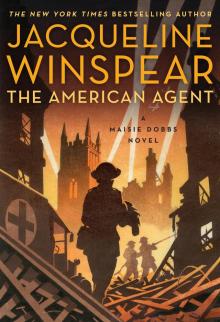
The american agent, p.11
The American Agent,
p.11


“What was he doing? He couldn’t have been just standing there.”
“That’s the funny thing—he was. Just standing there. I had to stop a bit sharpish, in case he saw me. I pulled my cap down a bit, and went on slowly to have a proper gander. He was standing on the other side of the road, just looking at the building as if he was weighing up a few things. Then he turned and walked away into the park—Kingston Gate was right opposite.”
“He was just looking at a house? Do you know who lives there?”
“I do now, because I found out—asked a copper I saw down the street. Turns out it’s the residence of the American ambassador. Joseph Kennedy. I remember when he got the job, and it was all over the papers, what with him and all his family coming over there. There wasn’t anything about that family they didn’t report on.”
“Hmmm. I’m not sure Scott being in that area is something to be surprised about—after all, he works at the embassy.”
“Nothing to be surprised about, perhaps. But the way he was looking—he was thinking. He was looking and thinking. And it seemed to me he looked like you or I might look at a gaff when we’re wondering about the people in there.”
“Billy—”
“You want me to talk to my mate down on Fleet Street, don’t you?”
“I do. Saves us going through a mound of newspapers on a dig to see what we can find. See what he says about the American ambassador. He might be at some risk and Scott is reviewing safety measures in place around his residence. Or maybe he’s responsible for someone who was at the house. I daresay the authorities have increased surveillance around all embassy and consular buildings, given the bombings and so on.”
“Consider it done, miss—I’ve got to say, even though he was outside, it was as if he didn’t want to be seen, yet at the same time he couldn’t care less if he was. I daresay the ambassador himself was not at home—he was probably at the embassy—but Mr. Scott looked like a man who was . . . I dunno, sort of . . . what’s that you’ve said once or twice? Yeah—that’s it. He was hidden in plain sight.” Billy shrugged. “I hope I was—wouldn’t want to think he’d seen me.”
“If he had seen you, you’re in the clear because you had just left a client’s residence. If he mentions it, then tell the truth. At that moment, you were in the area in connection with another job. Anyway, you talk to your friend the newspaperman, and in the meantime, I’m going over to Derry and Toms. I want to have a word or two with Mrs. Lockwood, the woman who lived on the floor directly above Catherine Saxon. Oh, and could you find out if your friend has ever heard of her father, Clarence Saxon, or Catherine’s brothers? It’s probably nothing, but I’d like to know if their names have cropped up in the press over here for any reason. I’m sure all these reporters keep tabs on each other, and they read the New York Herald, and other international newspapers, so you never know, there could be a snippet someone’s heard somewhere.”
“I’m leaving now, miss.”
“Good work, Billy—oh, and Billy—”
“Yes, miss?”
“Look, I cannot promise anything, but Dad and Brenda are spending all their time at the Dower House now, because we have a cellar and they like to know they can get down there when the bombers go over. They feel safer, given their age, and it’s better for Anna, so she has all three of us when I’m there. If you’d like Doreen and Margaret Rose closer but still in the country, I could ask if they can stay at the bungalow. The pub along the street has a big cellar that people in the village are using as a shelter, so it’s handy. There’s a tunnel leading from it that was used by smugglers in the 1700s, and they’ve put mattresses in there for the children—making it into an adventure of sorts.”
“Much obliged, miss. I won’t say anything until you let me know though.” He pushed back his chair, but lingered at the table, fingering the edge of the wallpaper. “Some blimmin’ adventure though, ain’t it?”
“Yes it is, Billy—some blimmin’ adventure. I’ll be back here before I go on duty again at five, so perhaps I’ll see you.”
They were about to leave the office, when Billy reached back to his desk and took up an envelope.
“Sorry, miss, almost forgot! This was delivered by messenger this morning, before you got here—looks like it’s from MacFarlane.”
Maisie took the envelope, ran a finger under the sealed flap and looked inside. She smiled. “Just what I was waiting for, Billy—this will come in handy today.”
Stepping out at the Kensington High Street underground station, Maisie stopped to look at an advertisement for Derry & Toms, then made her way to the department store, housed in a fairly new building Maisie thought was somewhat austere from the outside; it was in the Art Deco style, with bold architectural details reminding her of buildings she’d seen in Munich. Her sojourn in Munich was not a time she wanted to reflect upon, but as it was where she had first met Mark Scott, there seemed to be no escaping the memory. She asked an assistant to direct her to the offices, and made her way to the realm where Mrs. Lockwood worked.
It transpired Pamela Lockwood was a supervisor, and quite a senior one into the bargain. Maisie had no difficulty in asking if she might spare her a few minutes—Lockwood was not required to ask permission of a superior, and Maisie had a new identification card from MacFarlane to support her request. To her surprise she was shown into a private meeting room, where Lockwood asked if she would like a cup of tea.
“Thank you for the offer, Mrs. Lockwood, but I don’t want to take any more of your time than necessary.” Maisie took a seat at the table, while Lockwood sat opposite.
Pamela Lockwood wore a costume of pale rose pink, with a cream silk blouse under the jacket. Her hairstyle was neat and practical, and was similar to Maisie’s—cut to just below the ears, her hair was brushed away from her face in soft waves, then held in place on both sides by silver combs. She wore plain light brown court shoes with a low heel. Maisie wasn’t sure why, but she had imagined her as a woman who would not wear cosmetics, and was a little surprised to note that Pamela Lockwood wore make-up with powder, rouge, mascara and a hint of red lipstick applied to maximum effect. The result was a woman in her mid-forties who would pass for a thirty-year-old with ease.
“First of all, I’m so glad you were able to see me, Mrs. Lockwood—what with the blitzes, everyone vanishes into a shelter as soon as the air raid warning is heard, and it would have otherwise taken me days to speak to you.”
“I’m happy to offer any help I can. I gave a cursory statement to the police, mainly because they didn’t ask me much. I was rather surprised, because even though I might not have had any helpful answers, they didn’t exactly ask a lot of questions.”
“Indeed,” said Maisie. “They’re very busy, which is why this case was handed over to another department fairly quickly. I work on assignment for Scotland Yard, and on this occasion I am required to liaise with a representative of the United States consular service.”
“That makes sense, seeing as Catherine was an American,” said Lockwood. “Now then—fire away!”
“Right. First of all, I want to confirm that you are Mrs. Pamela Lockwood, and you are resident at the same address as the deceased, Miss Catherine Saxon.”
“Yes.”
“And you are a widow.” Maisie looked at her notes, though she could have continued without referring to them.
“My husband was killed in 1918, Miss Dobbs. One day before he was due to come home on leave. Just one day. October 1918 to be precise.”
“I am so sorry—how very sad. So close to the Armistice.”
“Just before the finish line. A single bullet to the right temple, from a sniper. I am inclined to think he was so excited about coming home, he stopped paying attention, as if he’d imagined it so many times, he was already here, so he became careless.”
“I can imagine that. I remember that frisson of anticipation as leave drew near—and feeling as if you were home before you’d even left.” She looked at Lockwood, and as their eyes met, she added, “I was a nurse in France, at a casualty clearing station close to the Belgian border.”
“I rolled bandages in the evenings in the local town hall, though I was helping out with the accounts and orders for my father’s business—well, I should say my parents’ business, because they both worked in the shop. Fortunately, I was able to get a better job after I’d managed to get some proper qualifications under my belt, and then came up here as soon as they moved closer to the coast.”
“Yes, of course.” Maisie cleared her throat. “Tell me when you first met Catherine Saxon.”
“When she moved in—first day, actually. It was a Saturday, so my half day, and I reached the front of the house as a man was unloading her belongings from a van. I think she’d just come from Spain, or France. Might it have been Berlin? I’m not sure. But she told me that many of her things had been stored in the cellars at a friend’s house—another American. Mrs. Barrington—Jenny. Both very nice girls.”
“I’ll come to Jennifer Barrington in a minute. Can you describe your first impressions of Miss Saxon?”
Lockwood nodded. “She was standing outside the house holding a box of books, and laughing with the driver. I don’t know where she’d lived before finding the rooms—I think she spent a few days in an hotel, just a cheap one, when she came from overseas, and she might have stayed at Jenny’s too. She seemed very forthright—put down the box when she saw me, and said, ‘I’m Catherine Saxon—your new neighbor.’ I was a bit taken aback. So my first impression was of someone very confident, as you might expect with an American.”
“Do you know any other Americans, Mrs. Lockwood?”
The woman shook her head. “Only from the pictures. She sort of reminded me of that actress—you know, the one who was in the picture Holiday with Cary Grant.”
“Katharine Hepburn?”
“That’s it. And Cary Grant—he’s British, you know.”
“I didn’t see that picture. I only usually go with my godson, and I don’t think Katharine Hepburn and Cary Grant are quite up his alley. But I know who Katharine Hepburn is. Do you like to go to the pictures?”
Lockwood smiled. It was a broad smile, and Maisie realized it was the first hint of true enthusiasm or connection she’d noticed in the woman. “Oh yes I do—go as much as I can, usually on a Saturday afternoon, when the shop closes, though with the bombing, you never know what’s going to happen. It’s like stepping into another world at the pictures—away from all this.”
“Yes, I suppose it is,” said Maisie. “Would you say you had a friendship with Miss Saxon?”
“Not really.” Lockwood looked away, her gaze directed out of the window. “We were cordial, but not pally. The woman on the lower ground floor, under Mrs. Marsh—Isabel—she would sometimes invite us all down to her flat for a cup of tea on a Saturday or Sunday afternoon, and of course it was very nice, having a chat. But Catherine would badger Isabel—Miss Chalmers—about her job, and she pushed it a bit too far if you ask me. In fact, I had a word with her about it once, on the way back upstairs. I said, ‘Cath, you should just wind your neck in. Isabel works for the government, and even if she’s only licking stamps, she wouldn’t be able to tell you if it was a penny stamp or a ha’apenny stamp.’ She just laughed and said, ‘Oh, I’m only teasing her.’ But I don’t think she was teasing at all. She was looking for something to write about, or after getting someone on the inside of government to bring her information that no other reporter could get, and she thought a secretary was the way to go about it. She was ambitious—and she wanted so much to be on the wireless. That’s why she picked up with that engineer, I would imagine—she thought she could get in that way. But as it happened, that American man gave her the chance she wanted anyway. And then she was dead.”
“Yes, the engineer,” said Maisie, looking at the notes Scott gave her at lunch. “Do you mean Bob Walkinshaw? Australian?”
“That’s him. Came over in 1915 with the ANZACS and ended up staying because he’d married here. Nice man—met him once when he came to see Cath. And before you ask, I don’t think they were having an affair, though he might have had a bit of a crush on her. He was very chummy—like they are, the Australians.”
“Did you get the impression he might have wanted more from Catherine?”
Lockwood shrugged. “I think if she’d been game for it, he wouldn’t have looked back. Not that she wasn’t nice to him—when I saw them a few times, she always had her arm through his, and she was giggling like a schoolgirl. I’m told men like that sort of thing, but I’ve always thought it demeaning for a woman.”
Maisie regarded Pamela Lockwood, the set of her jaw as she completed her observation. Demeaning was a word she uttered as if she could see it inscribed in capital letters before her, and had underlined it to emphasize a point.
Lockwood continued. “Cath seemed to have a few men friends. But she wasn’t flirty.” She tapped the table, as if to emphasize a point. “She wasn’t that sort of girl. But she had a light about her, and a person with that light attracts all sorts, wouldn’t you agree?” She didn’t wait for Maisie to answer, but went on. “And I’ve got to give it to her, she really worked hard. I heard her on the doorstep one evening saying, ‘Scotty, I don’t have time to talk to you now. I have to work—it’s really important. I’ll call you tomorrow.’”
“Scotty?” Maisie looked up at Pamela Lockwood.
The woman shrugged. “Didn’t see him and didn’t hear him, so I don’t know who he was. Just another stage-door Johnny.”
“Stage-door Johnny?” repeated Maisie.
“Oh, just something Polly said about Cath’s admirers—the stage-door Johnnies, she called them. And being an actress, she would know, though I think she spends more time serving drinks than treading the boards!”
“Can you tell me anything else about her friends, or anyone else who visited her?”
Lockwood shook her head, then seemed thoughtful, gazing out of the window again. “Not that he was an admirer—well, I suppose he might have been—but she was very excited about the American airman she’d interviewed. Apparently there are quite a few over here, and she wanted to write about them, just to let people know at home that there are some Americans who are doing their bit for us.”
“Do you know his name?”
Lockwood shook her head, then glanced at her watch.
“Just a couple more questions, Mrs. Lockwood.” Maisie consulted her notes, then met Lockwood’s eyes again. “On the morning of her death, did you hear any noise coming from Miss Saxon’s flat? After all, it was just below yours, and it seems sound travels a fair bit in that house.”
“It does, but I wasn’t there—I’d gone down to the shelter here at work. I wasn’t going to be blown out of my bed by the bloody Germans.”
“Of course.” Maisie closed her notebook. “Mrs. Lockwood, I wonder, would you be so kind as to get in touch if you think of anything pertinent to my investigation? I am sure you want to see Miss Saxon’s killer brought to justice. And I might have to return to you to ask a couple more questions.”
“All right.” Lockwood came to her feet, turning to pull away her chair and stepping toward the door.
“Thank you for your time,” said Maisie.
Lockwood nodded, though this time their eyes did not meet. “Follow me—I’ll show you to the lifts.”
As they reached the lift, Lockwood pressed a button on the wall, then paid attention to her cuff, brushing her fingers against it as if to remove a speck of lint.
“I do have one more question,” said Maisie. “Do you have trouble with the windows in your rooms? Do they stick, or not close properly?”
She nodded by way of reply. “Cold in winter, with that draft coming through. But it’s an old house. I bought some tape last year to try to keep the wind out. Did a fairly good job. Offered some to Cath, actually, and she said, ‘Oh, Pam, how can I let the guys in if my windows are taped!’” She always had to make something of it, that she attracted men—even if she wasn’t a big flirt. She had to let you know she was special.” Lockwood looked up at the series of numbers above the lift. “Here you are. You’ll know your way from here.”
Maisie watched Pamela Lockwood walk away along the corridor, then stepped into the lift bound for the ground floor.
The underground station was just a few minutes’ walk along the street, but Maisie wanted to sit and think, to consider the interview she’d just conducted, so having consulted her watch she decided to go to a nearby café instead. She ordered a strong coffee, though she knew it would not be quite the same flavorful blend she brought from the importers in Tunbridge Wells. This coffee would be laced with chicory, and would require hot milk to render it drinkable. Maurice’s love of good coffee had spoiled her from an early age, but she felt a need for sustenance if she were to have the energy required on the ambulance runs this evening. The coffee came with hot milk, along with her order of a round of Welsh Rarebit and an Eccles cake for something sweet before she set off again.
The questions leveled at Pamela Lockwood were innocuous enough. Her answers offered a mix of information Maisie had to hand. In Catherine Saxon, she already had a picture of a woman set on adventure, yet tempered with a certain understanding of the reality of her work, and the compassion to tell a story created to touch the hearts of her readers—or the listeners she wanted to reach. Maisie leaned against the back of her seat by the window, watching passers-by as she sipped the coffee and reached for the Eccles cake. Silver barrage balloons swayed in the sky above, sandbags protected people from broken glass should a window be blown out by a bomb blast, and gas masks in their shoulder-strap boxes bumped against the hips of those who remembered to bring them to work in the morning. Pamela Lockwood was busy in her office, immaculate in her rose pink costume, and with her coiffed hair. It was clear she had both regard for Catherine Saxon and an accompanying disapproval. But then, didn’t the characters Katharine Hepburn brought to the silver screen also draw an element of disapproval? The widowed Lockwood would know, being an enthusiastic follower of the pictures who would go on Saturday afternoons to escape loneliness. Maisie had felt Lockwood’s isolation as if it were a vapor that enveloped her; it was a solitariness, an aura of abandonment she sensed in one who had imagined a future with a husband and children, a family home with a dog, and a garden with swings.