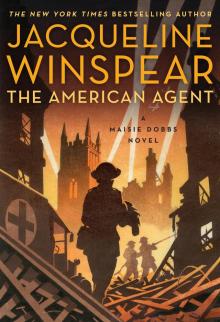
The american agent, p.25
The American Agent,
p.25


“You’re absolutely right, Billy, and—”
“And if someone killed her because of something she knew—or even someone she knew—what would they have done? They would have taken letters before anything else, either to read or destroy. Or both. And there might have been something about the killer in those letters.” Billy shrugged. “I dunno, I just think that in this case the fact that any letters addressed to her weren’t in the rooms means they were taken to protect someone.”
“It’s a fair observation,” said Maisie.
They had reached the square. “Let me have that knife now. I’ve just looked at the time. I’m going to try to find out more about Amelia Saxon, and where I can telephone her. You’d better be off, Billy—you’ll be late for duty.”
Billy handed Maisie the knife, and went on his way with, “See you tomorrow,” and a wave. Maisie proceeded to the office, and was a little disappointed to find it had not been broken into and a man named Mark Scott was not waiting with a witty comment about security at her place of work. She realized that she missed him.
Robert MacFarlane listened to Maisie’s request, and the information regarding Amelia Saxon’s living arrangements, which were apart from her husband. “And you say she was over here?” said MacFarlane.
“I do hope you’re not trying to pull the wool over my eyes, Robbie,” said Maisie, holding the telephone receiver awkwardly in her bandaged hand.
“No—by now I would have added a quip. I’m as surprised as you are. Perhaps our friend—well, should I say your friend—at the American embassy will have more information regarding Mrs. Saxon’s sojourn with her daughter.”
“What was that supposed to mean, Robbie? The emphasis on ‘your friend’?”
“Nothing, Maisie. Nothing, hen—but you probably know that we know he was in Kent for a day or two.”
“And he stayed at the Dower House because he left it too late to drive back to London—he slept in the conservatory, which I know you’ve seen before.”
“All right, all right—keep your bonnet in place. My, my—the lady doth protest too much!”
“Robbie—I want to make a telephone call to America—it’s crucial I speak to Amelia Saxon. I can’t do it because as we both know, trunk calls out of the country have been stopped. But you can make the call.”
MacFarlane was silent.
“Robbie?”
“I’m here, I’m here. Just thinking. I’ll arrange it for you—but remember they’re a bit behind us, over in America. And I suppose you could say in more ways than one, when it comes to this war. We have to allow five hours. Go home now—I’ll telephone you later with the arrangements.” There was a pause. She heard him yawn. “Sorry about that, hen—long days are catching up with me.”
“You’re not as young as you were, Robbie.”
“Ah, but what I’ve lost in stamina, I’ve made up for in wisdom. And before you say it—I know I’ve gained a few inches around the girth too. Are you going to brief me on your investigation?”
Maisie summarized her most recent findings, and voiced her frustration.
“Process of elimination, Maisie. Who can you rule out?”
“I think I can rule out Isabel Chalmers.”
“That’s a relief. I don’t know what we’d do without that one—doing a good job for us.”
“I didn’t know she worked directly for you, Robbie.”
“I’ve a finger in a few pies.”
“I’m sure you have. Anyway, I would say the girls on the top floor—they were useful though, giving me some very vital information.”
“How vital?”
“I believe I have the murder weapon—and it’s right here on my desk.”
“You what? Why didn’t you say?”
“I’m taking it over to the pathologist right now. I believe he’s working late, as usual.”
“I’ll telephone him to tell him to stay where he bloody well is. And I’ll see you there. Does the Yank know?”
“I have no idea where he is.”
“Probably keeping an eye on his ambassador.”
“What do you mean, Robbie? What’s going on?”
“Nothing. You’ve got enough on your plate. I’ll see you at Ferguson’s.”
The air raid siren had already sounded by the time Maisie and MacFarlane arrived at the pathologist’s office. Maisie handed over the knife.
“Hmmm, shorter blade than I might have expected.”
“Does that rule it out?” asked Maisie.
He shook his head. “Not at all—in fact, it makes it easier to handle, and it’s still sleek.” He turned away from her, crouched a little, and with the knife in his hand struck out into thin air, sweeping the blade from right to left.
“You still think the killer was left-handed,” said Maisie.
“I do. And if he used the knife in a motion such as the one I’ve just demonstrated, he’d get more heft because he’s using the outside muscle on the upper arm, and not the inner muscle. It’s instinctive,” said MacFarlane.”
“Yes, I know that. I just wonder if that’s how he used it.”
Ferguson nodded. “Always room for error, Miss Dobbs.” He held the knife under a long-stemmed magnifying glass screwed to the desk. “It’s a nice, easily controlled knife and it’s been sharpened a lot, which of course suggests it was used for pencils, as you suspected.” He sighed, and pushed the glass away, balancing the knife with one finger at the midpoint between the silver handle and steel blade. “Pity she left it on her desk—it’s the perfect murder weapon for someone who’d just lost their temper.” He turned to MacFarlane and Maisie. “And I believe it was a loss of temper—because in my experience, the murderers who plan ahead bring a different kind of knife with them. Something a professional would use—a flick knife, or a knife with a longer blade, something sharpened up for the Sunday roast, or a shorter knife with a serrated edge. People who plan to kill will use a knife they feel a sort of comfort with. A fishing knife’s another one. And remember, killing someone with a knife isn’t as easy as the pictures make it look—takes strength.”
“But here’s the other thing—the blood,” said Maisie.
“There was plenty of blood,” said MacFarlane.
“There wasn’t much spray. And if the killer was in front of Miss Saxon, as Dr. Ferguson has just demonstrated, then he—or she—would have been drenched, surely.” Maisie looked from one to the other. “I’m sorry to come back to this, but there is the question of an attempt to kill her perhaps just seconds before the stabbing—someone had tried to strangle her. Would that have reduced the blood sprayed?”
“If she were already dead or almost dead, it could have,” said the pathologist. He rubbed his chin. “Or if she had monumentally low blood pressure exacerbated by fear.”
“She didn’t sound like the fearful sort to me,” said MacFarlane.
“She was doubtless good at controlling it,” said Maisie. “She’d been in some scrapes in her time, Robbie, so I daresay she was used to carrying on despite being terrified on many occasions.” She looked from one man to the other. “Given the amount of time that has now elapsed between the death and this very moment, I think we have to make a few leaps of faith. We are assuming that this knife is the murder weapon. We are also considering the fact that she may have had a lowered blood pressure leading to a reduced—by just enough—loss of blood. And I am going to suggest her killer had a motor car outside, so he could leave without anyone seeing blood on his clothing or hands, because I doubt there was time for a wash and brush-up.”
“But the blackout—” said MacFarlane.
“Wasn’t so black, because London was burning, and at about half past four in the morning there were a few motor cars on the roads—not many, but they were there. The killer might have gone only so far—perhaps to Regent’s Park—before setting off for another place, though I suspect his destination would be home. After all, an animal is always drawn back to the lair when in trouble. And there’s another scenario.”
“What’s that?” asked MacFarlane.
“Perhaps the killer only had to run upstairs, or downstairs, or across the road, or up the street to be home.”
On the instructions of Robert MacFarlane, Maisie was taken to her flat in Holland Park by his driver in a government vehicle. The nighttime blitz continued, with the sky illuminated by fire and searchlights. She thanked the driver and was taking the key from her bag as she walked toward the front door, when she realized the blackout curtains in her downstairs flat had been drawn. She stopped for a second or two, then walked on, slipping her key in the lock and entering her home, knowing she would not be alone. The low sound of a blues number playing on her gramophone seemed to come in waves from the sitting room overlooking the garden, though no garden was visible in the blackout. She walked into the room, then stepped back into the hallway to the small kitchen, where Mark Scott was pouring two glasses of wine.
“I thought your record collection might be missing a beat or two, so I brought something of my own along. And some good wine, and with it a whole meal from Pete’s—he wrapped it for me and gave me very strict instructions about warming it for us.” He looked up at Maisie. “Please don’t ask me how I gained entrance to your castle, fair lady.”
“I wasn’t going to. If they ever kick you out of the Justice Department or the embassy, you could do well as a cat burglar.”
“At least I have a certain skill in knowing which house is worth breaking into,” said Scott, as he took her in his arms.
And as they kissed, Maisie felt unsteady. Whether she was prepared for it or not, Mark Scott had broken into her heart.
Chapter 16
A railway journey could be a double-edged sword, thought Maisie as the train passed through Clapham Junction. There was something about the rhythm, the side-to-side movement, and the pace of the journey that seemed to facilitate deeper thought. If she harnessed those thoughts and only allowed consideration of the Catherine Saxon murder case, the opportunity to reconsider all possible scenarios leading to the attack on her life could be fruitful. But this morning, it seemed she had no dominion over her mind, which seemed to be filled with the question: What should she do about Mark Scott? And of course, Anna was at the heart of her concern. Beyond the window, smoke was rising up above barrage balloons, and she admonished herself for selfishly considering a dilemma of a personal nature when so many civilians had been killed and injured and thousands were without a roof over their heads.
If she was to prepare for her visit to the Tucker home in Haywards Heath, she would have to concentrate. And to do that, she would write down her feelings about Mark Scott and then put them aside and not favor him with another thought for the rest of the day. She remembered Maurice, after the Armistice, asking her if she had planned to visit Simon, her first love, a young man who was expected be in an “old soldiers” hospital for the rest of his life, his mind shattered following a brain injury sustained when the casualty clearing station where they were working came under attack. Maisie had recovered from her own physical wounds, though those to her soul still ached at times. When she demurred, deflecting the question, Maurice had said, as if to himself, “War has such a strange alliance with the heart’s deepest feelings. It can make people fear the intimacy of love, and it can lead them to search for it, as if the poor heart clamors to be held through the worst of times, yet is paralyzed through the fear that the pain of separation will be more unbearable than death.”
Were she and Scott being pulled together by war? By death and destruction seen every single day? Was whatever they felt an affirmation of life itself at a time when so much was being lost? Or were they romantic conveniences for one another; emotional crutches grabbed to get them through the war, while it lasted? And what right did she have to fall in love when she was claiming responsibility for a child, a wonderful, dear child she adored? Already Anna had inquired after him. “Is Mr. Scott coming with you on Thursday?” she’d asked when Maisie telephoned the house that very morning. And she had replied that she doubted it, as he was someone she worked with, and was not a friend—and he was terribly busy.
She had to put a stop to this affair right now. There was too much at stake, not least Anna’s happiness. And what game did she think she was playing, entering into an affair with a man who would be upping sticks and moving back to a country thousands of miles away just as soon as whatever it was he was doing in England was done? She would speak to him that very evening. Put her foot down. This fledgling affair must end. Now.
Maisie looked out of the window at fields and farms. She began to reflect on questions she had planned to ask the Tuckers, but was interrupted by a nagging thought, one that now repeated itself time and again. What right do I have to fall in love? Had she really asked herself that question? Yes, she had, and now she had made a confession to herself, using the words that counted—she was in love with Mark Scott. Perhaps she always had been, in a way, even when she first met him in Munich, and put a gun to his throat.
“Miss Dobbs. Glad to see you’re on time.” Mr. Tucker answered the door, stepped aside for Maisie to enter, and having extended the chain of his gold watch as if to very visibly demonstrate a certain respect for punctuality, he replaced the watch in his waistcoat pocket. “As you might imagine, I would usually be in my London office, so it’s fortunate I have taken a day off and we were able to meet. I have only a short time to discuss this business with you, as I have another pressing appointment. Please follow me.”
A housekeeper stepped aside as Tucker led Maisie to the drawing room, and having invited her to be seated on a sofa covered with a fabric printed with red and gold cabbage roses, gave the housekeeper instructions to find Mrs. Tucker and also to bring a pot of tea and some biscuits, refreshment for the visitor.
“The tea will doubtless be weak and insipid, given our adherence to the mere two ounces we’re allowed per person, per week, but it will be wet and warm, as the saying goes.” Tucker took a seat in a wing chair opposite Maisie.
He was a man who at first seemed tall, but when she had stood beside him, Maisie realized it was his slender frame and choice of clothing that gave the impression of height. Tucker—she did not yet know his Christian name—wore a pinstripe suit of dark blue, with a waistcoat, white shirt and navy tie. His shoes were polished to a shine. His hair had receded to reveal a high forehead, and his eyes were dark blue. Lines around his eyes and mouth, and loose skin on his cheeks seemed to suggest a man who had known illness in recent years, but had never regained the weight of previous good health.
“I’m so sorry, dear—I was in the greenhouse, and completely forgot Miss Dobbs was coming.” As Mrs. Tucker entered the room, Maisie stood up to greet her and formally introduce herself. Scurrying was the word that entered Maisie’s head as the woman approached her.
“It’s so good of you to see me, though I should perhaps have come sooner,” said Maisie, taking a hand that was still damp, as if the women had hurriedly washed her soiled hands and had no time to dry them properly.
“Well, it’s probably difficult, what with the bombs dropping on London right, left and center,” said Mrs. Tucker.
“Yes, quite, though I would certainly have appreciated an earlier meeting, because we’re anxious to let the rooms out as soon as possible,” said Tucker. “And do sit down again, Miss Dobbs—you, too, Beryl. Sit down.” Tucker unbuttoned his jacket and took his place in the armchair again.
Maisie was just about to put her first question to Beryl Tucker and her husband, when the housekeeper entered with a tea trolley. Tucker sighed audibly and, crossing his legs, turned away from the women as if to demonstrate his frustration. After the housekeeper left and Beryl Tucker had furnished her husband and Maisie with cups of tea, Maisie took a sip and placed her cup and saucer on the side table next to the sofa.
“May I begin by asking you how long you’ve owned the house on Welbeck Street?”
Beryl Tucker spoke first. “Yes, of course, it was twenty years ago, I inherited it from my uncle, so it was—”
“It was only seventeen years ago, Beryl, so if you’re going to answer the questions, probably best to get them right,” said Tucker, still not turning toward Maisie or his wife.
“But—oh, anyway,” said Mrs. Tucker, “it was when John and Eunice were children, and I would not wish to contradict you, dear, but it must have been twenty years ago, because Eunice is thirty now, and she was about ten when we moved in.”
“Beryl—”
“Yes, I’m glad you mentioned your children, Mrs. Tucker,” said Maisie, circumventing the sharp rebuke she anticipated Tucker was about to aim at his wife. “You have two, is that right?”
“Yes,” said Beryl Tucker, before looking down at her hands. “Well—”
“We had two children, Miss Dobbs,” interjected Tucker. “But now we have one. Jeremy, our son, died several years ago, I’m afraid. An event still very difficult to bear in this household, so it’s one we do not linger upon in conversation.”
“Quite, yes, I understand,” said Maisie. Then, as if to inspire an element of connection with Beryl Tucker, she added, “I am a widow, Mrs. Tucker. My husband was killed in a flying accident several years ago, so I understand something of how you must feel.” She paused. “And I also lost a child.”
Beryl Tucker’s eyes filled with tears. She took a handkerchief from the sleeve of her cardigan and dabbed her nose.
“But let’s continue,” said Maisie. “So, you inherited the house—and it sounds as if you lived there, at least for a while.”
“I decided to take advantage of living in London whilst I became more established in the banking industry, Miss Dobbs,” said Tucker. “We moved to Haywards Heath ten years ago. As you know, there is a very good train service to London from here—when there are no bombs dropping, anyway. Furthermore, I decided to make arrangements to let the rooms out on each floor, and to that end our housekeeper, Mrs. Marsh, remained there as the de facto landlady—she rather preferred to live in London—and a firm of accountants deal with the rent. Such an arrangement is to my advantage.”