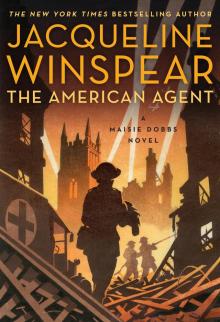
The american agent, p.29
The American Agent,
p.29


Maisie looked at the photograph and uttered the words “Thank you” aloud.
“What’s that, miss?” said Billy, who had just walked into the office.
“Talking to myself, Billy. Everything all right?”
“Still got a roof on the house, so nothing to worry about,” said Billy. “What’ve you got there, miss?”
“Have a look at these.”
Billy took up the photographs and studied them while Maisie rolled out the case map and with a red crayon began making final links one person to the other. Still holding the photographs, her assistant joined her.
“Makes me wonder what people like us did before cameras,” said Billy, placing the photographs on the case map.
“Several possibilities, I suppose. Investigators had to find even more clues to elicit a confession, or to give the prosecuting counsel enough evidence. Or, indeed, the perpetrators of crimes walked away free, either by dint of a jury conclusion or simply escape. Or the wrong person was sent down. I’m sure there are many other variables. And it’s the same for many of the tools we and the police have at our disposal today—fingerprinting has been with us for a while now, for example.”
“Hmmm. You might have these, but you’ve still to get more solid information, and a confession.”
“I know.” Maisie turned to Billy. “That’s what I’m going to endeavor to accomplish today. And I would like you to do something for me too.”
“That’s what I’m here for,” said Billy.
Maisie took her notebook, scribbled a name and a London address, and tore out the leaf of paper. “It’s the tedious end of the job, actually. I want you to go to this address and to keep tabs on this man. I’ll brief you regarding his appearance—he’s quite distinctive. You will know when your job is done—but while you’re there, you’ll have to keep your eyes peeled.”
Billy took the note, glancing at the information. “Makes it easier with those buildings covered in sandbags, because you can see people going in and out—they’re like rabbits climbing out of the burrow. And I’ll be the wily fox!” He looked up, grinning at his own joke, then became more serious. “What about Mr. Scott? Is he going to be there?”
Maisie shook her head. “He has embassy business to deal with, so I would think not. However, dependent upon how this morning proceeds, his presence will be required sooner or later.”
“You off now, miss?”
“Yes, I am.”
“And what about Mr. MacFarlane? Anyone can get nasty when they’re backed into a corner, so I hope he’s going to be with you.”
“MacFarlane will be close to hand—that’s the plan anyway.”
“All right then.” He paused, fingering the note Maisie had given him bearing a London name and address. “You take care of yourself, miss—remember little Anna.”
Maisie met Billy’s gaze. “I never forget her, Billy. Not for even one minute of the day.”
Maisie believed fate to be on her side when she arrived at the mansion in Green Street. The family’s nanny was just leaving the house, having placed the little boy in a pushchair for their morning walk. Maisie wondered again why the family—or at least mother and son—had not been sent to the country, but perhaps they had not wanted to be apart from the father. Taking the opportunity, Maisie approached the nanny before she had a chance to move off along the street.
“Oh hello—I was just about to knock on the door, when I saw you with little Charlie. How is he today?” Before the nanny could reply, Maisie knelt down and smiled at the child. “Are you taking your teddy to the park for a walk?”
“Master Charlie takes teddy with him everywhere,” said the nanny.
“His leg’s gone,” said the child, holding out the toy.
“Oh my goodness—where did he lose it?” asked Maisie, still kneeling alongside the child.
“He’s a soldier,” said the boy, pushing fair hair out of his eyes with a dimpled hand.
“And a very brave soldier he is too! You’d better take him to the park now,” said Maisie, standing up. “Sorry to keep you,” she said to the nanny. “Have a lovely walk.”
“Oh we shan’t be long now, just enough to tire him out a bit,” said the nanny, wishing Maisie good day.
Maisie watched the nanny as she pushed her charge along the street and, feeling the unwelcome flutter of nerves in her stomach, held her hand to her waist, took a deep breath and turned to the door. She rang the bell and waited.
Jennifer Barrington answered the door herself, greeting Maisie with a smile that went no farther than her lips.
“Miss Dobbs—what a surprise. Have you news?”
Maisie nodded. “Let’s go into the house—we can talk about it there.”
“Of course.” Barrington stepped aside for Maisie to enter, and having closed the door led her to the drawing room. “Please take a seat,” she said, indicating a chair opposite her own—the morning newspaper was draped across the arm. “Now, tell me what’s happened.”
Maisie looked at Jennifer Barrington, and for one second thought she might simply get up, say it was nothing, she was mistaken, and then she would walk out and never have to see the woman again. But she had come this far, and it was better she be the person to do this job than MacFarlane. MacFarlane could be heavy-handed.
“Mrs. Barrington—Jenny, if I may.” She took a deep breath. “I have a job that at times is very difficult, as you know. Some murder cases are the result of what we might call a crime passionnel—a person is killed in a moment of anger, of passion—and some are murdered by a person with a premeditated intention to end a life.”
“I’m sure I don’t require a description of your work, Miss Dobbs,” said Barrington, her smile tight. “I know the business of reporting as much as Catherine, and while I did not leap into exploits quite as adventurous or dangerous as hers, I am fully aware of what might inspire a person to kill.”
Maisie nodded. “Yes, I believe you do. Jenny, let me tell you what I have concluded. You loved Catherine very much, as if she were your sister—and indeed, you said as much yourself, that you were often taken for sisters, even twins, weren’t you? You would have gone to her aid anywhere in the world, if she needed you, and she would have come to your side if you were in trouble, I’m sure. And you went to her in Spain, when she was about to give birth. The child’s father had been killed, and Catherine suffered quite serious illness in the latter months of pregnancy following his death.”
“Please—”
“Let me finish, Jenny. Let me finish because if it’s not me recounting this story that you know so intimately, then it will be someone else. It’s much better if it’s me, now, before you have to hear or repeat it again, which will happen in due course.” Maisie paused, gathered her thoughts, and continued. “Catherine had a difficult birth and was very unwell following the delivery. The baby’s health was compromised, but you would not let him die, because you had held him in your arms, you’d felt his little body against yours, and you did everything in your power to keep him alive. But Catherine was tired, already drained from the loss she’d suffered, and from the delivery, and she was not in a position physically or emotionally to care for her son, and she told you she didn’t want the baby. Indeed, I would imagine she believed she would never be able to so much as hold her boy, and I can see her turning away from him, such was her state of mind. So you came to the conclusion—because you knew her—that when she recovered, she would be the same old Catherine, seeking adventure, not in a position to mother a child. And this dear boy was a gift for you, in a way—wasn’t he? I suspect because your husband could not father a child. I believe you made the decision to remain overseas at that point—you had to give Catherine a chance to change her mind, after all, though she continued to be more focused on making a name for herself. Catherine still wanted to prove herself in a realm other than motherhood. And your husband—who saw this as his opportunity to provide an heir to the family business, as well as to assuage any comments from other men regarding his ability to sire a son—arranged for you to bide your time abroad until you could come home with a babe in arms. Was it Switzerland, Jenny?”
Jenny Barrington nodded.
“I thought it might have been. The problems really started when Catherine came to London, didn’t they? Yes, she was still suffering from some lingering health concerns following the delivery, but life had moved on apace, and you had this delightful little boy who completed your marriage, and who everyone thought was the image of his mother—not surprising, given the similarities between you and Catherine. And of course, people are always looking for the reflection of the parents in a child. You idolize the boy, I know that. But Catherine began to want more than just being the delightful maiden aunt, didn’t she? And then she fell in love with a man she’d met, which I am sure you thought would strengthen your position, but it didn’t because Catherine knew there might not be more children, given the damage she’d suffered giving birth to her son. And she began to want him back. I’m sure she had worked out how she would introduce the child to her parents—especially her mother, who would help with the financial aspects of raising a child—and although I have not yet had a chance to speak to the man in question on this specific subject, I am sure, had he known about the boy, her lover would have embraced fatherhood, because he had fallen deeply in love with Catherine. But perhaps she wasn’t quite sure about that herself.”
“I don’t know why I don’t have you thrown out this very minute. I could call the police on you.” Barrington stood up, took a cigarette from a carved box on a side table, and lit it with a silver lighter placed alongside. She walked to a window overlooking a walled garden, drew on the cigarette and then came back to Maisie, who had not moved. “So what if that is all true—it doesn’t mean I would take a knife and slit Catherine’s throat, for heavens’ sake!”
“I hadn’t quite reached that point, Jenny—but now you’ve mentioned it, here’s what I think happened. Catherine had put even more pressure on you—she was trying to push you into relinquishing the child, and she was—I would imagine—coming up with all sorts of scenarios whereby you could both come out of the situation without everyone trying to second-guess what really happened. You had tried to reason from your point of view, and even your husband had visited her to try to get her to change her mind, and to leave Charlie well enough alone. It was all to no avail, and you couldn’t take it anymore, could you? And no one could blame you for the way you felt. So after you’d listened to her broadcast, you went to her home and you waited for her outside. Together you went to her rooms, and you talked for a long time, and perhaps you even dozed a little together, because it was just like the old days, when you were at college. Then the conversation started again, the pull and push. Once again you pressed your case, and then you became angry. You became so angry, you did not know what to do with yourself. Catherine probably told you to keep your voice down—but who was there to hear? Mrs. Marsh is hard of hearing, and the other women in the house were out, sheltering from the bombs.”
“You have a strong imagination, Miss Dobbs, I’ll give you that,” said Barrington.
“Then indulge me, just for a little longer,” said Maisie. “It was probably about this time that your husband came along, wasn’t it? How did he get in? At first I wondered if someone had climbed up into the room from the street, but no, that was rather fanciful, but it’s my job to entertain every possibility. Did you or Catherine creep down to open the door?”
There was no answer. Barrington pressed the half-smoked cigarette into an ashtray.
“Right, so however he gained entrance to the house, he came into the room, and the conversation about the boy’s future and Catherine’s demands became even more heated. You walked away toward the window, yet you lost your temper, didn’t you? And although people talk about losing their temper, few really know what it’s like when every element of control evaporates because the situation is lost. It’s a powerful sensation that starts in the feet and it rushes through you like fire, and then you don’t know what you’re doing. The next thing you know, you’ve gone for Catherine’s throat, because you want to shut her up, you want her to stop talking about her son, about her boy, when really he’s your son, your boy, and you have raised that child.”
“Stop it! Stop it, stop it, stop it!” Jenny Barrington put her hands over her ears. “For God’s sake stop it!” She turned to Maisie, her eyes wide. “You don’t know what it was like—what Cath could be like. Yes, she was wonderful, she was brave, she was—oh, for goodness’ sake, yes, she was the writer I could never be. But she knew what she wanted in life, and she never stopped until she had it in her hands. She was more like the senator than anyone knew, that’s for sure. And yes, Charles was her son—by birth. Her son by that English artist who couldn’t draw to save his life, who ran off to Spain in a cloud of stupid idealism when his daddy told him to get off his butt and do something useful. And yes, you can bet I lost my temper, Miss Dobbs, and it was a long time coming. I grabbed her by her hair and put my hands around her neck, because I just wanted her to shut up and go away and be a reporter somewhere else, and not think she could follow her muse and drag that darling child around with her and her flyboy lover at the same time. And so would you lose your temper, so would anybody. Did she think I was going to leave that poor little baby in Spain when she turned away from him? Not on your life, I wouldn’t. I took him, and we have raised a fine child as our own. We love him. But I didn’t kill her, I didn’t cut her throat.”
“I know,” said Maisie. “I know you didn’t. But I pressed you because I wanted to know I was on the right path.”
“What do you mean?”
“There were three of you in the room when Catherine was murdered, and the other person was Miles. When you failed to take Catherine down, and in the heat of the moment, he grabbed her knife—the one she used to sharpen her pencils; it was there on her desk—and he swiped the blade across the throat.”
“But—”
“I’d never told you how Catherine was killed, Jenny.” Maisie’s voice was low, almost a whisper. “Yet you knew. And it wasn’t an idle guess, was it? You knew because you saw it. I daresay there was a certain reduction in the amount of blood loss due to you clutching her throat from behind—the marks under her ears were roughly where your thumbs would have been. That was still visible.”
Jenny Barrington fell to her knees, clutching her stomach while a violent keening came from deep within her throat. “I never meant it. I truly never meant it. I loved her, and I love Charlie, and it was all so terrible.”
Maisie stepped across to Jenny Barrington and knelt down beside her, wrapping her arms around her shoulders.
“I hate him, I hate my husband for what he did,” said Jenny Barrington through deep, wracking sobs. “Now I’ve lost everything, everyone who ever mattered to me.”
“It’s all right, Jenny—it’s all going to come out right in the end.”
Within five minutes of Maisie’s call, a police vehicle arrived at the Barrington house. A policewoman in plain clothes attire accompanied MacFarlane.
“All right, Maisie,” asked MacFarlane. “We were waiting around the corner for your call and the Yard to alert me. And I won the bet with Miss Hawkins here, I said we’d hear at bang on twelve noon, and she thought nearer to quarter past.”
“Oh, Robbie—how could you make bets at a time like this?” Maisie shook her head. “Jennifer Barrington has just made a verbal confession regarding her involvement in the death of Catherine Saxon—and she’s absolutely at the end of her tether. What about Miles Barrington?”
“Caldwell’s got him—he tried to do a runner, but that Mr. Beale took him down. He only got a few yards out of the building, and the next thing you know, Beale belted across the road like greased lightning, and old Miles Barrington was on his face, screaming blue murder.”
“Oh dear—is Billy all right? I asked him to keep an eye on the building because I was afraid Barrington would leave before Caldwell arrived at the allotted time.”
MacFarlane consulted his watch. “An American bloke in a flash black Buick will be coming down the road in a minute or two. Do you want to wait, or leave it to me? He’ll have to come along to the Yard as the consular representative of an American citizen, and you’ll have to make your statement.”
“Please ensure Mrs. Barrington has legal counsel present, won’t you, Robbie? She might not have to go down, in the circumstances. Losing your temper isn’t a criminal offense, is it?”
“It is when you’ve kept quiet about someone else committing a murder, so you’d better stop the wishful thinking, or I’ll think you’ve gone soft—you know the law as well as I. But it looks like you’ve got it all sorted, haven’t you? You’ve done your best to make sure the boy won’t suffer, and the people who should have known about him all along will know about him soon.”
Maisie nodded. The policewoman came from the drawing room into the hallway, her arm around Jennifer Barrington.
“I’m so sorry, Jenny—that it’s come to this,” said Maisie.
Barrington nodded. “Me too—but it had to happen, didn’t it? This sort of secret would have come out one day. They always do, don’t they? Secrets. And it’s really strange, but I feel as if a weight has been lifted. It was always there, see—always there. Catherine was like a dog with a bone when she wanted something—and most of the time she wanted a story. I think I always knew she’d demand him back, that I was a mother on borrowed time.”
“And you’re a good mother, Jenny.”
At that moment the door opened and the nanny entered holding the little blond boy on her hip. She licked her hand, using her damp fingers to brush back an unruly curl that had dropped across his forehead.
“Oh, I’m sorry—I didn’t know you were expecting visitors, Mrs. Barrington.”