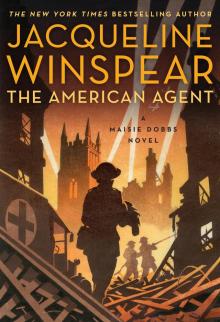
The american agent, p.14
The American Agent,
p.14


“You sound like Mark Scott.”
“No, I’m not kidding, miss—there’s all sorts of things people say about him, which is surprising, don’t you think?”
“Perhaps . . . .” Maisie began the sentence before her words seemed to vanish back into her thoughts.
“Perhaps what, miss?”
“No, nothing, Billy. Anything else?”
“Not at the moment, but—” Billy looked around at the door. “There goes the doorbell—I bet that’s Mr. Scott.”
“Better let him in, Billy—pity he’s on time; I wanted to talk to MacFarlane before he got here.”
“You want me to keep him occupied?”
Maisie shook her head. “No—he’s not stupid. Oh—and Billy, if he mentions seeing you over in Kensington, just say you were in the area to see a client, and say, ‘Why didn’t you give me a shout?’ Or something like that. And before you go down, help me roll up this case map.”
“Right you are, miss.”
With the case map rolled up and put away, Maisie waited for the men to return to the office, and was looking over her notes when she heard Billy say, “Well I never—sorry, I didn’t see you, Mr. Scott. Mind you, I had something on my mind—new client just along the street. The poor old lady had been getting some aggravation from people on account of her Dutch name, which everyone thinks is German. Ain’t that terrible? You know, Miss Dobbs had a case some years ago, similar situation—”
Maisie stepped into the outer office. “Hello, Mark. It sounds as if Billy was on the verge of telling you about one of our former cases.”
“Don’t worry. He’s not revealing your secrets.”
Maisie smiled. “Cup of coffee? Or tea?”
“What’s the coffee like?”
“The real thing—from an importers in Tunbridge Wells. My former employer swore by his good cup of coffee.”
“I’ll make it, miss,” said Billy, leaving the room.
“Thanks, Billy,” Maisie called after him.
“Tunbridge Wells—not far from your country seat, is it?” said Scott.
“I would hardly call it a ‘country seat’ but it’s a very nice house.”
Scott nodded. “Don’t mind me asking, but shouldn’t you be resting?”
“No, I shouldn’t. It’s already taken too long to get this far, and I am still only picking at the edges of the investigation—the blitzes have made it harder to see the people I want to talk to.” She paused, wincing in pain as she moved to take up her pen. “Anyway, as we know, I won’t be driving ambulances for a while, and I’m going back to Welbeck Street this afternoon. In the meantime, I have some questions for you, if that’s all right.”
“Fire away.”
Maisie extended her hand toward a chair next to the table. She sat down opposite him as he was seated, and continued the conversation.
“There are a number of American men here in Britain who have come over to help with the war effort, and I understand quite a few are aviators. Some are attached to the Canadian air force, others to the RAF. Do you have a list of them? Is that information the embassy has to hand?”
Scott sighed. “As citizens given leave to remain, they should register with the embassy upon arrival in Britain, but of course, these are young men and most want to just get on with the job. I can request a list of names we have on file, though it might not be complete. Do you have anyone in mind?”
“I don’t have a name, but—”
“You’re not planning to see every single American aviator in the country?”
“No, of course not. I have some of Catherine’s notebooks and have not finished going through them, so I would hope to have a name or two by tomorrow. But there is one I’d like to locate in particular—an airman who visited Catherine, and I believe more than once.”
“Anyone else?”
“I’m also planning to talk to Mr. and Mrs. Tucker, the owners of the building, and there’s another person.”
“I figured there might be.”
“Really?”
“There’s always one more person, and they’re usually important and the last to be mentioned.”
“‘Scotty.’” Maisie looked directly at Mark Scott. He did not flinch.
“Scotty?”
Maisie rested her elbows on the table as she leaned forward. “You know very well what I’m getting at—did you know Catherine Saxon? Are you her ‘Scotty’? Are you the man who turned up on her doorstep and she didn’t really want to see, who went by the name of Scotty?”
Mark Scott waited just a second before shaking his head. “No. I did not know Catherine Saxon before being assigned to the case, and I am not the Scotty she was referring to.”
“Do you know who is?”
“Scott might not be a popular first name here in the sceptered isle, but there are quite a few ‘Scotts’ where I come from. And I guess it might be kind of popular in Scotland—you should ask Mac.”
“I have quite a few questions for Mr. MacFarlane.”
“Don’t go all Englishy-maid-proper on me, Maisie—I came to find out how you are, and how your friend is doing. She’s pretty badly injured.”
“Mr. Scott—Mark—I’m not going proper on you, though I suppose I have to be more formal in my work than you might imagine. But I am frustrated by this case. However, I intend to get to the bottom of it, and seeing as you’re supposed to be in on the job, I’d like some help. And—”
“Coffee’s up,” said Billy, returning to the room with a pot of coffee, two cups and a small jug of milk. “Sorry it took a bit longer—had to nip across to the dairy for some milk. Here you go.” He set the tray down on the table. “Miss, I’ve got to be getting along—seeing a new client, down near Soho Square.”
“Go home after that, Billy. I know you’ll be on patrol this evening, but no need to linger here.”
“Right you are, miss. Make sure you’re down the shelter on time.” He turned to Mark Scott. “Nice to see you, Mr. Scott.”
“Likewise, Billy.” Scott turned to Maisie as her assistant left the room. “And?” he asked, taking his cup of coffee.
“And what?”
“You were about to say something more when Billy came in, then you stopped.”
Maisie rubbed her head, grazing the dressing above her eye. “I can’t remember now. Anyway—I should be going soon. I have a lot to do before this evening.” She took two sips of her coffee and set down the cup.
“Need a ride anywhere? I have a driver along the street.”
“No, it’s all right—the walk will do me good.”
Maisie packed up her bag while Mark Scott finished his coffee, before accompanying her out to the square.
“Let me know as soon as you have a name, Maisie.”
“I will—and it will be by tomorrow, I hope.” She looked at her feet and then back to Mark Scott. “I can’t remember if I thanked you, Mark—you were so very good last night. I had no idea you knew where I lived, or—indeed—how you got into my flat, but thank you for . . . for . . . for looking after me.”
“Isn’t that what a gentleman’s supposed to do?”
“Yes, but—”
“I’ll talk to you tomorrow—will you be going down to your country seat?”
“Later in the day, and of course I must see Priscilla. I’m anxious to know how she is—I would have gone to see her sooner, but she’s being moved to another hospital.”
Mark Scott nodded. “Take care then—and brief me tomorrow.”
As Scott turned and walked away, Maisie waited before stepping out across the square on her way to Welbeck Street. It would be a fifteen-minute walk at a clip, but Maisie did not have the energy to move with any speed, and her hand had begun to hurt as she carried her bag. Yet it was not the pain that was on her mind, or how she might have extended the time she would take to heal by removing the hospital dressing—instead she felt torn about Mark Scott. Every time she thought about him, she felt conflicted. She trusted him with her life, but did not trust his word. She considered him to be loyal, yet could not count on his presence in the investigation. And while she felt he was a man of integrity, there were moments when she wondered if he was pulling the wool over her eyes. And given the overheard conversation with Billy, it would seem he saw her assistant while he was in South Kensington. It was an interesting exchange, because she had assumed he would have kept that piece of information to himself, as one might be careful not to show an ace in a game of cards.
“Hello, Mrs. Marsh,” said Maisie, as the landlady held open the front door. “Do you happen to know if Miss Harcourt is in her rooms?”
“I believe she’s home—learning lines for a new play, apparently. I’m not sure where it’ll be running, but I suppose the show has to go on!” Marsh looked at Maisie’s hands. “Oh my dear, what have you done? I can see blood seeping through those gloves.”
“Oh, it’s nothing—I just sustained some burns last night. The ambulance auxiliary aren’t supposed to be the ones who get hurt, but I slipped up and let the side down. I’ll sort it out as soon as I get home. Anyway, do you mind if I just go up?”
“Of course not—you know where to find her.”
Maisie made her way up the stairs, pausing alongside Pamela Lockwood’s door as she passed, noticing the door was ajar. She continued on.
“Come in,” said Polly Harcourt.
“Hello, Miss Harcourt—Polly—it’s me, Maisie Dobbs.”
“Oh, Miss Dobbs.” Harcourt pushed back the chair at her desk, and stood up to greet Maisie. “What can I do for you—have you found out who killed Cath?”
“Not yet, I’m afraid. But I thought I might ask you a couple more questions.”
Polly Harcourt moved a jacket that had been thrown across the armchair, and hung it on a hook behind the door so Maisie could sit down, then pulled her desk chair closer to Maisie
“Would you like anything to drink—tea?”
“No thank you—I can see you’re busy. I understand you’re learning lines for a new play.”
“Christmas panto. It’s Peter Pan, and I’m Tinkerbelle—the fairy. Not exactly Oscar Wilde or Shakespeare, but it’s a part, and I’m grateful. It’s going on tour, because so many children are away from London now, though you would be surprised about the number who are back here because the parents don’t want to be separated any longer. I heard a woman in a shop yesterday saying, ‘If we go, then we all go together.’ And I can’t say I blame them—who wants to think their children might be orphaned? But on the other hand, you can understand those mums and dads who go so far as to send their children to Canada, or America. My sister’s neighbor’s children left to go to Canada a few days ago—on a ship from Liverpool.”
“The parents must feel such a wrench having made that decision, even though it’s to keep their children safe.”
“They won’t know them when they come back though, will they? I read in The Stage that there are Hollywood actors and actresses taking in our evacuees. Can you imagine it? There you are, just a nipper and you get used to living out there, and then you have to come back here? They could be grown-ups by the time they’re home! Mind you, I was thinking of signing up as a chaperone on one of the evacuation ships, just to get over there to America. Even though Cath told me not to, I still think I’d like to go. Anyway—thank you for asking about the play. I’m lucky they gave me the part.”
“Polly, I understand from Miss Chalmers that you saw Catherine with a man—an American airman. Can you tell me anything about him?”
“Yes, though I don’t know his name—she probably told you I called him ‘Catherine’s stage-door Johnny.’ For a while he seemed to be hanging around every time he was on leave, even if he only had a twenty-four-hour pass. And he was probably the one I heard, though I thought that man was older.” She shrugged. “I should have given you more details but . . . but I didn’t want you to think Cath was running around with lots of men. And Catherine never told me his name—not that it was a secret, but it never came up. She brushed it aside. Maybe she even brushed him aside. I believe they met when she was writing about the Americans over here, what they think of the war and so on.”
Maisie considered Harcourt’s response. There was no guile in the woman before her, no sign of reticence when being questioned. She seemed the sort of person who took people as she found them, accepting who they were—but given her experience working as an actress and behind the bar at a club in Paddington, she suspected Polly Harcourt was no pushover either.
“Had you any idea where he was stationed?” asked Maisie.
Harcourt shrugged. “Must have been within about an hour or so of London, or he would never have been able to get up here and back so easily if he only had twenty-four hours before he had to return to his aerodrome. If I had to pick somewhere, I would say Biggin Hill or one of those other places between us and the English Channel—but that’s a lot of ground to cover.” Harcourt pressed her lips together and seemed to study the floor, as if more information had been dropped there. Then she looked up. “You know who could help you—Jenny, Cath’s friend. They’d known each other for years. I bet you she knows everything about Cath. A girl always tells her best friend everything, after all.”
“I was hoping to see her today, though I think at this point, it will be tomorrow morning.”
“I’d wait until the morning, Miss Dobbs,” said Harcourt. “I mean, I’ve met you before, but Jenny hasn’t, and I don’t know if you’ve looked in the mirror, but that’s a nasty cut over your eye. And here—let me help you with your hands. What happened to you anyway? I mean, I didn’t like to ask, because it seemed rude, but I thought you might have got caught in an air raid.”
“Yes, that’s what happened. I was hit by some debris.”
“Come on—I’ve got some antiseptic in the bedroom, and believe it or not, I have some bandage—I fell over in the street last year and cut my knee, so I’ve got a first-aid kit now. And I’ve a pair of white gloves you can use—you’ll need to soak yours in bleach when you get them home, or they’ll stain.”
Polly Harcourt proved to be proficient with the contents of her first-aid kit, bandaging Maisie’s burned hands, and with a gentle touch slipping on a pair of white gloves to protect the dressing. It was as Harcourt was putting away the antiseptic, that Maisie heard a noise from the rooms below—from Pamela Lockwood’s quarters.
“Did you hear that?” asked Maisie, standing up from the chair and inclining her head.
“Yes—it’s probably Mrs. Marsh. Nosy old woman, that one. She’ll be snooping into Pamela’s things, probably looking to see if she’s left any money lying around. If I’m at home and I know she’s in there, I’ll tiptoe down and ask her if Mrs. Lockwood’s all right, or something like that. I’ve let Pamela know she’s going into her rooms, but Pam doesn’t seem to worry—she says there’s nothing worth stealing. And you know what? I think she also just likes to look at Pamela’s clothes. She’s a very well turned-out woman, and she has good costumes, quality skirts and dresses, very well tailored, and I think Mrs. Marsh likes to just look at them. Funny old bird, that one.”
“And does she go into all the rooms?”
“She’s got a master key, so I bet she does—though Liz and Helena are probably safe enough, because not only are they right on the top floor with the gods, but Mrs. Marsh keeps them at arm’s length, though she wouldn’t let anyone say a word against them. No, she’s a bit like a mother hen in that regard. Protective, but reserves the right to put her nose in whenever she wants.”
“I think I might drop in on her while she’s on the prowl,” said Maisie, gathering her bag. “Thank you, Polly—I appreciate your time, and your nursing skills. You should volunteer, you know.”
“I’m doing my bit every evening in that club, keeping people’s spirits up. And I’ll be doing the same when we take the panto on the road—making people laugh. Hitler can do a lot of things to us, but if he stops us laughing and having some fun, then the wicked old sod has won, hasn’t he?”
Maisie stopped outside the door to Pamela Lockwood’s rooms, leaning forward to listen. She could still hear someone shuffling around, so she knocked, then opened the door. She was in time to see Mrs. Marsh opening a drawer in a desk by the window—again, the room had an almost identical configuration of furniture to the rooms of Catherine Saxon and Polly Harcourt.
“Hello, Mrs. Marsh—I thought that might be you. I just wanted to let you know I’m leaving now.”
“Oh . . . oh, right you are, my dear.” Marsh stepped back as if she had been pushed. Still flushed, despite having regained some composure, she began to explain. “Mrs. Lockwood likes me to come in and push the duster around, tidy up a bit for her. She’s such a busy woman—like all my ladies, they’re all busy. But Mrs. Lockwood likes a clean room, and it’s a bit extra for me every week, you know.”
“Of course—if I lived here, I would be delighted to have a landlady like you.” Maisie took another step toward Marsh, and began to look around the room. “It’s so very nicely decorated, isn’t it?”
“Mrs. Lockwood is my oldest tenant—well, old because she’s lived here the longest, and to be fair, she is older than the others. She’s a very elegant lady, very particular, as you can imagine.”
“And she was a beautiful bride,” said Maisie, pointing to a framed photograph on the desk. Pamela Lockwood was in her wedding dress, standing next to a young man in the uniform of an infantry officer.
“Geoffrey, his name was.”
“Geoffrey?” repeated Maisie. “How tragic, to lose your husband so close to the Armistice.” She leaned toward the photograph, paying particular attention to the bride. “And she seems so very happy there.”
“I don’t think I’ve ever seen her smile like that,” said Marsh, folding her arms while studying the photograph. “Well, perhaps once or twice.”
“Can you remember the occasion,” queried Maisie.
“There was one time when Miss Chalmers had invited everyone out to the garden—lovely sunny day it was, in the summer. It was after Dunkirk, I remember that much. Catherine was telling some sort of story, and Mrs. Lockwood was laughing, and you could see a little spark in her eyes. Yes, it’s coming back to me now—Catherine had received a man visitor the evening before, and Mrs. Lockwood was asking her about him, because they’d passed on the step. I’d looked out of my window when I heard them speaking—not to be nosy, mind, but I like to know who’s coming and going, because I have to think about these things with a houseful of women. Mr. and Mrs. Tucker wouldn’t like any funny business and their property being known as a house of ill-repute. And that was the other time I saw her smiling. Didn’t see the man’s face though, but I could see Mrs. Lockwood, and she seemed very happy that day.” Marsh shook her head. “Funny, isn’t it, the things you remember?”