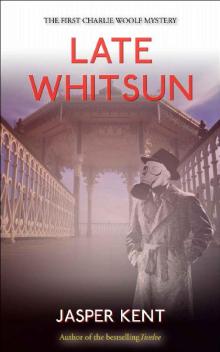
Late whitsun charlie woo.., p.20
Late Whitsun (Charlie Woolf Book 1),
p.20


The sun shone brightly through the windows, making it warm inside. The town would already be crowded, down by the seafront at least. I imagined them pouring out of the station and along Queen’s Road towards the beach. The trains would bring them in in pulses, but frequently enough so that the arriving bodies merged into a single stream filling the pavements. Some would be here just for the day, others for the whole of the bank holiday weekend. Whether this evening, tomorrow or on Whit Monday, they would make the journey back up the hill and on to the trains, many of them glowing a bright pink after too much of the sun. By then the Morlocks of Brighton would have taken all they could.
And I knew I should be one of them. There would be rich pickings on the Palace Pier for a sketch artist. I’d played detective for a week; now I should return to what I was trained for. Eventually the migraine would come and I’d be unable to work anymore, but by then I could have made at least a pound or two. I’d have to force myself to stop when the time came; I could produce some extremely strange images under the influence of an attack, things my customers wouldn’t appreciate. I’d been expecting the events at Ingram’s flat, the day before, to elicit some kind of reaction, but why should I sit at home and wait for it? Anyone with a little nous would be able to find me on the pier.
I dressed quickly in the usual get-up I chose for the tourists: a blue blazer and a cravat – neat but not too formal. They had to see me as an artist. Then I grabbed my two folding seats, my easel, my pad and my drawing box, and headed out. As I opened the door from my rooms, I could hear the telephone ringing. Mrs Croft had reached it before I was even halfway down the stairs. I paused, somehow guessing it was for me.
‘I’ll just go and find him,’ she said, after listening for a moment. She looked up at me and held out the receiver. There was a smirk on her face.
I took it from her with a brief ‘Thanks’, and then waited for her to get back into the kitchen before speaking. ‘Hullo?’
‘Charlie?’ I recognized the voice immediately. It explained Mrs Croft’s arch expression.
‘That’s me.’
‘It’s Rachael. Rachael Westby.’ She sounded nervous – unnatural. Did she really think I needed to be told her surname? ‘I need to talk.’
‘Fire away.’
‘Not on the phone. I need to see you. It’s about Vince.’
‘Do you want me to come round to your place?’
‘No!’ The response was sudden and insistent. ‘What about the cinema? The Duke of York’s? That’s near you, isn’t it?’
It was – very near – and I wondered for a moment how she knew that. But then I remembered giving her my business card the first time we met. ‘All right, the Duke of York’s. What time?’
‘As soon as I can get ready. Say 11 o’clock.’ There was a brief pause. ‘Back row of the stalls.’ She produced an unconvincing giggle. ‘But keep your hands to yourself.’ She hung up before I could say anything more. It wasn’t quite what I’d been expecting, but I knew I had to go and meet her. I felt a certain anxiety at her choice of rendezvous, but how could she know? Most of the time the flickering silver screen wasn’t a problem for me, but on a day like today, with a migraine pending, it could only make things worse. Even if she did know that much about me, how could she guess that an attack would strike today? I hadn’t known it myself until I woke up. I blinked and looked out through the glass of the front door, not in search of anything real, but to check whether the usual patterns had begun to permeate my field of vision. There was nothing, though; not yet.
I turned away and caught sight of myself in the long mirror next to the phone, weighed down by the paraphernalia I would have needed for the pier. That would have to wait. Sunday and Monday would be just as busy as today, if I was still around. I made my burdened way back up the stairs.
*
The Duke of York’s Picture House really was nearby. I turned out of Rose Hill Terrace on to London Road, walked past the Hare and Hounds, crossed Viaduct Road, passed the fire station and there I was. The clock high on the pediment told me it was five minutes to eleven. I’d not wasted any time. I’d had a phone call to make, but that didn’t take more than a few minutes. It would be a longer journey for Rachael, so I guessed she would turn up late. I went in through the arched porch and bought myself a ticket for the stalls, then stepped into the darkness of the auditorium. The flickering light of the screen was enough to see by. The place wasn’t anywhere close to full. It was early in the day, certainly for locals, and this was off the beaten track for trippers who were more likely to head for the big screens in the centre of town, like the Regent or the Savoy. There was just one couple already in the back row. I kept away from them, but still it felt odd sitting there alone.
I lit up and watched the film, realizing I’d come in halfway through. I recognized the girl – I’d seen her in The Man Who Knew Too Much – but I couldn’t name her. This looked like Hitchcock too. Basil Radford was another familiar face, though it wasn’t much of a part for him. The plot seemed to swing on a box of matches from the Grand Hotel – not our Grand Hotel, though. It was a good deal more savoury than the clues that had led me to the Metropole. That all seemed like a long time ago now, and it was as much a piece of play-acting as the story being projected on to the screen in front of me. The question had always been over the matter of the intended audience. Were those pictures taken for me to see? For Metzger? Once I realized that whole show was really put on for O’Connor’s benefit, it all began to make sense. It didn’t matter that he was the photographer, he was still being duped. It was as if Hitchcock had become the victim in one of his own movies.
After ten minutes, Rachael still hadn’t arrived, but it was then that I began to notice something else on the screen, something other than the picture itself. It started out in the bottom left-hand corner – nothing you’d discern if you weren’t looking for it, but I was. It was an arc, not big to start with and not smooth. It was jagged, forming into triangles, but even where the straight edge of a triangle emerged, that too shattered into smaller zigzagging lines. The first time I’d seen it, decades before, I’d been more fascinated than afraid. Now I knew it for what it was, the migraine aura, but I also knew the pain that it portended. It would only be a matter of hours now, if that.
The pattern grew and spread, propagating itself as each sharp point punctured my field of vision and caused splintering cracks to spread through it. Is wasn’t fast but was possessed of an inexorable purpose. Soon it filled almost a quarter of the screen, though in its wake my sight was beginning to clear. I tried to look away from it, but knew I would not succeed. It was not on the screen, or in the air, or even in my eyes. It was in my brain – a fault of my brain. It was inescapable.
I sensed someone sitting down beside me, to my left, where I could see almost nothing. Even so I could tell that it wasn’t Rachael. It wasn’t a woman at all. I turned, having to look a little behind him to get a clear view. I momentarily expected to see again the blank emptiness of a gas mask, but for once I was confronted with a simple human face; Tremaine’s face. I’d expected it but hoped otherwise, especially now when I could barely see, and when I knew that soon a crippling headache would make me incapable even of thinking coherently.
‘Young and Innocent,’ he said.
‘What?’ My only thought was that he was talking about Rachael – and what he might have done to coerce her into luring me here.
‘The film. It’s called Young and Innocent. I saw it when it first came out. Not one of his best. It turns out the drummer did it, though you’d never work it out.’ He paused. ‘Well, perhaps you would.’
I kept my eyes fixed on the screen. If I looked him in the face I knew he’d be able to tell that I wasn’t myself. Now was not the time to show weakness. ‘I can never make sense of any of these things,’ I said.
‘But you made sense of what happened to O’Connor.’
‘That Ingram killed him, you mean?’
‘Don’t be silly.’ He sat forward a little in his seat, staring eagerly at the screen. ‘Now this is the good bit: this continuous shot cutting through the dancers in the ballroom, finally focusing on the killer.’ We watched in silence for a few moments, until he spoke again. ‘What always strikes me as wrong with these stories is the way they think you can point a gun at someone and make him do exactly what you want.’
‘Fear of death seems like a pretty good motivation to me.’
He tutted wearily. ‘Not if you know you’re going to die anyway. The villain lures the hero to a public place where he’d never dare shoot him because of all the witnesses. But then, by threatening him with the gun, he persuades him to go somewhere quiet, where he can kill him whatever way he likes. So unconvincing.’
‘So that’s not how you persuaded Ingram to climb on a chair and put a noose around his neck?’
‘As if I’d do such a thing.’ There wasn’t even an attempt at sincerity in his words, or at a true denial.
‘But you had to persuade him to put on the gas mask.’
‘I just told him I needed a photograph of someone wearing it. He didn’t even bother to ask what the picture was for, though I’m sure I could have made something up. He was like that, trusting. Shame to lose him.’
‘And what had you put in it? Ether?’
‘Ah, you noticed that, did you? I thought you might have. Chloroform actually.’
‘Didn’t he smell it?’
‘I was behind him, helping to do up the straps. There was nothing he could do.’
‘Was it that that killed him?’
‘I do hope not. The doctors would spot that easily. I let him come round before I removed the chair.’
‘They might still find something.’
‘Only if they bother to look. Marchant thinks he’s got it all wrapped up. You’re the only one who harbours any doubts about Ingram at all. Which reminds me, grab hold of this would you?’ He reached across and pushed something into my hand. The terror I felt at the prospect of the oncoming migraine was all-consuming, so much so that I could scarcely think about what was happening. I instinctively took it from him and at the same moment felt what it was: a revolver. Before I’d even tried to think why he should hand me such an object, I’d curled my finger around the trigger, though I’d not the least intention of firing.
I turned to face him. ‘Why give me this?’ The jagged lines cut across him. One eye peeped at me through them as they seemed deliberately to separate around it.
‘Because you’re not likely to put on a gas mask if I ask to take a picture of you in it.’
‘What?’
‘What I mean is, I need to solve that problem they so often have in the movies. If I were to simply point this gun at you,’ – he moved his hand towards me and I felt something hard pressing against my ribs – ‘and asked you to take a walk with me to somewhere nice and quiet, you’d just say, “No, shoot me here, if you dare.” At least you would if you had any sense.’
‘So why won’t I now?’
‘Because now I’ve got the perfect reason to shoot you. I’m a member of His Majesty’s Security Service and you’re pointing a gun at me. I’ve every right to defend myself. How was I to know your gun wasn’t loaded? And, with a bit of luck, it would be by the time the lads from the Borough Constabulary arrived. So come on.’ He pushed the muzzle of his gun harder against me. ‘Let’s go for a little walk. Unless you want to wait till the end of the film.’
‘I still don’t see what’s in it for me. Die here or die somewhere else? Why don’t I just let you get on with it?’
He answered with a single word. ‘Hope.’
I considered for a moment, then stood up and headed out into the daylight.
CHAPTER 21
We crossed Preston Circus and walked up New England Hill. Tremaine kept a few paces behind me, his gun hidden in his pocket. He’d not taken the other revolver from me, and I kept it similarly concealed. I took him at his word that it wasn’t loaded, but it still might come in handy to whack him with. We didn’t talk, except for him directing me where to go. Out in the sunlight, the patterns that played before my eyes seemed almost tangible, but they’d now crossed over to the right-hand side of my vision. Once they began to fade, the pain would come. Still Tremaine suspected nothing of my affliction, but I knew it would be impossible for me to hide the agony when it reached its peak. And yet I had to remain utterly lucid in order to convince him of the pointlessness of killing me.
We passed under the bridge carrying the goods line and then the much wider viaduct for the tracks out to London and to Lewes, and continued walking. It was a steep hill but I pressed on quickly, in part because exercise tended to lessen the pain of the migraine, in part with the hope of tiring Tremaine. To the latter end it was proving ineffective. He was older than me, but in good shape. He kept up the pace without trouble. We crossed the road and continued on the other side of it, until he issued another instruction.
‘Turn in here.’ I didn’t know the name of the street, but we didn’t proceed along it more than a few paces before he spoke again: ‘Stop.’ He looked around, checking that we were alone. ‘Now over that wall.’
I did as I was told. It wasn’t a difficult climb and, before my feet had even landed on the other side, he was coming over as well, too quickly for me to be able to take advantage of our brief separation. We were in a tract of derelict land behind the terrace of houses which stretched up the hill. Not far to the left, the ground dropped precipitously down to the railway line heading out to Hove. It was a reflection of the steepness of the terrain that only a few minutes before we had passed under a set of tracks, supported far above our heads by brick and steel, and now we stood looking down at another nestling in a groove gouged out of the earth. And yet within less than a mile, at the Brighton terminus, the two lines were at the same level.
Now that we were off the public roads, Tremaine had his gun out again.
‘I don’t suppose you’d turn out your pockets for me, would you?’ he asked. ‘It would make things ever so much easier.’
It was a question to which only one answer would be accepted. I reached inside my jacket, where I kept my wallet on the left-hand side, and offered it to him.
‘Just pop everything on the ground between us; that’s the ticket.’ He gestured with his gun as he spoke.
On the other side of my jacket were a few folded sheets of crisp, white paper from my sketch pad. I put them on the dry earth, next to my wallet.
‘And the gun.’
I complied.
He tilted his head towards the railway cutting behind me. ‘Down there.’
‘On to the track?’
He nodded.
‘So it’s going to be an accident rather than a shooting, is it?’
‘Or suicide.’
‘And why should I commit suicide?’ As I spoke, I knew for sure that the headache had finally begun. The pain had been lurking there all morning, but now it was becoming concrete. As usual, my vision was almost clear again. The cycle was quite predictable.
‘Over Rachael.’
The implication hit me immediately. ‘Is she —?’
He didn’t allow me to finish the question. ‘She broke your heart.’
‘Perhaps now is a good moment for me to refuse.’
He took a step forward. ‘A hefty push should do just as well.’ I looked behind me. The fall would probably kill me before the trains had a chance. ‘Just get down there,’ he said.
There was nothing I could do but comply. I turned and began to climb down. Tremaine took the opportunity to retrieve my possessions from where I’d left them. In places the cutting was almost as steep as a cliff. I scrabbled to find handholds in the smooth chalk, a reminder that we were in the foothills of the Downs. When I was about halfway, a train passed right beneath me, heading towards Brighton, but still moving at quite a lick, despite the curve in the track it was about to encounter as it turned towards the station. I pressed myself against the hard stone and clung on, feeling everything around me shake. Once it had passed I continued down and soon I was at the level of the track. The pain was stronger now, but still nothing compared to what I knew would come.
Tremaine found himself a ledge to perch on, so that his feet were a little above my head. Bushes and trees clung to the slope of the cutting, much as I had just moments before, acting as camouflage for us both. I doubted anyone on a passing train would notice us. The tracks were only a few feet away from me, the traditional ones that kept the trains’ wheels on course, and then those third rails that carried the electricity. Perhaps that was the means by which Tremaine planned my death; electrocution rather than a simple collision. In one direction the tracks continued under a bridge on New England Hill. In the other, towards Hove, the steep, hewn sides deepened further as the hill rose, before finally the engineers had given up on the idea of a cutting and instead the tracks disappeared into a tunnel. Light penetrated a little way into its black mouth, but I couldn’t see far.
‘What gave it away?’
I looked up at Tremaine. Evidently he wanted to quiz me before I died, to find out how much I knew – what loose ends he’d need to tidy up. I was more than happy to tell him. Once he knew everything, there’d be no point in killing me. Except I wasn’t sure he needed there to be a point.
‘Your face. At the races. You tried to pass it off as just a “flutter”, but I saw your expression as the pack came past. That was a gambler’s face. More than that, it was a loser’s face – just the kind of loser that O’Connor had been looking for.’
‘All that from one glimpse of my expression?’