Late whitsun charlie woo.., p.3
Late Whitsun (Charlie Woolf Book 1),
p.3
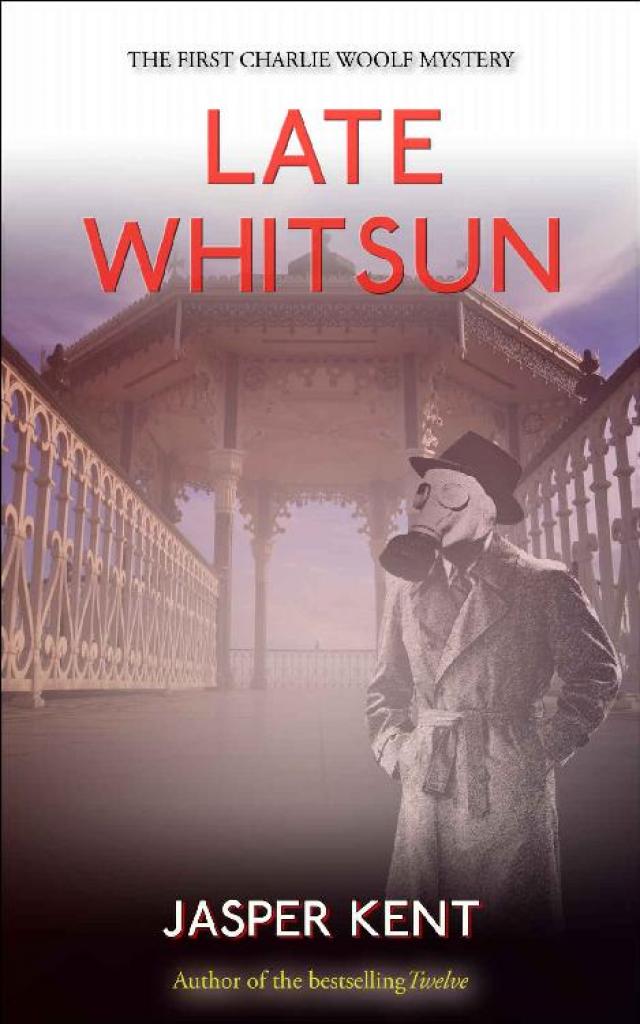


I was staring into the face of some giant, upright, clothed pig.
CHAPTER 3
It could not be so. My next thought was that some new, hideous form of migraine aura had forced itself upon me. At its worst it could make a normal, human face splinter into facets as though rendered in a cubist painting, but I had never been the victim of anything like this before, and I felt none of the other usual symptoms. I flicked my eyes from side to side, observing this bizarre apparition at different points in my field of vision, but it remained steady – a physical reality, not an artefact of my mind.
The figure raised a hand to me in a friendly greeting; and it was a hand – not a cloven trotter – wearing a black leather glove. We approached one another, and what I was seeing became clear. It was merely a man, a man wearing a coat, a trilby and a gas mask. It was an unfamiliar sight, but not a complete novelty. I’d seen them in the newsreels, as everyone had. If it came to war, we’d all be issued with them. I remembered my dad’s wheezing lungs and blistered skin after the Germans had used mustard gas. I can’t have been much older than eight or nine at the time. He’d had a gas mask, little help though it had been. But there was no poison gas here in Pimlico. I could only deduce that this fellow was afraid I might recognize him – or that O’Connor might have.
The figure spoke, but I could make no sense of it. His voice was muffled by the mask.
‘What?’ I demanded, not trying to hide my irritation at the farcical nature of it all.
He spoke louder and I could just about make out what he said. ‘You got them?’
‘You got the money?’ I countered.
He reached inside his coat and pulled out a wad of notes, rolled up and fastened with a rubber band. He held it up between his thumb and forefinger, so that I could see it clearly, then tossed it on to the bench alongside him. I offered him the envelope. He took a step towards me and grabbed it. Immediately his fingers were at the flap, scrabbling to tear it open. He raised his hand to his face, then let out a gasp of annoyance. He tucked the envelope under his arm and pulled the glove from his right hand by using his left. I realized that his instinct had been to use his teeth, but the mask prevented him.
With his fingers freed he was finally able to open the envelope. He stepped into the lamplight to see better and tipped the photographs out into his other hand. As he did so I noticed a tattoo on his forearm, stretching down to the back of his hand itself. It looked like an anchor. That told me something: this was not the man in the photographs. I’d seen pretty much every inch of his body, and there were no tattoos – not anywhere. Whatever the reason he was hiding his face, it wasn’t that.
He held the photographs at arm’s length, as though he needed reading glasses, and turned his head to one side. The gas mask evidently didn’t make things easy. I wondered how he might be reacting to the sight of them. Disgust? Shock? Arousal? Whatever his expression beneath it, the mask remained impassive. He didn’t bother to go through all of the prints – the first few were enough to verify their nature. He slipped them back into the envelope.
‘Take it and go,’ he said, gesturing towards the roll of money lying on the bench.
I walked over and picked it up, pulling the rubber band off and on to my wrist. They were all one-pound notes. I half expected the masked man to say something along the lines of ‘It’s all there,’ but perhaps I’d seen too many talkies. It didn’t take long to count the notes. There was exactly fifty quid. I put the rubber band back around them and slid the roll into an inside pocket.
The man jerked his head in the direction of the gate. There was nothing else for me to do here, so I turned and walked away. At the gate I paused and looked back, but he had already gone.
I walked briskly back to Victoria Station, my hands buried in my pockets, feeling the lump of banknotes pressing against my chest. It was a lot of cash to be carrying around. Only two other people knew about it: one of them had just given it to me and the other would soon be receiving it, minus my cut. Even so, I felt nervous. I’d learned to my cost more than once what a blabbermouth O’Connor could be, and I knew nothing of the other bloke. It still felt like a set-up and I wasn’t going to play it all O’Connor’s way. At the station I sat down. I’d bought two envelopes earlier in the day. The second one was smaller and padded. I scribbled an address on the front, making some slight attempt to disguise my handwriting, then unrolled the notes and slipped them inside. I put a stamp on and then posted it in the pillar box on the station concourse. I’d missed the last collection, but at least I felt safe.
I looked up at the departure board. There was a train in ten minutes. I’d soon be home.
*
It was getting on for midnight when we rolled into Brighton. The station was quiet but not deserted. Almost as soon as I was off the concourse, I doubled back on myself and went down Trafalgar Street, descending into the tunnel where the station itself had been built over the roadway. It was somewhere around there that I first realized I was being followed. I stopped to light a cigarette and took the opportunity to look back. He stopped a second later, ostensibly to tie his shoelace. It took him a long time. I’d seen him at the ticket barrier – blond crew haircut and pimples – but not thought much of it then. He’d been standing with his back to the platforms, not a very helpful position if you’ve been tipped off about a chap carrying fifty quid on his way back from London. He was scarcely twenty, but I’d known younger kids who could manage a better tail. Employed them, too, on more than one occasion.
I carried on down Trafalgar Street and stopped at the phone box on the corner of Pelham Square. I went inside and pretended to make a call. He fell for it. He knew I’d spot him if he loitered for too long, so he had to give himself a reason to be there. He stood just outside, pretending he was waiting to use the telephone. I finished my ‘call’ and stepped out, holding the door open for him. He was hoist on his own petard; his only option was to pretend to make a call of his own. He went in and I hovered for a moment, finishing my cigarette, while he affected an earnest conversation into the receiver. In truth I was indulging in what I believe the Japanese call ‘origami’, busily transforming the now empty envelope that O’Connor had given me, folding it into a wedge.
I threw my cigarette stub to the ground and bent forward, slipping the folded paper under the crack at the bottom of the door. It wouldn’t detain him for long, but long enough. I walked swiftly away and soon heard the sound of him banging against the glass. I turned a corner and began to run, quickly losing myself in the grid of tiny streets that make up North Laine. There was no sign of him following, but I went home the long way, just in case, crossing the Victoria Gardens and sticking to the side streets before making my way back home via the Level.
As I turned into my street I saw that it was busy – busier than it ever should be at that time of night, and with a very specific kind of visitor. Three police cars – black Wolseleys – were parked outside my house. On the steps up to the front door two coppers stood chatting. There was no point in avoiding them, so I carried on walking, trying to look calm and wondering why I shouldn’t be. In the distance I saw another figure coming along the pavement towards me, from the other end of the street. As we got closer I recognized him: the pimply kid who’d followed me from the station. Giving someone the slip was pretty pointless if they knew where you lived. He offered me an embarrassed smile then held out his hand, gesturing that I should go first into my own home. I mounted the steps.
‘You Woolf?’ asked one of the policemen.
I nodded. He took a step through the open door and shouted up the stairs. ‘Governor? He’s here.’
A sudden fear took hold of me. ‘Mrs Croft – is she …?’ I couldn’t finish the sentence.
‘The landlady?’
I nodded again.
‘She’s fine. A bit shaken. It was her that called us.’
I went on in. Along the hall I could see Mrs Croft sitting in the kitchen, drinking from a teacup which I guessed had something stronger in it. The police inspector, dressed in civvies, was looking down from the first floor landing.
‘Woolf?’ he asked.
I climbed the stairs, always looking up at him. He was a tall man, balding, with a ginger moustache from behind which peeked a thin, white scar. I recognized him immediately.
‘Marchant, isn’t it?’ I said.
‘That’s right. Been a couple of years. You were working with Alan O’Connor back then, weren’t you?’
I was tempted to reveal I still was, but for now the less said the better. ‘What’s happened?’ I asked.
‘Come and look.’
It wasn’t far from the top of the stairs to my rooms. The door had been forced open, the splintered jamb left leaning against the wall.
‘My boys, I’m afraid,’ said Marchant. ‘Your landlady heard a shot, so we had to get in quick.’
He indicated I should go first. My office was still reasonably tidy, but I could tell someone had been there. Each of the three filing cabinets had a drawer left open. There were some papers spread out on my desk that I hadn’t put there. God only knew what might have been taken.
‘Looks like I’ve been burgled,’ I said.
‘Looks like it, yes,’ Marchant replied.
‘You said there was a shot?’
He pointed to my living room. ‘Through there.’ I went in.
This was in much more of a mess. The window was broken. The standard lamp that I used to read by was lying on the floor, the green cotton lampshade knocked askew and the bulb shattered. I felt oddly relieved to see that my wireless set appeared undamaged. A uniformed constable stood next to my armchair. I wondered if he might have been sitting in it until he heard us coming.
‘Move your arse, Foster,’ said Marchant.
The constable stepped aside, revealing what I had evidently been brought in here to see. Between my armchair and the wall, a body lay face down. The upper part of it was still hidden by the chair but, now that the copper had moved, the legs were there for all to see.
‘This is how it was when we got here,’ continued the inspector.
‘You haven’t even turned him over?’ I asked.
‘We have, but we thought you’d like to see exactly how we found things.’ He gestured to the constable, who grabbed my chair by the arm and began to pull it across the room. I wanted to complain about how he was rucking the carpet, but thought better of it. The entirety of the body could be seen now. It wasn’t a dainty figure. The hair was matted with blood, as though he’d been hit on the back of the head, but I remembered there had been a shot.
‘You can see the exit wound clearly,’ said Marchant helpfully.
There was something else strange too: what looked like a dark strap of cloth pressing down and flattening his hair. Marchant took a step towards the body, but I remained still. He looked at me, then took my arm and led me forward, somewhere between guiding me and dragging me.
‘He must have spun around as he fell.’
We were standing just feet away now. I noticed there was a patch of blood on the wall behind my chair, just above a man’s height, splattering outwards. At its centre, the plaster was cracked. Another bloodstain had soaked into the carpet around the body’s head, bigger than the first.
‘Turn him over,’ said Marchant.
Foster grimaced and rubbed his face, then leaned over the corpse. He reached across and under, grabbing it by the trousers and the shirt, then heaved until the body rolled on to its back. I felt a horrible certainty that I would recognize the face once I saw it, but for a moment the constable remained crouched, blocking my view. At last he moved.
I recognized the face all right – if you could call it that – but I couldn’t put a name to it. No one could. It was the same face I’d seen in London, in Eccleston Square just hours before. The dangling snout of the nose was the same. The two great wide eyes were the same. It was a gas mask – just like the one I had seen before.
Except that there was one difference. In the right eyehole the flat glass disc remained just as it should do. But the left one was shattered. A few jagged splinters remained in place; the rest had been blasted inwards. Through the gap, even in the dim light of my living room, I could see some of the face beneath, or I should have been able to. But all I could make out was the glistening bloody pulp that remains when a bullet penetrates a human eye.
CHAPTER 4
They put me in a cell in the Police Station in the centre of town, occupying part of the same building as the Town Hall itself. I had to wait for an age or more until they called me up for interview. It was now into the small hours, but I didn’t know quite when. They’d taken my watch along with everything else in my pockets.
Marchant was there, accompanied by a detective sergeant called Purvis, who didn’t talk much. It was obvious I was considered a suspect. Marchant’s first question was a cliché, but it also came as a relief.
‘Where were you between the hours of nine and ten this evening?’
So that told me when the victim had died, and I had an alibi. It wouldn’t have been too hard for them to work out the time of death; Mrs Croft had heard the shot. And they’d have taken the body temperature and done the calculations, just in case she was mistaken, or lying.
‘London,’ I said.
‘Any witnesses?’
‘Possibly.’
‘What do you mean, “possibly”?’
I told him the whole story, or most of it: how O’Connor had first approached me on the pier and asked me to act as courier for him; how I’d rung him later and agreed; our meeting at Brighton Station; the rendezvous in Eccleston Square; the journey home; the man who’d followed me from the station.
‘But, then, you know about that part,’ I concluded.
Marchant nodded. ‘After we found the body, DC Langley was sent to the station to look out for you. Once he’d extricated himself from that telephone box, he made his way back to your flat.’
‘So you knew I was in London anyway?’ I said.
‘No.’ Marchant spoke deliberately, as if explaining things to a child. ‘When we found a body in your flat, we thought you might attempt to leave the town. That’s what Langley was looking out for. We had someone at Hove Station as well … and at Pool Valley in case you decided to catch a bus.’
It was laughable. Even in the grim interview room, I couldn’t help but smile.
‘What’s so funny?’
‘This isn’t the sort of town you can put a cordon around, not if you sent out the entire force. There’s half a dozen other stations. And I could have got on a bus anywhere.’
‘We found you, didn’t we?’
‘Only because I wasn’t trying to hide. And you caught me coming in, not going out.’
He looked at me sourly and changed the subject. ‘So who can verify your story?
‘Anybody. The passengers on the train. The ticket collectors at either end. The man in Eccleston Square.’
‘Anyone you could actually name?’
‘O’Connor, obviously, though he can’t prove I really went up to London.’
Marchant and Purvis exchanged an uncomfortable glance. Purvis took up the questioning. ‘So what about this bloke you met? You can at least tell us what he looked like.’
On that part of the story I’d overlooked some details, but I had to tell them sometime.
‘He looked,’ I said, ‘rather like the deceased.’
‘What?’
‘He was wearing a gas mask, just like the body in my flat.’
‘Just like?’ asked Marchant.
‘Apart from the shattered eyepiece, they looked pretty much the same. The same type.’
Marchant again spoke slowly, precisely. ‘So you’re saying that the dead man in your room is the same man you met in London?’
‘I’m not saying anything,’ I snapped, ‘other than that they were both wearing gas masks.’ My immediate instinct, on seeing the body lying in my room, had been that it was the same man, but that was difficult to make any sense of. ‘I don’t see how it can be, though. We were in London. He couldn’t have been in my flat at 9.30 to be shot, any more than I could have been there to shoot him.’
‘You seem to know very precisely when he was killed.’
‘You said between nine and ten. I split the difference. So when was he killed?’
Marchant paused, but decided there was nothing to be gained by not telling me. ‘Your landlady called us at twenty to ten. She said it couldn’t have been more than two minutes since she heard the shot. You left Brighton at…?’
‘I caught the 8:18.’
‘And you got back…?
‘Ask Langley.’
‘I’m asking you.’
It wasn’t worth a fight. ‘Around midnight,’ I conceded.
‘And the murder took place slap-bang in the middle of your little sojourn.’ He pronounced the last word as though it was new to his vocabulary. ‘Quite convenient.’
‘You’re saying my alibi’s just too good?’
‘Your alibi’s a pile of shit. You’ve got no one to confirm it.’
‘You could at least ask O’Connor!’ I hadn’t meant to raise my voice.
He directed the same look towards Purvis that he had before, and shook his head resignedly. ‘Let’s get back to your trip to London. What was in the envelope?’
‘I didn’t look,’ I lied. I’d exchanged obscene material for money; they could get me on that as a purveyor.
‘And how much did he give you for conveying it?’
‘Fifty pounds.’
‘So where is it? We didn’t find more than a few quid on you.’
‘I posted it. To a friend.’
‘Who?’
‘I’d rather not say.’
‘It could save your neck.’
The words hung in the air. He might have been right. The postmark might give them some idea of when I was at Victoria – show that I’d been there late enough to miss the last collection. It could help prove my story.