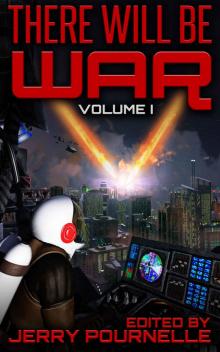
There will be war volume.., p.10
There Will Be War Volume VIII,
p.10


Sarah’s talent, if she could make it work, would work best on missiles in the boost phase, January’s during coast, and Timmy’s any time.
“Launches. Early warning satellites report launches from Eastern sector. Satellites report launches from Southern sector. Satellites report launches from Northern sector.” A pause. “Launches from submarines in polar sea. Launches from Baltic Sea. Launches from Black Sea. Launches from North Pacific. Total launches confirmed, 1419. Probables, 214. Failures on boost, 757.”
Not a so-called “surgical strike” like you sometimes read about in the papers, the strike at military bases and missile silos. This was a full scale attack, nothing held in reserve. Don’t ask me why. I’ve never claimed to understand superpower politics.
“Okay, Sarah, here it comes. Go for it!”
“I’ll see what I can do. I’m not making any promises, though.” She closed her eyes and leaned back. I looked over to the TV screen. Still too early to see anything, I decided to pray. I’m an atheist, but maybe there was time to convert.
Sarah opened her eyes. “Well?”
We both looked at the monitor.
“BMEWS confirms 1589 launches. 3 boosters failed second stage ignition. 26 minutes to first arrivals.”
“Damn,” she said. “Some days you got it, some days you don’t. Looks like today I don’t.” She leaned back to try again. Beneath her apparent calm I saw she was trembling slightly.
“Confirmation from PARC radars. Confirmation from PyWE-RASVS.” The first dots were beginning to appear on the screen. “Launch of second wave. Launches from North Atlantic. Launches from North Sea. 820 launches confirmed, 19 probable, 22 failures.” The voice on the hardwire link was cool and professional. How could he remain so calm?
Time to try January. She was fully relaxed, breathing deeply and evenly.
“You are very calm. You’re floating, higher, higher. You’re above the clouds. You can see a metal cylinder moving through the air. It’s coming toward you. You can imagine the explosive inside the cylinder. You can reach out and touch it. It’s getting hot. It’s getting very, very hot. Make it explode.”
The screen was filled with tiny dots, like ants crawling across the screen. Vicious angry ants, heading for us. “Burnout on all boosters. 18 minutes to first impacts.”
“You can feel the missile next to you. Reach out and touch it, January. Touch the explosive inside. You can feel it! Make it explode!”
A fire started burning merrily in a wastebasket across the room. On the video screen, though, none of the little dots disappeared. Time to try Timmy.
“Surveillance satellites report first wave warheads have separated from the bus.”
Timmy had one more talent, in addition to being able to see a little through time. He could also make things disappear. Where they went, nobody knew. None of them ever came back.
“Timmy, can you hear me?”
“Yes.”
“Way, way up over us there are a whole lot of missiles flying through the sky. I want you to focus your attention on them. They’re whizzing toward us at hundreds and hundreds of miles an hour. Can you picture them?”
“Yes.”
“Lots and lots of them, Timmy. All around, coming at us. Now, when I count to three, I want you to concentrate real hard, and make them all go away. Ready?
“One…
“Two…
“Three!”
No sound, nothing seemed to happen at all. The dots on the display screen just vanished. “They vanished.” For the first time, the voice on the hardwire link lost his cool. “They vanished. I don’t believe it.” He started to giggle. “The whole Russian attack just disappeared.”
Jason looked stunned. Sarah jumped up and hugged me. “Dan, we did it! Timmy did it!” I hugged her back. She was laughing, laughing and crying at the same time.
It wasn’t quite over. We had to use Timmy’s talent twice more, on the second wave and again on stragglers. After about an hour, we heard the announcement that the bombers were returning to base. Then we knew it was all over.
Maybe we could have counterattacked with our own missiles, or maybe we should have announced that we had a secret weapon and asked for unconditional surrender. Maybe we could have done any number of things. It was pretty clear, though, that one thing we couldn’t do was announce what really happened. Not unless we knew we could repeat it.
So the U.S. government just ignored the attack. Pretended it never happened. I think that this unnerved them worse than anything else we could have done. They never knew what had happened. It would be a long, long time before they’d try another first strike.
They kept secrecy here, as well. After all, it had all come and gone at two in the morning, and there had been no general alarm. Naturally, there were a lot of rumors that something had happened that night, but who could have guessed that a full scale attack had been launched? And who would believe it?
We did all get to meet the President. In secrecy, naturally. I wasn’t surprised, but then, I hadn’t voted for him either. Timmy was pretty excited about it.
Some days later, things were back to what passed for normal. Timmy sat at his desk, flipping through a book, The End of the Dinosaurs.
“Gee, Mr. Sanderson,” he said, “I wonder what really did happen to dinosaurs?”
I thought about the iridium casings on nuclear warheads, about clouds of soot and ash rising from atomic explosions, setting off a long nuclear winter. I thought about Timmy’s two strange talents, one dealing with time, one completely different. A talent to make things go away. And where do they reappear? I’ve often wondered. But I think I know now.
I could almost picture the warheads, six thousand of them, raining down on the forests of the Mesozoic. Poor dinosaurs, they never had a chance. And in sixty-five million years, even the last faint traces of radioactivity would have decayed to nothing.
Yes, I think I know who killed the dinosaurs. But I didn’t say it.
“I don’t know, Timmy,” I said. “I doubt if anybody will ever know for sure.”
The Prevention of War: About Unthinking the Thinkable, by Reginald Bretnor
Editor’s Introduction
“No price is too high if we can truly make these terrible weapons obsolete and irrelevant.”
—George Brown, Member of Congress (Democrat, California) at the L-5 Society Annual Space Development Conference, 1984
Earth is well-armed. There exist at least 20,000 nuclear weapons, some unimaginably powerful and each with at least the destructive power of the Hiroshima bomb, all poised and waiting for someone to push the button. Every year, more nuclear weapons are added to the strategic inventory.
For over thirty years the offensive power of the nuclear-tipped ICBM has dominated military planning and nearly paralyzed strategic thought. Whole generations have grown up in the shadow of nuclear terror, as East and West accumulate ever more bombs and missiles. There seems no help for this: the only way to preserve freedom has been to live in the shadow of death—by preserving what Albert Wohlstetter called “the delicate balance of terror.”
Since 1969 S. T. Possony and I have argued, in The Strategy of Technology and elsewhere, that we must re-examine our strategic premises. Reginald Bretnor, author of Decisive Warfare and frequent contributor to this series, thinks so too.
The Prevention of War: About Unthinking the Thinkable
Reginald Bretnor
When a course of action or pattern of behavior ends over and over again in results directly opposite to those it is allegedly designed to achieve, we should (before continuing in it) examine the functional relationships between its words and actions, actions and results, to determine whether the claims made for it have any validity.
An excellent example of this was the centuries-long practice of bleeding patients for any number of misunderstood diseases and conditions. Almost none (in certain rare cases it does have limited utility) recovered because of it (unless in some cases it acted as a placebo) and it was the immediate cause of unnumbered deaths even after anatomical and medical science had demonstrated its irrationality. (Not too many years ago, leeches and “cupping” devices were still available at many pharmacies.)
A parallel example, and the one which concerns us here, is the history of mankind’s attempts to prevent war and ensure lasting peace. As a clearly defined and loudly announced objective, this hardly dates back earlier than the mid-nineteenth century, and thus far it has developed two means only: treaties and disarmament agreements arrived at between governments, and international organizations to which governments may or may not belong (and whose rules they are not compelled to follow).
The world we live in is an eloquent witness to their ineffectiveness, and when Herman Kahn made his famous statement about thermonuclear war—that “we must think about the unthinkable”—he was, intentionally or not, commenting on this failure very pointedly.
Let us first consider the word disarmament. It is a word of promise, holding within itself its entire argument: take away the tools of war and war will cease. Unhappily, it is not the tools, but their users, who make war. (“Guns don’t kill people—people kill people.”) This has been true since the first caveman clobbered his neighbor with a stone. Like man ever since, he was a technological being, even though his society was scarcely technological in the modern sense—and it is literally impossible to disarm completely any technological being who remains free; doubly so to disarm a technological society. A technological society cannot be disarmed even if it wants to be. At what point does an interplanetary vehicle become an ICBM? Or a supersonic airliner an intercontinental bomber? Or a peaceful fishing boat (with a hydrogen mine or two aboard) a warship? Or a caterpillar tractor an extemporized battletank? Not as efficient as the professional models, true, but still far more deadly than any of the instruments with which Genghis Khan and his successors conquered most of their known world.
Essentially, this is what makes the word disarmament a carrot on a stick and nothing more.
Yet donkeys keep on following such carrots day after day and generation after generation.
Since the Czar of Russia called the first disarmament conference at the Hague in 1899, dozens have been convened—hundreds, if one counts the routine proceedings of the League of Nations and its child, the United Nations—and innumerable solemn treaties have been signed; thousands of books and tens of thousands of articles and learned papers have been published on the subject; and the number of speeches delivered concerning it is simply mind-boggling.
What is the net result? We have outlawed the dumdum bullet—and anyone who has ever seen a shell-fragment or who is familiar with what a jacketed bullet out of an AR-15 can do can appraise the value of that accomplishment.
Now we have SALT I and SALT II.
Disarmament has most certainly not preserved the peace of the world, so let’s consider the next major instrument proposed in our century: the world organization. There have been two: the League of Nations and the UN. The League was senile, toothless, and impotent at its birth. It perished with World War II and it was not revived under its old name after that war simply because everyone knew its flaws, and to be successfully revived it would have had to be reformed. Instead, its flaws and weaknesses were perpetuated by the simple ad-man’s expedient: It stinks? Change its name. The UN was born, and even given new flaws and weaknesses peculiarly its own. Today it is nothing more than a playpen for savages and semi-savages, and an arena for manipulators out of Moscow. The closest it ever came to preserving the general peace was when the Security Council—in the absence of the Russians, who happened to be off sulking and pouting—made war against Communist aggression in Korea.
Another carrot-on-a-stick? Indeed yes.
The idea that either the effort towards disarmament or our continued support of the UN in its present form is going to establish—let alone preserve—the peace of the world is, if we look at it fearlessly and frankly, indeed unthinkable. Both are instances of the failure to think things through, of wistful dreams drowning out practicality, of behavior which—certainly in the West—has now become ritualized and compulsory.
Thinking About the Thinkable
Very well, then, what is thinkable? The question can perhaps be better answered by putting it in the past tense: what has been thinkable in the past? In other words, what has worked to keep the peace historically—on those rare occasions when, at least generally speaking, it has been kept for relatively long periods of time?
The answer is very simple: empire. That means union under one authority. It can be empire by force majeure, or empire by agreement. The Russian Empire was—and is—an example of the first. The Swiss Confederation can be taken as an example of the second. The British Empire has, to a great extent, been both. An empire can start as one and end up as the other—but the word fits, and I use it here deliberately, for were I to disguise it (as one so easily can) I would nonetheless be labelled an imperialist.
What does empire mean? Essentially, it means a strong central government, preferably acting according to a code of law, supported by the force necessary to keep it in the saddle, and ruling over a diversity of peoples, languages, and cultures. Most certainly, it means some surrender of absolute sovereignty by its various member groups and nations: no civilized empire could or would tolerate a Pol Pot or an Idi Amin; nor would it tolerate a Hitler or a Stalin; and had we of the civilized West had the courage and the imagination to establish such an empire after World War II—if necessary forcing it down totalitarian throats—then the world might not have had to continue tolerating tyrants great and small, and blithering about human rights might not have become the travesty it is today.
We would not have had to call it empire. We could have called it the United Nations Organization, or any other pretty name that occurred to us. But it would have functioned according to Western concepts of law and justice and man’s liberties.
Then why didn’t we? It is not enough to say that all we Americans wanted was to “bring the boys home,” which was true enough. Most of us were satisfied with the ritual dances of our statesmen and politicians: the Disarmament Dance, the One World Dance, the Three Freedoms Dance, and so on. (In the United States, at least, those who were not satisfied usually took refuge in the ritual dance of isolationism—in a world which, in terms of speed of communications, had become smaller than the original thirteen colonies.)
The majority had, unhappily, swallowed several Great Simple Myths, some of which had roots in the American past, and all of which had become virtually the religious tenets of liberalism. Here they are:
All peoples, everywhere, want peace.
Only their wicked leaders—kings, dictators, militarists, and of course arms dealers—want war.
All peoples everywhere, regardless of their cultural backgrounds, religious beliefs, institutionalized hatreds, and education or lack of it, are really just displaced Vermonters, yearning to go to town meeting, exercise the democratic process, and squabble peacefully (if at all) with their good neighbors.
All cultures everywhere are of equal value: all they need is for us to understand them.
Given any opportunity, any culture—no matter how retarded, how vicious, or how apparently opposed to everything we ourselves consider good and true and beautiful—will (what a lovely word!) emerge into the glorious light of civilization.
Therefore there are no savage nations, no backward nations, no nations that need more than government by their own leaders and lots of American financial support (plus plenty of Russian arms and a contingent of Cuban janissaries) to achieve equality with the United States, Great Britain, France, Sweden—you name it.
The only trouble with these pretty myths is that they are unadulterated bullshit.
All peoples everywhere do not want peace—if by peace we mean peace for all other peoples everywhere. Many individual men and women find war exciting; many are sadistic; many are susceptible to the exhortations of the inordinately ambitious, the fanatical, the lunatic. If the great majority really and actively wanted peace, there’d be no problem.
All peoples everywhere do not have democratic aspirations. Many of them still want to kill their neighbors, rob their neighbors, enslave their neighbors, or even serve their neighbors up for supper.
All cultures are most certainly not of equal value—and the more clearly we understand them, the more obvious that becomes. Some imperialists, like the British, did understand this, and usually had the good sense not to give first-rate modern weapons to peoples who had not absorbed the Anglo-Saxon concepts of how men should live with one another, and by what rules. There is absolutely no natural law dictating that cultural emergence will follow either prosperity or the acquisition of Western technology and its products. (Take a look at Libya. Take a look at Iran. For that matter, take a nice long look behind the Iron Curtain.)
Therefore all peoples, and all nations, are not equal. All cannot be trusted equally, either with the powers inherent in science and technology or with absolute sovereignty. One reason that the UN is an almost total failure is because it is based on the assumption that—except where size is concerned—they are.
Now, given all this, how could any world organization have succeeded after 1945?
Very simply, any organization—an army, a private club, a political party, a nation, a Boy Scout troop—must have a common code of behavior for its members. It must have the means to enforce this code, and to discipline (or at least to expel) any who violate it.
Where a world organization is concerned, this means at least some uniformity in each member nation’s body of domestic law. Certain human rights must be uniformly guaranteed. Certain individual and collective acts must be uniformly prohibited. It is, for instance, ridiculous to expect a dictator legally free to preach and launch a holy war to be a reliable member of our world club; and it is just as absurd to expect this reliability from a power group legally free to quell any opinion contrary to their own and to preach and plan the violent overthrow of the governments or economic systems of their fellow members.