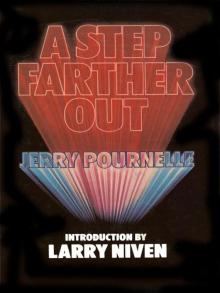
There will be war volume.., p.9
There Will Be War Volume VIII,
p.9


“I’m waiting for Buck.”
“Where is he?”
“He run off in the woods, chasing something.”
I worked my backpack straps around my shoulders. They creaked in the quiet.
There wasn’t much time left. Pretty soon now it would start. I knew the sequence, because I did maintenance engineering and retrofit on US3’s modular mirrors.
One of the big reflectors would focus sunlight on a rechargable tube of gas. That would excite the molecules. A small triggering beam would start the lasing going, the excited molecules cascading down together from one preferentially occupied quantum state to a lower state. A traveling wave swept down the tube, jarring loose more photons. They all added together in phase, so when the light waves hit the far end of the hundred-meter tube, it was a sword, a gouging lance that could cut through air and clouds. And this time, it wouldn’t strike an array of layered solid-state collectors outside New Orleans, providing clean electricity. It would carve a swath twenty meters wide through the trees and fields of southern Alabama. A little demonstration, the Confeds said.
“The bus—look, I’ll carry that suitcase for you.”
“I can manage.” She peered off into the distance, and I saw she was tired, tired beyond knowing it. “I’ll wait for Buck.”
“Leave him, Mrs. McKenzie.”
“I don’t need that blessed bus.”
“Why not?”
“My children drove off to Mobile with their families. They’re coming back to get me.”
“My insteted radio”—I gestured at my radio—“says the roads to Mobile are jammed up. You can’t count on them.”
“They said so.”
“The Confed deadline–”
“I tole ’em I’d try to walk to the main road. Got tired, is all. They’ll know I’m back in here.”
“Just the same–”
“I’m all right, don’t you mind. They’re good children, grateful for all I’ve gone and done for them. They’ll be back.”
“Come with me to the bus. It’s not far.”
“Not without Buck. He’s all the company I got these days.” She smiled, blinking.
I wiped sweat from my brow and studied the pines. There were a lot of places for a dog to be. The land here was flat and barely above sea level. I had come to camp and rest, rowing skiffs up the Fish River, looking for places I’d been when I was a teenager and my mom had rented boats from a rambling old fisherman’s house. I had turned off my radio, to get away from things. The big, mysterious island I remembered and called Treasure Island, smack in the middle of the river, was now a soggy stand of trees in a bog. The big storm a year back had swept it away.
I’d been sleeping in the open on the shore near there when the chopper woke me up, blaring. The Confeds had given twelve hours’ warning, the recording said.
They’d picked this sparsely populated area for their little demonstration. People had been moving back in ever since the biothreat was cleaned out, but there still weren’t many. I’d liked that when I was growing up. Open woods. That’s why I came back every chance I got.
I should’ve guessed something was coming. The Confeds were about evenly matched with the whole rest of the planet now, at least in high-tech weaponry. Defense held all the cards. The big mirrors were modular and could fold up fast, making a small target. They could incinerate anything launched against them, too.
But the U.N. kept talking like the Confeds were just another nation-state or something. Nobody down here understood that the people up there thought of Earth itself as the real problem—eaten up with age-old rivalries and hate, still holding onto dirty weapons that murdered whole populations, carrying around in their heads all the rotten baggage of the past. To listen to them, you’d think they’d learned nothing from the war. Already they were forgetting that it was the orbital defenses that had saved the biosphere itself, and the satellite communities that knit together the mammoth rescue efforts of the decade after. Without the antivirals developed and grown in huge zero-g vats, lots of us would’ve caught one of the poxes drifting through the population. People just forget. Nations, too.
“Where’s Buck?” I said decisively.
“He… that way.” A weak wave of the hand.
I wrestled my backpack down, feeling the stab from my shoulder—and suddenly remembered the thunk of that steel knocking me down, back then. So long ago. And me, still carrying an ache from it that woke whenever a cold snap came on. The past was still alive.
I trotted into the short pines, over creeper grass. Flies jumped where my boots struck. The white sand made a skree sound as my boots skated over it. I remembered how I’d first heard that sound, wearing slick-soled tennis shoes, and how pleased I’d been at university when I learned how the acoustics of it worked.
“Buck!”
A flash of brown over to the left. I ran through a thick stand of pine, and the dog yelped and took off, dodging under a blackleaf bush. I called again. Buck didn’t even slow down. I skirted left. He went into some oak scrub, barking, having a great time of it, and I could hear him getting tangled in it and then shaking free and out of the other side. Long gone.
When I got back to Mrs. McKenzie, she didn’t seem to notice me. “I can’t catch him.”
“Knew you wouldn’t.” She grinned at me, showing brown teeth. “Buck’s a fast one.”
“Call him.”
She did. Nothing. “Must’ve run off.”
“There isn’t time–”
“I’m not leaving without ole Buck. Times I was alone down on the river after Gene died, and the water would come up under the house. Buck was the only company I had. Only soul I saw for five weeks in that big blow we had.”
A low whine from afar. “I think that’s the bus,” I said.
She cocked her head. “Might be.”
“Come on. I’ll carry your suitcase.”
She crossed her arms. “My children will be by for me. I tole them to look for me along in here.”
“They might not make it.”
“They’re loyal children.”
“Mrs. McKenzie, I can’t wait for you to be reasonable.” I picked up my backpack and brushed some red ants off the straps.
“You Bishops was always reasonable,” she said levelly. “You work up there, don’t you?”
“Ah, sometimes.”
“You goin’ back, after they do what they’re doin’ here?”
“I might.” Even if I owed her something for what she did long ago, damned if I was going to be cowed.
“They’re attacking the United States.”
“And spots in Bavaria, the Urals, South Africa, Brazil—
“’Cause we don’t trust ’em! They think they can push the United States aroun’ just as they please–” And she went on with all the cliches I heard daily from earthbound media. How the Confeds wanted to run the world and they were dupes of the Russians, and how surrendering national sovereignty to a bunch of self-appointed overlords was an affront to our dignity, and so on.
True, some of it—the Confeds weren’t saints. But they were the only power that thought in truly global terms, couldn’t not think that way. They could stop ICBMs and punch through the atmosphere to attack any offensive capability on the ground—that’s what this demonstration was to show. I’d heard Confeds argue that this was the only way to break the diplomatic logjam—do something. I had my doubts. But times were changing, that was sure, and my generation didn’t think the way the prewar people did.
“–we’ll never be ruled by some outside–”
“Mrs. McKenzie, there’s the bus! Listen!”
The turbo whirred far around the bend, slowing for the stop.
Her face softened as she gazed at me, as if recalling memories. “That’s all right, boy. You go along, now.”
I saw that she wouldn’t be coaxed or even forced down that last bend. She had gone as far as she was going to, and the world would have to come the rest of the distance itself.
Up ahead, the bus driver was probably behind schedule for this last pickup. He was going to be irritated and more than a little scared. The Confeds would be right on time, he knew that.
I ran. My feet plowed through the deep, soft sand. Right away I could tell I was more tired than I’d thought and the heat had taken some strength out of me. I went about two hundred meters along the gradual bend, was nearly within view of the bus, when I heard it start up with a rumble. I tasted salty sweat, and it felt like the whole damned planet was dragging at my feet, holding me down. The driver raced the engine, in a hurry.
He had to come toward me as he swung out onto Route 80 on the way back to Mobile. Maybe I could reach the intersection in time for him to see me. So I put my head down and plunged forward.
But there was the woman back there. To get to her, the driver would have to take the bus down that rutted, sandy road and risk getting stuck. With people on the bus yelling at him. All that to get the old woman with the grateful children. She didn’t seem to understand that there were ungrateful children in the skies now—she didn’t seem to understand much of what was going on—and suddenly I wasn’t sure I did, either.
But I kept on.
Dinosaurs, by Geoffrey A. Landis
Editor’s Introduction
In 1979 Nobel Laureate Luis de Alverez concluded that the extinction of the dinosaurs was caused by an asteroid striking the Earth’s surface. Dr. de Alverez presented some quite convincing evidence based in part on the distribution of the rare element iridium in sea-bottom mud.
This was the opening salvo in what has now become known as the “Extinction Wars.” Opponents of Alverez’s view quickly proposed an alternate explanation, that an unusually large bout of volcanic activity was the culprit. Soon others offered such novel explanations as acid rain. Some of the most interesting theories accepted de Alverez’s basic thesis—that a large object hit the earth—but postulated that it was a comet or series of comets. One such theory also postulated Nemesis, a dark star companion to the sun that periodically disturbs the orbits of the millions of objects out in the “Oort sphere” beyond the solar system, and sends showers of comets to the Earth.
If the Nemesis theory is correct, we’re due for another cometary shower about now, give or take a few hundred thousand years.
Alverez himself believes the impact theory of Cretaceous-Tertiary extinctions has been demonstrated sufficiently that he has moved on to other geological pursuits. He says: “The unusual features of the Cretaceous-Tertiary (stratigraphic) boundary layer are exactly compatible with a major impact.” Larry Niven and I, for sentimental reasons, still favor Lucifer’s Hammer—the comet strike. That novel also postulated a dark star companion to Earth…
Recently, there has come new support for a Hammer Fall. Ronald C. Prinn of MIT, an atmospheric chemist, has come up with evidence for a comet impact theory of extinctions. At the Great Extinctions Debate during the 1986 meeting of the American Geophysical Union, Prinn drew a very bleak picture of life after Lucifer’s Hammer; swirling brick-red skies, sheets of burning acid rain, herds of animals asphyxiated by noxious air, and soil the color of moon dust.
He claims the acid in the soil would dissolve trace metals out of the top soil and increase the acidity of the oceans high enough to begin dissolving the calcium carbonate shells of sea animals. He ends by stating that the scenario would even be worse were the Earth to encounter a comet swarm.
The cometary extinction theory also explains the selective element involved in mass extinctions: those animals with the best chance of survival would be those which live in burrows and have learned to hibernate. Of course it also helps to be a long way from the place of impact. Sea life that lived in fresh water lakes and those salt water animals that have silicate shells might also survive.
Geoffrey Landis postulates another theory for the mass extinctions of Cretaceous-Tertiary life—one based on something as simple as a boy’s love of dinosaurs.
Dinosaurs
Geoffrey A. Landis
When the call came in at 2 A.M. I wasn’t surprised. Timmy had warned me it was coming. “Today or tomorrow, Mr. Sanderson,” he’d said. “Today or tomorrow for sure.” His voice was serious, far too serious for his age. I’ve learned to accept his prognostications, at least when he was sure, so I had my people ready. When the colonel called, I was already reviewing what we could do.
Timmy has a gift for time. He can, sometimes, see into the future, and a few days into the past as well. Perhaps because of his particular talent, he has a passion for paleontology. He’s got quite a collection of fossils: trilobites and fossilized ferns and even one almost-intact dinosaur skull. He’s particularly interested in dinosaurs, but perhaps that’s not so unusual. After all, Timmy was only eleven.
He has one other talent as well. I hoped we wouldn’t have to depend on it.
I found Timmy in his room. He was already awake, passing the time sorting his collections of fossils. We’ll be joining them soon enough, I thought. Maybe in a million years the next species will be digging up our bones and wondering what made us extinct. We walked in silence to the conference room. Sarah and January were already there. Sarah was still in her bathrobe and fuzzy slippers, sipping coffee from a Styrofoam cup. Jan had managed to throw on a pair of rather tight jeans and a faded Coors T-shirt. A moment later, Jason, our hypnotist, arrived. There was no need to brief them. They already knew.
Sarah was my number two talent. We found her while testing people who claimed to be able to locate subs underwater. We didn’t find any, but we found her. She’d been one of the controls. Instrumentation for the control group had failed a lot more often than for the test subjects. Perhaps another project team might have ignored this, but I’d instructed my team to investigate the inexplicable—in any form. So we investigated the controls and finally came up with the cause: Sarah. She was a feisty, forty-year-old divorced housewife who had the Murphy talent, an ability to make complex equipment screw up. After some training, she’d even gotten to the point where she could control it. Some.
My third talent was January. She’d shown an ability to enhance the rate at which things burn. With a little more training, she might be the most dangerous one of all. Now, though, she was just a college student with an untrained talent.
I had a handful of other people, with an erratic smattering of other talents. Nothing that might be useful against what was coming, though.
“Sarah, how you feeling?”
“Burned out, Danny boy, feeling burned out. Never was good for much after midnight.”
“That’s not so good. Let’s see, you work best awake. Jan, how about you?”
“I think I’d better go under, Dan. I’m too nervous to do any good awake.”
“Right.’’ I nodded to Jason, and he went over to put her to sleep. “How about you, Timmy? Ready to go under?”
“Yes, sir.”
“How are you feeling?”
“I’m feeling really hot tonight, Mr. Sanderson.” He grinned at me. “Real good.”
If so, he was the only one.
Once I’d thought that being assigned to Project Popgun was the last stop in a one-way journey to obscurity, a dead-end directorship of a make-work project. But even if I was relegated to a dead-end project, I resolved to make it the best-run dead-end project in the government.
Maybe I should explain what Project Popgun is. Popgun is a tiny government agency set up to study what the military euphemistically call “long shot” projects. What they mean is “crackpot.” Psychic assassins, voodoo priests, astrologers, tea leaf readers, people who claimed to be able to contact UFOs. Nobody really thought any of these would pan out, but they were each carefully investigated, just in case. Dogs who could foretell the future, children who could bend spoons, gamblers who could influence the fall of dice. There were always new crackpots to investigate as fast as the old ones were dismissed. After all, with the defense budget numbering hundreds of billions, a few million to check out crackpots is considered a bargain.
The psychics, the palm readers and fortune tellers, none of them turned out to be worth the investigation. But here and there, in odd nooks and by-ways across the nation, I’d found a few genuine talents. I’d begged, bribed, coerced, and flat-out hired them to come work for me here in Alexandria, where we could study them, train them to use their talents, and maybe even figure out what they were good for.
Strangely enough, as long as I had reported negative results, I was commended for rigorous work and carefully controlled test procedures. Once I started to report something worthwhile, though, we were accused of sloppy research and even downright falsification. The investigating committee, although not going so far as to actually endorse our results, finally suggested that our findings “might have legitimate defense applications,” and recommended that I be given limited scope to implement near-term applications. So I’d asked for—and received—a hardwire link to the threat evaluation center at NORAD, the North American Air Defense command. Voice plus video images of the main NORAD radar screen, carried on EMP-proof fiber-optic cables.
Now we waited, listening to what was corning down across that link.
“Surveillance satellites report covers are now coming off the silos.”
The President must be on the hot line by now, trying to avert the impending catastrophe. ICBMs were being readied in their silos for a retaliatory strike, waiting for the word.
Across the U.S., fighter squadrons were being scrambled and ancient antiaircraft missile batteries armed to intercept incoming bombers. Those couldn’t shoot down ICBMs, though. The last defense of the U.S. would not be fought from the ultra-hard command post under some mountain in Colorado, but right here, in an ugly, nondescript cinderblock building in the suburbs of Alexandria, all but ignored by the military high command. A housewife, a college girl, and an eleven-year-old boy.