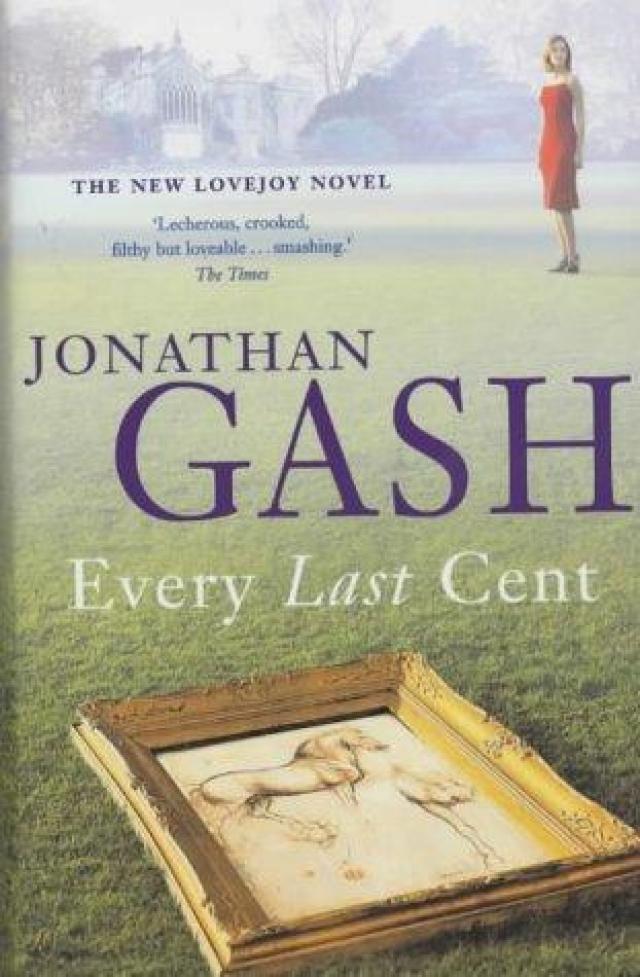
Every last cent l 22, p.27
Every Last Cent l-22,
p.27


And saw a lovely little Victorian fede ring (means faith, trust in a loved one). A real lover's antique. I've a soft spot for them. I knew it instantly. Me and Alicia nicked it from Corridern's Auction, Scunthorpe. I'd checked the opening device myself. Describe it, a fede ring sounds almost impossible –how did craftsman get so much on a single small gold ring? Two hands often linked by pearls, with diamonds or rubies in the setting. They sometimes open, showing two hands clasping inside.
It was on the bottom tier of my mahogany serving table. Brig must be hoping to keep some of my – well, Alicia Domander's and Peshy's – stolen antiques for himself. I brooded on a plan to restore rightful ownership, meaning mine.
'Bad news, Brig?' I asked, swallowing my anger.
His face was grim. 'Purdey's the gunsmith has been taken over by a French firm. Guess what comes next.' When I shook my head, 'They're going to increase production, from sixty to eighty shotguns a year! Bounders, what?'
'As long as they keep it going, who cares?' I hate huntin', shootin', fishin', all those sporting massacres. The implements are sometimes beautiful, but my experience is that carnage reduces merriment. Ancient gunsmiths' artefacts, like Purdey's weapons, are an instance. Lovely in a glass case, horrible in action.
'Standards, Lovejoy!' He was puce. 'Good God, man, they're not tins of beans!'
'What's this show?' I asked for diversion. Maud rolled her eyes in exasperation.
'Sandy's doing it,' Brig told me evenly. I almost spluttered. If he deplored Quaker, what on earth did he think of Sandy and Mel?
'Sandy's such a dear,' Maud said, smiling. 'His show's secret! Isn't he the one for surprises!'
Knowing Sandy, it would be a mad frolic, himself the centre of attention, embarrassment the main ingredient.
'What's it in aid of?' Like fowl pest viruses, charities abound in East Anglia. Like antiques auctions, too. I've never met an honest one of either yet.
Brig said smoothly, 'It's a London thing, Lovejoy. Let's hope it goes well for all our sakes.'
'Wotcher, Lovejoy.'
In wheeled Quaker with that electric hum. I said hello and was me taking Maud out okay.
'As long as you drive carefully!' We all fell about at the drollery, because the Quay Theatre was only a couple of hundred paces along the riverbank. You can walk the towpath to the side entrance. 'Did you hear about Morgan Motors?' His eyes shone. 'I'm driving their Formula One racer at Silverstone!'
'Brilliant, mate! Congratulations!'
This extra lunacy made me wax lyrical, saying how marvellous but those risky hairpin bends and watch out for that Finland geezer who's champion. Quaker answered with axle ratios and drag coefficients. The brigadier kept a stiff upper lip throughout this nonsense but showed his screaming exasperation at his barmy son-in-law by rudely putting the telly back on to watch his bouncing nags.
'Have you been all right, Lovejoy?' Quaker asked. 'I heard you were in that accident, Timothy Giverill on the bypass.'
'Not in. Just nearby.'
'Lucky you.' He beamed. 'You're lodging his missus?'
Maud's attention came on me like a laser. I said, 'She'll be gone as soon as her relatives get organized.'
'And Tinker. Okay, is he?'
'Fine.' I thought, what is this? Blokes don't say such things. Keeping useless conversations going is women's talk, how's Jimmy's leg and did Constance's dance shoes prove right and all that. Quaker had never talked like this before.
'And your Mortimer. He in good health?'
'Who?' I tried to be casual, but gave in. 'Fine, last I saw.'
'Good. And little Henry? It is Henry and Eleanor who you're so fond of?'
'Fine, ta.'
'Good, Lovejoy. Pleased to hear it. No, Maud, I'll not have a drink.' She hadn't offered him one. He patted his belly. 'I've to watch the weight. No Schumacher octane tricks on us Morgan drivers!' And out he whirred, waving.
'Cheers, Quake,' I called after him, wondering what that was all about.
Brig switched the TV off. Still looking for somewhere to put my glass down, I noticed something odd. The Victorian fede ring had vanished. I almost gaped but had the sense to simply tell Maud ta and pass her the drink like I was surfeited.
'Tell me about Mrs Giverill, Lovejoy. You asked her to stay?'
'Actually at a neighbour's, except during the day.' The lie got me out of it. 'She's still poorly from the crash, goes to out-patients.'
'Poor thing,' Maud said with that mix of sympathy and satisfaction that speaks volumes, while I wondered if I was the only one who'd not solved the Case of the Vanishing Ring.
Quaker hadn't been near it. I hadn't touched it. Maud was on the wrong side. The brigadier hadn't got out of his chair. Therefore ... My mind found a fraction of explanation with relief, for who was the swiftest, slinkiest arch-thief in the kingdom?
Who moreover was small and stealthy, and might creep in unnoticed on all four paws?
No wonder Brig knew all about the antiques Alicia Domander had stashed for me at Eleanor's. Therefore Alicia and Peshy were here. And Brig and Alicia were Just Good Friends.
'What time tomorrow?'
Maud coloured slightly, deception now. 'It starts at seven-thirty, so just before that?'
'Right.' I watched her go.
'We'll have time for a gin and tonic first, Lovejoy,' Brig said.
'Maud might like to go somewhere else.' Me, testing the water.
Brig appraised me. 'Lovejoy. Your special talent is a matter of survival.'
'Whose?' The disappearing ring hadn't come back.
'Mine.' He spoke with the weight of years.
'I can't believe that.' I was shot by his glance. 'Not like you say it.'
'You think I'm immune?'
'No. But look at what I do.' I shrugged, made sure Maud hadn't reappeared, Quaker not lurking. 'Antiques is a grubby trade. Rooting through people's cast-offs. Rust and dust, to earn a crust.' I told him about Marjorie, queen of the rubbish dumps. 'She's our only grubber with style. I have no style at all. I scrape along by cadging. You said so yourself.'
'That's because you're stupid, Lovejoy.'
'Eh?' I said, narked. Even shame has its pride. Except the trouble with shame is that it's indivisible. It has no components, doesn't arrive in bits. And it has only one speed, flat out and total. Shame overwhelms you.
He leaned forward, eyes piercing. 'You could be a multi-billionaire. Why? Because you can divvy a single genuine antique among scores of lookalikes.'
He kept his voice down. A bloke like him, military background, would be aware of any bugging devices.
'It's not as easy as that.'
'You mean you're weak, Lovejoy. You give your divvy skill away to grope some bint. Or because you're sorry for a friend. Or to protect your by-blow Mortimer.' He stared me down. 'In my book that's utter stupidity. Well, those days are ended, Lovejoy. You are now subject to discipline.'
'Who says?'
'I do. Until further notice.' He added, not without a hint of regret, 'Everybody agrees.'
So I was enslaved for ever and ever? 'What if I refuse?'
'You will...' He searched for the right phrase, 'Be put down.'
Like a vet puts down sick cats? I gulped. He smiled, seeing cowardice.
'There is a positive side, Lovejoy. You will earn the undying gratitude of me and all my ilk.'
It didn't sound much. I'd got along pretty well without it so far. My expression must have shown because he leaned forward, keen to explain.
'Reluctance is all very well, Lovejoy.' He said it like my teachers used the phrase. When people say something's all very well they mean its opposite. 'You fail to understand the plight of my class.'
Here we go, I thought. His class? There's no such thing any longer. I used to know an old Polish soak who was mystified that one of our royal princes had failed some college examination. 'It could never happen anywhere else,' he said over and over in bafflement. I couldn't see why he was thunderstruck. 'Lazy little sod should have studied harder,' I'd told him in puzzlement. It was some time before it got through.
Other countries weigh breeding with advantage. Middle Eastern professors' sons get an extra twelve per cent free marks in exams. But here, that's all back in the Dark Ages except in romance stories. We've simply exchanged class for robber barons in council offices and government.
'There's no such thing any longer, Brig,' I said straight out. 'Class has been replaced by jacks-in-office with inflated pensions. We serfs get ballocked just the same.'
'Your ... sort would think so.' He came near to a sneer. 'You have the arrogance of ignorance. Who keeps this world going, Lovejoy? Commerce, merchants, investors.
People like me. We keep order, protect the lazy and indigent – fools like you, Lovejoy.
Accept it.'
I already knew where his argument was leading. He too was a Name, a heavy investor in Lloyd's. His mob – okay, his clarrrsss – had gone broke because their chits were being called in. He and his pals were looking for a new profitable source of promissory notes, and they'd found me. I was to rescue them. They would stump up with the money gusher they'd get from antiques.
Maud was a carrot, and carrots didn't come any lovelier. My survival was another.
Wealth – soon, I was sure, he would promise me a fortune – was a third. Other benefits? Possibly superb educations for Mortimer, Henry, Uncle Tom Cobley and whoever I favoured. The thought suddenly occurred: wasn't I suddenly important? Brig and his cronies evidently thought so. Except, who'd topped Vestry? And Bernicka?
What I felt at that moment was contempt. Brig had become a Name in order to reap easy profits year upon year. That's what insurance is. It's also why I don't trust it, and always tell folk never to insure. Now, the brigadier had to pay up. He didn't like it. So he wanted out, thought it unfair. The honourable thing would have been to simply keep his promise. Take the money in the good years, pay up in the bad.
'Play the game, Lovejoy. You'll be in clover.'
What he meant was, disobey and I was for it.
'Ta for the drink, Brig,' I said meekly. I'd not even tasted the damned thing. 'I'll do as you say. But. . .'
'Quaker?' He smiled. I was looking at a firing squad. 'He's just a clerk, Lovejoy. He will agree. Every step of the way.'
I left him watching his nags on the screen. Step, see? A jest, Quaker being in a wheelchair. Some joke to do with class, I expect.
If you're like me, you get dispirited. I made it as far as the Donkey and Buskin, where I stopped for pie and mash. I didn't begrudge the brigadier his authority – he'd doubtless sweated in the jungles or wherever in defence of the realm. He was entitled to peace in his advancing years.
Making me team up with his Maud? With married Maud? I felt shanghaied, to save his skin. I'd be under his thumb. That was too much. But he seemed all-powerful. No way out for the likes of me.
I must have been there, sunk in despond, for the best part of an hour, before I realized somebody was standing a yard away. It was the hulk from the Countess's Antiques Emporiana.
'Come wiv me, mate,' he growled.
The motor must have been a converted hearse. The Countess reclined on cushions inside, watching a television. The Antiques Road Show was on, as drilled and rehearsed as ever. She smiled, crooked her finger. I felt my heart yearn.
'Drink, Lovejoy?' Her hand extended with a clang of gold. She'd had diamonds set in her front teeth since I'd seen her last. The perfume was overpowering. Her cosmetics were trowelled on. Beautiful. That's taste.
'No, ta.'
'Lovejoy, would you help me?'
Time for defiance, rebellion against all these tyrants.
'Yes, Countess,' I said faintly. 'Anything.'
'Soon, I'll want you to do something .. . really special. Divvy some antiques that may or may not exactly belong to me.'
'I see.' My voice went hard to manage.
'Would you? No matter whose they were?'
Like Brig's syndicate? I thought it, but did not say.
'Yes, Countess.' Me, the hardliner.
'And could I depend on you for full. . . satisfaction?'
Three swallows later, I croaked, 'Yes, Countess.'
She squeezed my thigh. 'Then I'll let you go. For the moment.' She blew me a kiss. I sat transfixed, a hare in her headlights.
'When can I see you, Countess?'
'Later. Until then, Lovejoy.'
'Thank you,' I said like I'd received the most generous largesse, and got out. The motor drifted off down the road. I gazed admiringly after it, thinking that there went real class, not the brigadier's old-school attitudes. I caught the bus.
Where the hell was Tinker? Time was rushing to the meeting. I wanted at least one ally, and apart from Alicia Domander I'd no real hope of anybody who'd take my side.
And now even she was joined at the hip to the brigadier.
35
ODD WHAT THINGS fascinate people. There's an American university offering millions, to anyone who can solve any unsolved mathematical problem. One is this: why do buses come in threes? No good telling them the old Cockney's joke: buses only come in convoys so they don't get torpedoed, ha-ha. That won't earn you the money. Another is this: why is it harder to discover a solution than have it explained? Seems simple to me, but brainboxes say no. If you can write down the mathematical proof, post it off.
Honest, they'll send you millions. They think numbers are reasonable.
Others work with equal devotion doing wrong. It's sad, bad news. In antiques there's the doc job. (This is where you go into hospital, then antique dealers raid your house.
And take everything.) If it happens to patients admitted to the same hospital then the crooked informant will be somebody in Reception who takes your details down. She tells her criminals the addresses of patients who are in for lengthy treatments . . . The plod are worse than useless. Ask the police to protect your house while you have your hip done, they'll simply go back to their snooker halls which, locals here joke, never get robbed. The box job's another version, when crooks strip your Aunt Agatha's house while you're at her funeral. (That's easier, needs no accessory other than the obituary columns.)
It was glimpsing Paul and his birds – still collecting for the hospice in the shopping precinct – that made me remember somebody he'd mentioned. I crossed over, keeping a weather eye on his latest, an irritable sparrow the size of a sack.
'Wotcher, Paul. Okay to ask?'
He smiled, said hello. He was allowing a little girl to stroke a bird with white feathers. It looked a real gangster.
'That auctioneer you mentioned. Remember? He chandeliered me once, and there was that fuss. He used to stand help you collecting.'
To chandelier is when an auctioneer takes fake bids instead of from some legitimate punter. Auctioneers are always at it. I owed him.
He thought a minute, saying, 'Ta, missus,' every time somebody clanked a coin into his tin. Then, 'Nice bloke. Still lives in Dragonsdale. Lanny Langley-Willes. Big twitcher.'
He told me the address. I had the good manners to ask Paul about his missus. His face clouded.
'She gives her time to Aspirin, Lovejoy.' He glanced about, made sure no children could hear. 'I think it's the end for us, really. Pity.'
What can you say? 'Sorry, mate.'
He smiled bravely on, telling bystanders of his birds' evil predatory habits, letting them stroke their feathers. Some folk are just kindly made, and act holy all their lives. Other people, I've heard, aren't.
Money, like lawyers, absolves the killer. Enough money could beatify Stalin. It's a feature of civilizations. Countries in the throes of revolution do without the middlemen, go straight for the gun or famine. In it all, there stands the squeeze.
Squeeze is the old China Coast word for illicit money. You want a new dress design before the catwalk show? Easy. You pay squeeze to the guards, who let you in after nightfall so you can snap it and your seamstress run it up overnight. You want to leak that secret government report on Walsall's homeless? Slip squeeze to the printers, and behold a copy comes under your door! You want your handsome bachelor boss's private curriculum vitae? Why, a little squeeze paid to Elsie who does his dinners and, surprise surprise, his CV's on your desk! So now you can accidentally bump into him, all glammed up ... and so on.
The hallmark of the squeeze? Nobody knows anything afterwards. When police hunt that somebody who stole those secret dress designs before the London Fashion Show, or filched that White Paper on the homeless, or let slip where your eligible boss went fishing, nobody knows anything. It's the old 'What, moi?' business, with the wide-eyed stare. Innocence rules.
It's everywhere. But mostly in auctions.
Think of the benefits. Suppose you knew the names and addresses of all the people who sent stuff in to an auction. You could casually meet them, then it's, 'Good heavens!
I've just been looking for a piece of pure white-paste brilliant glazed Derby porcelain!
My beloved sister collects post-1770s Derby ware! And you've actually sent it in to be auctioned? You poor thing. Auctioneers rook you, you know.' And quickly move on to,
'Look. Why don't I make you an offer? By the way, isn't your hair lovely! I've always admired women who wear blue / lemon / pink ...' etc, etc.
Not only that, you could steal desirable items before viewing day if you get the catalogue early enough. Theft is always done for a flat fee, currently fifty zlotniks an item, unless there's something special about the antique. Incidentally, your hired thief will expect at least one item's fee as a tip if he does the job well. It's polite. Your thieves will then spread the word that you're a decent wallet to work for. Add one tip extra for every five antiques they steal. So if you want, say, ten antiques stolen from an auctioneer's, pay the thief ten times fifty zlotniks plus fifty times two – total six hundred for the transaction. They pay their own transport. Don't do it for them – you don't want to be implicated in any shocking robbery, do you? You're honest! And don't pay until you receive the stolen goods.