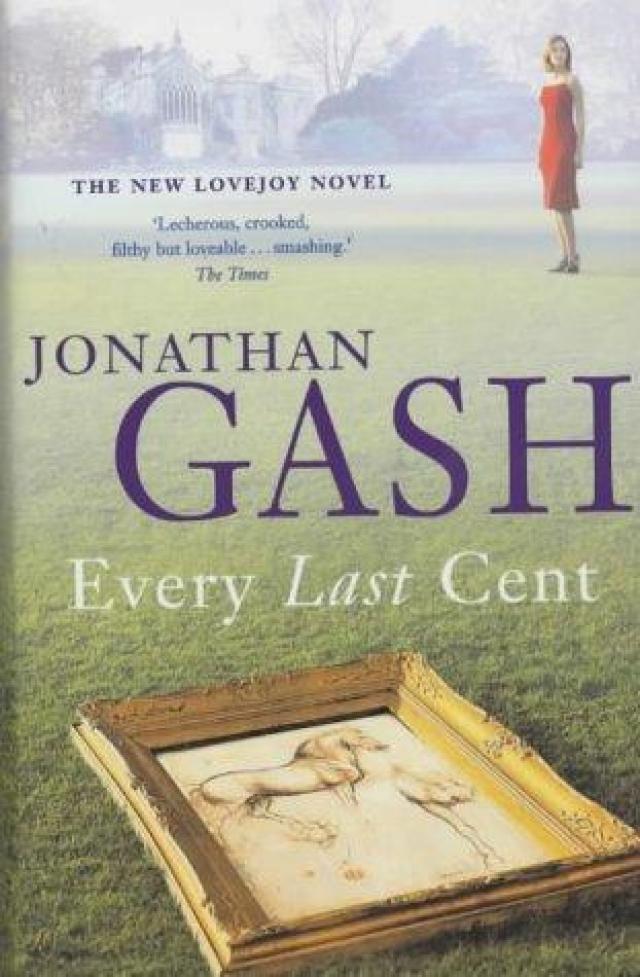
Every last cent l 22, p.31
Every Last Cent l-22,
p.31


'Nothing important? You're mad, Lovejoy! This means survival. Without your talent the syndicate will go under. People who've never lacked a thing in their lives. Not people used to poverty. People in responsible positions.'
'You mean posh folk should be protected from their own greed?'
'Yes!' she screamed, hitting out at me in fury. I ducked and weaved but still she caught me. I felt against the wall for the bloody rope, get out of this.
Then a bloke's iron grip took my arm. His voice said, 'Stop it, Maudie. I've got him.'
God, but I was relieved. Maud halted her assault. I could hear her breaths, fury in every waft.
'Thought you plod were never on time, Sep,' I gasped.
'No jokes, Lovejoy.'
'Sep?' Maud seemed puzzled. 'What are you doing here?'
'I've come to take Lovejoy into custody, Maudie. I have bad news. I'm sorry.'
'What bad news?' I sounded strangled. 'Tinker?'
Tinker couldn't hide, not with his cough. He's like a foghorn. So Sep must mean—
'Quaker's been found in the river, Maudie. He'd been bludgeoned and drowned. No hope, I'm afraid.'
'But—' Maud looked at me.
'Lovejoy slipped out, and did Quaker. I saw him. Lovejoy was seen coming from there.
Then he went to sit with you. Alibi, see?'
'Me?' I bleated. 'I couldn't club anybody, Sep. You know that. Christ, I was in clink with you.'
'You're under arrest, Lovejoy. Don't move!'
'Sep,' Maud said. 'I don't know what you are saying. Where is Quaker? I want to see him.'
Maybe I could dart past the loon, find those wooden steps Sep must have used.
'Stand still, Lovejoy!' Sep yelled, coming at me swinging something.
I ducked, shoved Maud in front of me, stooping so he'd clout her instead of me. He did just that. I heard the crunch, something hitting her. She shrieked and went down moaning. Verner lashed at me and the world span out of sense. I actually heard blurs and saw Sep loom, arm raised.
A balcony door opened. A light came on. The brigadier stepped out, locking the door behind him. He was in full fig, regimental blues, medals, more brass than you'd see on a fender. From a carnival? How come he had keys? He held something long in his hand.
It shone. But was he help, cavalry to the rescue?
'Verner,' he said quietly. 'That'll do.'
'I had to go for Lovejoy, sir. He was about to do for Maudie.'
'Eh?' I tried to stand, but Verner was too close. 'Stay still, Maud, Lovejoy.'
As if I'd want to move with a homicidal plod intent on battering me to death.
'I had to do it, sir,' Verner explained as if making a report, all calm. 'He'd some daft notion about coming clean to that Quayle tart, and helping the Countess's mob to take us over, do us out of our scheme.'
'Stand by the balcony. I'll get Lovejoy up.'
The brigadier moved. Sep moved. I tried to crawl away behind the recumbent moaning mound that was probably Maud, to hide and let her take the brunt of whatever was coming. I thought maybe I could lob myself over the balcony, splash in the water below. Or was the vertical drop onto the quayside, where I'd smash my brains out on the flagstones—
Something swished. Hot wetness hosed across my neck. I screeched, wailed. The thing went swish, swish. Horrid spurts hosed my face.
A gurgle sounded near me. I clasped Maud and hung on, hoping the maniac wouldn't start swinging at his daughter while him and Verner came to some arrangement.
The brigadier grunted. Sep gurgled, tried to cough, failed. The balcony seemed to shiver a second, but it could only have been my imagination. Something heavy fell, thudding onto stones below.
Vertical. The drop was vertical.
Somebody close by – the brigadier, doubtless – shone a pencil torch into the balcony corners. There was blood everywhere. Maud was covered in it. The brigadier stood there, his expression calm. In his hand he held his sabre. It had surprisingly little blood on it at the tip, but the rest was gore, gore. Even the balcony doors' windows were liberally sprayed with a red cascade slowly trickling down the glass panes.
The brigadier stooped, looked at his daughter, then removed the door key and handed it to me.
'Do the necessary, old chap.'
'Eh?'
His face assumed a pained look. 'Insert the key in the other side of the door, if you please. Don't lock it. Then dial the police.'
'Where from?'
'Try the telephone.' He waited expectantly, then added, 'In the bar.'
I did as he said. Just told them to come fast, and bring an ambulance. They started asking me questions, bloody idiots, as if I knew anything.
'Good man,' Brig said. 'Bring Maud a cushion, Lovejoy.' As I turned, he asked conversationally, 'Oh, where did you leave Quaker?'
'I didn't touch him,' I croaked.
'I know,' he said with exhausted patience. 'You couldn't. He was on the opposite side of the river. Just remember that Verner said that, eh?'
'Right, sir,' I said, wondering what the hell he was on about.
He placed the cushion and sat down, cradling Maud.
'You can go, Lovejoy. You are irrelevant. Be prepared to answer their questions later.
Be factual, please.'
'Right.' I hesitated. 'Do you want to get away, Brig? I'll think of something.' God. What if he said yes?
'No, Lovejoy. You fail to understand. Your perennial habit.' He gave a wry smile. Maud stirred in her father's arms. 'I am the principal Name. Therefore I must accept responsibility. Bankruptcy is now my duty.'
'Duty? But you might get out of it.'
'Duty is for doing, not evading. It is the possession of a gentleman.'
'Right, Brig.' He meant he hoped I'd do mine, irrelevant as I was.
39
MY JACKET WAS hopelessly caked with blood. I found the bar's loos and washed some of the blood off. I didn't look presentable but when did I ever?
Maud was sitting up, shuddering. Her dad had draped his bloodstained jacket round her shoulders. He was seated beside her amid the gore. An execution scene. A couple of people were shouting up from below. Somebody had brought a torchlight, never still, flickering on trees. 'Is she all right?'
'A bad bruise.' The brigadier had wiped his sabre on his trouser leg – I saw the stripe it made – and sheathed it. First things first. 'Lucky I came, hey?'
'I'll go and find Quaker.'
'Be a good chap. Go down and let them in.' No police as yet, though. I did as he said.
Two astonished blokes, one in the uniform of a car-park attendant, coat of arms on his cap, were gaping aghast at me through the glass doors. I unlocked. They came in. One had two dogs straining at a leash, wanting ever more excitement on this unusual night walk.
'What the hell's happened?'
'I've called the police. It's upstairs.'
'There's a man dead out there,' the uniformed bloke said. It was beyond him. He wanted reason, like don't we all. 'Ted's there.'
'The lady will be all right,' I said, doing my best for his rational world. 'Her dad the brigadier's with her.'
'What do we do?'
'Ted minding the body, is he?' I said, walking past. 'Go on up until the police come.'
They went toward the staircase, dogs and all. Their relief was tangible, somebody telling them to do something and mentioning the police.
There's no bridge across the river until you reach the railway pub, then you get a choice of three. Too far. The theatre's lights were coming on, giving enough light to see the leisure boats. I unmoored one and rowed clumsily across to the opposite bank, left it there and walked until I judged I was opposite the place where I'd heard what I thought were lovers.
'Quaker?' I kept shouting. 'Quaker?'
Like a fool I'd not brought a flashlight. I did the best I could, flailing about the undergrowth by the towpath. Nothing. Then I heard it, a magic sound that almost brought tears of relief to my eyes. It was a long slow wheeze repeated until the ground shook. Tinker's cough. He thinks I don't know he still smokes. His snitch is always stained with snuff, which he's not used – honest, Lovejoy – for ten years, the lying old sod.
'Tinker?'
Answer came from across the river. Then lights, but from curtained windows. I recognized Maud and Quaker's house.
'That you, son?' And instantly into grumbles. I still couldn't see him. 'I found this lame bloke in the water like the brigadier said. I didn't get his wheelchair out. Sod that.
Turns out the lazy bastard's nothing wrong wiv him. Not a drop in the house.'
'Stay with him, Tinker. I'll be back.'
'Right. The brigadier get on all right, did he?'
'Aye, fine,' I said drily. I'd a mile walk into town.
'The brigadier said there'd be booze here but I found noffink. Any idea where he keeps it? This silly burke keeps showing me photographs of the Olympics.'
I walked on in silence.
The Drum and Flag is ancient, even as our local taverns go. Every so often some enthusiast dredges up proof that this pub or that hostelry was around in the ninth century, but we've some taverns encrusted in old Roman walls and they're still hard at it, serving their ale and nosh.
Ashamed, I walked into the light. It was still fairly crowded. I carried my jacket, and had turned my collar under. People must have assumed I was from the gala. The head waitress was standing at her podium, blonde, smart, thick spectacles, uniform. I asked for the Americans. A waitress conducted me to the alcove where the three of them were seated.
Consul Sommon smiled affably with that well-nourished bonhomie only millionaires can attain. I have a sneaking feeling that it puts the rest of us down onto some servile plane. Like society women, whose rich dresses do the same to the poor.
He was not quite sprawling – the sprawl is another characteristic of worldly power – on a couch. Before him, a long coffee table stocked with drinks, food, enough to host a party. People all about talked, chatted, called to friends. Some TV match was on.
Pleasant, everything safe, the town solvent for a generation. People were happy.
'Sit you down, feller. What'll you have?'
Friends, now he thought it all over.
'Nothing, thank you.'
The food looked stupendous. I looked away.
'May I offer you a shandy, Lovejoy?'
'Yes, please, Ms Deighnson.' Could I call her Petra?
'What the fuck?' said the consul. 'My drink not good enough?'
Grief is the only emotion insoluble in alcohol. I thought this, but did not say. He'd have demanded an explanation.
Petra Deighnson signalled a waitress and ordered me a shandy ('The gentleman likes his lemonade in first, please!' – the first I'd heard of it). 'You know, Lovejoy,' she went on quietly, 'half the trouble is that our country has never signed UNESCO's treaty banning the sale of archaeological treasures.'
'It's time you stopped these sales!' the consul exclaimed, his remark of course for public consumption. I've always found that those in public office want controls because they're on the right side of the barricades.
'Where will the antiques be exported?' I asked.
'You mean what, exactly?' she asked, her smile hardening.
Definitely not the question to ask Petra, for she was among friends. I wasn't.
'The consul's Nok-Jos terracotta in the theatre foyer isn't illegal here. A dozen antiques shops openly specialize in them.'
She almost winced. 'The Continent. The USA. It's a seller's market.'
'The United States is taking enormous steps to control traffic in illegal antiques.' The consul intoned the party line.
God, but politicians sound good. You have to admire them. They're really lifelike.
'You're not,' I told him, but pleasantly, like I too was their pal, part of the team. He'd recruited me at the Martello tower restaurant. He must take the consequences.
'The US of A has made enormous strides towards an ethical goal.'
'Famous museums throughout Africa are forced to display replicas of their own stuff.'
The shandy came. I gulped it with what I hoped was decent slowness. La Deighnson ordered me another, adding her lemonade-in-first speech. 'It's unstoppable.'
Susanne Eggers was inspecting my jacket. I'd dropped it as I'd sat, casual man of the world that I was. She paled.
'Is that blood?'
'An accident at the fireworks.' They relaxed. 'You were saying, sir?'
'The US is against exploitation of Third World heritage.' He looked about for possible voters and placed his own drink carefully on the table. A portentous speech was coming on. 'We have a constant, definite, and determined policy of international cooperation ...'
and so on.
Petra Deighnson was a Name in Lloyd's. Nothing illegal there. I already knew that Susanne Eggers was the consul's former missus. They were still together. That too was allowed. Also, politicians transgress in ways that only Sun Kings and medieval popes were once able to. They also got away with murder.
Consul Sommon, a giant Name, had insurer's debts that were darkening his sky. Party politics deplore poverty. The only way for a man with political ambition was to get money. How lucky, I thought as his rhetoric bumbled on, that his position as an eminent diplomat provided him with the means to extort wealth. Contacts in embassies, favours for diplomats, his illicit antiques would bring a fortune. And it would be the very best sort of money, the untraceable sort.
Through the fenestrated wooden screen that shielded us from the hoi polloi I saw the head waitress at her podium. She'd made some sort of error and was laughing. A young waitress was laughing too, hand to her mouth in mock alarm, pointing to the ledger. I thought she looked a bit familiar, but not so you'd remember where you'd seen her last.
I suddenly decided on a wrong tack.
'Is Mr Verner a friend of yours, Mr Sommon?' The consul looked at Susanne. 'Yes. A business associate.'
I didn't really want to bring it up until the last person came in. It wouldn't be the brigadier. With his sabre or without.
'Only, I don't want any trouble.' I tried to look on edge.
He thumped me playfully.
'You're aboard with us now, Lovejoy. You've achieved your life's ambition! Being paid for what you like doing! There'll be no trouble from police, Lovejoy.'
Susanne was still unhappy about my jacket. Her unease had communicated itself to Petra Deighnson. I saw the latter look at my shoes. I'd rubbed the grubbier one on the back of my calf, like children do. I didn't glance down. Did it show blood?
'Have you cut yourself?' she asked.
'Somebody fell. I tried to help.' I'd wriggled to put Maud between me and a murderous maniac. Ever the hero.
'Did the antiques show go well, incidentally? I went out for a breath of fresh air while it was on. Too hot.'
'Yes.' Susanne described how well it had been received. 'They were all so good.'
She meant her actors were convincing enough to deceive the ignorant, and protect this ex-husband of hers.
'Anyhow, I'd already seen the show.' I said it like a gag, the last one-liner, smiling.
Mr Sommon hooted, choked. I had to bang his back. 'Your orders, sir?' Clear things up.
He opened his hands displaying largesse, the world his to be handed out to the deserving.
'I want three shipments a month to begin with, Lovejoy.'
'That many?' I stared, working it out. The man was off his trolley. 'Container loads?
Four or five thousand antiques a month?'
'So?' His beaming smile faded. 'Jeez, Lovejoy. You're a freaking divvy. You've only got to say whether the antiques are genuine or not. Christ. You don't have to work.' He became mottled at the thought of idle bums who didn't slog ergs to achieve the dream.
'You've only to sit down and look.'
He had no idea. Only a divvy knows how sick you feel, the utter malaise. One divvying session ruins you for days. The headaches, the eerie disorientation. It drains. I once divvied a shipment in two days, several hundred pieces of antique furniture, for a French shipper. I'd taken it on soon after their one and only French divvy died. I didn't recover for a fortnight. He was old, lived in Brittany. Nice chap, very quiet. Normal people haven't a notion.
Thinking of how poorly I'd been that time brought my headache on. My temple thumped tribal paradiddles.
'How many, then?' Petra Deighnson, straight to the gelt.
'One container load in three weeks, for me to stay sane.'
'One? That's less than a thousand!'
'Keep your voice down, darling,' Susanne said.
She reached but her hand didn't make it. He drew away, eyes challenging me to mortal combat. Me, his only salvation, note, for the ghastly financial mess his greed enticed him into.
'Christ! Susanne's actors only needed ten minutes!'
Like other crooks, he'd begun to confuse reality and myth. The actors going through their paces on stage were acting rehearsed fiction. The import of antiques through his diplomatic channels was criminal reality.
'They were pretending,' I said patiently. Abruptly I was tired, sapped to exhaustion. 'It's me alone that would divvy your illegal shipments.'
'But—'
'If you think they can do it, hire them instead.'
'What he says is true,' Susanne said quietly. 'Remember? It's on the video movie Taylor made at Saffron Fields that day.'
He seethed, glared. A thwarted politician is an ugly sight. I wondered if Congress had a televised Prime Minister's Question Time like us. It's the nearest the electorate ever get to a straight answer. It's still miles off.
'One shipment a month would be better.'
'One a fortnight, Lovejoy.' He put the flat of his hand on the coffee table so hard the crockery jumped. 'And that's that. I already have one shipment here. You start tomorrow.'
'Right.' I gave in. If I'd guessed right, we'd not get to his bloody shipment anyway.
Where were the Keystone Kops? I felt I'd done enough, got them all to speak the obvious.
'Can I have another drink, please?'
'Shandygaff, isn't it, sir?'