Falling out of time, p.10
Falling Out of Time,
p.10


But Zola kept her expression bland.
No, go with awestruck, she reminded herself. These people think you’re seeing some amazing Amazon wildlife.
She studied the tourists, but pretended she was studying exotic birds.
About half of the tour group seemed to be kids on some sort of school trip—there was even a cluster near the front that reminded her of herself and Beatriz and Amir and Eromi, half listening to the tour guide and half whispering together under their breath. The tourist kids’ clothes didn’t quite achieve the same range of dressy to faux-battered that Zola might have seen in her own classroom; it looked more as though they were wearing uniforms of jeans and T-shirts and hoodies.
Behind the schoolkids, the other tourists included older people in capri-length shorts and what seemed to be Hawaiian shirts—were they retirees on vacation?
“See, Murray, we should install solar panels—it’s the wave of the future,” Zola heard one of the women exclaim to her partner.
“Enh, Carol, we’re not going to live long enough to see this future,” the man replied grumpily.
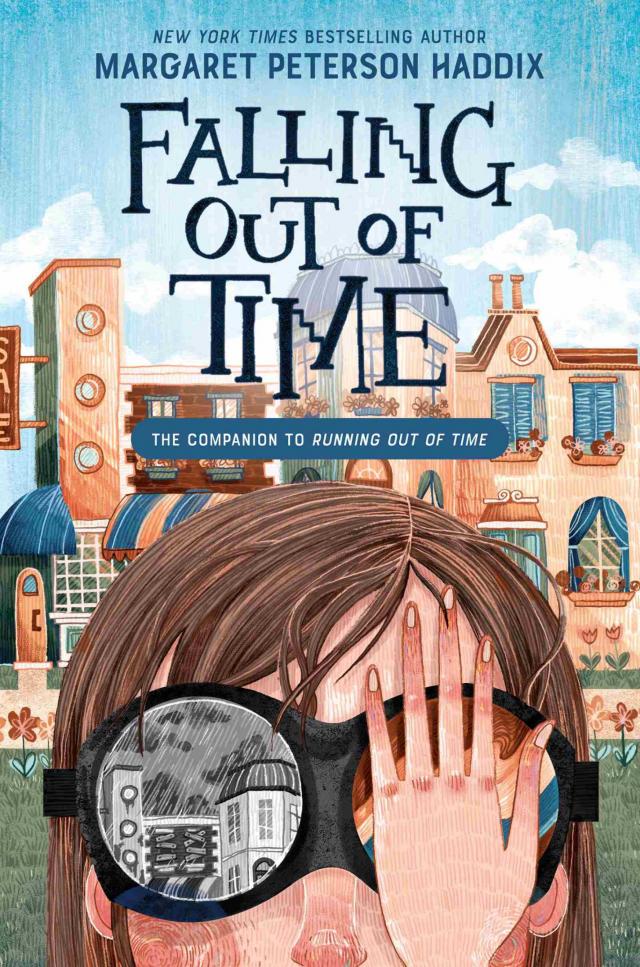
Like everyone else in the tour group, both the man and the woman were wearing goggles. Zola remembered Mom telling her that the tourists’ goggles made everything look shinier and more exciting—just like the VR goggles that Zola had always worn before. But their goggles seemed a little retro—and they all had the word “TOURIST” stamped on the straps.
Zola wished she could see exactly what the tourists were seeing. She also tried not to stare jealously at the umbrellas many of the tourists carried.
“Does that girl realize it’s raining?” a boy asked anxiously as he flipped his own sweatshirt hood over his head. “Does she feel the mist on her face, or—”
“She probably thinks it’s rainforest mist,” the tour guide said. “Some kind of all-around virtual sensation. Or, who knows, maybe she thinks she’s walking alongside Niagara Falls. Want to find out? Remember how I told you in my introduction that if you stood close enough to any of the Futurevilles residents, you can view the same scene they’re seeing through their VR goggles?”
Wait—what? Zola thought.
The boy nodded and started walking toward her.
“It should start when you’re one foot away,” the tour guide added. “And then if you push the ‘echo’ setting on your goggles, we can all see what you’re accessing.”
What was Zola supposed to do now?
The boy was getting closer and closer.
Then Zola knew what to do.
“Oh no!” Zola exclaimed loudly, as if responding to a Sirilex voice in her earbud. “Why didn’t you remind me earlier? Now I’m going to be late for school if I don’t run!”
She treated the sidewalk like a starting block and took off sprinting her fastest.
“Bye, birds!” she called over her shoulder, using that as an excuse to look back.
None of the tourists were following her.
To keep up the pretense, Zola kept running even after that cluster of tourists was out of sight. She darted past one group of tourists after another. It almost made her giggle to see them scramble out of her way. She veered close enough to some that, without the usual noise-canceling earbuds, she caught bits and pieces of several tour guide spiels:
“. . . and this is their city hall where, as with every level of government, they’ve perfected the combination of being perfectly efficient and perfectly humane . . .”
“. . . over there, you’ll see their public transportation depot, which accommodates the needs of everyone in town . . .”
“. . . yes, that looks like an art museum, but it’s actually a retail outlet where town residents can purchase masterpieces for their home from all over the world . . . Well, yes, they’d just be digital reproductions, but even a trained expert could hardly see the difference. . . .”
Finally, Zola reached the school. Without the glow of the VR effect, it seemed a little run-down, its limestone walls a dull gray against the duller gray sky. But it still seemed to have attracted more tourists than Zola had seen anywhere else. And they all seemed to be school tour groups, all swarming on the school steps. Since Zola had to slow down for the bottleneck of everyone going into the building together, she was able to hear a tour guide’s entire description of what the tourists would see.
“This is the only location in this Futureville where you’re allowed to interact with the residents,” this tour guide explained breathlessly. She was a heavily made-up woman about the same age as Mom. Zola could see the kids around her rolling their eyes at the woman’s enthusiasm.
“How do you explain that if this whole place is supposed to be ‘exactly what the future could look like, if we do our part now’?” a particularly snarky-sounding boy asked. Even Zola could tell he was quoting some motto. “In schools in the future, will kids from the past show up to ask questions? What do you tell the kids here about strangers just appearing out of nowhere?”
“Excellent questions!” the tour guide said with a totally fake smile. “Remember, these kids know this is a tourist attraction and they’re being watched. . . .”
Zola wanted to scream, “That’s a lie! My friends and I were never told any of that!” But she gritted her teeth and swallowed hard.
You can’t let on that you see them, she told herself. You can’t let on that you hear them. You can’t give away that you’re wearing real reality goggles. Not unless you want to be caught, and get yourself and Mom both in trouble.
“Anyhow,” the tour guide continued, “in your interaction with the Futurevilles schoolchildren, they’ll see you as avatars joining virtually from around the globe, not visitors from another time.”
Visitors . . . , Zola thought vaguely. Then she jerked to attention. So that was who the Visitors were, who showed up in her classroom on Visitors’ Day. No wonder they always seemed so odd!
“Yeah, but what if she decides to be a troublemaker?” the snarky boy asked, pointing to a shy-looking girl that even Zola could tell would be voted “Least Likely to Make Trouble” at any school. “What if Amelia starts asking questions like, ‘Don’t you know it’s not really the future? Are you trapped here? Doesn’t all this being perfect all the time make you want to play a prank on the teacher, like hiding the Smartboard remote or—’”
“Bryson!” another woman standing nearby scolded the boy. “This is your last warning. If you can’t be respectful, I will personally escort you out of this park and you will sit on the bus until the rest of us are finished!”
Zola felt kind of sorry for Bryson. Maybe some of the other kids did, too, because a few of them surrounded Bryson and muttered, “Don’t talk back!” “Don’t make the chaperone mad again!”
But Zola also felt sorry for Amelia, whose face had flushed bright red. Nobody surrounded her to advise: “Ignore Bryson! Yes, he’s acting immature, but that’s on him, not you!”
Why weren’t the adults offering a lesson about how impulse control isn’t fully developed in preteens, so you have to be understanding and forgiving of your own failings and those of others as well, and . . .
And, okay, I never listen all the way to the end of that particular lesson, Zola thought. But maybe it would help Bryson and Amelia?
The tour guide shifted uncomfortably on her feet.
“No worries!” she said, too brightly. “Since the children in the classroom you’ll visit will see you only as avatars, we’ve allowed for a time lag on all interactions. So any inappropriate questions will be filtered out—the schoolkids here will never hear them.”
Well, that explains why the Visitors always seem so slow and jerky, Zola thought.
She was at the doorway to the school now, the last Futureville child in, since she’d been dawdling to hear the conversation in the Bryson and Amelia group.
“Oh, here, we’ll just follow this child,” the tour guide said behind her. “Don’t worry—she’ll be totally unaware of our presence until we’re actually in her classroom.”
Zola barely managed to keep herself from looking back over her shoulder and smirking.
Act normal, act normal, act normal . . . , she told herself.
She braced herself for entering the classroom and seeing it totally empty. That’s how it would have to look since her classmates—and the teacher—were from all around the world, and only present virtually, as avatars themselves.
This is where I could totally give myself away, Zola thought, panicking. How can I act normal when I can’t see anyone around me? When I’m going to make it look like I’m walking right through people—and not answering my friends when they talk to me?
She’d have to use the VR again. She’d need that to hear whatever her teacher and classmates might say and do.
Zola flipped the switch on the goggles just as she stepped into her classroom. What a relief! There were all her classmates milling around—their avatars, anyway. The classroom looked as it always did in VR: as if kids from every continent were meeting in cyberspace, all their shiny technology glowing around them.
Zola went over to stand by her friend Beatriz, who was resplendent today in a traditional Bolivian skirt and a blouse threaded through with green and red and blue ribbons along the neckline.
“I was starting to worry you might be absent!” Beatriz gushed. “I’m so glad you made it before the bell!”
“Me, too!” Zola agreed, with a relieved laugh.
The laugh would be a good way to cover her actions if she switched back into real reality mode for an instant, wouldn’t it?
Zola lifted her hand, pretending she needed to scratch her forehead. She hit the switch on the goggles. And then, because she couldn’t quite believe what she was seeing, she actually shoved the goggles completely above her eyes, so they covered her eyebrows instead.
It didn’t matter. She still had trouble trusting what she saw. Her eyes still presented her with an impossible-to-believe situation:
Beatriz hadn’t disappeared. Beatriz wasn’t all the way away in Bolivia, beaming in to Zola’s classroom every day as an incredibly clear avatar, thanks to futuristic technology.
Whether Zola saw her in VR or with her own bare eyes, one fact didn’t change:
Beatriz was standing right in front of her.
21
So for our entire friendship—all the years we’ve been together in school—Beatriz must have been right here in my own town, not thousands and thousands of miles away? Zola wondered. We could have been inches away from each other most days?
There were other kids around her, too, but for the moment, Zola could only focus on Beatriz.
For the first time since walking out her door that morning, Zola was furious.
All along, we could have been talking and playing together, face-to-face? Zola thought. Beatriz could have come over to my house after school? We could have had sleepovers together, and whispered secrets late into the night, just like kids used to do in the old days?
Zola hadn’t even realized that was something she’d been longing for.
“Beatriz!” she called. “Look at me for real! Please!”
Beatriz just kept smiling blankly.
She can’t even hear me now, Zola thought. Because of the noise-canceling function of the earbuds on her goggles. Because I’m not speaking through VR.
This was unbearable. Being face-to-face with her best friend and not able to communicate was worse than thinking they were thousands of miles apart, and speaking only through VR.
Zola reached out, ready to yank the goggles from Beatriz’s face. Ready to make her friend see real reality, too.
But at the last minute, she stopped.
“People’s lives might depend on it,” Zola thought. That’s what Mom had said the day before, when she was afraid Zola might make a scene about the note in her Insta-Closet. And that was when they were at home, just by themselves.
Now Zola was at school—in front of the strange, unpredictable tourists. What if Zola did something that endangered Beatriz?
Nobody ever took their goggles off in public. Nobody ever touched anybody else’s goggles.
Zola buried her face in her hands. This was too distressing, too confusing.
“What’s that girl doing now?” someone asked behind her. One of the tourists.
Zola had to think fast.
“Oh, these new goggles!” she exclaimed. She remembered a line she’d heard in history VRs about early twenty-first-century games. “I need to reset the VR boundaries.”
Quickly, she pulled the goggles back over her eyes, and waved her arms a few times, turning slowly in all directions for good measure.
But she still had the goggles on the real reality setting, so she could still hear the tourists and tour guide behind her.
“Let me explain what you’re seeing,” the tour guide was saying. “In the future, kids will be grouped together in school not by geographic locations but by their educational needs and personal learning styles. This classroom brings together children from all around the globe, who all benefit from being together. In a sense, you could say they are each other’s global studies teachers.”
Not true, Zola thought. Not exactly . . .
But she managed not to say that out loud.
Bryson, the kid who’d been so snarky before, wasn’t so good at staying silent.
“So, what, you’ve got Futurevilles all over the world?” Bryson asked. “Dang, why didn’t our school spring for a field trip to the one in the Caribbean? A little beach time, a little—”
“Bryson!” the chaperone hissed. Her face flushed. “No interrupting! That’s—”
“It’s okay,” the tour guide said quickly. “He’s helping me introduce my next point.”
She kept a tight smile on her face.
“Our friend here with the inquiring mind”—the tour guide gestured toward Bryson—“probably already knows that right here in Indiana is the only place you can see a Futureville. Maybe someday we will have Futurevilles all over the planet. Wouldn’t that be wonderful? But we can still get the feel of the global classroom of the future right now. For the most part, as tour guide, I don’t want to ruin the illusion that you have stepped into the future by telling you how we ‘work our magic,’ as it were. But I do want to tamp down any further unnecessary questions.” She fixed Bryson with a stern gaze. “It’s true that all the kids in the classroom actually live right here in this Futureville. I mean, in reality, these kids are neighbors. After hours, when all the tourists have left, of course the kids get together. In person. Their lives outside of school are probably not that different from yours. But isn’t it gracious of these children to depict the world of the future every day for kids like you?”
Now it took every ounce of self-control Zola possessed not to scream out, “That’s a lie! I never get to see my friends except virtually! We’re never truly face-to-face! At least, not without thinking that we’re hundreds or thousands of miles apart . . .”
She couldn’t listen to any more lies from this tour guide right now. She took a step forward, bringing her closer to Beatriz, who looked confused.
What had Zola missed in the conversation with Beatriz?
Zola flipped back into VR just in time to hear Beatriz say, “Hello? Zola, did you walk to school in your sleep today? And you’re still sleeping?”
Maybe the VR had made it look like Zola was just standing there, doing nothing.
“Got a lot on my mind today,” Zola muttered. “Sorry. What were you saying?”
“I was just telling you how beautiful the sunrise over the Andes looked today,” Beatriz said.
“Yeah, I’ve seen that in VR,” Zola said wistfully. “But someday it would be cool to see it for real. Don’t you think?”
Wouldn’t that be like an invitation for Beatriz to admit that she didn’t actually live any closer to the Andes than Zola did?
She didn’t want to get Beatriz in trouble, but . . . Beatriz was her best friend! How could they keep lying to one another?
Good grief, Zola thought. Who knows where Beatriz has been told I actually live?
She leaned her head closer than usual to Beatriz, because maybe they could just whisper back and forth; maybe they could bypass the VR. Zola pulled out the earbud from her left ear and raised the goggle from her left eye even as she kept everything in place on the right. That way, she could hear and see reality and VR all at once.
But that meant that she could hear her own voice coming out of Beatriz’s VR earpieces. Only, Zola’s words had been twisted and reshaped. Instead of “Someday it would be cool to see that for real,” the words being fed into Beatriz’s ears were, “We’re so lucky to have VR show us everything. It’s as good as being there for real.”
Zola jerked back and stared—with both eyes—straight at Beatriz. And it was so odd. Zola’s right eye, the one covered by a VR goggle, saw Beatriz’s expression light up. Her right ear heard Beatriz giggle again and agree, “You’re right. We are so lucky to live in 2193.”
But Zola’s left eye, the one that she’d uncovered, saw the corner of Beatriz’s lips droop downward. How had Zola never noticed that Beatriz looked so lonely?
Zola had to strain to catch the actual words Beatriz spoke. Were they, “Yes, I wish we could meet for real someday”?
And it was in English, too, Zola thought. Not Spanish or Quechua. We never needed Insta-Translators to speak to each other.
It was so unfair how Zola and Beatriz had been kept apart and lied to. The VR even made it seem like they were lying to each other.
But it also made no sense. If the tourists were told the kids got together all the time—and they were only acting and pretending to need VR during school hours—why didn’t that really happen?
Zola felt her heart lurch. She recognized the loneliness on Beatriz’s face. Her own face probably looked the same a lot of the time.
Her real face, anyway.
Zola missed whatever Beatriz said next, both the fake and real words.