Falling out of time, p.14
Falling Out of Time,
p.14
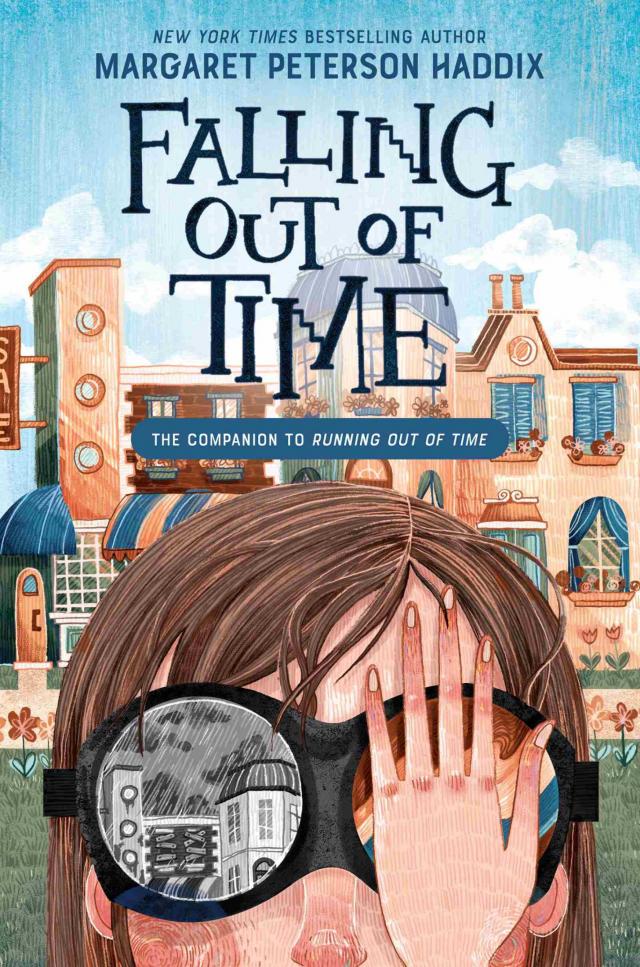


“Sirilex, are those—” Zola began, and broke off. She looked around guiltily. What if just saying the word “Sirilex” was dangerous? In Zola’s Futureville, that was all she had to do to get the attention of the AI system—what if the Sirilex network extended out even into the tourist area?
What if she’d just done the equivalent of telling Sirilex, “Hey, look, I’m not where I’m supposed to be!”?
At least no one around her seemed to be paying attention.
“Yeet!” a kid yelled beside her, extending his arm high over his head.
“I asked for a straight line, people—would you call that straight?” a teacher scolded.
“Next time we take a field trip, I vote for Kings Island,” one girl was telling another.
It’s too loud in here for anyone to hear what I said, Zola told herself. Even Sirilex.
She had to hold herself back from putting her hands over her ears. She’d never heard such a high decibel level before. The earpieces of her VR goggles always protected her precious ear canals from such a damaging situation.
She had to stop herself from asking Sirilex to turn the volume down. But at least this time she managed to do that before saying Sirilex’s name.
“Should we . . . hold hands again so we don’t get separated?” Puck asked—even though he practically had to shout in Zola’s ears so she could hear him over all the noise.
She glanced his way. Puck was from the other Futureville, where people did horrifying things like wasting metal cans, burning bonfires, and beating each other up. But even his face had turned pale, as if he was just as overwhelmed and frightened as Zola was.
“Sure,” Zola said. “Sounds like a good idea.”
She slipped her hand into his. It felt like this was something much younger kids would do—say, kindergarteners on a playground. But Zola didn’t care. It helped.
The kids ahead of them were pushing their way out the door, heading into the fresh air just beyond. Zola and Puck followed along.
As soon as they stepped outside, one of the buses in front of them started up with an unbelievably loud roar of its motor. A cloud of exhaust floated toward them. Puck sniffed.
“Diesel fumes?” he muttered. “They still use diesel in the 2020s? They really are headed for turning into my Futureville!”
Zola inhaled too deeply and began to cough.
“This is a disaster!” she told him. “In a VR, we’d have to report this instantly, and—”
Then she forgot about the exhaust fumes. Because she saw something even more terrifying out of the corner of her eye, off to the left. That direction was a no-go. She looked to the right. Same. She tried to back up into the tourist center, but the crowd of schoolkids flowing out the door just shoved her back into place. She started sprinting toward the nearest bus instead. She tugged Puck along with her.
“Come on!” she told him. “We’ve got to hide! Now!”
30
Zola’s foot caught just the edge of the bottom step of the bus’s entryway. She struggled to keep her balance, leaping onto the next step up.
“No running on the bus,” a bored voice said ahead of her.
It wasn’t even an AI voice—it came from a large woman enthroned in front of a giant black circle.
Is she the driver? Zola thought. A human driver, not automated? And that’s a steering wheel?
But the driver wasn’t even looking directly at Zola. She didn’t seem to care what Zola did, as long as she didn’t run.
Zola rushed down the aisle of the bus, just walking fast, not running. She kept her face turned away from the windows at the side.
“What are you doing?” Puck whispered behind her. “Why did we have to get on this bus?”
“I saw a tour group that saw me in my Futureville,” Zola said. “These kids named Bryson and Amelia and their chaperone . . . they were coming from opposite directions. And . . . they would have remembered me.” She reached the back of the bus and ducked down into the last row of seats. “Check and see if they’re still there. Especially if they’re looking this way. Bryson has brown hair, and he’s wearing a green-and-blue-striped shirt. The chaperone’s a worried-looking woman in yoga pants. Amelia has, like, super-black hair, and she’s wearing pink. . . .”
Puck plopped down in the seat beside Zola and peered out the window. Zola crouched down even lower.
“No, I don’t—” Puck began. He craned his neck, looking all around. Then suddenly he jerked his head down. “Zola! They’re getting on this bus!” He barely peeked over the padded green seatback in front of them. “And they’re headed this way!”
Zola moaned.
“We’ve got to hide even better, then,” she muttered. “That Bryson kid in particular, he’d yell about how I was one of those ‘creepy’ people and how did I escape and . . .”
She slid down lower, cramming herself into the small space between the bottom edge of her seat and the back of the seat in front of them.
“I call back seat!”
That was definitely Bryson’s voice.
Zola groaned and crawled under the seat in front of hers.
“Should I do that, too?” Puck bent forward to ask her.
It was too late. From her position under the seat, Zola could see Bryson’s bright red sneakers just a few inches from her nose.
“You a new kid or something?” Bryson asked, clearly talking to Puck. “Don’t you know? That’s my seat. Get out of here.”
Zola thought about how Puck was so short and scrawny, and Bryson . . . Bryson was the kind of kid who’d pull a girl’s hair.
Am I going to have to jump out and defend Puck? Zola wondered.
But what if she did that, and Bryson started yelling for the chaperone or the teacher or the bus driver to kick Zola and Puck off the bus?
In the VRs, the choices were always so simple. It was always “Do the right thing and be rewarded, or do the wrong thing and fail.” Zola had been outside her Futureville for a grand total of probably ten minutes, and it felt like there were a thousand choices at every turn.
And none of them were clearly right or wrong.
“Oh, hey, I didn’t know,” Puck told Bryson. Puck flexed his knees like he was going to get up. Then he sat back down. “But I gotta tell you. When I sat down here, the seat was kind of wet. And it smelled like pee. Are you sure you want to sit here?”
Zola saw Bryson’s shoes shift slightly.
“You know what?” he asked. “I got turned around. That’s the seat I was sitting in on the way over here.”
His shoes turned toward the seat across the aisle. Zola could tell by watching his feet that he’d slid all the way over beside the window.
He didn’t see me, Zola told herself. He can’t see me now.
Her heartbeat slowed to more of a normal rate. The engine of the bus rumbled beneath her.
But how did Puck know to act like that with Bryson? How did he know it would work?
“All right, kids,” a woman shouted from the front of the bus. “Settle down. When we get back to school, we’ll discuss what we just saw. But you might want to think about these questions now. What choices do you think led to the differences between the two Futurevilles? What kind of a Futureville would you design, if you were in charge? What kind of a future are your current choices leading toward?”
Zola heard Bryson’s voice call out the first answer: “Reform school!”
“I want to live where there’s trash everywhere!” another kid said.
“Who cares about the environment?” another yelled. “We mess up Earth, we’ll just move to Mars!”
Zola froze, her face pressed hard against the rubbery floor of the bus. It’d been bad enough to see Puck’s Futureville, with all the fighting and filth. But at least she’d known that part of it was just for show, just an act for the sake of the tourists.
What if the 2020s were even worse?
31
“Zola! It’s just humor! Those boys are only joking around!”
Zola dared to scoot her head ever so slightly out from under the bus seat. Now she was peering up as Puck bent down, pretending to tie his shoe.
“Oh,” Zola said. She squinted up at him. “How did you know that upset me?”
“I know more about your Futureville than you know about mine, remember?” Puck whispered. “I know . . . nobody has a sense of humor in any of your VRs!”
That was true. Zola wanted to defend her own Futureville by arguing, “But Beatriz and my other friends and I—we make fun of the VRs a lot! We laugh together all the time!”
But did they really? Zola only saw her friends virtually, so how could she be sure what any of them thought or felt or did?
The bus picked up speed.
“Puck!” Zola called. “Are we out of the Futurevilles parking lot yet?”
Puck checked the window, then bent back down again, as if his other shoe were untied, too.
“I see trees and grass, and, Zola—it’s green grass and green leaves on the trees and . . . things aren’t brown and dead all over the place, like back home, where they make things look bad on purpose. It’s beautiful! Zola, is this what the 2020s are really like outside our Futurevilles?” he whispered excitedly.
“I wish I could look out, too,” Zola muttered. It felt like she was going to have to peel her face from the floor—the floor seemed that sticky. “But, Puck, watch everything. Maybe that will help us figure out more about what to do next.”
Puck straightened up. Now Zola’s only view was of shoes again. Shoes and the floor.
“Sirilex—” she started to ask. But of course there was no answer. And there wasn’t room to pull out the All My Questions Answered book to read any more of it. She’d have to wait to find out anything else about pay phones or news conferences.
The bus swerved and turned and sped up and slowed down and sped up again. Zola had no way of knowing for sure, but it felt like as much as an hour could have passed before the bus stopped for good, and the teacher voice called from the front again, “Okay, everyone, go to your fifth-period class.”
From her position on the floor, Zola could see kids scrambling out into the aisle, walking toward the exit. She let out a soft sigh of relief when Bryson’s shoes walked away.
Puck’s face reappeared above Zola.
“Should we go into the school and look for a whatchamacallit—the pay phone?” he asked.
“Do you think someone there would help us?” Zola asked. “A teacher? A principal?”
“Why would a stranger help us?” Puck’s face turned into a puzzled squint.
“Because people are kind and—” Zola was still whispering, but her voice suddenly seemed too loud. It was because the surrounding noise had dimmed to almost total silence. From her vantage point on the floor, Zola looked down the aisle again—it had become one long, empty stretch of black rubber. Besides Zola and Puck, the only kids still left on the bus were up by the front door, about to get off.
Then Zola heard the bus driver’s voice, echoing from the front: “Bus nineteen, checking in. Yeah, I don’t have time to go back to the bus garage before kindergarten pickup. I’ll just park in our usual spot. Hey, I saw that the gas station has two-for-one Gatorade this week—anybody else want some?”
“Puck!” Zola exclaimed. In her excitement, she barely remembered to keep her voice to a whisper. “Jessie Keyser found a pay phone at a gas station! Maybe we can find one there, too!”
“What’s a gas station?” Puck asked.
“Um, it’s where people fueled up their motor vehicles, before pollution-less cars were invented . . . maybe we should try to hold our breath when we get there?”
The bus rumbled to life again. Zola had to clutch the legs of the seat to keep from sliding back and forth. Apparently the bus driver liked driving a little more wildly when she thought she was alone on the bus.
But it was barely five minutes before the bus pulled up to a stop and the driver shut off the engine. Puck peeked over the edge of the seat and then out the window, and reported the driver’s every move to Zola: “She’s off the bus now. She just shut the door. We’re in, like, a whole sea of—I think it’s called blacktop? It’s beautiful, too! So smooth and perfect! Anyhow, now the driver’s walking toward a little building. . . .”
Zola sprang out from underneath her bus seat. She at-tempted to brush off her shirt and jeans, but the sticky stuff from under the seat had left a dark stain.
“Wait, Puck, I need to swap out my clothes in my Insta-Closet before . . . ,” Zola began.
Puck glared at her.
“Oh, right,” Zola muttered. “Never mind.”
She too concentrated on peering out the bus window. Now the bus driver was circling around to the front of the little building Puck had described.
“Let’s get out of here while she can’t see us!” Zola ex-claimed.
It took them a moment to figure out how to operate the door at the front of the bus—Zola wasn’t used to things that operated mechanically like that, instead of sliding apart automatically. But Puck pointed to a long metal stick attached to the door. He pulled on it, and the door sprang apart.
And then they both scrambled down to the ground.
Puck hadn’t been lying about the blacktop seeming like a giant sea. It stretched on and on and on, with the little building—the gas station?—in one corner, and an enormous flat building taking up the entire opposite side of the blacktop. The flat building was labeled with two red circles—one completely inside the other—and the word “TARGET” in large red letters. Was that some kind of store? It was nothing like the small, cozy shops of Zola’s Futureville.
It disturbed Zola to see how many motorized vehicles were zipping across the blacktop. Where were all those people going? Yellow lines marked off spaces across the blacktop, as if sometimes hundreds of cars converged here all at once.
“Shouldn’t we go around the other side of the gas station, so the bus driver doesn’t see us?” Puck asked anxiously.
Zola realized he was thinking strategically while she was just looking around and marveling.
“Good idea,” she said.
They darted over to the side of the gas station building and crouched down to peek in the windows. The bus driver stood in front of a counter now, with a bottle of unnaturally blue liquid in each hand.
“She’ll recycle those when she’s done, won’t she?” Zola asked Puck.
“Oh, if only we’d had good strong plastic bottles like that in my Futureville,” Puck muttered.
How could she and Puck look at the same objects and have such different reactions?
The bus driver pushed her way out of the door of the gas station. Zola and Puck waited until the woman had rounded the corner of the building, out of sight, and then they darted in through the door themselves.
“Remind me what a pay phone would look like so I can help find it?” Puck whispered in her ear.
“Um . . . ,” Zola said uncertainly. It wasn’t as though the book about Jessie Keyser had explained. Whoever had written the book had acted like everyone reading it would know. And maybe everyone in the 1990s would have known about pay phones.
“We’ll have to ask,” she told Puck. She opened her mouth to say, “Sirilex . . .” but of course that wasn’t going to work here. She pointed toward the man standing behind the counter.
“You think it’s safe to ask an actual person?” Puck hissed, clearly distraught. “What if he’s dangerous? You can’t just go up to people and think they’re going to be nice!”
“What other choice do we have?” Zola muttered.
The man was watching them now. He scowled and pointed to a sign that said “Shoplifters will be prosecuted to the full extent of the law.”
What were shoplifters?
Zola shoved that question aside and tried to stay focused.
“Hello,” she said, stepping up to the counter. She smiled pleasantly at the man, as if he were a Helpful Clue Source in a VR (even though Helpful Clue Sources never scowled, and certainly not in a way that made their grizzled eyebrows into one long caterpillar across their forehead, like this man’s). “Could you tell me where your pay phone is?”
The man guffawed.
“What is this, some kind of a prank? One of those scavenger hunt things where kids have to ask ridiculous questions?” he asked.
Zola wasn’t sure what he meant, but at least he’d stopped scowling.
“Okay, okay, I’ll be a good sport about it,” the man said. “Get out your cell phones, and you can record my response for proof. Want me to play up the old-man angle, like, ‘Eh, what’s that? I don’t think we’ve had a pay phone here since the last century! Even I barely remember what they looked like!’” He hunched over as he said that, and made his voice sound even more ancient and crochety. Then he straightened up and jerked his jaw back and forth, making his face look rubbery. “Or do you want sarcasm? How’s this: ‘Kiddo, you are clearly a time traveler from—what? The 1980s? Let me clue you in. Cell phones are where it’s at nowadays. I bet you can even buy one over at that Target. Electronics department, you know?’” He pointed dramatically over his shoulder.
“Cell . . . phones?” Zola asked numbly. “Are they a different kind of pay phone?”
“Oh, you’re good at this!” the man said. He was beaming at her now. “I see an acting career in your future!”
“Come on,” Puck said, tugging on her arm.
“Oh, were you secretly filming me?” the man said. “Already got everything you wanted? Hey, I’ve got a right to half your profits if you post this on TikTok or YouTube and make any money!”
Puck was practically sprinting for the door now, pulling Zola along with him.
“You’re welcome!” the man called after them. “Come back and let me know when you post it, so I can tell my grandkids to look for it! Would you believe they put me in their TikToks sometimes? They call me TikTok Grandpa!”
As soon as they were out the door, Zola whipped her gaze to Puck.
“What was that about?” she asked.
“The tourists are always talking about cell phones, not pay phones,” Puck said, squinting back at the gas station in distress. The TikTok Grandpa waved at them, but it might have just been another act. “Once that man realizes we weren’t joking, what if he reports us to the people from our Futurevilles?”