Falling out of time, p.11
Falling Out of Time,
p.11
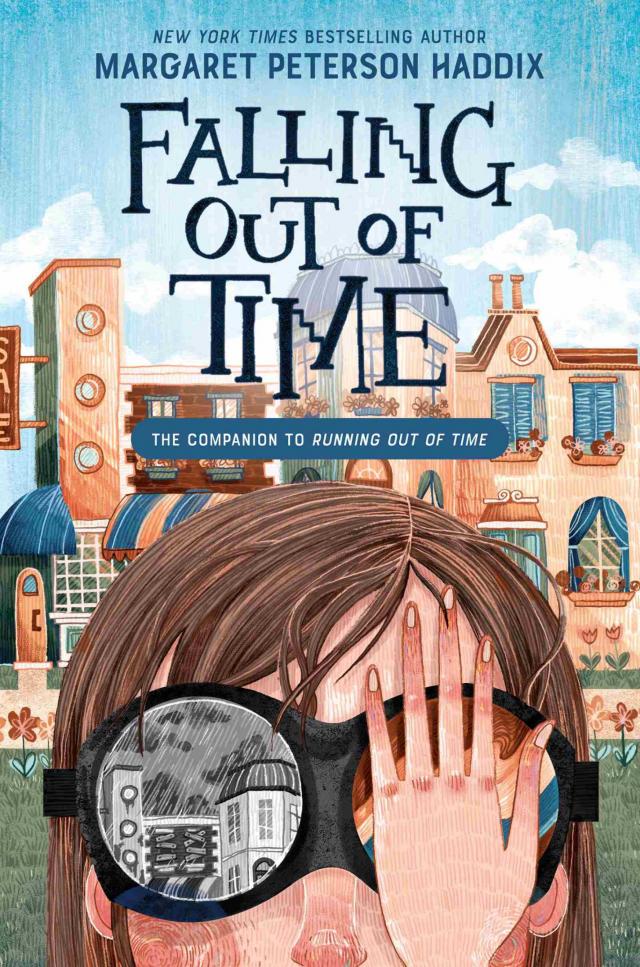


“Sorry,” Zola apologized again. “I’m spacey today. Didn’t get enough sleep last night.”
But who could say what Beatriz actually heard? Zola didn’t dare to dart her head close to Beatriz again. Not without calling attention to herself.
For a moment, Zola just stared at her friend—that wouldn’t seem too weird, would it, since Zola had just said she was spacey? Zola was getting even better at looking around with both eyes, and still managing to separate the two views. In reality, Beatriz wasn’t wearing a traditional Bolivian skirt and beribboned blouse. Her outfit was colorful, but the reds and blues and greens bled together more like an abstract painting than a traditional South American weaving. Her hair wasn’t pulled into a thick braid over one shoulder, but was springing out in a torrent of curls that made Zola think of the difference between 1800s Clifton Village Jessie Keyser and the 1990s version.
At least when Jessie saw her Clifton Village friends with braids and calico dresses, that’s truly what they wore, Zola thought ruefully. At least she and her friends could whisper together for real.
But they had also been infected with diphtheria. On purpose.
Zola held back a shiver, remembering Puck telling her that she was in danger, just like him.
But he didn’t say anything about disease . . .
He hadn’t had time to tell her exactly what danger she and her classmates were in.
Resolutely, Zola looked around, hoping to pick up on more clues in her classroom.
Off to the side, Amir and Eromi were actually wearing jeans and T-shirts that could have helped them blend into one of the Futureville tour groups, rather than anything representing their supposed lives in Egypt and Sri Lanka. And . . . they looked lonely, too.
But it’s 2193, Zola thought automatically. Everybody’s happy all the time because . . .
No. That wasn’t true.
Zola had no idea what any of her friends were really thinking and feeling, because she only ever saw them in VR.
And the VR lied. All the time.
All of Zola’s friends were actually strangers. She didn’t know or understand them any better than she knew the odd tourist kids at the back of the room.
Her heart in her throat, Zola glanced back at the tourist kids again, to see what they had noticed. Who could say what the VR was showing them?
But no one in the tourist group was even watching Zola and her friends. They were circled around Amelia and Bryson and the chaperone. Clearly something had happened.
Zola inched a little closer to the tourists to hear better.
“But I didn’t pull Amelia’s hair!” Bryson was protesting. “It just got caught on—”
“You were standing too close!” Amelia countered. She didn’t look meek and mild anymore. She looked fierce.
“That’s it, Bryson,” the chaperone said, tugging on his arm, pulling him away from the other students. “I’m taking you out to the bus.”
Zola heard everything in real time, but it took her brain a moment to catch up. The chaperone was behaving so oddly. Why wasn’t she asking Sirilex for a replay of the scene from a moment before, so she could be sure she was treating both Amelia and Bryson fairly?
Oh, right, Zola thought. Mom said the tourist goggles are different than ours—they don’t have Sirilex.
And the chaperone didn’t even ask Bryson or Amelia or the other kids how the misunderstanding made each of them feel. That left the whole group to poke each other and whisper and point. It was hard to tell what anyone was learning from this experience.
No, no, don’t focus on any of that right now, Zola told herself. Think . . . think . . .
The chaperone was taking Bryson out to the school bus.
The bus was apparently outside of the Futurevilles. Or, if it wasn’t outside now, it would be driven out when the entire school group left.
What if I follow the chaperone and Bryson? Zola thought. What if that’s how I find a way out of the Futurevilles for myself?
22
“Oh no!” Zola said aloud. She hadn’t figured out her whole plan yet, but she thought that was a good start.
“What’s wrong?” Beatriz asked. Her face wrinkled into a concerned squint that stayed the same whether Zola looked with her left or right eye.
“I, uh . . .” An excuse occurred to Zola like a gift from above. “I’m getting a low battery signal on my VR goggles, even though they’re brand-new. Ugh, now nothing’s working. Hold on. Let me go get a backup pair. . . .”
She dashed toward the classroom door, right behind Bryson and the chaperone. Hopefully Beatriz and all her other classmates—and the teacher, too—would just think that Zola would reappear once she’d replaced the battery. Of course, Beatriz and her other classmates also thought they were only together virtually, anyhow.
But who else would be paying attention to where I go and what I do? Zola wondered.
Automatically, she opened her mouth to ask, “Schoolilex, can you tell me . . .” She caught herself just in time.
“Schoolilex, I’m just going to run home to order another pair of goggles from my Insta-Closet,” she muttered.
Would that work? Was anyone watching her besides the tourists and the AI framework that kept the entire town running?
She was out in the school hallway now, and nobody stopped her. There was no one in sight except Bryson and the chaperone, and they were already turning the corner ahead of her. Zola slowed her pace, so it wouldn’t be obvious that she was following.
“Ha ha, why didn’t I ever think of this before?” she muttered, just in case someone was listening. “What a great excuse to get out of class! I’ll have to remember this the next time we have a test!”
That would help cover for her actions, wouldn’t it? Especially if she followed Bryson and the chaperone in a different direction than back toward Zola’s house?
She also didn’t want anyone to notice that she was still wearing her goggles with one eyepiece shoved up over her eyebrow. So she yanked the goggles fully back into place, and set them completely to real reality mode.
Zola rushed around the corner just as the door out of the school building was swinging shut behind Bryson and the chaperone. Now she sped up, because there were so many directions they might go once they got out to the sidewalk. She hurled herself through the door behind them, and came close enough that she could hear Bryson whining, “Mo-om! You embarrassed me in front of my friends!”
He’s calling her “Mom”? Zola thought. The chaperone is Bryson’s own mother?
“And you embarrassed me,” the chaperone said, jerking Bryson around to face her directly. “Look, I thought it’d be fun to chaperone your field trip. Do you act like this at school all the time?”
Zola missed hearing Bryson’s reply, because she was so stunned. She stopped in her tracks.
A mother would tell her own child he’s embarrassing? Zola wondered. An adult would say that to a kid?
That was so cruel. It wasn’t cruel for a kid to say a parent embarrassed him—kids were just learning. Parents understood that.
“We’ll have you stay on the bus until lunchtime,” the chaperone told Bryson. “You can think about all the ways you disappointed me.”
That was horrifying, too. Zola felt a little sick to her stomach. She felt a stab of fear. Maybe she didn’t want to keep following Bryson and the chaperone. Maybe she didn’t want to see anything of the world outside her Futureville.
But what if this is my only chance?
The chaperone went back to tugging Bryson forward, and Zola kept going, too.
“I can walk on my own,” Bryson said sulkily. “You don’t have to treat me like a little kid.”
The chaperone shot Bryson a look that was almost kind.
“I know it’s hard being twelve,” she said, more gently than before. “I do remember that.”
So maybe the chaperone isn’t a completely terrible person? Zola thought.
This was confusing, too.
The chaperone and Bryson were walking away from the school now, back toward the public plaza in front of city hall. Zola crept behind them, even as she kept pretending she couldn’t see or hear them.
But maybe she wasn’t as good an actress as she’d hoped. They’d barely gone a block when Bryson asked, “Why’s that Futureville girl following us?”
“She’s not,” the chaperone said. “Weren’t you listening before? Her goggles block every view of us. It’s like, some VR invisibility cloaking thing.”
But even the chaperone turned to look at Zola. If Zola kept walking, she’d run into them.
She pretended to be fascinated by the giant tulip bed along the sidewalk.
The chaperone and Bryson started walking forward again. While they weren’t looking, Zola inched closer to make sure she could still hear them.
“Whatever,” Bryson grumbled. “I still think the people here are creepy. It’s like they’re trapped in a video game or something.” He spun into an imitation: he robotically took two steps forward, turned as if he were following a line on the ground, took two more steps, and turned again. He could have been a mime making a perfect box. Then his shoulders slumped and he slipped back into his more-normal saunter, trailing along behind the chaperone.
“You’re pretty good at that,” the chaperone said admiringly.
Is that really how we look to them? Zola wondered. She remembered laughing at the history VRs of twenty-first-century kids with their clunky video game goggles and jerky movements—but she’d never thought that her own motions could look the same from the outside. She wanted to tell Bryson and the chaperone, “You know, you’re seeing us through goggles, too. The virtual versions you see aren’t necessarily accurate, either!”
Oops—she’d accidentally gotten too close again. Both Bryson and the chaperone shot her a worried glance as they stepped into the wide-open public plaza in front of city hall.
“What if she tackles us and steals our tourist goggles?” Bryson asked. “Didn’t that tour guide say the goggles are our tickets in and out of this creepy place? And they’re the only way we can even see the exit signs?”
What? Zola thought. What exit signs?
She barely managed to stop herself from gazing all around. Or from totally freaking Bryson out by grabbing the goggles from his face. That would show him not to make fun of her and her friends!
But that would also give away that she could see him.
Bryson turned and kicked his foot toward her, high in the air, like someone attempting karate or tae kwon do without any training.
“Stay away from me, creepy girl!” he yelled.
Once again, it took a lot of acting on Zola’s part not to react. She turned her automatic flinch into a pretense that she was hearing some command through her goggles.
“No, Sirilex, I am not playing hooky from school! I’m going after new batteries for my goggles!” she called.
The chaperone snatched Bryson off the sidewalk.
“Don’t you ever think before you act?” she demanded. “Don’t you remember that whole lecture about how it is your responsibility to stay out of the residents’ way, and if you touch any of them, you will be thrown out of the park instantly?”
“You’re already throwing me out of the park,” Bryson grumbled.
“But there’s also a huge fine for touching the residents,” the chaperone countered. “You know that would come out of your allowance, right? For approximately the next ten years.”
“Whatever,” Bryson muttered.
The two of them went back to walking forward, with Zola following as closely as she dared. Strangely, they seemed to be heading straight toward the blank wall at the back of the plaza. They didn’t slow or turn even when they were just a step away.
And then something truly bizarre happened. A panel of the wall in front of them just slid away. Zola got a quick glimpse of bright lights and signs—“ENTRANCE,” “GIFT SHOP,” “CAFETERIA,” “GUEST DROP-OFF”—and lines of people snaking through a maze of roped-off areas. And then both Bryson and the chaperone stepped through the open space.
Right after that, the panel slid back into place. Bryson and the chaperone had disappeared, and Zola was staring at nothing but a blank white wall.
That . . . was the exit, she thought numbly. They could tell, and even with my real reality goggles I couldn’t see any labels.
She couldn’t help herself. She’d stopped caring about anyone noticing that she was acting strange—or that she was following Bryson and the chaperone.
She dashed right after them.
23
One second later, Zola smashed into the wall.
“Ow, ow . . .” Zola clutched her nose, which had taken the brunt of the impact. She gingerly felt the ridge of cartilage beneath the scraped skin.
Okay, it’s not broken, she told herself. Or bleeding. She lifted her hand a little higher, to the nosepiece of the goggles, which had been painfully slammed into the bridge of her nose. But she was lucky again—the goggles weren’t broken, either.
Don’t you ever think before you act? she thought ruefully, the same question the chaperone had hurled at Bryson. She’d heard the chaperone say only tourist goggles worked for leaving the Futurevilles. And Zola had still run straight into a wall, thinking she could get out anyway.
And now I’ve probably tipped off everyone around me that I can see the tourists, that my goggles aren’t the VR kind I’m supposed to have. . . .
Mom was going to be so mad at her. No, it was worse than that—Mom was going to be so disappointed.
And scared.
Zola whirled around, trying to think of some excuse to explain her strange behavior.
Science experiment about testing the properties of solids? No. Acting class? Maybe . . .
Dozens of tourists were milling about the plaza, the giant open space between the city hall of Zola’s town and the wall she’d just smashed into. But absolutely none of the tourists were looking in Zola’s direction. Instead, they seemed to all be gazing toward a spot to Zola’s right, farther down along the wall. Someone over there was screaming.
Please let it not be because of me. Please, let it not be someone who’s going to come over and arrest me and . . .
Zola could just barely make out words in the screaming.
“No! No! Too tight! Hurts!”
It sounded like a kid.
All these people are just standing around, and some little kid is in pain? Zola thought incredulously.
Forgetting her own problems, Zola dived through the crowd.
Beside a second seemingly blank stretch of the wall, a little kid was flailing about on the ground. A man and a woman—undoubtedly his parents—were crouched beside him.
“Caden, buddy, we talked about this,” the mom was saying. “You have to wear the goggles to see all the fun things in this Futureville.”
“I’m wearing my goggles,” the man said. “Don’t you want to be like Daddy?”
“Hu-u-urts!” the boy wailed, kicking and pounding his fists on the ground.
“Maybe you could adjust the strap,” a woman said, off to the side.
“With a kid like that, throwing tantrums, the best strategy is to just walk away and deprive them of attention until they calm down,” another woman advised.
“When I was a kid, I would have been spanked for acting like that,” a man muttered.
What does the word “spanked” mean? Zola wondered. And why isn’t Sirilex chiming in to tell the parents what they should really do?
She guessed this proved that the tourist goggles didn’t have a Sirilex connection. But it seemed like in an emergency like this, Sirilex should find a way to speak somehow.
She edged a little closer, pretending she was only examining the archway over the blank wall behind the screaming boy. Now that she thought about it, this archway matched an archway over the section of blank wall where Bryson and the chaperone had disappeared.
So maybe one side’s the entrance and the other’s the exit? she wondered.
The little boy’s screams grew louder. The mother tried to pick him up, but he shoved her away. Then he began yanking at the goggles.
“No, buddy,” the dad said. “Leave those on, or we’ll have to go back out of the park. If you just calm down, we can—”
The little boy managed to pull the goggles off his face.
“Bad goggles!” he screamed.
Then he hurled them away. The goggles sailed through the air, and Zola knew instantly: they’re going to hit me.
There was no time to step out of the way. No time to react at all.
The goggles thwonked against Zola’s rib cage. Instinctively, Zola doubled over. She clutched her hands over her ribs and her stomach—and the little boy’s goggles. Around her, she heard seemingly everyone in the crowd of tourists let out a gasp.
And then a siren began sounding throughout the plaza. Zola could hear it through the little boy’s goggles.
Everyone was still watching her.
What do I do? What do I do? Zola thought frantically.
And then she knew.
24
“Ow!” Zola exclaimed, straightening up even as she rubbed the place where the goggles had hit. This required no acting at all—it really did hurt. But then she added, “Something bit me!”
She raised her hands to her face, letting the little boy’s goggles slide down her right sleeve, out of sight. She pressed her fingers against her ear, as if listening intently.
“What’s that, Sirilex?” she asked loudly. “You say I should go home and let my mom look at my injury, make sure I won’t have an allergic reaction? Okay!”
She took off running, and the crowd of tourists parted before her. She’d hoped nobody would be watching her by the time she reached the other archway—and the other stretch of blank wall she now knew to be an exit. (At least, it was an exit if you had tourist goggles—which she did now! She did!) But lots of tourists were still gazing curiously after her, even as others watched the family with the goggle-throwing, screaming child.
Okay, plan B, Zola thought grimly.