Falling out of time, p.20
Falling Out of Time,
p.20
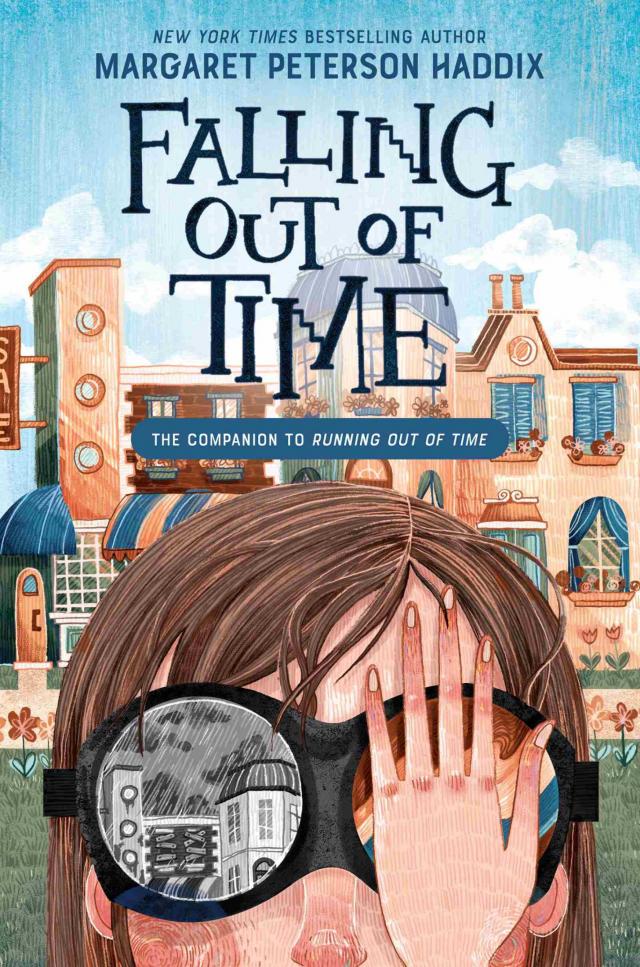


Zola flicked her gaze toward the huge decorative clock in the center of the plaza. It was only 8:35. They still had time.
She tuned out most of the rest of the guide’s narration as they walked past city hall and the transportation depot and the row of quaint stores. It didn’t matter. All she had to do was blend in until they got to the residential areas.
But beside her, Puck was wide-eyed, peering around at all the perfect buildings, the artful landscaping, the glorious blue sky with only a few decorative white clouds. (At least, it looked glorious through the tourist goggles.)
“I didn’t know,” he whispered to Zola. “I never actually saw your Futureville. I didn’t know you had all this and still . . . you left it because I asked for help? And your mom risked losing all this to help me?”
“It only looks good on the surface, remember?” Zola whispered back.
Were they endangering themselves just by whispering that? Were their murmurs picked up by the microphones attached to their goggles?
“I mean, yeah, I thought it was a good idea to leave, but I found out it was an even better idea to come back,” she corrected herself.
Puck shot her a startled glance, but then seemed to understand, Oh, right. Zola is just acting. Pretending. Because we’re back in a Futureville, and we can’t be real anymore. At least . . . not yet.
The guide seemed to drone on forever, describing the purpose of every building they passed. But finally he led them into the residential area.
And then the group was right in front of Zola’s house.
“Here’s a home where a girl about your age lives,” the guide began. “Maybe you would like to watch and listen as she and her mother begin their day. You can do that if you switch the setting on your goggles to—” Zola saw the guide jolt back, as if he’d just received startling news over his headset. “Oh, wait, never mind. I just got word that this family is running a little behind because the girl took longer than usual to figure out what she wants to wear today—I’m sure that happens sometimes in your household, too. Even in 2193, kids are still kids!”
He turned and began to walk to the next house over. The other kids trailed along.
But as soon as everyone was facing the other way, Zola and Puck raced toward the front door of Zola’s house.
“Sirilex, open the door for me,” Zola said softly—the first test of how the next stage of their plan might go.
The door swung open, and Zola breathed a sigh of relief even as she and Puck scrambled into the house as quickly as they could.
Puck slammed the door behind them. They both yanked the goggles off their faces.
And then Mom appeared from the kitchen, crying out, “I don’t care what anyone does to me. I don’t regret—”
Her gaze fell on Zola and Puck, and she put her hand over her mouth, stifling a sob.
“No,” she moaned. “No. You two were supposed to be safely away from here. You were supposed to—”
“Mom, we have to hurry,” Zola said, dashing toward her mother. “We—”
A change came over Mom’s face—a transition Zola now recognized as Mom going into acting mode.
“Why, Zola, look at you! Did you forget to order clothes from your Insta-Closet? So you’re wearing yesterday’s instead?” Mom asked. To an outsider, her voice might have sounded teasing, but Zola could hear the ache beneath each word. “Is this some tween absentmindedness kicking in?”
“I—I need your help with my Insta-Closet,” Zola said. “Nothing I ordered looks right.”
“Of course, honey,” Mom said. “You know you can always come to me for help.”
That . . . is actually true, Zola thought. That’s the part that Mom really wants me to know.
Puck stayed glued to Zola’s side as they rushed with Mom toward Zola’s room and her Insta-Closet. Mom didn’t even glance his way now.
It’s not because she doesn’t care about him, Zola decided. It’s because he’s so completely out of place in our Futureville that she has to pretend he doesn’t exist.
All three of them smashed themselves into Zola’s Insta-Closet. It had been crowded enough the day before when it was just Mom and Zola in the Insta-Closet—even though Puck was skinny and slight, he still barely fit in the leftover space.
But as soon as Zola pulled the door shut behind them, he touched the mirror and scrambled out through the opening that appeared as it slid down.
“Puck, wait!” Mom called after him. “Both of you—didn’t you understand? Didn’t you see I was trying to let you get away? And never come back?”
If there’d been an underpinning of regret and sorrow in her words before, now her voice practically throbbed with pain.
“Mom, it’s okay,” Zola said. “We’ve got a plan.”
“I had so many plans over the years,” Mom said sadly. “So many I thought would work and then . . .”
Puck was hesitating on the platform behind the mirror.
“Puck, go!” Zola insisted. “I’ll tell Mom everything.”
“There’s one thing you can’t tell her,” Puck said. “Because you don’t know.” He squared his shoulders and peered directly at Mom. “No matter what happens next, you need to know this. I think of you as my mother, too. I am grateful for all you did. And everything you tried to do.” And then he grinned. “But you were wrong about me not telling Zola.”
He touched the back of the mirror. Even as it slid up into place again, Zola could see him begin to scramble down the stairs.
And then the mirror was closed again, and Zola could see nothing but a reflection: her and her mother, huddled fearfully together. In the mirror image, Zola saw her mother turn toward her. Mom had tears streaming down her face now.
“Yesterday—after I thought you were safe—I finally went in search of answers I’d wondered about for the past twelve years,” Mom said. “I found out who was really behind starting these Futurevilles. And my worst fears were realized. It was a lot of the same people who set up Clifton Village.”
Zola felt a jolt of fear in the pit of her stomach. Those people had made children sick and let them die. On purpose.
“But those men were arrested!” she protested. “They went to prison!”
“And then they got out,” Mom said. “They changed their names. Including . . .”
“Including who?” Zola asked.
“Your grandfather,” Mom whispered.
43
“My grandfather?” Zola repeated numbly. “You mean, your father?”
“No, your other grandfather. Your father’s father.”
Zola had barely ever thought about possible relatives besides Mom—and her dead father—before she’d read the book about Jessie Keyser. Having other relatives just wasn’t . . . part of her Futureville. But now she had both a good side of the family and a bad side?
“None of this makes sense,” Zola complained. “Did Dad know? Before he . . .”
She couldn’t say the word “died” right now. Or “accident,” and certainly not “murder.” She couldn’t ask any of the questions flooding her mind. Mom’s eyes already held too much pain.
But maybe Zola’s questions showed in her own gaze.
“Your father . . . ,” Mom began. She winced and bit her lip. Then she looked back over her shoulder and shrugged, as if it was too late to do anything but talk as quickly as possible.
“I have to go back to the beginning,” Mom said. “To the end of Clifton Village. It was so confusing to leave when I was fourteen. Just a little older than you—maybe you can understand, now that you’ve been outside.”
Zola thought about how disorienting the outside world had been. But that was partly because everything seemed so primitive, so stuck in the past.
“Weren’t the 1990s better than Clifton Village?” Zola asked. “I mean, no more churning butter, no more emptying chamber pots . . .”
Mom gave her a sad smile.
“You would think that,” she said. “And that was how my brothers and sisters felt. They were young enough that they saw everything as an adventure. They loved being what they called ‘modern.’ They were thrilled with every new technological discovery. But I was old enough that I felt completely . . . shaped . . . by Clifton Village. In the early 1800s on the Indiana frontier, a fourteen-year-old girl was practically an adult. She was supposed to be thinking about getting married and having babies and keeping house and nothing else. And, when I was fourteen, that’s all I wanted. I was already in love.”
“With Dad,” Zola whispered. It was a comfort to say that, to have that be something she recognized from her life story. She knew her parents had loved each other, regardless of where they’d come from or what time period they’d lived in.
“Yes,” Mom said. “He was the son of the richest, most powerful man in the village—and I’m ashamed to say that that mattered to me, too. But then when Mr. Seward turned out to be one of the evil men plotting to introduce diphtheria to our community . . . well, that was confusing. But I still loved your father.”
Zola gulped. She could handle this latest news. She knew how.
“Because it wasn’t Dad’s fault, what his father did,” Zola said. “He wasn’t involved in any of the evil.”
This was a guess, but it was such a relief when Mom nodded. Zola was sure: Mom wouldn’t get that sad, longing look in her eye at the mention of Dad’s name, if he’d been evil.
“Of course not,” Mom said firmly. “When the news came out, your dad went from being proud and adoring of his father to . . . horrified and ashamed. He’d even been named after his father, and so he changed his name, from Chester to Arthur—it was a joke between us, when we found out there was a president named Chester Arthur. . . . He did that for me. And then when we got married, he took my last name instead of me taking his, and we agreed that any children we had would be named Keyser, not Seward—oh my, that was by far the most ‘modern’ thing I could ever conceive of, back then!”
“Okay . . .” Zola couldn’t see why names mattered at a time like this. “But . . .”
Mom held up her hand, as if she wanted Zola to be patient.
“Mr. Seward—Arthur’s dad—was livid. He and your father stopped speaking to one another. We didn’t visit him in prison. We didn’t welcome him home when he finished serving his time and was released. And then he vanished, as far as any of us knew. So we also didn’t know Mr. Seward was involved with the effort to reinvent Clifton Village as a Futureville. We didn’t know it would turn evil. We just saw this Futureville as . . . possibility.”
“Why, Mom?” Zola exploded. She thought of all the his-tory VRs she’d seen. She thought of all the times she’d wondered, What if this was real, and I actually could make a difference? “Even if you didn’t know how it would all turn out, why in the world did you want to come here? Knowing the problems of the twenty-first century, why didn’t you try to fix them? Why did you just want to pretend they were all in the past?”
Zola hadn’t even known she was angry with her mother about that.
Mom’s face drooped with sadness.
“Knowing all the problems of the twenty-first century, I just saw it as . . . overwhelming,” she said. “I thought the only way I could help was by showing people a possible future. People I . . . wouldn’t even have to talk to or see. But Arthur and I weren’t sure what we wanted. Up until you were born, we’d kept our lives as much like Clifton Village as we could. Arthur made wood furniture. I sold baked goods. We used modern equipment in our jobs, but we came home each night to candlelight, to homemade quilts, to . . . even an outhouse, not indoor plumbing.”
Zola tried to remember what an outhouse was. Then she gaped at her mom in horror.
“Seriously, Mom?” she asked. “You were going to bring me home to a place where the only bathroom was a little shack with a hole in the ground? Outdoors?”
“Exactly,” Mom said, ducking her head as if in shame. “We were happy, but you would need more than that. We knew that our lives looked to the outside world like . . . poverty. Deprivation. What if you needed a computer for school? What if other kids made fun of you for having homemade clothes? We couldn’t afford anything else.”
“But that’s—” Zola began, automatically ready with a typical line about how in 2193, everybody had everything they needed or wanted.
But it wasn’t actually 2193.
And even in the fake version of 2193 she’d lived in, all her luxuries had depended on Puck’s Futureville, a place where people really were poor. Starving, even.
It doesn’t have to be this way, Zola thought stubbornly. That’s not even how the Futurevilles organizers claim they set things up.
Mom wrapped her arm around Zola’s shoulders and dropped her chin to Zola’s head, as if to warn her that the rest of the story would be harder to hear.
“Your father took on more hours at work,” Mom said.
Zola went silent, because Mom was going to go there. She was going to talk about Dad. About him dying.
The truth.
“And I didn’t know this until later, but the woodshop where he worked, they didn’t follow all the safety requirements,” Mom said. “They were under such pressure to do everything fast, everyone all crowded together around electric saws. . . . Your father told the bosses someone was going to get hurt. And then . . . he was the one who got hurt.” Mom’s voice dropped to a whisper. “And some people say he might have been pushed. By someone who just didn’t like him.”
Zola felt like she’d been punched in the stomach. She’d never actually been punched ever in her life, even in a VR. But this had to be the feeling.
“If I had any choice at all, how could I raise you in a world with such terrible, malfunctioning machines?” Mom asked. “With even the possibility that people could be so evil? When I knew people had been evil, dealing with Clifton Village? You were two days old, and I was suddenly your only parent. After what happened to your father, all I could think about was protecting you. That’s why we moved here. It seemed like the safest choice.”
She gave a bitter laugh.
“Little did I know, nowhere’s safe.”
Zola could feel her mother’s despair tugging at her, pulling her down. It was a pressure just as steady as the feel of Mom’s chin against her head, Mom’s arm around her shoulders.
This all makes sense . . . for Mom, Zola thought.
But Zola was a different person. She’d had a different life, different experiences, different hopes and dreams.
Some of them were even real.
Zola thought about how she’d felt the night before, surrounded by everyone making plans at Jessie’s house.
“But . . . but . . . I read Jessie’s letter,” Zola said, pulling back from Mom. “I met Aunt Nicole and Uncle Andy. And lots of other people. They would have helped you raise me in, uh, modern ways. And, I guess, they would have protected me, too. They wanted to take care of us both. They still want to. They—”
“It’s too late,” Mom said. Her eyes swam with unshed tears. “I messed up too badly. I thought I was sending you to safety yesterday, but . . . you came back. All we can do is pretend everything’s back to ‘normal,’ and we’re going to do what they want. And maybe they won’t punish us too harshly, maybe—”
“Mom, that is not the only choice,” Zola said.
“You don’t have my experience,” Mom said, shaking her head despairingly. “From the very beginning, every time I tried to get out to see my family—as I’d been promised I’d be allowed to do—there was some punishment, some privilege taken away from me. And they’d threaten to send you to the other Futureville, without me. Your life would have been just like Puck’s. Or maybe worse.”
In spite of herself, Zola couldn’t hold back a shiver of fear.
“Given that choice—that, that blackmail—how could I actively resist?” Mom moaned.
“You helped Puck,” Zola said stubbornly. “You did resist.”
“Only in secret,” Mom said. “Only in ways that couldn’t be seen by the tourists. And, I hoped, only in ways that no one but Puck knew about.”
In VRs, Zola had seen people in jails and prisons—even in cages. She felt like she was talking to one of those trapped people right now.
“I told myself it didn’t matter what happened to me, as long as you were okay,” Mom said. “And at first, you had everything a child could possibly want. Except a father.”
Zola grimaced.
“And except a mother who was truly happy and felt safe herself,” Zola muttered. “And . . . except for knowing the truth about what was really going on around me. And then, well, you know. The way almost my whole life is virtual now. My whole life . . . except for arguing with you. I didn’t even know how much I missed seeing other real people until I met Puck.”
Mom met Zola’s gaze exactly.
“I’m so sorry,” she said. “I wanted everything to be better for you than it was for me. Your father wanted that, too. When I sent you away yesterday, I was ready to be miserable the rest of my life, missing you, but . . . oh, is this selfish? It does help me that you’re here with me again. We’ll find a way to keep helping Puck and avoid getting in trouble again. We’ll just have to . . . stay under the radar for a while. Hide everything real. Pretend we’re obeying completely. Maybe then there won’t be any punishment. Maybe then . . .”
“No,” Zola said.
This felt so familiar, Zola disagreeing with her mother. On any day in the past year, she usually found about twelve different things to argue with her mother about just during breakfast. She saw now that she’d disagreed constantly with her mother—and no one else—because her mother was the only one she ever interacted with who was real, not some prettied-up virtual version whose every word and gesture was digitally altered to be completely bland, completely perfect.
And completely fake.
And, anyhow, a lot of Zola’s disagreements with Mom had been because of things Zola hadn’t understood—the way Mom was so often just pretending for the sake of the tourists, the way she was so often deeply afraid.