Stormbringer, p.39
Stormbringer,
p.39
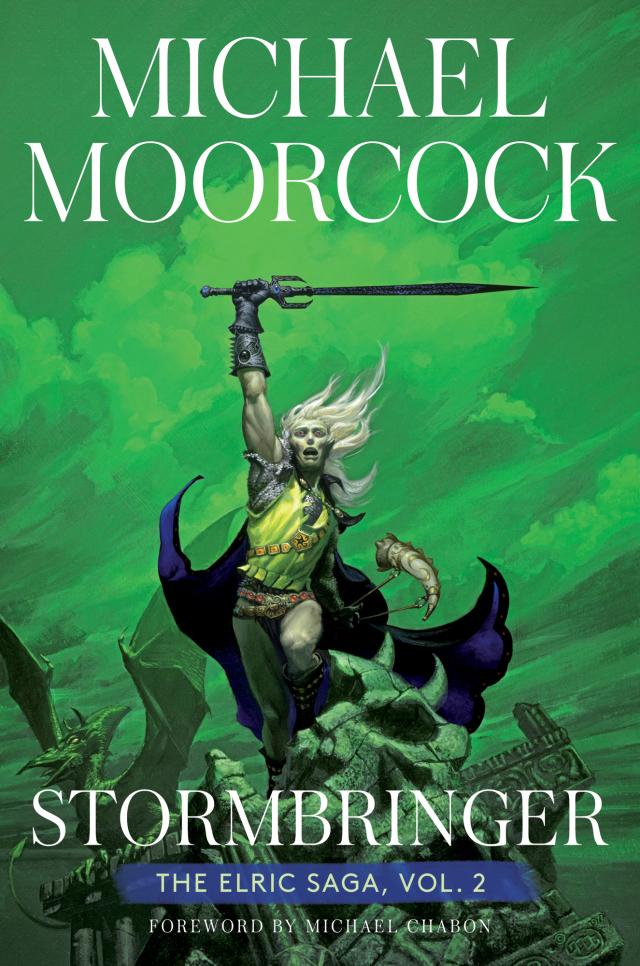


And with that, she took a casual step through time and space which had not been in existence when she had first decided to sleep, and which she therefore ignored, and found herself standing in an ill-smelling morass of corrupt flesh and rotting bone which displeased her. But through all this she sensed another scent, something of herself in it, and she lowered her massive, woven head, a head of thick thorn branches whose eyes were not eyes at all, but flowers and leaves, and then she opened her briar lips and asked, in a voice so low it shook the ground, why her daughter had summoned her?
To which the Rose replied, in similar speech, while Elric sang his own tale to her, in a melody she found tolerable. It seemed that she concentrated her woven branches more thickly about her and looked with a certain sternness towards Gaynor and the remains of the Chaos army which had come full stop to stare at her before, at Gaynor’s lifting of his black-and-yellow sword, a shard of raging energy, they began to race to the attack!
And the sisters clutched hands, linked with Charion and Elric and the Rose, and they held tight for security and power, for they somehow informed the Tangled Woman in her primitive soul—they directed her as she bent and reached a many-branched hand towards Gaynor, who barely yanked his horse aside in time and rode beneath her, slashing at the wood which, because the energy which enlivened it was of a kind that no power could suck out nor any mortal weapon damage, was scarcely marked and, where it was marked, healed immediately.
With calm deliberation now, as if she performed some unwelcome household task, the Tangled Woman stretched her long fingers through the attacking ranks of Chaos, oblivious to their hacking swords and jabbing pikes, their bitings and their clawings, and wove her fingers thoroughly amongst them, twining and twisting and bending and entangling them until every Chaos warrior and every Chaos beast still living was embraced and fixed by her bramble fingers.
Only one figure escaped, riding like fury from the bloody crystals of that battlefield, slashing at the horse’s rump with the satiated leechsword.
Tangled Woman reached thin tentacles out towards the disappearing Gaynor but had little strength left; just enough to flick, with a thin, green branch, the sword from his flailing hand and bear it triumphantly up, to fling it away, deep into the forest where a black pool began to spread, turning all the surrounding crystal to the consistency of coal.
Then the leechsword vanished and they heard Gaynor’s furious yell as he forced the sweating stallion up out of the valley and rode, without looking back, down the other side, to vanish.
Tangled Woman had lost interest in Gaynor. Slowly she withdrew her brambly fingers from the field, from the bloody corpses her thorns had pierced, from the flesh from which life had been crushed, her victims knowing a cleaner death than any Elric offered.
But now Elric pulled himself into his saddle and, while the others refused to look, he went about the business of slaughtering the wounded, letting the sword feast and renew his energy. He was determined to find and punish Gaynor for the evil he had done. And as he passed among what remained of the living, their imploring wails were ignored. “I must steal from you what your master would have stolen from us,” he explained. And that killing had neither honour nor satisfaction in it. He did only what was necessary.
When he returned to his companions the Tangled Woman had gone, taking whatever payment she required, and all that were left were the dead.
“The Chaos army is defeated,” said Princess Shanug’a. “But Chaos still dwells within our realm. Gaynor still has power here. He will soon come against us again.” She had recaptured her horse.
“We must not let him come again,” said the Rose, cleaning Swift Thorn upon a scrap of satin surcoat. “We must drive him back to hell and ensure he nevermore threatens your realm!”
“It is true,” said Elric, moody with his own unquiet thoughts, “we must track the beast back to its lair and it must be confined, even if we cannot kill it. Can you find the way, Charion Phatt?”
“I can find it,” she said. She had several minor wounds, which the others had helped her dress, but there was a kind of breathless pleasure in the way she moved, as if she were still exulting in her unexpected salvation. “He has returned, without doubt, to The Ship That Was.”
“His stronghold…” murmured the Rose.
“Where,” said Princess Mishiguya, settling herself in her saddle, “his power must be greatest.”
“There is a power there, to be sure,” agreed Charion drawing her brows together—“a mightier power than any he commanded on this field. Yet I cannot completely understand why he did not use it against us here.”
“Perhaps he awaits us,” said Elric. “Perhaps he knows we will come…”
“We must go to reclaim the Rose’s treasures,” said Princess Tayaratuka. “We cannot allow Prince Gaynor to hold them.”
“Indeed,” agreed Elric with some feeling and a renewing sense of urgency. He had remembered that his father’s soul remained in Gaynor’s keeping and that very soon Arioch or some other Duke of Hell would try to claim it, whereupon it would flee to him and hide within his own being, forever united, father and son.
Elric drew off his black gauntlets and put his hands upon his horse’s muscular flanks, but nothing would take away the chill that gripped his being. No ordinary warmth could comfort him.
“What of the others?” said Charion. “What of my uncle and my grandma, my cousin and my betrothed? I think they must be reassured.”
They rode slowly back towards the cavern city, stabling their horses before beginning the long climb up the steps and walkways hidden within the walls, and when they finally reached the balcony where they had left the others, they found only Wheldrake.
He was distraught. His eyes were full of tears. He embraced Charion Phatt but his gesture was one of consolation rather than joy. “They have gone,” he said. “They saw that you were losing the battle. Or thought they saw that. Fallogard had to consider his son and his mother. He did not want to leave, but I made him. He had the power to do it. He could have taken me, but there was no time and I would not go.”
“Gone?” said Charion, holding him at arm’s length now. “Gone, my love?”
“Mother Phatt opened what she called a ‘tuck’ and they crawled under it, to disappear—at the very moment when that vast thicket materialised. It was too late. They have escaped!”
“From what?” yelled Charion Phatt, enraged. “To what? Oh, must we begin this search all over again?”
“It seems so, my dear,” said Wheldrake meekly, “if we are to have your uncle’s blessing, as we had hoped.”
“We must follow them,” she said firmly.
“Not yet,” said the Rose softly. “First we must ride to The Ship That Was. I have a small reckoning to extract from Gaynor the Damned—and from the company I suspect he keeps.”
5 Concerning the Capturing and the Auctioning of Certain Occult Artefacts: Reverses in the Higher Worlds; The Rose Exacts Her Revenge; Resolving a Cosmic Compromise.
The little caravan came to a ragged halt as the cliffs were reached at last. Their remaining horses, sometimes carrying double, were almost completely exhausted. But they had found the Heavy Sea; dragging its dark and weighty waves upon the shore, then dragging them back again, all beneath a slow, morbid sky. They looked down now at the narrow entrance of a bay, where the sea seemed calmer. Its high, obsidian walls enclosed a beach of oddly coloured shingle, of bits of quartz and shards of limestone, of semi-precious stones and glaring flint.
Anchored in the bay was a ship which Elric recognised at once. Her sail was furled, but the great covered cage in the forecastle made her prow-heavy. Gaynor’s ship and her crew had rejoined their master. On the far side of a spur of rock, which obscured their sight of the rest of the beach, there seemed to be activity—perhaps a figure or two—and now they must allow their horses to pick their way slowly down the narrow track from cliff to beach, threatening to slip on the shiny rock. Then at last the hoofs were grinding down upon the gleaming shingle, making a sound like ice being crushed, and the companions could see that the beach extended beyond the spur and that it was possible to ride along it.
Princess Tayaratuka rode a little ahead; then came her sisters (sharing a horse). Then came the Rose, followed by Elric and Charion Phatt, with Wheldrake’s tiny hands about her waist. A strangely disparate party, but with many shared ambitions…
Then they had rounded the point and they looked upon The Ship That Was.
Before them stood one of the most grotesque settlements Elric had ever seen.
Once it had, indeed, been a ship. A ship whose score of decks rose higher and higher to form what had been a vast, floating ziggurat crewed by huge, unhuman creatures; a ship worthy of Chaos herself. Her lines had the appearance of something organic which had petrified suddenly after being tortured into unnatural forms. Here and there were suggestions of faces, limbs, torsos, of otherworldly beasts and birds, of gigantic fish and creatures which were combinations of all these things. And the ship seemed to Elric to be of a piece with the Heavy Sea which, like green quartz turned viscous and sluggish now, flung its spume upon that gloomy strand where men, women and children, in every variety of clothing, in rags and silks and shoes which rarely matched, in the filthy sables of some slaughtered king, in the jerkins and breeks of a nameless sailor, in the dresses and undergarments of the drowned, in the hats and jewels and embroidery with which the dead had once celebrated their vanity, moved backwards and forwards amongst those dreadful breakers, amongst carrion and flotsam brought here on the morose tide, the detritus of centuries, to scuttle with any treasure they might discover back to the warren of the ship, which lay at a slight angle on the beach, its starboard buried, its port atilt, where perhaps a mast had halted its complete upending.
A dead husk, the ship was infested with its human inhabitants much as the body of some slain sea-giant might be infested with worms. They stained it with their very presence, dishonoured it by their squalor, as the bones of the fallen are stained and dishonoured by the droppings and the débris of the crows which feed upon their putrefying flesh. Within the ship was constant movement, an impression of one writhing mass of life without individual identity or concerns, without dignity, respect or shame—wriggling, scampering, quarrelling, fighting, squealing, roaring, whining and hissing, as if in imitation of that horrible sea itself, these were those humans pledged to Chaos but not yet transformed by Chaos; creatures who doubtless had had little choice in their masters as Gaynor carried the banner of Count Mashabak out into this world. They were wretches now, however, and they had only their shame. They would not look up as Elric and his companions rode towards the looming shadow of The Ship That Was.
They would not answer the albino’s questions. They would not listen when the sisters tried to speak to them. Terror and shame consumed them. They had already given up hope, even of an afterlife, for they reasoned that the misery they suffered surely proved that the entire multiverse had been conquered by their tormentors.
“We are here,” said Elric at last, “to take prisoner Prince Gaynor the Damned and to hold him to account!”
Yet even this did not move them. They were used to Gaynor’s deceptions, the games he had, in his moments of boredom, played with their lives and their emotions. To them, all speech had become a lie.
The seven rode to where a kind of drawbridge had been built into the body of the upturned ship and, without hesitation, they cantered inside, to discover a nightmare of murky galleries and ragged holes, where crude doors had been carved between bulkheads, all strung with shreds of net and rope and various roughly made implements, drying bits of cloth and rag, of tattered clothing and ill-washed linen, where lean-to shacks and teetering shanties were erected, often on the very brink of an injured deck. Something large and strong had pierced this ship and brought her to her end, rupturing her innards.
Through the portholes from deck to deck poured a foggy, unpleasant light, creating a lattice of pale and dark shadows within the ship’s serpentine bowels, making the shapes of the inhabitants equally shadowy, like ghosts, crouching, skulking, coughing, wheezing, tittering, too despairing to look upon the living without increasing their already unbearable misery. The floor of The Ship That Was was deep with human ordure, with discarded litter even they did not value. Wheldrake put a hand to his mouth and dropped down from Charion’s horse. “Ugh, this is worse than the Stepney warrens. I’ll let you go about your business. I have nothing useful to do here.” And somewhat to Charion’s surprise he returned to the comparative wholesomeness of that dark beach.
“It is true,” said the Rose, “that he can do little that is practical. But his poetic inspiration is without parallel when it comes to tuning oneself to the harmony of the multiverse…”
“It is his most delightful quality,” agreed Charion with a lover’s enthusiasm, glad that what she admired in her beau was reflected in another’s opinion—which went a short distance to disproving what lovers always suspect of themselves; that they have gone entirely mad.
Now Elric was losing patience with that conspiracy of the desperate and the dumb. As his warhorse stamped upon the filthy shingle, he drew the runesword out of its scabbard so Stormbringer’s black radiance poured into that great, ruined space, and a dangerous murmuring song came out of it, as if it lusted for the soul of he who had tried to steal its energy.
And the warhorse reared up, pawing at the murky air; and the albino’s scarlet eyes blazed through all that layered darkness, and he cried out the name of the one who had wronged them, who had created all this, who had abused every power, every responsibility, every duty, every treaty, every trust ever placed in him.
“Gaynor! Gaynor the Damned! Gaynor, thou foulest hellspawn! We have come to be revenged on thee!”
From somewhere high above, in what had once been the deepest and strongest parts of the ship, where the darkness was complete, came a distant chuckling that could only emanate from that faceless helm.
“Such rhetoric, my dear prince! Such bluster!”
Then Elric was finding a way for himself and his horse, crashing upwards into the shadows, through the trellises of misty light, up companionways which had once felt the feet of massive sailors and which were now all crowded and cluttered with the débris of these human inhabitants, knocking aside steaming pots and scattering fires, heedless of any damage, knowing that whatever materials constituted this hull it could not burn from mortal flames, the Rose close at his heels, shouting for the sisters and Charion to follow.
Riding through galleries of filthy darkness, where startled eyes stared for a second from a cranny or hunched figures skittered into ill-smelling holes; riding through this collection of hopeless souls, to seek their master and (all manner of entities and forces willing) free them from his tyranny! It was the Rose who now threw up her head in a clear, sweet song—a song which spoke, through its melodies, of lost love, lost lands and frustrated revenge—of a dedication to make an end to this particular injustice, this obscene perversion in the order of the multiverse; the Rose who drew out her sword Swift Thorn and brandished it like a banner. Then the sisters, too, had drawn their blades—one of ivory, one of granite, one of gold—and were joining in with their own harmonies of outrage, determined that the cause of their despair should perpetrate no further harm. Only Charion Phatt sang no song. She was an inexpert rider and had fallen behind the others. Sometimes she looked back, perhaps hoping that Wheldrake had decided to follow after all.
They reached at last a pair of massive doors, their carvings so alien that they were, right or wrong way up, indecipherable to the mortals. Once these doors had guarded the quarters of whatever beast had ruled the ship and had been deep at the vessel’s heart, but now they lay close to the roof from beyond which could be heard the slow booming of the heavy breakers.
“Perhaps,” came Gaynor’s amused tones again, “I should reward such folly. I sought to bring you here, sweet princesses, to show off my little kingdom to you, but you refused to come! Now curiosity brings you here, anyway.”
“It is not curiosity, Prince Gaynor, which brings us to The Ship That Was.” Princess Shanug’a dropped from the horse she shared with her sister and went to push at one of the heavy doors, forcing it back a fraction—enough for them to pass through after they had all dismounted. “It is our intention to end your rule in this realm!”
“Brave words now, madam. Were it not for primitive earth-magic, you would be my slaves at this moment. Just as you shall be my slaves very soon.”
The foggy air was thick with hot, unnatural odours and brands burned in it, scarcely casting better light than the flickering candles whose huge yellow stems dripped hissing wax upon what had once been an intricately carved roof but which was now covered in matted straw and rags. Webs were silhouetted in the air, hinting at the workings of enormous spiders, and from the deeper shadows came a scuttling that could only be of rats. Yet it seemed to Elric that all this was merely an illusion, a curtain which was being parted, for into view—and he was never sure how—came the fierce, rich, roiling colours of Chaos—a great sphere whose contents were in constant movement—and this displayed the dark outline of Gaynor the Damned, standing before it as if at some kind of altar on which he had placed some few small objects…