Stormbringer, p.42
Stormbringer,
p.42


Pilarmo and the other merchants were plainly astonished, too. “Then how shall we pay you?”
“I will decide that later,” Elric smiled. “But why talk of such things until the time—what do you wish me to do?”
Pilarmo coughed and exchanged glances with his peers. They nodded. Pilarmo dropped his tone and spoke slowly:
“You are aware that trade is highly competitive in this city, Lord Elric. Many merchants vie with one another to secure the custom of the people. Bakshaan is a rich city and its populace is comfortably off, in the main.”
“This is well known,” Elric agreed; he was privately likening the well-to-do citizens of Bakshaan to sheep and himself to the wolf who would rob the fold. Because of these thoughts, his scarlet eyes were full of a humour which Moonglum knew to be malevolent and ironic.
“There is one merchant in this city who controls more warehouses and shops than any other,” Pilarmo continued. “Because of the size and strength of his caravans, he can afford to import greater quantities of goods into Bakshaan and thus sell them for lower prices. He is virtually a thief—he will ruin us with his unfair methods.” Pilarmo was genuinely hurt and aggrieved.
“You refer to Nikorn of Ilmar?” Moonglum spoke from behind Elric.
Pilarmo nodded mutely.
Elric frowned. “This man heads his own caravans—braves the dangers of the desert, forest and mountain. He has earned his position.”
“That is hardly the point,” snapped fat Tormiel, beringed and powdered, his flesh aquiver.
“No, of course not.” Smooth-tongued Kelos patted his colleague’s arm consolingly. “But we all admire bravery, I hope.” His friends nodded. Silent Deinstaf, the last of the four, also coughed and wagged his hairy head. He put his unhealthy fingers on the jewelled hilt of an ornate but virtually useless poignard and squared his shoulders. “But,” Kelos went on, glancing at Deinstaf with approval, “Nikorn takes no risks selling his goods cheaply—he’s killing us with his low prices.”
“Nikorn is a thorn in our flesh,” Pilarmo elaborated unnecessarily.
“And you gentlemen require myself and my companion to remove this thorn,” Elric stated.
“In a nutshell, yes.” Pilarmo was sweating. He seemed more than a trifle wary of the smiling albino. Legends referring to Elric and his dreadful, doom-filled exploits were many and elaborately detailed. It was only because of their desperation that they had sought his help in this matter. They needed one who could deal in the nigromantic arts as well as wield a useful blade. Elric’s arrival in Bakshaan was potential salvation for them.
“We wish to destroy Nikorn’s power,” Pilarmo continued. “And if this means destroying Nikorn, then—” He shrugged and half-smiled, watching Elric’s face.
“Common assassins are easily employed, particularly in Bakshaan,” Elric pointed out softly.
“Uh—true,” Pilarmo agreed. “But Nikorn employs a sorcerer—and a private army. The sorcerer protects him and his palace by means of magic. And a guard of desert men serve to ensure that if magic fails, then natural methods can be used for the purpose. Assassins have attempted to eliminate the trader, but unfortunately, they were not lucky.”
Elric laughed. “How disappointing, my friends. Still, assassins are the most dispensable members of the community—are they not? And their souls probably went to placate some demon who would otherwise have plagued more honest folk.”
The merchants laughed half-heartedly and, at this, Moonglum grinned, enjoying himself from his seat in the shadows.
Elric poured wine for the other five. It was of a vintage which the law in Bakshaan forbade the populace to drink. Too much drove the imbiber mad, yet Elric had already quaffed great quantities and showed no ill effects. He raised a cup of the yellow wine to his lips and drained it, breathing deeply and with satisfaction as the stuff entered his system. The others sipped theirs cautiously. The merchants were already regretting their haste in contacting the albino. They had a feeling that not only were the legends true—but they did not do justice to the strange-eyed man they wished to employ.
Elric poured more yellow wine into his goblet and his hand trembled slightly and his dry tongue moved over his lips quickly. His breathing increased as he allowed the beverage to trickle down his throat. He had taken more than enough to make other men into mewling idiots, but those few signs were the only indication that the wine had any effect upon him at all.
This was a wine for those who wished to dream of different and less tangible worlds. Elric drank it in the hope that he would, for a night or so, cease to dream.
Now he asked: “And who is this mighty sorcerer, Master Pilarmo?”
“His name is Theleb K’aarna,” Pilarmo answered nervously.
Elric’s scarlet eyes narrowed. “The sorcerer of Pan Tang?”
“Aye—he comes from that island.”
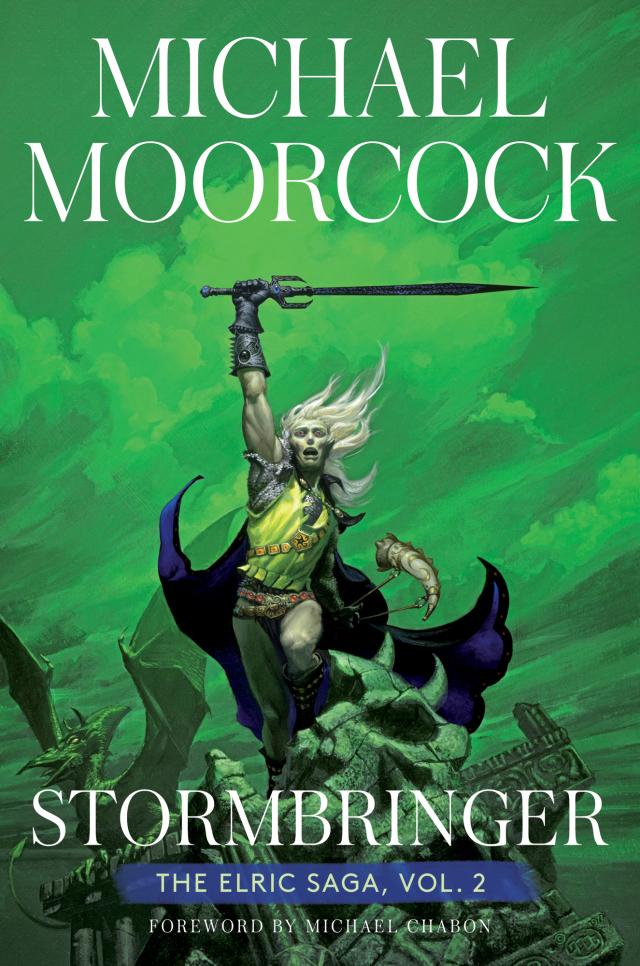
Elric put his cup down upon the table and rose, fingering his blade of black iron, the runesword Stormbringer.
He said with conviction: “I will help you, gentlemen.” He had made up his mind not to rob them, after all. A new and more important plan was forming in his brain.
Theleb K’aarna, he thought. So you have made Bakshaan your bolt-hole, eh?
* * *
Theleb K’aarna tittered. It was an obscene sound, coming as it did from the throat of a sorcerer of no mean skill. It did not fit with his sombre, black-bearded countenance, his tall, scarlet-robed frame. It was not a sound suited to one of his extreme wisdom.
Theleb K’aarna tittered and stared with dreamy eyes at the woman who lolled on the couch beside him. He whispered clumsy words of endearment into her ear and she smiled indulgently, stroking his long, black hair as she would stroke the coat of a dog.
“You’re a fool, for all your learning, Theleb K’aarna,” she murmured, her hooded eyes staring beyond him at the bright green and orange tapestries which decorated the stone walls of her bedchamber. She reflected lazily that a woman could not but help take advantage of any man who put himself so fully into her power.
“Yishana, you are a bitch,” Theleb K’aarna breathed foolishly, “and all the learning in the world cannot combat love. I love you.” He spoke simply, directly, not understanding the woman who lay beside him. He had seen into the black bowels of hell and had returned sane, he knew secrets which would turn any ordinary man’s mind into quivering, jumbled jelly. But in certain arts he was as unversed as his youngest acolyte. The art of love was one of those. “I love you,” he repeated, and wondered why she ignored him.
Yishana, Queen of Jharkor, pushed the sorcerer away from her and rose abruptly, swinging bare, well-formed legs off the divan. She was a handsome woman, with hair as black as her soul; though her youth was fading, she had a strange quality about her which both repelled and attracted men. She wore her multicoloured silks well and they swirled about her as, with light grace, she strode to the barred window of the chamber and stared out into the dark and turbulent night. The sorcerer watched her through narrow, puzzled eyes, disappointed at this halt to their love-making.
“What’s wrong?”
The queen continued to stare out at the night. Great banks of black cloud moved like predatory monsters, swiftly across the wind-torn sky. The night was raucous and angry about Bakshaan; full of ominous portent.
Theleb K’aarna repeated his question and again received no answer. He stood up angrily, then, and joined her at the window.
“Let us leave now, Yishana, before it is too late. If Elric learns of our presence in Bakshaan, we shall both suffer.” She did not reply, but her breasts heaved beneath the flimsy fabric and her mouth tightened.
The sorcerer growled, gripping her arm. “Forget your renegade freebooter, Elric—you have me now, and I can do much more for you than any sword-swinging medicine-man from a broken and senile empire!”
Yishana laughed unpleasantly and turned on her lover. “You are a fool, Theleb K’aarna, and you’re much less of a man than Elric. Three aching years have passed since he deserted me, skulking off into the night on your trail and leaving me to pine for him! But I still remember his savage kisses and his wild love-making. Gods! I wish he had an equal. Since he left, I’ve never found one to match him—though many have tried and proved better than you—until you came skulking back and your spells drove them off or destroyed them.” She sneered, mocking and taunting him. “You’ve been too long among your parchments to be much good to me!”
The sorcerer’s face muscles tautened beneath his tanned skin and he scowled. “Then why do you let me remain? I could make you my slave with a potion—you know that!”
“But you wouldn’t—and are thus my slave, mighty wizard. When Elric threatened to displace you in my affections, you conjured that demon and Elric was forced to fight it. He won, you’ll remember—but in his pride refused to compromise. You fled into hiding and he went in search of you—leaving me! That is what you did. You’re in love, Theleb K’aarna…” she laughed in his face. “And your love won’t let you use your arts against me—only my other lovers. I put up with you because you are often useful, but if Elric were to return…”
Theleb K’aarna turned away, pettishly picking at his long black beard. Yishana said: “I half hate Elric, aye! But that is better than half loving you!”
The sorcerer snarled: “Then why did you join me in Bakshaan? Why did you leave your brother’s son upon your throne as regent and come here? I sent word and you came—you must have some affection for me to do that!”
Yishana laughed again. “I heard that a pale-faced sorcerer with crimson eyes and a howling runesword was travelling in the north-east. That is why I came, Theleb K’aarna.”
Theleb K’aarna’s face twisted with anger as he bent forward and gripped the woman’s shoulder in his taloned hand.
“You’ll remember that this same pale-faced sorcerer was responsible for your own brother’s death,” he spat. “You lay with a man who was a slayer of his kin and yours. He deserted the fleet, which he had led to pillage in his own land, when the Dragon Masters retaliated. Dharmit, your brother, was aboard one of those ships and he now lies scorched and rotting on the ocean bed.”
Yishana shook her head wearily. “You always mention this and hope to shame me. Yes, I entertained one who was virtually my brother’s murderer—but Elric had ghastlier crimes on his conscience and I still loved him, in spite or because of them. Your words do not have the effect you require, Theleb K’aarna. Now leave me, I wish to sleep alone.”
The sorcerer’s nails were still biting into Yishana’s cool flesh. He relaxed his grip. “I am sorry,” he said, his voice breaking. “Let me stay.”
“Go,” she said softly. And, tortured by his own weakness, Theleb K’aarna, sorcerer of Pan Tang, left. Elric of Melniboné was in Bakshaan—and Elric had sworn several oaths of vengeance upon Theleb K’aarna on several separate occasions—in Lormyr, Nadsokor and Tanelorn, as well as in Jharkor. In his heart, the black-bearded sorcerer knew who would win any duel which might take place.
2
The four merchants had left swathed in dark cloaks. They had not deemed it wise for anyone to be aware of their association with Elric. Now, Elric brooded over a fresh cup of yellow wine. He knew that he would need help of a particular and powerful kind, if he were going to capture Nikorn’s castle. It was virtually unstormable and, with Theleb K’aarna’s nigromantic protection, a particularly potent sorcery would have to be used. He knew that he was Theleb K’aarna’s match and more when it came to wizardry, but if all his energy were expended on fighting the other magician, he would have none left to effect an entry past the crack guard of desert warriors employed by the merchant prince.
He needed help. In the forests which lay to the south of Bakshaan, he knew he would find men whose aid would be useful. But would they help him? He discussed the problem with Moonglum.
“I have heard that a band of my countrymen have recently come north from Vilmir where they have pillaged several large towns,” he informed the Eastlander. “Since the great battle of Imrryr four years ago, the men of Melniboné have spread outwards from the Dragon Isle, becoming mercenaries and freebooters. It was because of me that Imrryr fell—and this they know, but if I offer them rich loot, they might aid me.”
Moonglum smiled wryly. “I would not count on it, Elric,” he said. “Such an act as yours can hardly be forgotten, if you’ll forgive my frankness. Your countrymen are now unwilling wanderers, citizens of a razed city—the oldest and greatest the world has known. When Imrryr the Beautiful fell, there must have been many who wished great suffering upon you.”
Elric emitted a short laugh. “Possibly,” he agreed, “but these are my people and I know them. We Melnibonéans are an old and sophisticated race—we rarely allow emotions to interfere with our general well-being.”
Moonglum raised his eyebrows in an ironic grimace and Elric interpreted the expression rightly. “I was an exception for a short while,” he said. “But now Cymoril and my cousin lie in the ruins of Imrryr and my own torment will avenge any ill I have done. I think my countrymen will realise this.”
Moonglum sighed. “I hope you are right, Elric. Who leads this band?”
“An old friend,” Elric answered. “He was Dragon Master and led the attack upon the reaver ships after they had looted Imrryr. His name is Dyvim Tvar, once Lord of the Dragon Caves.”
“And what of his beasts, where are they?”
“Asleep in the caves again. They can be roused only rarely—they need years to recuperate while their venom is re-distilled and their energy revitalised. If it were not for this, the Dragon Masters would rule the world.”
“Lucky for you that they don’t,” Moonglum commented.
Elric said slowly, ironically: “Who knows? With me to lead them, they might yet. At least, we could carve a new empire from this world, just as our forefathers did.”
Moonglum said nothing. He thought, privately, that the Young Kingdoms would not be so easily vanquished. Melniboné and her people were ancient, cruel and wise—but even their cruelty was tempered with the soft disease which comes with age. They lacked the vitality of the barbarian race who had been the ancestors of the builders of Imrryr and her long-forgotten sister cities. Vitality was often replaced by tolerance—the tolerance of the aged, the ones who have known past glory but whose day is done.
“In the morning,” said Elric, “we will make contact with Dyvim Tvar and hope that what he did to the reaver fleet, coupled with the conscience-pangs which I have personally suffered, will serve to give him a properly objective attitude to my scheme.”
“And now, sleep, I think,” Moonglum said. “I need it, anyway—and the wench who awaits me might be growing impatient.”
Elric shrugged. “As you will. I’ll drink a little more wine and seek my bed later.”
* * *
The black clouds which had huddled over Bakshaan on the previous night were still there in the morning. The sun rose behind them, but the inhabitants were unaware of it. It rose unheralded, but in the fresh, rain-splashed dawn, Elric and Moonglum rode the narrow streets of the city, heading for the south gate and the forests beyond.
Elric had discarded his usual garb for a simple jerkin of green-dyed leather which bore the insignia of the royal line of Melniboné: a scarlet Phoorn dragon, rampant on a gold field. On his finger was the Ring of Kings, the single rare Actorios stone set in a ring of runecarved silver. This was the ring that Elric’s mighty forefathers had worn; it was many centuries old. A short cloak hung from his shoulders and his hose was blue, tucked into high black riding boots. At his side hung Stormbringer.
A symbiosis existed between man and sword. The man without the sword could become a cripple, lacking sight and energy—the sword without the man could not drink the blood and the souls it needed for its existence. They rode together, sword and man, and none could tell which was master.
Moonglum, more conscious of the inclement weather than his friend, hugged a high-collared cloak around him and cursed the elements occasionally.
It took them an hour’s hard riding to reach the outskirts of the forest. As yet, in Bakshaan, there were only rumours of the Imrryrian freebooters’ coming. Once or twice, a tall stranger had been seen in obscure taverns near the southern wall, and this had been remarked upon but the citizens of Bakshaan felt secure in their wealth and power and had reasoned, with a certain truth in their conviction, that Bakshaan could withstand a raid far more ferocious than those raids which had taken weaker Vilmirian towns. Elric had no idea why his countrymen had driven northwards to Bakshaan. Possibly they had come only to rest and turn their loot into food supplies in the bazaars.
The smoke of several large campfires told Elric and Moonglum where the Melnibonéans were entrenched. With a slackening of pace, they guided their horses in that direction while wet branches brushed their faces and the scents of the forest, released by the life-bringing rain, impinged sweetly upon their nostrils. It was with a feeling akin to relaxation that Elric met the outguard who suddenly appeared from the undergrowth to bar their way along the forest trail.
The Imrryrian guard was swathed in furs and steel. Beneath the visor of an intricately worked helmet he peered at Elric with wary eyes. His vision was slightly impaired by the visor and the rain which dripped from it so that he did not immediately recognise Elric.
“Halt. What do you in these parts?”
Elric said impatiently, “Let me pass—it is Elric, your lord and your emperor.”
The guard gasped and lowered the long-bladed spear he carried. He pushed back his helmet and gazed at the man before him with a myriad of different emotions passing across his face. Among these were amazement, reverence and hate.
He bowed stiffly. “This is no place for you, my liege. You renounced and betrayed your people four years ago and while I acknowledge the blood of kings which flows in your veins, I cannot obey you or do you the homage which it would otherwise be your right to expect.”