Stormbringer, p.78
Stormbringer,
p.78
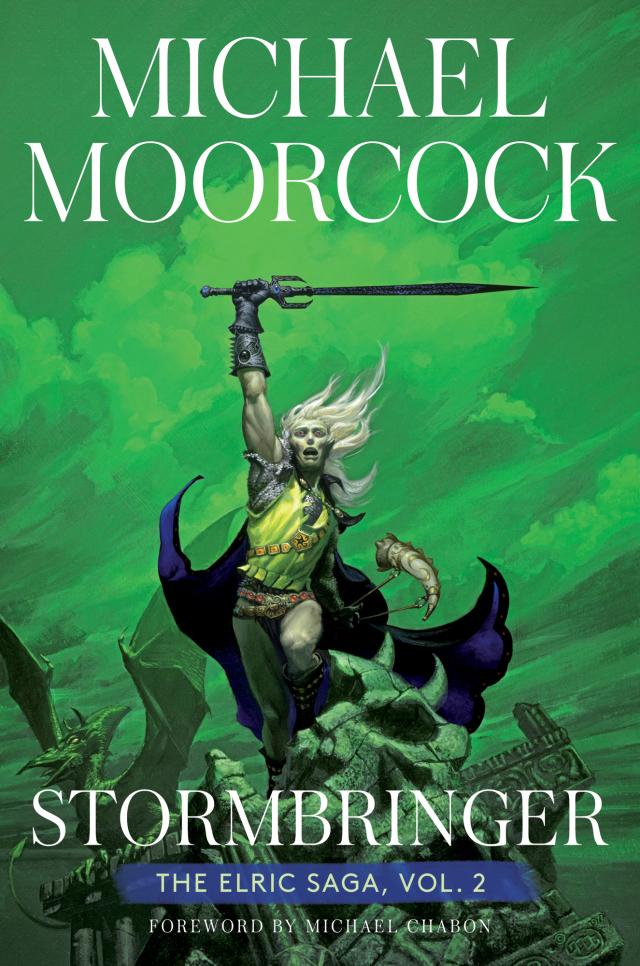


Both the Lords of Law and those of Chaos had become huge and misty as their earthly mass diminished and they continued to fight in human shape. They were like half-real giants, fighting everywhere now—on the land and above it. Far away on the rim of the horizon, he saw Donblas the Justice Maker engaged with Chardros the Reaper, their outlines flickering and spreading, the slim sword darting and the great scythe sweeping.
Unable to participate, unsure which side was winning, Elric and Moonglum watched as the intensity of the battle increased and, with it, the slow dissolution of the gods’ earthly manifestation. The fight was no longer merely on the Earth but seemed to be raging throughout all the planes of the cosmos and, as if in unison with this transformation, the Earth appeared to be losing its form, until Elric and Moonglum drifted in the mingled swirl of air, fire, earth and water.
The Earth dissolved—yet still the Lords of the Higher Worlds battled over it.
The stuff of the Earth alone remained, but unformed. Its components were still in existence, but their new shape was undecided. The fight continued. The victors would have the privilege of re-forming the Earth.
6
At last, though Elric did not know how, the turbulent dark gave way to light, and there came a noise—a cosmic roar of hate and frustration—and he knew that the Lords of Chaos had been defeated and banished. The Lords of Law victorious, Fate’s plan had been achieved, though it still required the last note of the horn to bring it to its required conclusion.
And Elric realised he did not have the strength left to blow the horn the third time.
About the two friends, the world was taking on a distinct shape again. They found they were standing on a rocky plain and in the distance were the slender peaks of new-formed mountains, purple against a mellow sky.
Then the Earth began to move. Faster and faster it whirled, day giving way to night with incredible rapidity, and then it began to slow until the sun was again all but motionless in the sky, moving with something like its customary speed.
The change had taken place. Law ruled here now, yet the Lords of Law had departed without thanks.
And though Law ruled, it could not progress until the horn was blown for the last time.
“So it is over,” Moonglum murmured. “All gone—Elwher, my birthplace, Karlaak by the Weeping Waste, Bakshaan, even the Dreaming City and the Isle of Melniboné. They no longer exist, they cannot be retrieved. And this is the new world formed by Law. It looks much the same as the old.”
Elric, too, was filled with a sense of loss, knowing that all the places that were familiar to him, even the very continents were gone and replaced by different ones. It was like the loss of childhood and perhaps that was what it was—the passing of the Earth’s childhood.
He shrugged away the thought and smiled. “I’m supposed to blow the horn for the final time if the Earth’s new life is to begin. Yet I haven’t the strength. Perhaps Fate is to be thwarted after all?”
Moonglum looked at him strangely. “I hope not, friend.”
Elric sighed. “We are the last two left, Moonglum, you and I. It is fitting that even the mighty events that have taken place have not harmed our friendship, have not separated us. You are the only friend whose company has not worn on me, the only one I have trusted.”
Moonglum grinned a shadow of his old, cocky grin. “And where we’ve shared adventures, I’ve usually profited if you have not. The partnership has been complementary. I shall never know why I chose to share your destiny. Perhaps it was no doing of mine, but Fate’s, for there is one final act of friendship I can perform…”
Elric was about to question Moonglum when a quiet voice came from behind him.
“I bear two messages. One of thanks from the Lords of Law—and another from a more powerful entity.”
“Sepiriz!” Elric turned to face his mentor. “Well, are you satisfied with my work?”
“Aye—greatly.” Sepiriz’s face was sad and he stared at Elric with a look of profound sympathy. “You have succeeded in everything but the last act which is to blow the Horn of Fate for the third time. Because of you the world shall know progression and its new people shall have the opportunity to advance by degrees to a new state of being.”
“But what is the meaning of it all?” Elric said. “That I have never fully understood.”
“Who can? Who can know why the Cosmic Balance exists, why Fate exists and the Lords of the Higher Worlds? Why there must always be a champion to fight such battles? There seems to be an infinity of space and time and possibilities. There may be an infinite number of beings, one above the other, who see the final purpose, though, in infinity, there can be no final purpose. Perhaps all is cyclic and this same event will occur again and again until the universe is run down and fades away as the world we knew has faded. Meaning, Elric? Do not seek that, for madness lies in such a course.”
“No meaning, no pattern. Then why have I suffered all this?”
“Perhaps even the gods seek meaning and pattern and this is merely one attempt to find it. Look—” he waved his hands to indicate the newly formed Earth. “All this is fresh and moulded by logic. Perhaps the logic will control the newcomers, perhaps a factor will occur to destroy that logic. The gods experiment, the Cosmic Balance guides the destiny of the Earth, men struggle and credit the gods with knowing why they struggle—but do the gods know?”
“You disturb me further when I had hoped to be comforted,” he sighed. “I have lost wife and world—and do not know why.”
“I am sorry. I have come to wish you farewell, my friend. Do what you must.”
“Aye. Shall I see you again?”
“No, for we are both truly dead. Our age has gone.”
Sepiriz seemed to twist in the air and disappear.
A cold silence remained.
* * *
At length Elric’s thoughts were interrupted by Moonglum. “You must blow the horn, Elric. Whether it means nothing or much—you must blow it and finish this business for ever!”
“How? I have scarcely enough strength to stand on my feet.”
“I have decided what you must do. Slay me with Stormbringer. Take my soul and vitality into yourself—then you will have sufficient power to blow the last blast.”
“Kill you, Moonglum! The only one left—my only true friend? You babble!”
“I mean it. You must, for there is nothing else to do. Further, we have no place here and must die soon at any rate. You told me how Zarozinia gave you her soul—well, take mine, too!”
“I cannot.”
Moonglum paced towards him and reached down to grip Stormbringer’s hilt, pulling it halfway from the sheath.
“No, Moonglum!”
But now the sword sprang from the sheath on its own volition. Elric struck Moonglum’s hand away and gripped the hilt. He could not stop it. The sword rose up, dragging his arm with it, poised to deliver a blow.
Moonglum stood with his arms by his side, his face expressionless, though Elric thought he glimpsed a flicker of fear in the eyes. He struggled to control the blade, but knew it was impossible.
“Let it do its work, Elric.”
The blade plunged forward and pierced Moonglum’s heart. His blood sprang out and covered it. His eyes blurred and filled with horror. “Ah, no—I—had—not—expected this!”
Petrified, Elric could not tug the sword from his friend’s heart. Moonglum’s energy began to flow up its length and course into his body, yet, even when all the little Eastlander’s vitality was absorbed, Elric remained staring at the small corpse until the tears flowed from his crimson eyes and a great sob racked him. Then the blade came free.
He flung it away from him and it did not clatter on the rocky ground but landed as a body might land. Then it seemed to move towards him and stop and he had the suspicion that it was watching him.
He took the horn and put it to his lips. He blew the blast to herald in the night of the new Earth. The night that would precede the new dawn. And though the horn’s note was triumphant, Elric was not. He stood full of infinite loneliness and infinite sorrow, his head tilted back as the sound rang on. And, when the note faded from triumph to a dying echo that expressed something of Elric’s misery, a huge outline began to form in the sky above the Earth, as if summoned by the horn.
It was the outline of a gigantic hand holding a balance and, as he watched, the Balance began to right itself until each side was true.
And somehow this relieved Elric’s sorrow as he released his grip on the Horn of Fate.
“There is something, at least,” he said, “and if it’s an illusion, then it’s a reassuring one.”
He turned his head to one side and saw the blade leave the ground, sweep into the air and then rush down on him.
“Stormbringer!” he cried, and then the hellsword struck his chest, he felt the icy touch of the blade against his heart, reached out his fingers to clutch at it, felt his body constrict, felt it sucking his soul from the very depths of his being, felt his whole personality being drawn into the runesword. He knew, as his life faded to combine with the sword’s, that it had always been his destiny to die in this manner. With the blade he had killed friends and lovers, stolen their souls to feed his own waning strength. It was as if the sword had always used him to this end, as if he was merely a manifestation of Stormbringer and was now being taken back into the body of the blade which had never been a true sword. And, as he died, he wept again, for he knew that the fraction of the sword’s soul which was his would never know rest but was doomed to immortality, to eternal struggle.
Elric of Melniboné, last of the Bright Emperors, cried out, and then his body collapsed, a sprawled husk beside its comrade, and he lay beneath the mighty balance that still hung in the sky.
Then Stormbringer’s shape began to change, writhing and curling above the body of the albino, finally to stand astraddle it.
The entity that was Stormbringer, last manifestation of Chaos which would remain with this new world as it grew, looked down on the corpse of Elric of Melniboné and smiled.
“Farewell, friend. I was a thousand times more evil than thou!”
And then it leapt from the Earth and went spearing upwards, its wild voice laughing mockery at the Cosmic Balance; filling the universe with its unholy joy.
THE ELRIC SAGA: A READER’S GUIDE BY JOHN DAVEY
Elric of Melniboné—proud prince of ruins, kinslayer—call him what you will. He remains, together with maybe Jerry Cornelius, Michael Moorcock’s most enduring, if not always most endearing, character.
This guide attempts to provide a title-by-title breakdown of the novels together with omnibuses in which each appeared, all in a chronological format, listing omnibuses as individual titles rather than including them within the main books’ descriptions.
Elric began life sixty years ago, in response to a request from John Carnell, editor of SCIENCE FANTASY magazine, for a series akin to Robert E. Howard’s Conan the Barbarian stories. What Carnell received, while steeped in sword-and-sorcery images, was something quite different. All in all, nine Elric novellas appeared in SCIENCE FANTASY between June 1961 and April 1964, the last four “serialising” (in effect) the novel Stormbringer, while the first five were collected as The Stealer of Souls (1963). These five were later split up and re-collected in, or absorbed into, The Weird of the White Wolf and The Bane of the Black Sword (q.v., both 1977) and were also, as a result of this assimilation, slightly revised. Collectors should note that the true first edition of The Stealer of Souls (subtitled by its publishers as “… and Other Stories,” against Moorcock’s wishes) was bound in orange boards; an otherwise identical but less collectable second printing had green boards.
Stormbringer (1965), conceived as a novel, was first published as such when abridged and revised from the four remaining SCIENCE FANTASY novellas. It was later restored to its original length and further revised, in 1977. The original abridgements basically condensed the first two novellas (plus part of the third) into one long section, “The Coming of Chaos.”
The Singing Citadel (1970) was a collection of four other novellas originally published in various anthologies and periodicals between 1962 and 1967. They were later split up and all but one were re-collected in, or absorbed into, The Weird of the White Wolf and The Bane of the Black Sword as their events interconnect with those of The Stealer of Souls. They were also, as a result of this assimilation, slightly revised. The unused novella, “The Greater Conqueror” (sometimes erroneously listed as “The Great Conqueror”), was subsequently collected in Moorcock’s Book of Martyrs (1976, a.k.a. Dying for Tomorrow, 1978), Earl Aubec and Other Stories (1993), Elric: To Rescue Tanelorn (2008) and Elric: The Sleeping Sorceress (2013).
The Sleeping Sorceress (1971) was expanded from a novella of the same name, although it was originally commissioned as a serial for Kenneth Bulmer’s magazine, SWORD AND SORCERY, which never appeared. One of its sections retells, from Elric’s viewpoint, a part of the Corum novel, The King of the Swords. In 1977, The Sleeping Sorceress was retitled, with minor textual amendments, as The Vanishing Tower (q.v.).
Elric of Melniboné (1972) is a prequel to all other Elric novels. The Dreaming City (1972) was a version of Elric of Melniboné, published with unauthorised changes. Collectors should note that, in 1977, Elric of Melniboné was one of three Elric books sold as illustrated editions in slip-cases. This first (in a red case) also had a smaller, limited edition (in a brown case) signed by the author, artist (Robert Gould) and publisher. In 2003, Elric of Melniboné was the first novel of Moorcock’s to become an unabridged audiobook.
Elric: The Return to Melnibone (sic, 1973) remains, despite its comparative irrelevance to the overall series, one of the scarcest and most sought-after of Elric books. This is the result of its somewhat chequered history, a saga complex enough to rival Elric’s own. It is actually little more than a showcase for the exquisite artwork of Philippe Druillet, beginning life in 1966 as double-spread colour illustrations for the only issue of a French magazine, MOI AUSSI, with text by Maxim Jakubowski. In 1969, Druillet illustrated an omnibus called Elric le Necromancien, and in 1972 some of this (and new) artwork was put into a twenty-one piece portfolio as La Saga d’Elric le Necromancien, this time with text by Michel Demuth. All of this work up until then was unauthorised, but when the portfolio was reprinted and bound (less one piece) in the U.K. as Elric: The Return to Melnibone (text by Moorcock), Druillet threatened to sue. Moorcock was forced to step in on behalf of the British publishers, pointing out that permission had never been granted for Druillet to draw Elric in the first place. In order to avoid messy litigation, it was decided to allow the small print run to expire, never to be reprinted. However, a republication was finally agreed, the book made available again in 1997 as Elric: The Return to Melniboné, and it was later collected (alongside James Cawthorn’s 1976 graphic adaptation of Stormbringer) in 2021’s Elric: The Eternal Champion Collection.
The Jade Man’s Eyes (1973) was a separate novella which, in order to bring it in line with the developing series, was revised and absorbed into The Sailor on the Seas of Fate as “Sailing to the Past.”
The Sailor on the Seas of Fate (1976) originally slotted, chronologically, between events in Elric of Melniboné and The Weird of the White Wolf. One of its sections retells, from Elric’s viewpoint, a part of the Hawkmoon/Count Brass novel, The Quest for Tanelorn. In 2006, The Sailor on the Seas of Fate also became an unabridged audiobook.
The Weird of the White Wolf (1977) is a chronological arrangement of selected contents from The Stealer of Souls and The Singing Citadel, compiled in order to bring them in line with the developing series.
The Vanishing Tower (1977) is a retitling, with minor textual amendments, of The Sleeping Sorceress. Collectors should note that, in 1981, The Vanishing Tower was the second of three Elric books sold as illustrated editions in slip-cases. This edition (in a pictorial red case) also had a smaller, limited edition (in a brown case) signed by the author, artist (Michael Whelan) and publisher.
The Bane of the Black Sword (1977) is a chronological arrangement of selected contents from The Stealer of Souls and The Singing Citadel, compiled in order to bring them in line with the developing series.
The somewhat misleadingly titled Six Science Fiction Classics from the Master of Heroic Fantasy (1979) was a boxed set of six American paperbacks: Elric of Melniboné, The Sailor on the Seas of Fate, The Weird of the White Wolf, The Vanishing Tower, The Bane of the Black Sword and Stormbringer.
Elric at the End of Time (1984) was a collection of short fiction and non-fiction which actually contained only three Elric-related items among its contents of seven (excluding the introduction). The title story was also published separately in 1987 as a large-format novella (q.v.) illustrated by Rodney Matthews.
The Elric Saga Part One (1984) was the first Elric omnibus, and contained Elric of Melniboné, The Sailor on the Seas of Fate and The Weird of the White Wolf. The Elric Saga Part Two (1984) was the second omnibus, and contained The Vanishing Tower, The Bane of the Black Sword and Stormbringer.
Elric at the End of Time (1987) was a separate, large-format novella illustrated by Rodney Matthews for whom it was originally written some years earlier. Collectors should note that it was published simultaneously in both hardcover and paperback formats.
The Fortress of the Pearl (1989), the first Elric novel for thirteen years, expanded the saga and slots, chronologically, between events in Elric of Melniboné and The Sailor on the Seas of Fate.
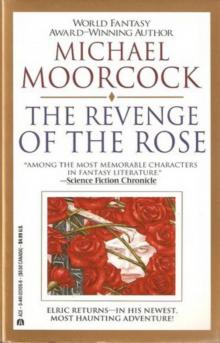
The Revenge Of The Rose (1991) slots between events in The Sleeping Sorceress/The Vanishing Tower and the stories from The Bane of the Black Sword.
In 1992, Moorcock began an ambitious project of re-ordering, revising and republishing much of his back-catalogue in a large set of omnibuses in the U.K. under the collective title of “The Tale of the Eternal Champion.” The first of these to feature the albino prince was Elric of Melniboné (1993), containing Elric of Melniboné, The Fortress of the Pearl, The Sailor on the Seas of Fate and selected contents from The Weird of the White Wolf. The omnibus was retitled in the U.S.A., when the “Eternal Champion” series began to appear there, as Elric: Song of the Black Sword (1995).