Master alvin, p.53
Master Alvin,
p.53
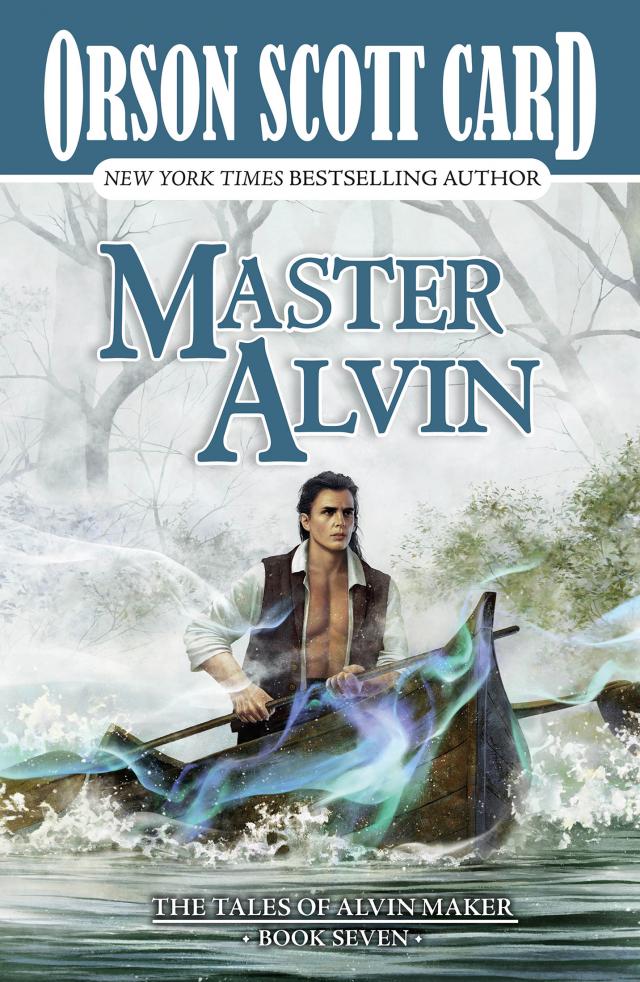


“And you came, not as his shadow or his echo, but with his heartfire and with his voice.”
Arthur Stuart bowed, and then knelt before Ta-Kumsaw. “You are king of this land,” he said. “I pledge my allegiance and obedience to you.”
“There will be no kings in this land,” said Ta-Kumsaw.
“Then be my father,” said Arthur Stuart. “The father of my body is a creature of slime and filth. Please take me as your son, and be the father of my heart, and I will obey you as a father, because you have nurtured me as a son.”
The people of Crystal City who were just coming off the ice bridge saw Arthur Stuart kneel before Ta-Kumsaw, and whether anyone called it by that name, they understood that the mayor of their city was pledged to the chief man of the Reds. Word of this would spread, and they would understand that no matter what, any lands they had here were Red lands, and they would answer to the Reds for anything they did. They talked about this, and decided they could live with that. The Reds did not have to take them in, yet they opened their wall and let them enter.
The last wagons crossed after it was dark, but there was moonlight, and darkness was no hindrance. The Crystal City settlement consisted of wagons and blankets spread out on the grass, because there was no rain coming tonight. The children slept easily, near their parents but not huddled in any kind of fear. The marauders had been left behind. The people who had murdered Alvin and Measure had been left behind as well. And the Reds were accepting them in peace.
The animals weren’t in on any such treaty, but there were enough people with knacks to keep wolves and coyotes at bay, and bar them from taking so much as a lamb or a calf or a foal.
That night as he lay on his blanket under the stars, Arthur Stuart cast out far and wide, looking for all the heartfires he could find. He looked into the heartfires of many Reds, and found only pity for the refugees and acceptance of them in their land for Alvin’s sake, because Alvin was a legend of nobility among them. He had been with Ta-Kumsaw in the great war and saved his life. He had healed Lolla-Wossiky of his drunkenness and blindness so he could become the Prophet and teach the Reds. There was no hate there, not tonight.
And he looked into the heartfires of his own people, heartfires that he already knew before they became his people. And there, too, there was no malice or fear or hate or anger. No one harbored any ambition of crossing back over the river in order to take retribution on Carthage for murdering the Maker.
Tonight, thought Arthur Stuart, we have something so rare that it is remembered only in legends of a golden age. Tonight we have peace.
I will nurture it. I will make it last as long as the people want it. Long after I die, let them live in this peace. Then we will have fulfilled Alvin’s dream by creating the true Crystal City.
Suddenly it crossed Arthur Stuart’s mind: There is no reason now for me not to marry, because I will not be haring off with Alvin to the ends of the Earth. I belong to myself now, if I belong to anybody, so it’s time for me to have the life that Alvin longed for but could never have except for moments here and there.
She must be somewhere in this company, among the people from the South. She knew that I loved her, and I knew she loved me, and if she hasn’t chosen someone else, she will be there for me, and I will be there, at last, for her.
That was the dream in his mind when he fell asleep in the land of the Red man, in the midst of the Crystal City, on the grass of this great land, under this moon and these stars, where he belonged.
Afterword
The Tales of Alvin Maker began with an idea and a poem.
I was taking a graduate course in Elizabethan literature except Shakespeare, which led directly to Edmund Spenser and The Faerie Queene. While I had little patience with the heavily allegorical narrative (I prefer my history in prose and plain speaking), I did appreciate the fact that Spenser was trying to do for Modern (Post-Chaucerian) English poetry what Dante Alighieri had done for Tuscan vernacular poetry.
I had already begun to dislike the apparent duty of American fantasy writers to set their stories in a pseudo-medieval England. When Tolkien did it, he was writing a profoundly English epic. But what do American writers have to do with the English landscape, folklore, and culture? Don’t we have folklore of our own? We do, along with a history and a landscape that are quite different from those of England.
I wouldn’t have minded so much if the traditional fantasy writers had bothered to learn enough about medieval English culture to understand how the society worked. It grates on my nerves when American writers speak of the non-royal peerage and armiger classes as “royalty.” No! “Royalty” refers only to direct and near relatives of the reigning monarch. Also, the king and queen are addressed as “your majesty,” princes of the royal house are “your highness,” and other nobility are addressed as “my lord,” “my lady,” “your lordship” (or ladyship) or, at the lowest levels, “Sir John” and “Lady Jezebel.”
And, to me, the most annoying thing—a fault even with Tolkien’s The Lord of the Rings—is the fact that gentlemen of property, like Bilbo and Frodo, seem to have no duties apart from making tea, entertaining visitors, reading and writing letters, and gallivanting about on horseback or in carriages. Jane Austen, who rarely makes such omissions, shows her well-to-do gentlemen with very demanding duties in directing the agriculture on their property, caring for the tenants of their land, seeing to the upkeep of their buildings, and hiring and paying employees. Being a prosperous landowner is a full-time job, and those who expend their income on gaming and gambling and other money-losing activities are prone to leave nothing to their heirs but debts and obligations.
When Lobelia Sackville-Baggins finally gets possession of Bag End, Bilbo’s and Frodo’s prosperous estate, there is no hint that there are tenants and employees to be met with and supervised. It seems, in The Lord of the Rings, that Bag End is nothing but the house and its furnishings, with its only staff being Hamfast Gamgee (the Gaffer) and his son, Samwise. Sam is definitely a servant—somewhere between a valet and a batman—and views himself as a minor character in his “master’s” biography. But where is the source of Bilbo’s money, once he spent or gave away all the treasure he had brought home from his travels and adventures in The Hobbit? There’s real work to be done, or where in the world does your money come from.
Some fantasy writers broke away from the medieval English straitjacket by writing contemporary fantasy. I think particularly of Megan Lindholm’s brilliant Wizard of the Pigeons, which profoundly affected me. It simultaneously opened the door to a universe of fresh fantasy milieux, and closed the door for me on urban fantasy itself, since she had created such a gorgeous urban fantasy world that I did not know how I could write urban fantasy without imitating or echoing her.
Besides, fantasy benefits from a sense of being ancestral, a memory of days long past. So I thought, what would an American ancestral story look like?
My first thought was of James Fenimore Cooper’s Leatherstocking Tales. Natty Bumppo was definitely not a creature of fantasy, with no magic about him. But he was larger than life, herculean, and gave American history a sense of depth and humanity. Anything earlier than the frontier days of the French and Indian War would not be American history. The Native Americans certainly had cultures, many of them very magical, and a depth of history that is impossible for Anglo-America. But most Americans today don’t feel any ancestral connection with the Mound Builders, still less the Aztecs, Mayas, Quechuas, or Olmecs. There are fantasy epics to be written in those milieux, of course, but if I’m setting out to write fantasy in the American past, Natty Bumppo is as far back as I could go.
Until I realized that I had a different past—still American, but both more and less. I grew up as (and continue to be) a believing, practicing Mormon, deeply inside the culture of The Church of Jesus Christ of Latter-day Saints.
Christian historical novels, like biblical fiction in general, have the power of supernatural happenings along with tales of great heroes, both hubristic and humble—or both, like David the humble shepherd, and David the lecherous and predatory king. One of the great beloved novels and plays of the late nineteenth century and well into the twentieth was the story of Judah in Ben-Hur: A Tale of the Christ. Jesus was not the hero of the story—he was the god. Every reader in that time period knew the story of Jesus, so that in writing the novel, Lew Wallace did not have to explain. Judah Ben-Hur could cross paths with Jesus several times in the novel, and each time the encounter was memorable and transformative—but not history-making. Jesus touches Judah Ben-Hur and transforms him, but Ben-Hur does not change Jesus in any way, or bend his path even a little.
At that time, in the late 1970s, I shifted a little. It wasn’t enough for me to attempt a vernacular American epic. I also had to write a vernacular Mormon epic. The obvious thing was to tell the story of Joseph Smith, a figure with supernatural connections at least as good as those of Achilles or Hercules. But, like Spenser, I knew I could tell the story best as allegory. Nobody would be named Joseph Smith, and nobody would have visions like those of the founding Mormon prophet. Instead, I would take a cue from his name, and make my character a blacksmith. And I would take his name from that of Joseph’s beloved older brother who died as a young adult: Alvin Smith.
However, I regarded the Mormon connection as being less important to the story than the American setting. This was to be an American fantasy, not a Mormon one. For one thing, Mormonism has no room for fantasy—there are plenty of supernatural events in the historical lore. No magic added.
When I first set pen to paper, I was still in grad school, though I had already had several novels and other books published. I was comfortable inventing a fantasy universe, though for my initial foray it did not need to be very wide or deep. There was an apprentice blacksmith, still a boy—conceivably, fourteen years old, like Joseph Smith at the time of his first vision. But instead of being concerned about which Christian church to join, Alvin Smith was concerned with making his masterpiece—the work that would prove his worthiness to be called Master.
What would he make? An iron plow is a difficult thing to make, since it is both cast and wrought. That was hard enough. But if I reached into alchemical tradition, Prentice Alvin needed to make a plow that turned iron into gold—but a gold that was not only hard and unmalleable, but also alive, able to move under its own volition, needing no horse or ox to pull it through the dirt.
When in Alvin Smith’s life should my story take place? For me, it was obvious that it had to be about the making of his masterwork. And with some idea of how the story would be told, I first wrote the title: “Prentice Alvin and the No-Good Plow.”
I wrote the poem, not in contemporary English, really, but in imitation of the dialect spoken in the early nineteenth century. I had already received confirmation of the accents of the frontier when I saw, in one of his letters, that Brigham Young spelt “piano” as “pianna.” Which nails down his pronunciation at the time.
I wrote the poem as if it were being told aloud to listeners staying warm near a fire—listeners who spoke a hill-country dialect of English, where it was the accent of the West Virginia Appalachians, of the Ozarks, or of the mountain valleys of Utah.
I knew the rhythms, cadences, and some of the vocabulary of those dialects. I knew the pronunciations—the hard retroflex R, the open O that becomes the open Ah of opera. (See Wayne Booth’s wonderful essay, “Farkism and Hyperyorkism.”)
There were two competing standards. I could try, as Artemus Ward did, to write down the accent. But this is why Artemus Ward has vanished from the public consciousness, while Mark Twain is still widely read by volunteers. Twain suggested the country dialect, but spelled almost all the words exactly as they’re normally spelt.
There was only one place where I felt a need to correct a long misconception. In modern English, our present participle and gerund verbs end in “ing.” Often, to show that a character is a country hick, writers will have these lower-class people use words like “talkin’,” “eatin’,” “sufferin’.”
But I knew from personal observation that even the most pretentious people elide the “ng” sound into a simple “in” or a nasalized schwa. In other words, saying “walkin’ up the street” and “hoppin’ mad” does not mark you as a lower-class person—it marks you as someone who speaks modern English, period.
And why should people pronounce “ng” at the ends of participles and gerunds? That “ng” is as accurate as spelling “offen” as “often,” even though the T is silent in the correctly spoken word.
Those participles were originally written as “and.” Had this ending survived, we would write of people “walkand down the street” and “singand a song.” But, as languages do, English dropped that D, and the ending began to be a simple nasalized schwa or grunt, with no vowel at all. It should be written as “walkn” and “singn,” because, like the final “le” of “little,” the final syllable of those participles is a vowelless grunt, with the liquid L and the nasal N functioning as standalone syllables. Walkn, eatn, hittn, speakn.
But when writers first tried to write that syllable, they settled on “ing,” to represent a general nasalized sound. Syllables needed vowels, so they used the shortest vowel. And it was not a terminal N as in “broken,” “taken,” “beaten,” or even “stone,” “pain,” “throne.”
Alas that we make little to no distinction between the final syllables of “eating” and “eaten,” “beating” and “beaten.” Fortunately, not a lot of past participles take the “en” ending—there’s no “I have often walken there,” nor “I have never callen that number.” Still, the “ing” spelling lingered, even though as a present participle it is almost never pronounced like the “ing” of “ending,” or of “linger,” or of “ring.”
If I had characters in my vernacular language say, “I’m working on that,” should I spell it as it is pronounced—“I’m workn on that”? Or with the condescending apostrophe—“I’m workin’ on that”? I figured that “workn” would look like Polish to American eyes, while “workin’” with an apostrophe would seem like the sneering way the educated represent the conversation of the unlettered.
Instead I settled on the “in” ending, no G and no apostrophe: “Laughin and pantin on the ground … Frost a-comin on.” The words thus remained completely intelligible, while better reflecting the common pronunciation.
Yes, right, you always pronounce the “ing” properly. Maybe you do. But maybe it’s like when I was directing a production of A Dixie Christmas Carol, in which someone was supposed to say the name of the North Carolina town Fayetteville. I insisted that the actor say the name of the city the way it is almost always pronounced in Carolinian conversation: “Fettvul,” or even with the “tt” replaced by a glottal stop: “Fe’vul.”
One cast member was outraged. I think she thought I was disparaging the way North Carolinians talked, while I was merely trying to use it to get the right feel for the language. “We say ‘Fay-ette-ville,’” she said adamantly.
I stopped arguing with her about it and went on with the rehearsal. During a break not ten minutes later, I heard her talking with some other cast members, and she mentioned Fayetteville in passing—pronouncing it as “Fe’vul.”
I don’t remember what we did in performance. I think I changed it to another regional town name, like Danville (“Damvul”) or Asheville (“Ashvul”). What matters is that a lot of people think they speak with elevated formality, when in fact they usually speak the more abbreviated and elided vernacular.
I labored over the story of “Prentice Alvin and the No-Good Plow” for several months, until I had worked out the orthography to my own satisfaction, even if to no one else’s. Then I submitted the finished poem to a contest sponsored by the Utah State Institute of Fine Arts. In the Long Serious Poem category, it won first place in 1981.
The poem appeared in the August 1989 issue of Sunstone magazine, and I included it in my short fiction collection Maps in a Mirror. Upon publication, it seemed to me that the poem actually existed, though I have little indication that anybody read it all the way through. For all I know, “Prentice Alvin” was the only entry in the Long Serious Poem category that year.
I had no illusions. The audience for long-form poetry in America today is usually the poet and his mother. Even English graduate students feel imposed upon when asked to read any modern poem longer than a sonnet or a limerick. But I loved the character and situation of Prentice Alvin. I didn’t want to let the story die on the vine.
That’s when I worked it up as a proposal for an American frontier fantasy trilogy: Prentice Alvin, Alvin Journeyman, and Master Alvin. I submitted it to Lester del Rey of Del Rey Books. He rejected it with an explanation that I was violating a whole bunch of rules of fantasy, every single one of which was also violated by Stephen R. Donaldson’s then-recent Thomas Covenant trilogy, published by Del Rey. In other words, they weren’t rules at all—if the story was good enough, it would transcend the rules.
My goal, as always, wasn’t to “get published.” It was to get the novel right, and then try to find its audience. It didn’t take long to find the right editor and publisher: Beth Meacham, whom I had worked with when she was at Berkley, but who now was at Tor Books, which would soon become the publisher of Ender’s Game and Speaker for the Dead. Beth and I had tried to work out a contract for a science fiction novel based on the Middle English romance King Horn. Beth and her boss, Tom Doherty, made a generous offer on the Alvin Make series. That advance allowed me to quit my job as book editor at Compute! Publications and go back to being a freelance novelist working from home. Alvin Maker changed my life.
The trouble is that the first volume, Prentice Alvin, turned into three novels: Seventh Son, Red Prophet, and Prentice Alvin. And in Alvin Journeyman, something Alvin didn’t do much of was journey. The series was out of hand. I kept hearing from people about the seven books in The Tales of Alvin Maker. Seven? Five, I insisted. I figured it was the title of Seventh Son that led readers to think of “seven” in connection with the series. And then when Heartfire didn’t move us more than a micron forward in the story, I realized there had to be six books.