Master alvin, p.54
Master Alvin,
p.54
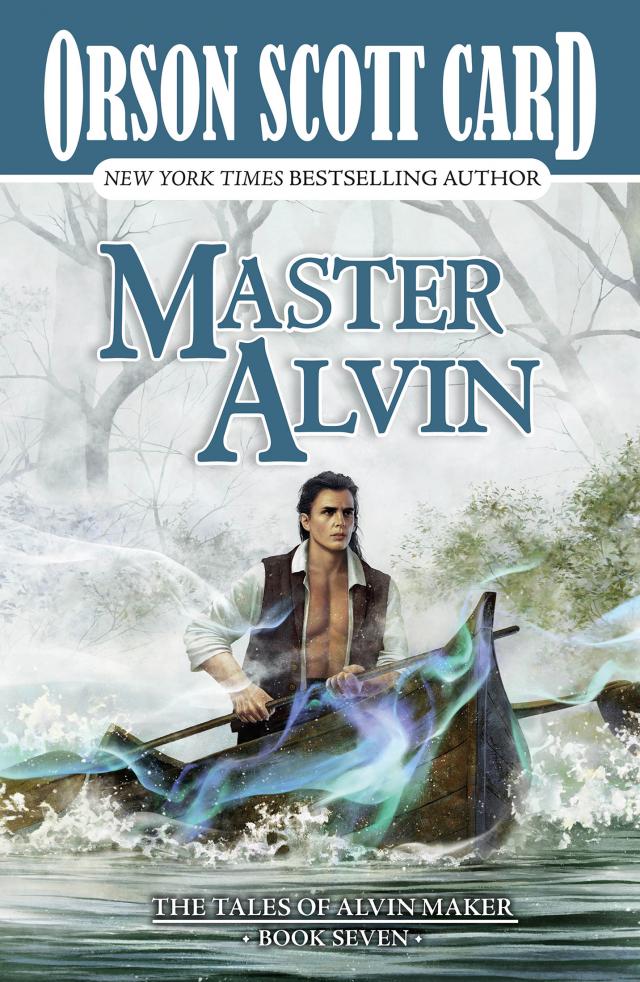


But in book six, Crystal City, to bring the series from Louisiana to Illinois and take the story through to its obvious end would have taken a thousand pages, or so I figured. So when I turned in Crystal City, without the conclusion of the series, we had to face the fact that despite my best intentions, the Alvin Maker series would be seven books long. Beth was a little cynical about it—did I really think I could end it in one more book? I promised that there was only going to be one last book, entitled Master Alvin, and I really hoped it wouldn’t be a thousand pages long.
Her reply? “I’m an editor. I know how to cut.”
The real problem for me was that Master Alvin was going to show Alvin as the political leader of Crystal City, as well as its designer and architect. This was analogous to Joseph Smith’s time as mayor of the city of Nauvoo, Illinois, a period of time I had already dealt with in my long historical novel Saints (originally published under the ridiculously generic title Woman of Destiny).
Furthermore, in Joseph Smith’s life everything was complicated by the idea of polygamy—which I had already dealt with in Saints and in the musical play Father, Mother, Mother and Mom (with composer Robert Stoddard). I wasn’t interested in doing anything more with these topics than I already had.
So I didn’t intend to deal with the entire history of Crystal City and all the betrayals and problems. My task was simple: Alvin Maker was going to die near the end of the book, murdered in his jail cell in the city of Carthage—which, in the Alvin Maker series, is basically Cincinnati. Then his people cross the Mississippi River and move on through prairies and mountains to the Great Salt Lake Valley. Therefore, this final volume needed to show why Alvin Maker, who could have been effectively immortal, placed himself in harm’s way and died at the hands of a disciplined military force that had decided to assassinate him.
All I had to show of Crystal City was the condition it was in shortly before Alvin’s death—I didn’t have to cover the whole thing. All I had to do with polygamy was to ignore it completely, since it had no place in this story. I had to have characters who worked against him, among them his brother Calvin, perpetually envious of his powerful brother.
Master Alvin starts near the end of the Crystal City period. All the development phases have already happened. If you find this intriguing, my novel about it is Saints. But Saints is a historical novel. Master Alvin is a fantasy.
Let me go back now to the early days of writing the series. I wanted the fantasy to rely on the actual beliefs and practices of frontier Americans—only those magical beliefs would actually be true, in the world of the book. I knew that I would be using the idea of knacks, but those aren’t in the old folk beliefs. So instead of trying to research frontier beliefs from scratch, I decided to rely on somebody who had already studied that period. Carol Breakstone was a graduate student who knew how to get the information I needed. Only I couldn’t tell her what I needed; I’d know it when I saw it.
She brought me a few things at first, to see if she was on the right track. But they were the right things. They immediately triggered everything else. First, she reminded me that hexes were displayed on buildings as a blessing or a protection. I knew I could play with that.
Then she told me of the practice of having a seer lay hands on a pregnant woman’s belly, to find out things about the coming baby. I turned that practitioner into a “torch,” a term of my own invention, and eventually it became one of the most powerful magics in the Alvin Maker series.
I had never heard of a birth caul—a section of the amniotic sac that covers a baby’s face at birth, making breath impossible until someone peels it away. Carol told me that the caul was believed to have magical properties pertaining to the child, which opened many doors to me.
I believe that she also reminded me that people believed that a seventh son had powers of healing and other magics. I liked that—but I also thought about a seventh son of a seventh son. That would be powerful stuff. All the more powerful if all six brothers were still alive when the seventh son was born.
Carol gave me several starting points, and I ran with them. But there was more than magic required. Just as medieval fantasies needed to depict the details of life, I would need to do the same with frontier life. For this I relied on what I had learned from reading, in my early teens, Conrad Richter’s beautiful Awakening Land series: The Trees, The Fields, and The Town. If the “great American novel” could actually exist, I believe that Richter’s trilogy has the opening bid and a good chance of winning the category outright.
I had no intention of trying to top Richter’s fiction. I only aspired to convey some slender part of the world he created so beautifully. His research and storytelling were so excellent, I did not need more than a handful of sources beyond what Richter and Breakstone brought to me.
I had the magic; I had the daily life. But I was well into the first draft of Seventh Son when I realized: If the magical beliefs of the people of that time were true, wouldn’t that magical power have altered American history? A magical America wouldn’t have had all the same events, and while the prominent people might still rise to fame and influence, they would do so in a different way.
So I started playing games with history. I was taking my changes seriously, but at the same time, I was frolicking through American history, trying to tell a story that was truer than the actual historical facts.
Here’s a weird thing that happened: Americans are so ignorant of their own history that many readers didn’t realize that the history in the Alvin Maker books was bogus. We actually got one fan letter in which a lady said, “I never knew that George Washington was beheaded.” We tried to interpret her words as a joke, but we gave up. She meant it.
Another weird thing: Many Mormon readers recognized elements from Joseph Smith’s life, and then followed along as if the whole novel were a one-for-one allegory of his life. It was as if, because they got the Joseph Smith connections, they couldn’t see anything else. This is, above all, an American fantasy novel, and I’m trying to deal with the pre–Civil War era in American history as truthfully as possible, while playing entertainingly (I hope) with the facts.
You can’t find Joseph Smith’s life accurately portrayed in the Alvin Maker books. His life was a frame on which I built story and character. But American history was also a frame I built on—and it shaped far more of the story than Joseph Smith did.
One aspect of Joseph Smith’s life I kept: How it ended. I told Mormons who asked about the later books in the series, “Come on, you know how it all will end—with Alvin Maker dead on the street of Carthage City, and Arthur Stuart leading most of the citizens of Crystal City west to the Great Salt Lake.” They agreed. That was how it had to end.
And in the fall of 2023, I decided it was time for me to follow through and get to that ending. It took me until June of 2024, and then I needed to do a round of revisions, with which my audiobook-narrator daughter, Emily Rankin, was of extraordinary help.
But the whole project began because I wanted to follow in the footsteps of Dante and Spenser, by creating an epic poem about my own people. I originally planned to go back and add more to the poem—later chapters, if you will. But instead I gave up on the verse, for which there is little audience, and just told the story, plain and simple. Or plain and complicated—my plans don’t always work.
You have, I assume, now read the entire Tales of Alvin Maker. To coincide with the launch of the series finale, Tor has allowed me to assemble all the outside stories of Alvin Maker. One of them, “Yazoo Queen,” was originally the first chapter of Crystal City, and now it is back in its place. The other Alvin stories don’t have a clear place in the timeline, so we inserted them into the books we thought they were most compatible with.
Now the series is complete. The rumors are not true, of course. Neither Disney nor Universal are planning to open “The Hexing World of Alvin Maker.” For one thing, it would be hard to decide how many potentially fatal water hazards to have. And … no wands or quidditch.
Just because a story is presented to you as part of a genre, it doesn’t mean it has to resemble everything else in that genre. My American frontier fantasy did not spawn a new genre. I don’t see many other fantasy writers working in American history. But I wrote an American frontier fantasy series, and that’s enough for me. It will never have the stature of The Inferno or Faerie Queene, but I didn’t write it to impress; I don’t write anything to be impressive, and as my detractors would say, good thing.
Being “in fashion” is such a transient thing. Those who seek fame may find it, and they’ll find out that it is nothing.
What I wanted for Alvin Maker was readers. And here you are, fulfilling my ambition. I hope the story means something to you. I know that inventing it and writing it has meant a lot to me.
As Tolkien wanted The Lord of the Rings to be an epic for the English people, I would be glad if some people thought of The Tales of Alvin Maker as their epic, a place where their story is told. It is definitely a place where I think my people’s epic is told.
Remember that The Tales of Alvin Maker is set in the period of American history just before the Civil War—the war that killed more Americans than any other, and we did it to ourselves. Alvin Maker tried to forestall this terrible outcome. But in the real world, we went to war. We came to war, in our own towns, in our own homes. It’s part of our story, part of our epic—one we periodically decide to reenact among ourselves.
History can lead to tragedy. Good people die. Good projects fail. Awful people prosper at the expense of better people. That’s the world we live in. And that’s the world in which I tell stories. If fiction does anything valuable, I think it’s that stories allow you to have experiences that you could not otherwise have. You can experience tragedy without having to live through it. You can see how sacrificing for the good of others makes everything better for all. You can know what it’s like to build a community that’s good for everyone in it.
I have dreamed of building a Crystal City, a place where nobody has to be poor, because everyone shares their goods with others in need. I don’t think such a thing can ever be created by coercive power, by legislation, by confiscation. We build the Crystal City by voluntarily meeting other people’s needs when we see them, or when we’re asked. When we’ve given all we can, we give more, if not in money, then in service, in sharing.
The Crystal City is built out of blocks formed with drops of the blood and sweat of the citizens, added to the water of life that flows like a powerful river through and around us all. We work, not to build a private fortune to pass on to our children, but to build up an inheritance for all the people of the City, where all are partakers of the heavenly gift.
We do it one person at a time, by our own free decisions. We cooperate to identify the people in need. We help each other prosper, because only with prosperity will we have enough to share abundantly. The Crystal City can be built wherever there is freedom, love of neighbors, and kindness to strangers.
We don’t need Alvin Maker to create these blocks for us. The magic is already inside us. It’s already in our blood, our labor, our love. The Maker is the one who is part of what he makes.
Prentice Alvin and the No-Good Plow
Alvin, he was a blacksmith’s prentice boy,
He pumped the bellows and he ground the knives,
He chipped the nails, he het the charcoal fire,
Nothing remarkable about the lad,
Except for this: He saw the world askew,
He saw the edge of light, the frozen liar
There in the trees with a black smile shinin cold,
Shiverin the corners of his eyes.
Oh, he was wise.
The blacksmith didn’t know what Alvin saw.
He only knew the boy was quick and slow:
Quick with a laugh and a good or clever word,
Slow at the bellows with his brain a-busy,
Quick with his eyes like a bright and sneaky bird,
Slow at the forge when the smith was in a hurry.
Times the smith, he liked him fine. And times
He’d bellow, “Hell and damnation, hammer and tong,
You done it wrong!”
One day when the work was slow, the smith was easy.
“Off to the woods with you, Lad, the berries are ripe.”
And Alvin gratefully let the bellows sag
And thundered off in the dust of the summer road.
Ran? He ran like a colt, he leaped like a calf,
Then his feet were deep in the leafmeal forest floor,
He was moss on the branches, swingin low and lean,
His fingers were part of the bark, his glance was green—
And he was seen.
He was seen by the birds that anyone can see,
Seen by the porcupines that hid in the bushes,
Seen by the light that slipped among the trees,
Seen by the dark that only he could see.
And the dark reached out and stumbled Alvin down,
Laid him laughin and pantin on the ground,
And the dark snuck up on every edge of him,
Frost a-comin on from everywhere,
Ice in his hair.
Ice in the summertime, and Alvin shook,
Crackin ice aloud in the miller’s pond,
A mist of winter flowin through the wood,
Fingerin his face, and where it touched
He was numb, he was stricken dumb, his chin all chattery.
Where are the birds? he wondered. When did they go?
Get back to the edge, you Dark, you Cold, you Snow!
Get north, you Wind, it’s not your time to blow!
I tell you, No!
No! he cried, but the snow was blank and deep
And didn’t answer, and the fog was thick
And didn’t answer, and his flimsy clothes
Were wet, and his breath was sharp as ice in his lung
Splittin him like a rail. It made him mad.
He yelled, though the sound froze solid at his teeth
And the words dropped out and broke as they were said
And his tongue went thick, and his lips were even number:
“Dammit, it’s summer!”
With the snow like stars of death in your eyes? “It’s summer!”
The wind a-ticklin at your thighs? “It’s summer!”
Your breath a fog of ice? “Let it be spring!
Let it be autumn, let it be anything!”
But the edge of the world had found him, and he knew
That the fire of the forges would be through,
That the air would be thick and harsh at the end of the earth
And all the flames a-dancin in his hearth,
What were they worth?
“Oh, you can cheat the trees, so dumb and slow,
And you can jolly the birds that summer’s through,
But you can’t fool me! I’ll freeze to death before
I let you get away with a lie so bold!”
And he laughed as he was swallowed by the cold,
He sang as the ice a-split him to the core,
He whispered in his pain that it wasn’t true.
“You can bury me deep as hell in your humbug snow,
But I know what I know.”
And look at that! A red-winged bird a-singin!
Look at that! The leaves all thick and green!
He touched the bark so warm in the summer sun,
He buried his hands in the soil and said, “I’m jiggered.”
“Oh, blacksmith’s prentice boy,” said the red-winged bird.
“Took you long enough,” said Prentice Alvin.
“Came now, didn’t I? So don’t get snippety.”
“Just see to it you don’t go off agin.
Where you been?”
“I been,” said the red-winged bird, “to visit the sun.
I been to sing to the deaf old man in the moon.
And now I’m here to make a maker of you,
Oh yes, I’ll make you something before I’m through.”
“I’m something now,” said the lad, “and I like it fine.”
“You’re a smithy boy,” said the bird, “and it ain’t enough.
Bendin horseshoes! Bangin on the black!
Why, there be things to make that can’t be told,
So bright and gold!”
A thousand things, that bird was full of talk,
And on he sang and Alvin listened tight.
Till home he came at dark, his eyes so bright,
His smile so ready but his mood like rock,
He was full of birdsong, full of dreams of gold,
Dreams of what he’d draw from the smithy fire.
“How old is old?” he asked the smith. “How tall
Do I have to be for hammer and tong?
It’s been so long.”
The smith, he spied him keen, he saw his eyes,
He saw how flames were leapin in the green.
“A redbreast bird been talkin,” said the smith,
His voice as low as memory. “So young,
But not so young, so little but so tall.
Hammer and tong, my lazy prentice boy,
Let’s see if they fit your hand, let’s see if the heft
Is right for your arm, the right side or the left,
See how you lift.”
Out they went to the forge beside the road,
Up and stoked the fire till it was hot.
The tongs fit snug in Alvin’s dexter hand,
And the hammer hefted easy in his left,
And the smith had a face like grief, although he laughed.
“Go on,” says he. “I’m watchin right behind.”
The flames leaped up, and Alvin shied the heat,
But deep in the fire he held the iron rod
Till it was red.
“Now bend it,” cried the smith, “now make a shoe!”