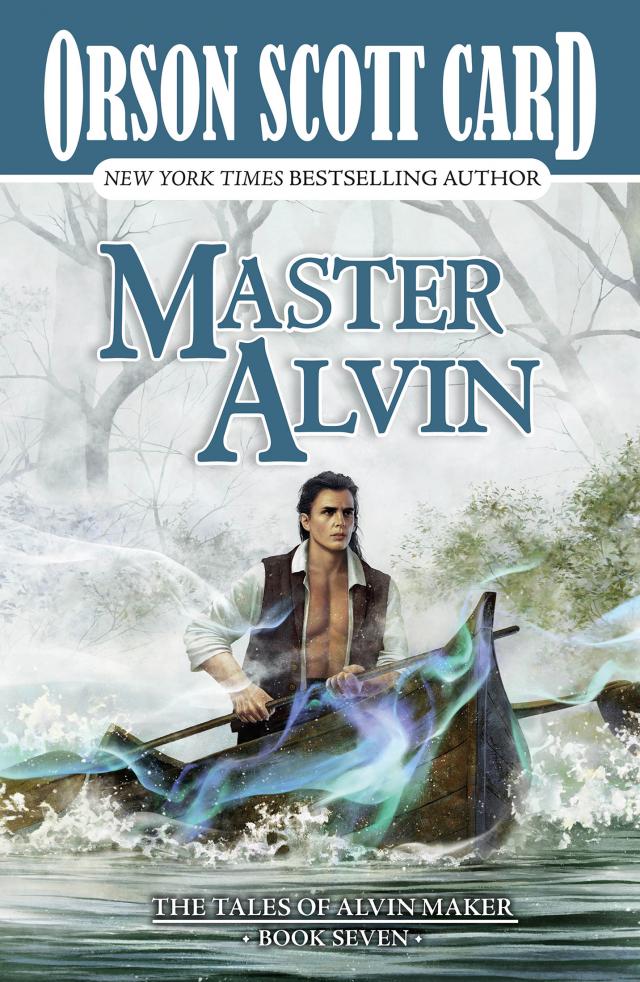
Master alvin, p.7
Master Alvin,
p.7


The six musketmen brought their horses to a stop six steps away from the Prophet. The men looked at the Prophet. The horses also, insofar as Alvin could tell where horses were looking. No one spoke.
The men dismounted—awkwardly, because they did not let go of their guns.
Still looking at the silent Prophet, three of them laid their guns in the grass at the Prophet’s feet.
The other three stood intransigent, their faces showing nothing, as was to be expected with Reds who had strong feelings. In this case, Alvin could guess shame at having been summoned to the leader of all tribes, and maybe fear, but more likely anger. Reds did not commonly make decisions based on fear, but on rage, that was far more common.
Tenskwa-Tawa merely looked at the three still holding their guns. There was no hint of the men preparing to aim or fire; they held the guns barrel-up, but their fingers were not within the trigger guard. Alvin recognized the make of the rifles—three from a Noisy River foundry with a poor reputation with their firearms, the others from an Irrakwa manufacturer whose muskets were fashioned with such precision and regularity that you could take any part from any musket of that make, and put it on any other musket, and it would fit as if it had been made for it. It was called the Mohican Foundry, though its owners and workers represented most of the Irrakwa tribes.
The guns on the ground were from Noisy River, and therefore had little resale value, thought Alvin. Few prosperous people would ever buy one new; nobody would buy one used, since they didn’t hold up well, and old ones were always closer and closer to the fizzle—or the explosion.
The guns still in their owners’ hands were from the Mohican Foundry, and Alvin was reasonably sure that they had been purchased rather than commandeered. They were an investment, and they had great value.
Finally one of the recusants spoke. “What will you do with our muskets?” he asked.
“When you lay them on the ground,” said Tenskwa-Tawa, “they will no longer be your muskets, and so you will have no more reason to be concerned with them.”
Alvin waited for one of the recusants to point a gun at the Prophet. None of them did. One of them laid down his very expensive musket in the grass and, hanging his head, he knelt in the grass before Tenskwa-Tawa.
“Let me see your face,” said Tenskwa-Tawa.
“The White man,” he said softly.
“This is Alvin Maker, my friend and savior,” said Tenskwa-Tawa. “There is no shame in his presence. He is me and I am him.”
The kneeling man raised his face toward the Prophet, not even glancing in Alvin’s direction.
“I will hear you,” said Tenskwa-Tawa.
“A great buffalo dragged my father from his horse and dragged him long enough that he died.”
“I knew your father,” said the Prophet. “A good man, a brave man, but also a stubborn man. Why didn’t he let go of the spear?”
“The spear was deep in the buffalo’s body, and I think my father might have imagined that the buffalo would weaken and stop.”
“As I heard it, the spear was only in the hump,” said Tenskwa-Tawa.
“The hump is pure muscle, the strongest of the buffalo’s meat,” said the kneeler, allowing himself to show a bit of pride in his knowledge.
“It is very strong,” said Tenskwa-Tawa, “which is why your father’s spear did not come loose. But it also does not contain any vital arteries or veins, so the buffalo that dragged your father was not seriously wounded. Your father would know this.”
The kneeler bowed his head again. “My father was very proud of that spear.”
“He died for it,” said Tenskwa-Tawa. “The buffalo who dragged him was killed later that day, and you were given the first choice of his meat. You refused to eat it.”
“The buffalo was the victor. Only the meat of the defeated may be eaten.”
There was a long silence. Nobody moved.
“My young friend,” said Tenskwa-Tawa, “I know you do not carry a musket because you fear a buffalo killing you or hurting you.”
No answer.
“Nor do you seek vengeance,” the Prophet continued.
Silence.
“Tell me why you spent so much to buy this fine weapon.”
“I earned the furs I traded,” said the kneeler. “They were mine to use as I wanted.”
“So you are without a clan?” asked Tenskwa-Tawa.
Silence.
Tenskwa-Tawa spoke to Alvin. “Everything we own belongs to the clan.”
“I have no clan,” said the kneeler.
“They weep for you every day,” said Tenskwa-Tawa.
“They should mourn me,” the kneeler said. “I died with my father, and I am now a ghost.”
The Prophet took a few strides forward and shoved the man by the shoulder. He toppled over into the grass, and made no effort to rise.
“You are a living man of flesh and blood and bone, but apparently very little brain. You will return to your clan, but speak to no one there. You will lie in your mother’s house like a dead man, saying nothing, eating nothing, drinking nothing, until you are truly dead, or until you decide you want to be alive and a part of your family, whereupon you may speak to your mother and beg her to forgive you. Then you will be alive again. And you will never touch a White weapon again as long as you live.”
The kneeler rose to his feet and walked toward his horse.
The horse shied away, then ambled toward the river.
The former rider walked off to the southwest.
“So he’s lost everything,” said Alvin.
“He lost his father, and stopped caring for anything. He will care again. He will belong again. He knows that his punishment is really his reward.”
Two men still held their muskets. Tenskwa-Tawa looked at them expectantly. Meanwhile, the three who had laid down their cheaper muskets followed the example of their companion, and knelt beside their guns.
“Did a buffalo kill your father? Someone you loved? A favorite horse?”
No one answered.
“Then you are not the same as Mud-in-the-Ear,” said Tenskwa-Tawa, “and you will not receive the same merciful judgment.”
Alvin wondered if it was wise to be threatening serious punishment while two men were still armed.
The Prophet called out to four of the men waiting nearby, who hurried to stand before him. “Take the guns from the ground,” said Tenskwa-Tawa. “Then take these three to the river and carry them across in the canoes you find there. When they are on the White side of the river, return their White weapons to them. Sell the Mohican musket for whatever a gunsmith will pay, and return with as many iron pots and long spoons as you can buy with the money.”
Tenskwa-Tawa turned to Alvin as the men walked away. “You wonder why I will buy pots and spoons of White manufacture. The reason is simple. Earthen pots break easily. Iron pots do not. Long spoons can reach to the bottom of those pots.”
Iron weapons were also less likely to break than bows and arrows and spears, Alvin thought. Then he understood the Prophet’s wisdom. He will use items of White manufacture if they have real value, and do no harm. Alvin nodded.
Two recusants still stood there holding Irrakwa muskets.
“You paid dearly for those weapons,” said the Prophet.
The recusants said nothing.
“They do not belong to you,” said the Prophet. “They belong to your clan.”
One of the men finally spoke. “My clan don’t want it.”
“Then no one in your clan may claim it,” said Tenskwa-Tawa. “That means that these fine Mohican muskets belong to all the people of the prairie and the mountains.”
A long moment of waiting.
At last one of the men threw his weapon to the ground. The other did the same. Then they stood expectantly. Alvin thought, They imagine that they, too, will have their weapons returned to them on the east side of the river.
“Now you have a choice, each of you separately. You can be exiled to the east side, the White lands, and you will never cross the Mizzippy again.”
The men said nothing.
“No, you will not have these fine weapons returned to you.”
The men still said nothing.
“Exile, or … you can remain on the Red side of the river. But you are dead to your own tribe and your own clan. They will never recognize you if they see you, or they will run from you as they would from a ghost. Instead, I will assign you to two different tribes and you will each be given to one of the clans to raise as a child who is not yet old enough to speak their language. You will learn the language of your new clan, and learn whatever skills they choose to teach you, and on a day they will bring you back before me to tell me you are ready to become a man—a man of that tribe, that clan.”
Did they understand how merciful Tenskwa-Tawa was being? thought Alvin. Maybe. These were not stupid men. They knew that if the Prophet had given the word, they would have been cudgeled to death within a minute. They were traitors, and they had known they were traitors when they brought the muskets across the river.
The men did not even look at each other. “I will stay,” said one. And the other said, “As a newborn child I will stay.”
“Not that young,” said the Prophet. “Your new clan needs you to be able to walk and feed yourself and carry out useful tasks. Do not imagine that you will be permitted to suckle at anyone’s pap.”
Then Alvin realized that Tenskwa-Tawa knew these two men. They were the kind who would try to turn every situation to their advantage, and find a way to subvert every rule. If they did not change, their new clans would never declare them fit to be men, and they would die as children.
Since Alvin lived on the White side of the river, he knew that exile was not such a bleak existence, especially for a Red who had already decided to adopt White ways. There would be Cherriky or Irrakwa who would take them in at first, till they could learn a trade. They would survive.
And if they stayed, they would still never return to their right families and clans.
Even so, the two of them walked away from the river. They were not going to go into exile. Maybe they would become loyal men of the West. Maybe they would stir up trouble or try to go east again. Maybe they would get themselves executed for treason after all. But Alvin thought that right now, at least, they thought they would easily learn the new language and be accepted by the nations as men before very long at all.
“Their horses?” asked Alvin.
The Prophet beckoned to one of the men-in-waiting. “The Pawnees are providing me with aides and escorts this year,” said Tenskwa-Tawa. “Nobody wants to tangle with a Pawnee, so they are invariably obeyed.”
“You gave them all choices,” said Alvin.
“They already made choices that could have cost them their freedom or their lives,” said the Prophet. “I dealt as kindly as I could within the range of choices they had given me.”
The Pawnee man the Prophet had summoned arrived.
“There are six horses here that belong to the prairie,” said Tenskwa-Tawa. “Take them to see which tribe they want to join, or whether they wish to fend for themselves on the open prairie.”
The Pawnee walked toward the horses, and they immediately shifted position to follow him. Not a word, not a sign was given.
“Those are very good horses,” said Tenskwa-Tawa. “Animals are not property. We don’t decide for them how they will live.”
“There must be a lot of free-range horses, then.”
“Some. Several herds. Most stay where humans make sure they are fed through the winter and train them to work and earn their living. The wild ones are always free to join us. The working horses are always free to go out on the prairie. Like many people, some poor horses can’t make up their minds.”
“I don’t understand,” said Alvin. “You control who crosses the river.”
“Reds are always free to move East, and Reds are always free to come West.”
“Even carrying White weaponry?” asked Alvin.
“If I make it so they don’t have the power to break the law,” said Tenskwa-Tawa, “then how is it a virtue for them to obey it?”
Alvin smiled a little. “I’m glad you called me here.”
Tenskwa-Tawa showed no emotion when he said, “I didn’t call you.”
“I saw myself crossing the river in the canoe you sent,” said Alvin.
“So the Crystal City called you.”
“Did it send me the canoe?” asked Alvin.
“That canoe goes where it’s needed,” said Tenskwa-Tawa. “It doesn’t consult with me.”
“Then why am I here?”
“Exactly my question, Alvin. Why are you here?”
6
ALVIN WAS CONFUSED, of course. If Tenskwa-Tawa had not called him, why did he see the images he saw in the crystal blocks? Why was it a vision of Tenskwa-Tawa? What purpose would be served by Alvin’s being on the western shore, with the Prophet, at this time?
Meanwhile, the Prophet seemed to think this was an opportunity to show Alvin Maker the West country, which Whites were no longer able to see. “I could take you to mountains that would make the Appalachees look like a child’s sand village at the beach.”
“When have you ever seen that?” asked Alvin.
“I wasn’t always the leader of a great people,” said Tenskwa-Tawa. “And White children are not the only ones who pile up sand.”
“I don’t think I’m here to see mountains,” said Alvin.
“Ah, but are you here to see mounds?”
“You know I’m familiar with Eight-Face Mound,” said Alvin, “because you took me there.”
“That was one kind of mound, true, and an important one. But that’s in the East now, and I won’t be returning to it soon. Maybe ever.”
“Show me whatever you want me to see, while we both try to figure out why I was sent here.”
It wasn’t a long walk, because the Greensong was immediately accessible on this side of the river. They ran and with little effort beyond sloshing through a half-dozen rivers and streams, they reached the mound that Tenskwa-Tawa wanted Alvin to see.
“All right, yes, this is something,” said Alvin.
It wasn’t that the edge of the mound was exceedingly high. On the contrary, it wasn’t quite as high as Alvin remembered Eight-Face Mound to have been. It was the mound’s breadth that was astonishing. “How big is this mound?” asked Alvin.
Tenskwa-Tawa smiled. “Come,” he said. Then he took Alvin’s hand, and together they walked up a ramp built into the side of the mound. It was easier than going straight up the face would have been, but it was still a steep climb, and there was no Greensong to help here, since absolutely nothing was growing on the steep slope.
“Why isn’t there any grass here?” asked Alvin. “And when it rains, why doesn’t this whole edge of the mound slide on down?”
“There are many strange things here. But I like to say to curious children like you, Alvin, ‘This mound was made for many purposes, but maybe growing grass was not one of them.’”
“You’re sure this mound was made? Couldn’t it be natural?”
“Oh, we know it was made, because our people made it. Carried every bit of this soil up from the riverside in baskets.”
“That must have taken—”
“Several years in the building, but the original mound was finished four hundred years ago.”
“Then how do you know—”
“Alvin, why do you think that nothing can be known without being written down? The songs of building Cahokia Mound are often sung, and memorized by young singers, so we can continue to remember our stories as they are sung to us. We have a history and we know it and treasure it because we have to work harder to keep it alive.”
“I agree, my assumption was wrong. Of course you know.”
“Cahokia Mound. Perhaps Whites would call it New Cahokia, to emphasize that it is not the original. But to us, it is Cahokia, the same place, simply relocated to the other side of the Mizzippy. Here we are.”
Alvin noticed that when he was dealing with Reds, the Prophet was taciturn, and when he spoke at all his messages were terse. Now, though, he was talking to Alvin like a White man would—almost garrulous with his information, and saying needless things like “Here we are,” a statement that is invariably true and almost invariably uninformative.
Then these thoughts faded, because now Alvin could see the scope and scale of Cahokia Mound. From east to west it had seemed very large. But now he could see north to south, and he could not detect the end of the mound to the south.
“How big—” asked Alvin.
“No one has measured it in White miles. Early White explorers—Spaniards, I think—who visited Cahokia about three hundred years ago, they had their estimate, but none of my people knew or cared what the numbers meant. What the people knew was that more than fifty thousand Reds lived in a dozen villages—no, towns, I know the difference. Not a tent city, but mud and daub buildings that remained winter after winter. Roads leading from town to town. Storehouses of maize to eat during winter, and pemmican and smoked buffalo meat. Whatever anybody needed, that we had, they could have it. No one could possibly be poor, because we all owned everything and nobody took more than their share.”
“How old are you?” asked Alvin.
“They were my people, so I say ‘we,’ but of course I wasn’t there. Remember that I know the stories. We all listen to the songs as if we were inside them. We are inside them. They are stories of us.”
“Fifty thousand?” asked Alvin. “There’s not a city that big in the White lands.”
“Nor is there a city that big here and now. So much space between villages. And not everybody stays. You can see some of the villages are abandoned. Look at the collapsed roofs, the tilting walls, the unused streets. But up ahead, see the smoke of the cookfires. That village is alive.”
“If the original was east of the river—”
“The mound is still there,” said Tenskwa-Tawa. “White people don’t usually notice it, because it’s so large. It’s just part of the landscape, a stretch of land higher than the surrounding prairie. It’s in what you call Noisy River country.”