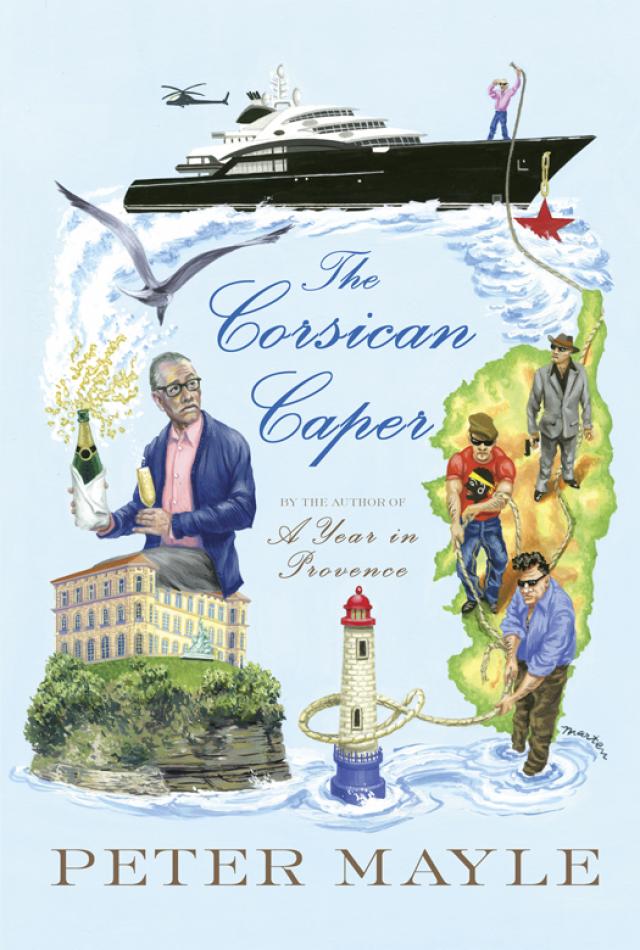
The corsican caper, p.1
The Corsican Caper,
p.1


ALSO BY PETER MAYLE
The Marseille Caper
The Vintage Caper
Provence A–Z
Confessions of a French Baker
(with Gerard Auzet)
A Good Year
French Lessons
Encore Provence
Chasing Cézanne
Anything Considered
A Dog’s Life
Hotel Pastis
Toujours Provence
A Year in Provence
These Are Borzoi Books
Published in New York by Alfred A. Knopf
THIS IS A BORZOI BOOK
PUBLISHED BY ALFRED A. KNOPF
Copyright © 2014 by Escargot Productions Ltd.
All rights reserved. Published in the United States by Alfred A. Knopf, a division of Random House LLC, New York, and in Canada by Random House of Canada Limited, Toronto, Penguin Random House companies.
www.aaknopf.com
Knopf, Borzoi Books, and the colophon are registered trademarks of Random House LLC.
This is a work of fiction. Names, characters, places, and incidents either are the product of the author’s imagination or are used fictitiously. Any resemblance to actual persons, living or dead, events, or locales is entirely coincidental.
Library of Congress Cataloging-in-Publication Data
Mayle, Peter.
The Corsican caper : a novel / Peter Mayle. — First Edition.
pages cm
ISBN 978-0-307-96286-7 (hardback) —
ISBN 978-0-307-96287-4 (ebook)
1. Real property—Fiction. 2. Provence (France)—Fiction.
I. Title.
PR6063.A8875C67 2014
823′.914—dc23 2013037049
Jacket illustration by Ruth Marten
Jacket design by Carol Devine Carson
v3.1
For Jennie, once more with feeling
Contents
Cover
Other Books by This Author
Title Page
Copyright
Dedication
Chapter One
Chapter Two
Chapter Three
Chapter Four
Chapter Five
Chapter Six
Chapter Seven
Chapter Eight
Chapter Nine
Chapter Ten
Chapter Eleven
Chapter Twelve
Chapter Thirteen
Chapter Fourteen
Chapter Fifteen
Chapter Sixteen
Chapter Seventeen
Chapter Eighteen
Chapter Nineteen
Chapter Twenty
A Note About the Author
Reading Group Guide
Chapter One
Francis Reboul sat in the sunshine, contemplating his breakfast: a shot glass of extra-virgin olive oil, which the French insist is so beneficial for le transit intestinal, followed by a large bowl of café crème and a croissant of such exquisite lightness that it threatened to float off the plate. He was sitting on his terrace, the shimmering sweep of the early morning Mediterranean stretching away to the horizon.
Life was good. Sam Levitt and Elena Morales, Reboul’s close friends and partners in past adventures, were arriving from California later in the day for an extended vacation. They had planned to sail around Corsica and perhaps down to Saint-Tropez then to spend some time at Reboul’s horse farm in the Camargue and to revisit some of Marseille’s excellent restaurants. It had been a year since they had seen one another—a busy year for them all—and there was a lot to catch up on.
Reboul put down his newspaper, squinting against the glare that bounced off the water. A couple of small sailboats were tacking their way toward the islands of Frioul. While he was watching them, Reboul’s attention was caught by something that was beginning to appear from behind the headland. It gradually became more visible, and bigger. Much bigger. It was, as he would later tell Sam, the mother of all yachts—three hundred feet if it was an inch, sleek and dark blue, with four decks, radar, the obligatory helicopter squatting on its pad in the stern, and not one but two Riva speedboats in tow.
It was now in front of Reboul, no more than three or four hundred yards offshore. It slowed, and drifted to a stop. A row of tiny figures appeared on the top deck, all gazing, it seemed to Reboul, directly at him. Over the years, he had become quite used to this kind of scrutiny from the sea. His house, Le Palais du Pharo, originally built for Napoleon III, was the biggest private residence in Marseille, and the most glamorous. Everything from one-man sailboats to the crowded local ferries had stopped, at one time or another, for a long, if distant, inspection of Chez Reboul. Telescopes, binoculars, cameras—he was used to them by now. He shrugged, and hid behind his newspaper.
On board the yacht, Oleg Vronsky—Oli to his friends and numerous hangers-on, and “The Barracuda” to the international business press—turned to Natasha, the statuesque young woman whom he had appointed his personal first mate for the voyage. “This is more like it,” he said. “Yes. This is more like it.” He smiled, making the deep, livid scar on his cheek pucker. Apart from that, he would have been a good-looking man. Although a little on the short side, he was slim, his thick gray hair was cut en brosse, and his eyes were that shade of icy blue often found in people from the frozen north.
He had spent the past week cruising along the Riviera coast, stopping off to look at properties on Cap Ferrat, Cap d’Antibes, Cannes, and Saint-Tropez. And he had been disappointed. He was prepared to spend serious money, fifty million euros or more, but he had seen nothing that made him want to reach for his wallet. There were some fine houses, certainly, but too close to one another. The Riviera had become crowded, that was the problem, and Vronsky was looking for plenty of space and maximum privacy—and no Russian neighbors. There were so many of them on Cap Ferrat nowadays that the more enterprising locals were taking Russian lessons and learning to like vodka.
Vronsky took a cell phone from his pocket and pressed the single button that connected him to Katya, his personal assistant. She had been with him before the billions, when he was no more than a lowly millionaire, and she was one of the very few people who had his absolute trust.
“Tell Johnny to come and see me on the top deck, would you? And tell him to get ready for a quick trip. Oh, have we heard back from London yet?” Vronsky was negotiating to buy an English football team from an Arab consortium, not the easiest group of people to deal with, and he was becoming impatient. Somewhat encouraged by Katya’s reply, he turned back to resume his inspection of Reboul’s property, pushing his sunglasses up onto his head and adjusting the focus of his binoculars. No doubt about it, the setting was superb, and it seemed, from what he could see, that there were ample grounds around the house, undoubtedly enough for a discreet helicopter pad. Vronsky felt the first stirrings of what would quickly develop into a full-scale lust to acquire.
“Where to, boss?” Johnny from Jamaica gave Vronsky the benefit of his wide white smile, a gleaming gash across his ebony face. During his time as a mercenary in Libya, he had learned to fly helicopters, a useful addition to his other skills with weapons and the finer points of unarmed combat. A good man to have on your side.
“A short hop, Johnny. A little reconnaissance. You’ll need a camera and someone who can use it.” Vronsky took the Jamaican’s arm and led him to a less crowded part of the deck.
Reboul dipped the final bite of his croissant into his coffee and looked up from his paper. The yacht was still there. He could see two figures in the stern busying themselves around the helicopter’s landing gear before climbing in, and then the rotor blades began to turn. He wondered idly where they were off to, and returned to the news of the day as reported in La Provence. Why was it that, even with the season long since over, journalists devoted so much space to football players and their antics? He sighed, put aside the paper, and picked up the Financial Times.
The noise was sudden and shocking. Flying low, the helicopter was heading directly toward him. It slowed, then hovered above the terrace before making a couple of circuits around the house and its gardens. As it tilted to make a turn, Reboul could see the long lens of a camera poking out of the side window. This was unacceptable. Reboul took out his phone and tapped in the number of the chief of police in Marseille, a friend.
“Hervé, it’s Francis. Sorry to bother you, but I’m being buzzed by some lunatic in a helicopter. He’s flying low and he’s taking photographs. Any chance of sending a Mirage jet over to discourage him?”
Hervé laughed. “How about an official helicopter? I can send one of the boys out now.”
But the intruding helicopter, with one final swoop over the terrace, was now on its way back to the yacht. “Don’t bother,” said Reboul. “He’s gone.”
“Did you see any of his registration markings?”
“No—I was too busy ducking. But he’s going back to a yacht that’s opposite the Pointe du Pharo, maybe heading for the Vieux Port. It’s a huge, dark-blue thing the size of a paquebot.”
“That won’t be too hard to find. I’ll look into it and get back to you.”
“Thanks, Hervé. Lunch next time is on me.”
Vronsky leaned over Katya as she connected the camera to her computer and brought up the first of the photographs. Like many rich and powerful men, his grasp of the details of modern technology was sketchy. “There,” said Katya, “just press this key to change the images.”
Vronsky peered at the scree
n in silence, his shoulders hunched in concentration. As one image followed another—the perfectly proportioned architecture, the immaculate gardens, the absence of close neighbors—he started nodding. Finally he sat back and smiled at Katya.
“Find out who owns that house. I want it.”
Chapter Two
“Reboul would never sell. It is well known from Marseille to Menton that he loves his house. And he doesn’t need the money. Désolé.” The speaker shrugged, and lit a cigarette with a gold lighter.
He was standing with Vronsky on the top deck of The Caspian Queen, which was paying a visit to the Cannes Film Festival. Vronsky’s yacht was moored offshore, well placed to appreciate the distant glitter of the Croisette. He had chosen to introduce himself to Cannes by giving a party on board, organized by his public relations company, and not a single invitation had been declined. It was a fairly typical gathering of the usual characters found at film festival events: thin, overtanned women; stout men with the pallor that comes from spending too much time in darkened screening rooms; starlets and would-be starlets; journalists; and one or two festival dignitaries—to add a slightly formal touch of local color. And, of course, the gentleman in the white silk dinner jacket who was now having a discreet conversation with Vronsky.
He was, so Vronsky had been assured, the most successful and well-connected real estate agent on the coast. In his early days, his name had been Vincent Schwarz. This he had changed, for professional reasons, to the Vicomte de Pertuis—a title he invented that had nothing to do with noble birth—and during twenty years as a self-promoted aristocrat he had gained a near stranglehold on the top end of the coastal property market. Vronsky, he had to admit, was a challenge. So far he had proved to be a difficult and demanding client, turning up his nose at properties from Monaco to Saint-Tropez. But the Vicomte, encouraged by the thought of the agent’s commission—a generous 5 percent—had persevered. Now, to his carefully concealed frustration, his client had found the house he wanted all by himself, without any professional help.
Circumstances like these demanded considerable finesse on the part of the Vicomte. He could scarcely expect 5 percent for merely supervising the transaction. Unforeseen difficulties and problems would have to be created—problems that could only be overcome by someone as experienced and wise in the ways of negotiation as the Vicomte. It was a principle that had worked for him several times in the past, and one which had prompted his negative response when Vronsky had asked him about Le Pharo.
“How do you know he doesn’t need the money?” Vronsky asked. His view was that there wasn’t a man alive who couldn’t be bought providing the price was right.
“Ah,” said the Vicomte, lowering his voice to little more than a whisper. “In my profession, one needs above all accurate information, the more private and personal the better.” He paused to nod, as if agreeing with himself. “I have spent years, many years, cultivating my sources. In fact, most of the properties I deal with never reach the open market. A word or two in the right ear, et voilà. A sale is made, always with the utmost discretion. My clients prefer it this way.”
“And you feel sure that the owner would never sell?”
Again the shrug. “That would be my opinion, in the absence of more detailed information.”
“And how do we get that?”
It was the question the Vicomte had been hoping for. “Of course, any inquiries would need to be carried out delicately, ideally by someone with a great deal of experience in these matters. Owners of important properties are never straightforward, often secretive, and sometimes dishonest. It takes someone with a shrewd eye and a keen nose to arrive at the truth.”
It was the answer Vronsky had been expecting. “Someone like you, perhaps?”
The Vicomte fluttered a modest hand. “I would be honored.”
And so it was agreed that the Vicomte would act as Vronsky’s ferret, gathering information about Le Pharo and its owner. The two of them could then work out a plan of action. With this settled, they returned to the party on the main deck, Vronsky to play the part of the gregarious host, the Vicomte to continue his efforts to persuade a tipsy film producer from Hollywood to buy a charming little penthouse in Cannes.
A hundred miles along the coast, another, much smaller party was taking place to welcome Elena and Sam, who had just arrived after spending a couple of days in Paris. Le Pharo was to be their base for the next three weeks, and Reboul had invited a few of the people whom Sam and Elena had met during a previous adventure in Marseille: the journalist Philippe Davin and his flame-haired girlfriend, Mimi; the redoubtable Daphne Perkins, this time without the nurse’s uniform she had worn so effectively when called upon to foil a kidnapping; and the well-connected Figatelli brothers, Flo and Jo, who had come over from Corsica for the evening.
Once the ritual hugs and kisses of renewed acquaintance had been observed, reminiscence began to flow. Daphne, Champagne flute in hand, little finger elegantly cocked, listened to Jo as he described the latest developments in the Corsican underworld. And then, taking advantage of a lull in the conversation, she asked, “Whatever happened to that ghastly man?”
As everyone there knew, she was referring to Lord Wapping, the unscrupulous and crooked tycoon who had very nearly managed, by arranging for Elena to be kidnapped, to get the better of Reboul in a business deal. Daphne turned to Philippe. “I’m sure you’ve been keeping up with the case. Is he in prison yet? Is a life sentence too much to hope for?”
“He’s not quite there yet,” said Philippe. “He’s using what we call the Serbian war-criminal defense—a sudden and unexpected life-threatening illness that prevents him from being cross-examined. He’s still holed up in a Marseille clinic, doing his best to look half-dead. The word is that he’s bribing one of the doctors. But they’ll get him in the end.”
Elena shuddered, remembering the events, and Sam put his arm around her. “Take it easy, sweetheart. That’s one guy we won’t be seeing again.”
The mood was lightened by Mimi, with a rather sheepish Philippe in tow. “Look,” she said to Elena, “he’s making an honest woman of me.” She giggled, and held out her left hand to show the engagement ring on her third finger. It was the signal for congratulations and enthusiastic embraces. Reboul proposed a toast. Sam proposed a toast. Each of the Figatelli brothers proposed a toast. They floated into dinner on a tide of Champagne.
When they were all seated, Reboul tapped his wineglass for silence. “Welcome, my friends, welcome to Marseille. It is truly a pleasure to see you all, this time under more relaxed circumstances.” He looked around the table, nodding at the smiling faces, before assuming a serious expression. “Now then, to business. Dinner tonight is a simple affair, but alternative arrangements can be made for anyone who is allergic to foie gras, rack of Sisteron lamb scented with rosemary, fresh goat cheeses, and tarte Tatin. Bon appétit!”
And with that, Reboul’s housekeeper, Claudine, appeared with the maid, Nanou, from Martinique, to start serving.
The food was too good to be rushed, as were the wines, the conversation, and finally the fond farewells. By the time Elena and Sam climbed the stairs and reached their top-floor suite it was almost two o’clock.
While Elena was busying herself in the dressing room, Sam strolled over to the floor-to-ceiling window, with its view of the pools of light scattered across the water of the Vieux Port. He wondered, not for the first time, what could induce otherwise sane adults to squeeze themselves into those tiny boats and endure discomfort and occasional danger on the heaving, unpredictable bosom of the sea. A sense of adventure? A desire to escape the cares of the world? Or was it just a refined form of masochism?
His musings were interrupted by the reappearance of Elena, her arms laden with the kind of expensive shopping bags that were sure to conceal even more expensive contents. “I wanted to show you what I bought in Paris while you were spoiling yourself with your shirt guy at Charvet,” she said. And she carefully laid out on the bed a selection of underwear that would have been enough to stock a small boutique: silk, of course, some items in black, some in a very pale shade of lavender, all of them looking as though the slightest breeze would blow them off the bed. “There’s this great little place on the Rue des Saints-Pères, Sabbia Rosa. Mimi calls it a girls’ outfitters.” She took a step backward and smiled at Sam, her head cocked. “What do you think?”