A bicycle built for brew, p.14
A Bicycle Built for Brew,
p.14
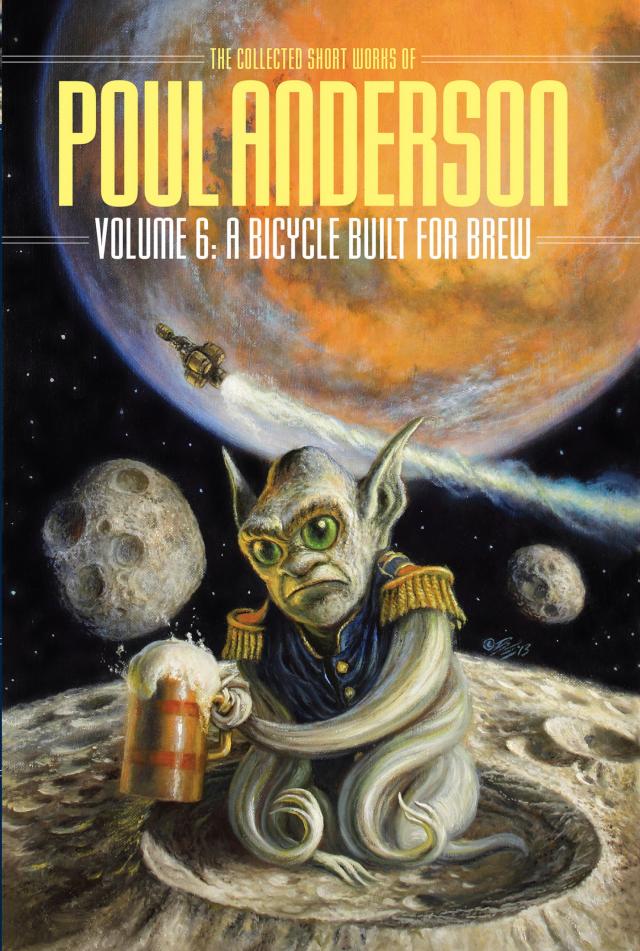


“No,” said Holger, “I’m from very far away. Where I come from, we reckon one man as good as the next.”
The little eyes regarded him from beneath shaggy brows. “An eldritch notion,” said Hugi at last. “Hoo’ll ye steer the realm if commons may sit to sup wi’ the gentle?”
“We manage. Everybody has a voice in the government.”
“But that canna be! ’Tis but a great babble then, and naught done.”
“We tried the other way for a long time, but kings were so often weak and foolish we thought we could hardly be worse off.”
“Hum, hum, ’tis vurra strange talk, though in truth— Why, it makes me think ye must be o’ the Chaos forces yeselves.”
“What do you mean?” asked Holger respectfully. “I know nothing of this land. Could you tell me something?”
He let the dwarf growl on for a long time without learning much. Hugi wasn’t very bright, and a backwoodsman to boot. Holger got the impression that there was a perpetual struggle between primeval forces of Law and Chaos. Humans, except for occasional witches and such-like, were, consciously or unconsciously, on the side of Law; the Middle World, which seemed to include such realms as Faerie, Trollheim, and the Giants, was with Chaos—was, indeed, a creation thereof. Wars among men, like that now being waged between the Saracens and the Holy Empire, were due to Chaos; under Law, all men would live in peace and order, but this was so alien to the Middle Worlders that they were forever working and scheming to prevent it and to extend their own shadowy dominion.
It sounded to Holger like the vague recollections he had of the old Persian religion; indeed this whole tale might well be purely religious or superstitious. He was more interested in the practical politics of this world, though Hugi wasn’t much help there either. He gathered that the lands of men, where Law was pretty firmly established, lay in the west: the major divisions of them seemed to be the Holy Empire of the Christians and the Saracen kingdoms south of it. The present reach of the Middle World started somewhere east of here, with Faerie closest to the realms of mankind. This immediate section was a disputed march where anything could happen.
“In olden time,” said Hugi, “there were all Chaos, see ye, but step by step ’tis been driven back. The greatest step was, as all know, when the Savior lived, for then naught o’ darkness could stand, and great Pan himsel’ died. But noo, ’tis said, Chaos has rallied and is ready to strike back. I dinna know.”
Hm. There was no chance just now to separate fact and fancy. But this world paralleled Holger’s own in so many ways that there must be a connection. Could it be that contact had been made from time to time, throughout the ages, and that the creatures of his world’s myth had a real existence here? Remembering some of those beings, Holger hoped not. He didn’t especially care to meet a fire-breathing dragon or a three-headed giant, interesting as they might be from a zoological standpoint.
Still—it was all so damnably real!
“Oh, by the way,” said Hugi. “ye’ll want t’ leave yer crucifix and iron at the gates, nor may ye speak holy words inside. The Faerie folk canna stand against such, but if ye use ’em they’ll find ways to send ye ill luck and ruin.”
Holger wondered what the status of an agnostic was here. He had been brought up a Lutheran, but hadn’t been inside a church for years. If this thing had to happen to somebody, it might have been safest for a good Catholic.
Hugi talked on. And on. And on. Holger tried to pay friendly attention, without overdoing it. Finally they got to telling stories, and he dug out all the off-color jokes he could remember. Hugi whooped.
They had stopped by a moss-banked stream for lunch when the dwarf suddenly leaned forward and put a hand on Holger’s arm. “Sir Knight,” he said, looking at the ground, “I’d do ye a good turn if ye wish.”
Holger restrained a shiver. “I could use one, thanks,” he said with a hard-held steadiness.
“I dinna know wha’ the best coorse be for ye. Mayhap ’tis to ride to Faerie e’en as the witch said, mayhap ’tis to turn tail richt noo. Nor have I any way to find oot. But there’s one I ken in the woods, a friend to all its dwellers, who’d know any news in the forest and could belike gi’ ye a rede.”
“If I could see him it would be a big help.”
“ ’Tis no a him, ’tis a her. I’d no take any other knight to her, for they’re all a lustful sort and she likes ’em little; but ye—well—I canna be an evil guide to ye.”
“Thank you, friend. If I can ever do you a service—”
“ ’Tis naught,” growled Hugi. “ ’Tis for ma ain honor I do ’t. And watch yer manners wi’ her, ye clumsy loon!”
-4-
It was several hours’ ride to the place they were seeking. Hugi spent most of the time talking about his exploits among the females of his species; Holger listened with one ear, pretending an awe which was certainly deserved if half the yarns were true. Mostly, though, he was lost in his own thoughts.
They were entering higher country, though Papillon seemed tireless. The forest was becoming more open, with broad meadows full of wild flowers and sunlight, gray lichenous boulders strewn between clumps of windy trees, now and then a wide view across hills rolling into purple distance. There were many streams here, hurrying down into the lower dales, leaping and flashing over green bluffs with rainbows caught in their foam. And there was much life: kingfishers like small blue thunderbolts, remotely hovering hawks and eagles, wild geese rising low from the edge of some reedy upland mere, a swiftly glimpsed rabbit or deer or bear. Overhead the sky was utterly blue, tall white clouds sweeping their shadows across the murmurous land, and the wind was fresh and cool in Holger’s face. He found himself rather enjoying the trip. Even the armor, which had dragged so heavily on him at first, was becoming like a part of him. And in some dim way, there was a—homeness—about this scene, as if he had known it once long before.
He tried to chase down that memory. Had it been in the Alps, or in Norway’s high sætere, or the mountain meadows around Rainier? No, it was more than just similarity. Almost, he knew these marches of Faerie. But the remembrance dodged back into the darkness of his mind, and he dismissed it as just another case of déjà vu.
Though if his transition here had taught him a new language, it was not unlikely it would have played other tricks with his brain. For a moment he had a wild idea that perhaps his mind had been transferred to another body. Then he looked down at his big golden haired hands, and reached up to touch the familiar dent in the bridge of his nose. No, he was still himself. And, incidentally, he was rather badly in need of a shave.
The sun was low when they crossed a final meadow and halted under trees on the shore of a lake. The water was broad, a sheet of sun-fire a mile across, fringed with rushes; a flock of wild ducks rose noisily at their approach. “We can wait here,” said Hugi. He slid nimbly to the grass and rubbed his buttocks, grimacing. “Oof, ma poor old backside!”
Holger dismounted as well, feeling a certain soreness himself. No reason to tether the dog-like Papillon; he looped the bridle up, and the stallion began contentedly cropping. “She’ll be here soon, belike,” rumbled Hugi. “ ’Tis her ain nest hereaboots. But while we wait, laddie, we could be refreshing ourselves.”
Holger took the hint and broke out the ale. “You still haven’t told me who ‘she’ is,” he said.
“ ’Tis Alianora, the swan-may.” Beer gurgled down the dwarf’s throat. “Hither and yon she flits, throughout the wood and e’en into the Middle World betimes, and the folk tell her o’ gossip. For she’s a dear friend unto all o’ us. Aaaaah! Old Mother Gerd, a witch she may be, but a brewmistress beyond compare!”
Papillon whinnied and reared. Turning, Holger saw a long form of spotted gold sliding down toward the lake. A leopard! His sword was out and aloft before he knew it.
“Nay, nay, hold.” Hugi tried to grab his arm, couldn’t reach far enough, and settled for his legs. “He comes in peace. He’ll no set on ye unless ye offer ill to the swan-may.”
The leopard flowed gracefully to a halt, sat down, and watched them with cool amber eyes. Holger sheathed his blade again, feeling sweat prickle on his skin. Just when these wilds were becoming familiar and understandable, something like this had to happen.
Wings beat overhead. “ ’Tis she!” cried Hugi. He jumped up and down, waving his arms. “Hallo, there, hallo, come on down!”
The swan fluttered to a halt a yard away. It was the biggest one Holger had ever seen. The evening light burned gold on its whiteness. He took an awkward step forward, wondering how you introduced yourself to a swan, and the bird flapped its wings and backed up.
“Nay, nay, be naught afeared, Alianora.” Hugi darted forward. “He’s a bra guid sire who’d but have speech wi’ ye.”
The swan stopped, poised a moment, and then spread its wings wide and stood on tiptoe. Its body lengthened, the neck shrank, the wings narrowed—“Jesus Kriste!” yelled Holger and crossed himself. It was a woman who stood there.
No—a girl. She couldn’t be over eighteen: a tall slender young shape, lithe and sun-browned, with coppery-brown hair flowing over her shoulders, huge gray eyes, a few freckles across a pert snub nose, a wide gentle mouth—why, she was beautiful! Almost without thought, Holger slipped his chin strap free and doffed helmet and cap and bowed to her.
She approached shyly, fluttering long sooty lashes. She wore only a brief sleeveless tunic that seemed to be woven of white feathers, and her bare feet were small and soundless in the grass. “So ’tis ye, Hugi,” she said, with more than a hint of the dwarf’s burr in her soft tones. “Welcome. And ye, Sir Knight, sith ye be friend to my friend.”
The leopard crouched, switching its tail and looking suspiciously at Holger. Alianora smiled and went over and chucked it under the chin. It rubbed against her legs, purring like a Diesel engine.
“This long lad hight Sir Holger,” said Hugi importantly. “And as ye see, yon be the swan-may hersel’. Shall we sup?”
“Why—” Holger sought for words. “It is a pleasure to meet you, my lady.” He was careful to use the formal pronoun; she was timid of him, and that leopard was still watching. “I hope we haven’t disturbed you.”
“Och, nay,” she said. Then, smiling and seeming to relax: “Nay, no at all. The pleasure be mine. I see so few new folk, sairly gallant knights.” There was no particular coquetry in her tone, she was just trying to match his own courtliness.
“Ah, let’s eat,” growled Hugi. “Ma belly’s a-scraping o’ ma backbone.”
They sat down by the lake. Alianora ripped the tough dark bread with her teeth as easily as the dwarf. Little was said until they had finished, when the sun was on the horizon and shadows very long. Then Alianora looked directly at Holger and said: “There be a man hunting for ye, Sir Knight. A Saracen. Is he friend o’ yours?”
“A Saracen!” Holger pulled his jaw up with a click. “I am a—stranger. I don’t know anyone here. There must be some mistake.”
“Mayhap there is,” said Alianora cautiously. “What brocht ye here unto me, though?”
Holger explained his difficulty. The girl frowned, a tiny crease between level brows. “Now that I fear I canna tell,” she murmured. “But ye move in darksome company, Sir Knight. Mother Gerd is not a good soul, and all know how tricky Duke Alfric be.”
“So you think I’d best not go to him?”
“I canna say.” She looked distressed. “I know naught o’ the high ones in Faerie. I only ken a few o’ the lesser folk in the Middle World, some kobolds and nixies, a werewolf or two, and the like.”
Holger blinked. There it went again. No sooner had he begun to believe he was sane, than off they were, speaking of the supernatural as if it were part of everyday.
Well—maybe it was, here. Damn it, he’d just seen a swan turn into a woman. Illusion or not, he didn’t think it was anything which could have happened in his own world.
The initial shock and its inward numbness was wearing off. He was beginning to realize, with his whole being, how far he was from home, how far and how alone. He clenched his fists together, trying not to curse or cry.
Remembrance. “What,” he asked slowly, “was it you said about a Saracen looking for me?”
“Oh, him.” The girl looked out across the twilit glimmer of the lake. “I’ve no seen him mysel’, but the woods be full o’ the tale, moles mumble it in their burrows and the badgers talk o’ ’t to the otters, and then the kingfisher and the crow get the word and cry it to all. It seems that for many weeks, now, a lone warrior, who must by his looks be a Saracen, has been riding about in these marches inquiring after a Christian knight he believes to be in these parts. He’s no said why he wanted the man, but the looks o’ him, as the Saracen tells ’em, are yours: a blond giant riding a black horse, and bearing arms o’ —” She glanced toward Papillon. “Nay, your shield is covered now. The arms he speaks o’ be three hearts and three lions.”
Holger stiffened. “I don’t know any Saracens,” he said thinly. “I don’t know anyone here. I come from further away than you know.”
“An enemy o’ yers, seeking ye oot to slay?” asked Hugi interestedly. “Or a friend, e’en?”
“I tell you I don’t know him!” Holger realized he was shouting. “Pardon me. I feel all at sea.”
Alianora widened her eyes. “All at sea—? Oh, aye.” Her chuckle was a sweet sound. “A pretty phrase.”
Somewhere in the back of his mind, Holger recorded the fact for future use that all the cliches of his world seemed to pass for new-coined wit here. But mostly he was busy thinking about this Saracen. Who the devil— The only Moslem he’d ever known had been that timid, bespectacled little Syrian at college: about as unknightly a character as you could find.
He must have made off with the horse and equipment of a man who, coincidentally, resembled him. That could mean real trouble later on. No point in seeking out the Moslem warrior—most certainly not!
A nihilistic mood of despair washed over him. “I’ll go to Faerie,” he said. “It seems to be my only chance.”
“And a chancy place it is for mortals,” said Alianora gravely. She leaned forward. “Which side be ye on? Law or Chaos?”
Holger hesitated. “Ha’ no fear,” she urged. “Here is peace for all beings.”
“Law. I guess,” he said slowly, “though I really know nothing of this wor—this land.”
“I thocht so,” said Alianora. “Well, I’m human too, and even if the minions o’ Law be often guzzling brutes, I think still I like their side better than Chaos. So I’ll gang along wi’ ye. It may be I can give some help in the Middle World.”
Holger started to protest, but she raised a slender hand. “Nay, nay, speak no of ’t. ’Tis small risk for me who can fly, and—” She laughed gaily. “And it could be a richt merry adventure, methinks!”
Night was coming, with stars and dew. Holger spread a blanket to sleep on, while Alianora went off saying she’d rather house in a tree. The man lay awake for a long lime, watching the constellations. They were all familiar, it was the summer sky of northern Europe up there. But how far was it to home? Or did distance have any meaning?
He recalled that when Alianora had changed into the human form, he had unthinkingly crossed himself, something he’d never done before in his life. Was it just the effect of this medieval environment, or was it part of the unconscious skills, language and riding and Lord knew what else, he had somehow gained? It was lonely, not even knowing yourself.
There were no mosquitoes here. For small blessings give praises. But he might have welcomed one, as a reminder of home.
Finally he slept.
-5-
They set out in the morning, Holger and Hugi on Papillon, Alianora flying overhead in the swan shape, curving and soaring and vanishing behind the trees to reappear again. The man’s spirits rose with the day; at least he was bound somewhere, and he seemed to be in good company. By noon they were high in the hills, a rough and windy land of great boulders, long harsh grass and gnarled copses, rushing waterfalls and deep shadowy ravines. It seemed to Holger that the eastern horizon was darker than it should be.
Hugi broke into tuneless and bawdy song. Holger, to match him, rendered such ballads as The Jolly Tinker and The Bastard King of England, translating with an ease that surprised himself. The dwarf guffawed till echoes rang around them. Holger was halfway through Les Trots Orfèvres when a shadow fell on him. Looking up, he saw that the swan was hovering overhead, listening with great interest. He choked.
“Eh, do go on, laddie,” urged Hugi. “ ’Tis a rare bouncy song.”
“I can’t remember the rest,” said Holger weakly.
He dreaded facing Alianora when they stopped for lunch. That was by a small thicket shielding a cave mouth. The girl came lightly toward him in human form, smiling. “Ye’ve a tuneful way with ye, Sir Holger,” she said.
“Um, yes, thank you,” he muttered, looking away.
“I would ye could recollect wha’ happened to the three goldsmiths,” she said. “ ’Tis rude to leave them there on the rooftop.”
He stole a look at her, but the gray eyes were wholly candid. Well, if she’d spent her life among the earthy little people— Still, he didn’t have the nerve. “I’ll try to remember,” he said falsely.
The brush rustled dryly behind them. Turning, Holger saw a creature emerge from the cave. At first he thought it was deformed, then he decided it must be a normal non-human development. The fellow stood a little taller than Hugi and much broader, with knotty arms hanging to his bent knees; the head was big and round, flat-nosed, with pointed cars and an enormous mouth; the skin was pale gray, and completely hairless. “Why, ’tis Unrich,” cried Alianora. “I thocht no ye denned this high in the hills.”
“Oh, Ay git aroon, Ay do.” The being hunkered down and regarded Holger with round eyes that were all black, no white about them. He wore only a leather apron, and there was a small hammer in his hand. “We-un bin a drayvin’ a new shaft thisaboots.” He waved at the stony landscape. “That’s gold in them thar hills.”