A bicycle built for brew, p.72
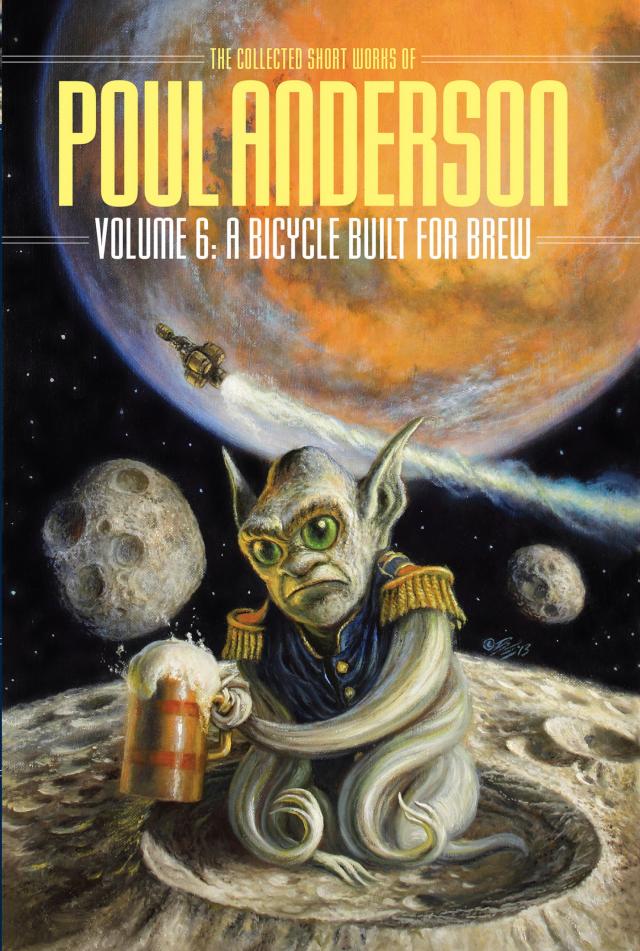
A Bicycle Built for Brew,
p.72


He was about to thumb the radiocom switch and put the instrument to his lips. Flandry said with great clearness and expression—rather proud of rendering it so well in Pulaoic—“Pillicock sat on Pillicock-hill: Halloo, halloo, loo loo!”
“What?” Warouw exclaimed.
“Take heed o’ the foul fiend,” cried Flandry: “obey thy parents; keep thy word justly; swear not; commit not with man’s sworn spouse; set not thy sweet heart on proud array. Tom’s acold.”
He twirled once around, laughing, and saw that he had all their eyes. A Guard made signs against evil. Another whispered, “He is going amok, tuan!”
The Terran flapped his arms. “This is the foul fiend Flibbertigibbet,” he crowed: “he begins at curfew, and walks till the first cock; he gives the web and the pin, squints the eye, and makes the hare-lip; mildews the white wheat, and hurts the poor creature of earth.” He burst into song:
“Swithold footed thrice the old;
He met the nightmare and her nine-fold—”
“Be still!” Warouw stuck the radiocom back in his pocket, advanced, and thrust expert fingers at Flandry’s solar plexus.
Flandry didn’t remain in the path of that blow. He tumbled on his back, just in front of the chief. His feet came up, hard, into the groin. As Warouw lurched forward on top of him, driven by the kick as much as the pain, Flandry got the man’s gun wrist between two arms and broke the blaster loose. No chance to use it—the effort sent it across the floor, out of reach.
He clutched Warouw against him, shouted, and wondered icily if the Guards would incinerate their own boss to get him.
The four sprang toward the grappling pair.
A rifle cracked at the rear window. A Guard fell backward, brains splashed from his skull. Tembesi fired again. One of the other Guards managed to shoot. Flame engulfed Tembesi. The whole rear wall went up in smoke and thunder. But even as the ecologist died, the room was exposed to outside view. Guns barked from a dozen surrounding boughs.
Flandry saw the last Guard crash to the boards. Fire sheeted up in the flimsy roof. He relaxed his hold on Warouw, preparatory to hustling the man out of the burning hut.
Warouw yanked his left arm free. His fist struck the angle of Flandry’s jaw.
For a moment, the Terran sagged among whirling ringing darknesses. Warouw scrambled clear of him, snatched up his blaster, and bounded to the doorway.
As he emerged, a voice from the leaves cried, “Halt where you are!” Warouw showed his teeth and fired full power into that foliage. The Tree man screamed and fell dead off his branch.
Warouw yanked the radiocom from his pocket. A gun spoke. The instrument shattered in his hand. He looked at his bleeding palm, wiped it, fired a thunderbolt in return, and sped for the ladder. Bullets smote the planks near his feet. The hunters hoped for a disabling shot. But they dared not risk killing him. The whole object had been to lure him here and take him alive.
As he reeled from the cabin, Flandry saw Warouw go over the platform edge. The Terran hefted the blaster he himself had picked up, drew a long breath, and forced clarity back into his head. Someone has to get him, he thought in an odd unemotional fashion, and as I’m the only one on my side who knows much about the care and feeding of spitguns, I seem elected.
He swarmed down the ladder. “Back!” he called, as supple bodies slipped along the branches on either side of him. “Follow me at a distance. Kill him if he kills me, but hold your fire otherwise.”
He set his weapon to full-power needle beam, gaining extreme range at the cost of narrowing his radius of destruction to a centimeter or so. If Warouw wasn’t quite as handy with pencil shots, there might be a chance to cripple him without suffering much harm from his own diffuse fire. Or there might not.
Down the holy Tree!
Flandry burst into view of the bough where Luang waited. Warouw confronted her and Kemul. Their hands were in the air; he had taken them by surprise. Warouw backed toward the next set of rungs. “Just keep your places and do not follow me,” he panted.
Flandry broke through the leaf cover overhead. Warouw saw him, whipped around and raised gun.
“Get him, Kemul!” shouted Luang.
The giant shoved her behind him and pounced.Warouw glimpsed the motion, turned back, saw the mugger’s gun not quite out of its holster, and fired. Red flame enveloped Kemul. He roared, once, and fell burning from the limb.
Having thus been given an extra few seconds, Flandry leaped off the bole rungs onto the bough. Warouw’s muzzle whirled back to meet him. Flandry’s blazed first. Warouw shrieked, lost his gun, and gaped at the hole drilled through his hand.
Flandry whistled. The riflemen of Ranau came and seized Nias Warouw.
-16-
Dusk once more. Flandry emerged from the house of Tembesi. Weariness lay heavy upon him.
Phosphor globes were kindling up and down the Tree Where the Ketjils Nest, and its sister Trees. Through the cool blue air, he could hear mothers call their children home. Men hailed each other, from branch to branch, until the voices of men and leaves and wind became one. The first stars quivered mistily in the east.
Flandry wanted silence for a while. He walked the length of the bough, and of lesser ones forking from it, until he stood on a narrow bifurcation. Leaves still closed his view on either hand, but he could look straight down to the ground, where night rose like a tide, and straight up to the stars.
He stood a time, not thinking of much. When a light footfall shivered the limb beneath him, it was something long expected.
“Hullo, Luang,” he said tonelessly.
She came to stand beside him, another slim shadow. “Well,” she said, “Kemul is buried now.”
“I wish I could have helped you,” said Flandry, “but—”
She sighed. “It was better this way. He always swore he would be content to end in a Swamp Town canal. If he must lie under a blossoming bush, I do not think he would want anyone but me there to wish him good rest.”
“I wonder why he came to my help.”
“I told him to.”
“And why did you do that?”
“I don’t know. We all do things without thinking, now and then. The thinking comes afterward. I will not let it hurt me.” She took his arm. Her hands were tense and unsteady. “Never mind Kemul. Since you have stopped working on him, I take it you have succeeded with Warouw?”
“Yes,” said Flandry.
“How did you do it? Torture?” she asked casually.
“Oh, no,” he said. “I didn’t even withhold medical care for his injuries: which are minor, anyhow. I simply explained that we had a cage for him if he didn’t cooperate. It took a few hours’ argument to convince him we meant it. Then he yielded. After all, he’s an able man. He can leave this planet—he’d better!—and start again elsewhere, and do rather well, I should think.”
“Do you mean to let him go?” she protested.
Flandry shrugged. “I had to make the choice as clear-cut as possible—between dying of the sickness, and starting afresh with a substantial cash stake. Though I wonder if the adventurous aspect of it didn’t appeal to him most, once I’d dangled a few exotic worlds before his imagination.”
“What of that carful of men out in the forest?”
“Warouw’s just called them on the dispenser’s radiocom, to come and get me. They’re to land on the airstrip—change of plan, he said. Djuanda, Siak, and some others are waiting there, with blasters in their hands and revenge in their hearts. It won’t be any problem.”
“And then what is to happen?”
“Tomorrow Warouw will call Biocontrol. He’ll explain that he has me secure, and that some of my co-conspirators spilled enough of what I’d told them for him to understand the situation pretty well. He and some Guards will take me in my own flitter to Spica, accompanied by another ship. En route he’ll hypnoprobe me and get the full details. Tentatively, his idea will be to sabotage the flitter, transfer to the other craft, and let mine crash with me aboard. Somewhat later, he and the Guards will land. They’ll tell the Imperial officials a carefully doctored story of my visit, say they’re returning what they believe was a courtesy call, and be duly shocked to learn of my ‘accidental’ death. In the course of all this, they’ll drop enough false information to convince everyone that Unan Besar is a dreary place with no trade possibilities worth mentioning.”
“I see,” nodded the girl. “You only sketched the idea to me before. Of course, the ‘Guards’ will be Ranau men, in uniforms lifted from the car crew; and they will actually be watching Warouw every second, rather than you. But do you really think it can be done without rousing suspicion?”
“I know damn well it can,” said Flandry, “because Warouw has been promised the cage if Biocontrol does sabotage the Central prematurely. He’ll cooperate! Also, remember what slobs the Guard Corps are. A half-witted horse could cheat them at pinochle. Bandang and the other governors shouldn’t be hard to diddle either, with their own trusted Nias Warouw assuring them everything is lovely.”
“When will you come back?” she asked.
“I don’t know. Not for a good many days. We’ll take along enough scientific material for the antitoxin to be synthesized, of course…and enough other stuff to convince the Imperial entrepreneurs that Unan Besar is worth their attention. A large supply of pills will have to be made ready, ships and ships full. Because naturally Biocontrol Central will be destroyed when they arrive, by some idiot like Genseng. But the merchant fleet will know where all the dispensaries are, and be ready to supply each one instantly. It will all take a while to prepare, though.”
Flandry sought yellow Spica in the sky, which was now quickening with stars. Here they called Spica the Golden Lotus, doubtless very poetic and so on. But he felt his own depression and tiredness slide away as he thought of its colony planet, bright lights, smooth powerful machines, sky-high towers—his kind of world! And afterward there would be Home…
Luang sensed it in him. She gripped his arm and said almost in terror: “You will come back, will you not? You will not just leave everything to those merchants?”
“What?” He came startled out of his reverie. “Oh. I see. Well, honestly, darling, you’ve nothing to be afraid of. The transition may be a little violent here and there. But you’re welcome to remain at Ranau, where things will stay peaceful, until you feel like a triumphal return to Kompong Timur. Or like getting passage to the Imperial planets—”
“I don’t care about that!” she cried. “I want your oath you will return with the fleet.”
“Well—” He capitulated. “All right. I’ll come back for a while.”
“And afterward?”
“Look here,” he said, alarmed, “I’m as mossless a stone as you’ll find in a universe of rolling. I mean, well, if I tried to stay put anywhere, I’d be eating my fingernails in thirty days and eating the carpet in half a year. And, uh, my work isn’t such that any, well, any untrained person could—”
“Oh, never mind.” She let his arm go. Her voice was flat among the leaves. “It doesn’t matter. You need not return at all, Dominic.”
“I said I’d do that much,” he protested rather feebly.
“It doesn’t matter,” she repeated. “I never asked for more than a man could give.”
She left him. He stared after her. It was hard to tell in the dimness, but he thought she bore her head high. Almost, he followed, but as she vanished among leaves and shadows he decided it was best not to. He stood for a time under the stars, breathing the night wind. Then faintly across ten kilometers, he heard the crash and saw the flare of guns.
Acknowledgments
Special thanks to Astrid Anderson Bear for her introduction to the book and Karen Anderson who provided another nifty picture of Poul Anderson—
—And thanks to the New England Science Fiction Association (NESFA) Inc. for its support in bringing classic science fiction back in print.
The original hardcover was made possible by help from many people:
Proofreading was done by David Anderson, Ann Broomhead, Jack Butterworth, Lis Carey, Gay Ellen Dennett, Dave Grubbs, Lisa Hertel, Rick Katze, Mike Kerpan, Patricia Morgan Lang, Suford Lewis, Tony Lewis, Paula Lieberman, Mark Olson, Priscilla Olson, Joe Ross, Jean Rossner, Sharon Sbarsky, and Tim Szczesuil.
Technical help was provided by Dave Grubbs and Alice Lewis.
Alice Lewis produced the dust jacket.
The ebook edition of this book was additionally proofed by Dave Grubbs, Chip Hitchcock, Robert Luoma, Jim Mann, and Wes Brodsky.
NESFA’s Choice books are proposed by a member of NESFA and created by NESFA members. They are intended to remain in print.
Visit www.nesfapress.org for a complete list of NESFA books and how to order them online.
NESFA editors
Hardcover Edition: July, 2014
Ebook Edition: November 2021
Sources
“My Father, Poul Anderson” by Astrid Anderson Bear, is original to this volume.
“A Bicycle Built for Brew” first appeared in Astounding Science Fiction, November-December 1958. It was reprinted in Ace Double, F-139, under the title The Makeshift Rocket.
“Three Hearts and Three Lions” first appeared in The Magazine of Fantasy & Science Fiction, September-October 1953. An expanded version was also published by Doubleday & Co.
“The Snows of Ganymede” first appeared in Startling Stories, Winter 1955. It was reprinted in Ace Double, D-303.
“Territory” first appeared in Analog Science Fiction / Science Fact, June 1963.
“The Sensitive Man” first appeared in Fantastic Universe Science Fiction, January 1954.
“Silent Victory” first appeared in Two Complete Science Fiction Adventure Books, Winter 1953. It was reprinted in Ace Double, D-335, under the title The War of Two Worlds.
“The Three-Cornered Wheel” first appeared in Analog Science Fiction / Science Fact, October 1963.
“A Plague of Masters” first appeared in Fantastic, December-January 1960-1961. It was reprinted in Ace Double, D-479, under the title Earthman, Go Home. Baen Books published the story under the title The Plague of Masters.
The New England Science Fiction Association
NESFA is an all-volunteer, non-profit organization of science fiction and fantasy fans. Besides publishing, our activities include running Boskone (New England’s oldest SF convention) every February, producing a monthly newsletter, holding discussion groups on topics related to the field, and hosting a variety of social events. If you are interested in learning more about us, we would like to hear from you. Contact us at info@nesfa.org.
from
Nesfa Press
www.nesfapress.org
The Grimm Future
Erin Underwood, editor
Blending fresh new science fiction with a futuristic dash of magic, The Grimm Future is a unique anthology of reconceived Grimms' Fairy Tales from some of today’s most exciting authors.
“The Grimm Future contains some of the most surprising, innovative retellings of fairy tales that I’ve yet had the pleasure to read. The mix of authors and the range of stories is perfect. Don’t miss this book.”
—Terri Windling, award-winning author of The Wood Wife
$6.95 ebook | $35 hardcover
Conspiracy!
Judith K. Dial & Thomas A. Easton, editors
Did you know that there is a secret government agency dedicated to creating conspiracy theories? It’s true! It’s on Facebook!
Stories from Allen M. Steele, Sarah Smith, Cat Rambo & Mike Resnick, Dave L. Clements, James L. Cambias, Jeff Hecht, Rev DiCerto, Paul Di Filippo, H. Paul Shuch, Shariann Lewitt, Debra Doyle & James D. Macdonald, and Steven Popkes.
$5.95 ebook | $17 trade paper
Making Book
by Teresa Nielsen Hayden
Making Book is an astonishing, Hugo-nominated collection of essays. It's far easier to quote some of the comments about it than to describe it:
“Making Book is like a tea party with E. B. White, Dorothy Parker, and M. F. K. Fisher …. Teresa Nielsen Hayden is smart, funny, satirical, sensitive—a treasure of an essayist.”
—Emma Bull
“An orrery of a book, all bright shiny bits whirling about and just when you think it's all random it clicks and you can see that the prose precesses with the drunken grandeur of a Galilean moon.”
—Steven Gould
“Making Book is delightful. Also insightful, erudite, laugh-out-loud funny, and more than a little dangerous.”
—Beth Meacham and Tappan King
$6.95 ebook | $14 trade paper
Making Conversation
by Teresa Nielsen Hayden
Making Conversation is a companion to the author's earlier Making Book. In its pages, it contains 59 essays (long and short) about time, space, genre, editing, gardening, saints, libraries, food, democracy, drink, insanity, fear, hamsters, chaos, moderation, palimpsests, fanfic, clichés, books, slush, spelling, scams, sleep, fantasy, policing, infundibula, trolls, writing, knitting, fandom, habaneros, exposition, management, Selectrics, Brooklyn, literary agents, pygmy mammoths, and the true cure for scurvy.
$6.95 ebook | $15 trade paper