A bicycle built for brew, p.64
A Bicycle Built for Brew,
p.64
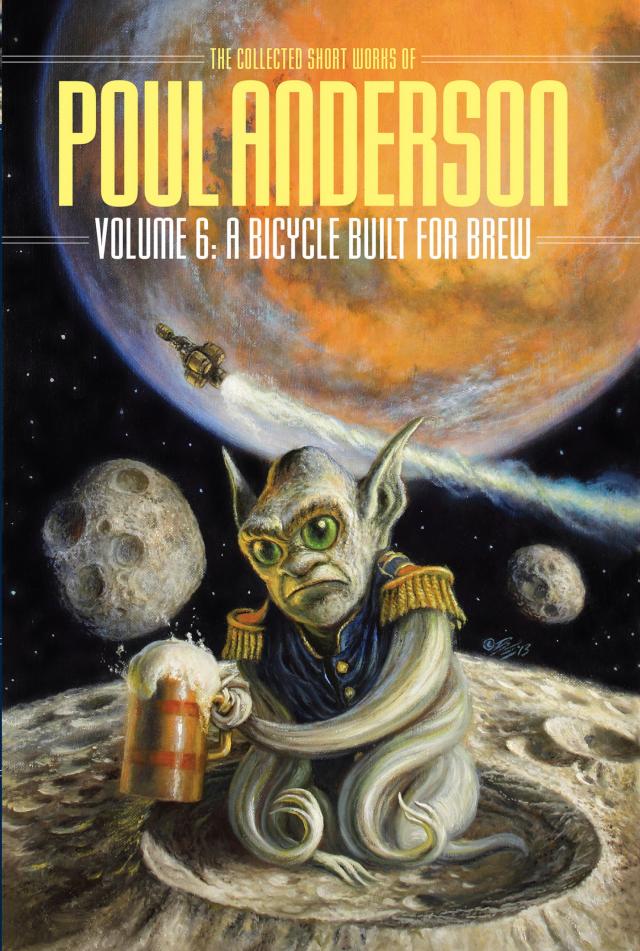


Kemul shook his head till the gray hair swirled. “No! Kemul doesn’t have it badly, the way things are. Not badly enough to risk the cage for helping you. Kemul says turn him in, Luang.”
The girl studied Flandry for a long minute. Her face was not readable. “How would you get off this planet?” she asked.
“Details.” Flandry waved a hand in an airy gesture.
“I thought so. If you don’t know, how can we? Why should we hazard anything, least of all our lives?”
“Well—” Flandry flexed his arms, trying to work out some of the tension that stiffened them and made his voice come out not quite natural. “Well, we can discuss that later.”
She blew smoke. “For you,” she said, “will there be a later?”
He donned the smile which had bowled over female hearts from Scotha to Antares. “If you wish it, my lady.”
She shrugged. “I might. If you make it worth the risk and trouble. But Kemul already took everything you were carrying. What can you buy your next thirty days with?”
That was a good question.
-6-
The part of Swamp Town between Lotus Flower Canal, the great spice warehouse of Barati & Sons, the Canal of the Drowned Drunkard, and those miserable tenement rafts where Kompong Timur faded into unreclaimed watery wastes was ruled by Sumu the Fat. Which is to say, every resident with a noticeable income—artisan, rentier, joy girl, bazaar keeper, freight hauler, priest, wizard, coiner, et multifarious cetera—paid regular tribute to him. It was shrewdly calculated according to ability to pay, so no one resented it dangerously. Sumu even made some return. His bully boys kept rival gangs out of the district; sometimes they caught lone-wolf robbers and made examples of them. He was an excellent fence for goods stolen from other parts of town. With his connections, he could even help a legitimate merchant make an extra profit, or find a buyer for the daughter of some impoverished man who didn’t know where his next pill was coming from. In such cases, Sumu didn’t charge an exorbitant commission. He offered rough-and-ready justice to those who wanted to lay their quarrels before him. Every year at the Feast of Lanterns, he bore the whole expense of decorating the quarter and went about giving candy to small children.
In short, he was hated no more than any other overlord would have been.
Wherefore Sumu’s man Pradjung, making his regular rounds to collect the tribute, was distressed to hear that a new storyteller had been operating on Indramadju Square for two whole days without so much as a by-your-leave.
Pradjung, who was of ordinary size but notoriously good with a knife, went thither. It was a clear day. The sun stood high and white in a pale sky. Sheet metal walls, canal water, even thatch and wood cast back its radiance until all things swam in that fierce light, wavered with heat haze but threw hard blue shadows. Far off above the roofs, Biocontrol Pagoda reared as if molten, too dazzling to look at. Sound of squalling voices and rumbling motors seemed baked out of the air; women squatted in doorways nursing their babies and gasping. As he hurried past the booths of listless potters, Pradjung heard his own sandals go slap-slap on planks where tar bubbled.
He crossed a suspension bridge to the hummock where Indramadju Square had been constructed, so long ago that the stone dragons on the central fountain were weathered into pug dogs. The fountain was dry, its plumbing had been stolen generations back, but fruit and vegetable vendors from the outlying paddy-farms still brought their produce here to sell. Their booths surrounded the square with thatch and tiny red flags. Because it was cooler here than many other places, and the chance of stealing an occasional modjo not too bad, children and idlers could always be found by the score. Which made it a good location for storytellers.
The new one sat under the basin. He had the usual fan in one hand and the usual bowl set out for contributions. But nothing else about him was normal. Pradjung must push through a crowd six deep before he could even see the man.
Then he gaped. He had never known anyone like this. The fellow was tall, reasonably young, and very well-muscled. But his skin was pale, his face long, his nose a jutting beak, his eyes deepset and of altogether wrong shape. He had hair on his upper lip, which was uncommon but not unknown; however, this mustache was brown, like the close-cropped hair peeping from beneath his turban. He spoke with a strong, unidentifiable accent, and had none of the traditional storyteller mannerisms. Yet he was outrageously at ease.
Which well he might be, for he spoke not of the Silver Bird or Polesotechnarch Van Rijn or any ancient themes known everywhere by heart. He told new stories, most of them indecent and all impudently funny. The crowd shrieked laughter.
“—Now after this long and mighty career, warring in the air for his country, Pierre the Fortunate was granted leave to come home and rest. No honor, no reward was considered too great for this prince among pilots.” The storyteller glanced modestly downward. “But I am a poor man, O gentle and generous people. Weariness overwhelms me.”
Money tinkled into his bowl. After pouring it into a bulging purse, the storyteller leaned back, lit a cigarette, swigged from a wineskin, and resumed: “The home of Pierre the Fortunate was called Paris and was the richest, most beautiful of cities. There, and there alone, had men altogether mastered the arts of pleasure: not mere wallowing in quantity, but the most subtle refinements, the most elegant and delicious accompaniments. For example, the tale is told of a stranger from an uncouth land called Texas, who was visiting in Paris—”
“Hold!”
Pradjung muscled past the inner circle and confronted the newcomer. He heard a growl behind him, and touched his knife. The noise subsided to angry mutters. A few people on the fringes began to drift away, elaborately inconspicuous.
“What is your name, stranger, and where are you from?” snapped Pradjung.
The storyteller looked up. His eyes were an eerie gray color.
“That’s no way to begin a friendship,” he reproved.
Pradjung flushed. “Do you know where you are? This is Sumu’s territory, may his progeny people the universe. Who told an outland wretch like you to set up shop?”
“None told me not to.”
The answer was soft enough for Pradjung to concede—after all, the storyteller was earning at a rate which promised a good rakeoff—“New arrivals of good will are never unwelcome. But my master Sumu must decide. He will surely fine you for not coming to him at once. But if you are courteous to him and—ahem!—his faithful men, I do not think he will have you beaten.”
“Dear me, I hope not.” The storyteller rose to his feet. “Come, then, take me to your leader.”
“You could show his men the politeness they deserve, and gain friends,” Pradjung said, glancing at the full purse.
“Of course.” The storyteller raised his wineskin. “Your very good health, sir.” He took a long drink and hung the skin on his back.
“What of our story?” cried some rustic, too indignant to remember Pradjung’s knife.
“I fear I am interrupted,” said the stranger.
The crowd made a sullen way. Pradjung was feeling surly enough himself, now, but held his peace. Wait till they came to Sumu.
The great man dwelt in a wooden house unpretentious on the outside, except for its dimensions and the scarfaced guards at every door. But the interior was so full of furniture, drapes, rugs, incense burners, caged songbirds, aquaria, and assorted crockery that you could easily get lost. The harem wing was said to possess a hundred inmates, though not always the same hundred. What most impressed a visitor was the air conditioning system, bought at fabulous expense in the palace section of town.
Sumu lolled in a silkite campaign chair, riffling through some papers with one hand and scratching his belly with the other. A pot of sweet black herb tea and a bowl of cookies stood in easy reach. Two daggermen squatted behind him, and he personally packed a gun. It was an archaic snubnosed chemical weapon throwing lead slugs, but it would kill you as dead as any blaster.
“Well?” Sumu raised his bulldog face and blinked nearsightedly.
Pradjung shoved the storyteller forward with a rough hand. “This outland sarwin has been narrating on Indramadju for two days, tuan. See how plump his purse has grown! But when I asked him to come pay his respects to my noblest of masters, he refused with vile oaths until I compelled him at dagger point.”
Sumu peered at the stranger and inquired mildly, “What is your name, and where are you from?”
“Dominic is my name.” The tall man shifted in Pradjung’s grip, as if uneasy.
“A harsh sound. But I asked where you were from.”
“Pegunungan Gradjugang—ouch!— It lies beyond the Tindjil Ocean.”
“Ah. So.” Sumu nodded wisely. One knew little about the dwellers on other continents. Their overlords sometimes came here, but only by air and only to visit the overlords of Kompong Timur. Poor folk rarely traveled far. One heard that strange ways of life had grown up under alien conditions. Doubtless generations of poor diet and insufficient sunlight had bleached this man’s people. “Why did you not seek me out as soon as you arrived? Anyone could have told you where I live.”
“I did not know the rule,” said Dominic pettishly. “I thought I was free to earn a few honest coins.”
“More than a few, I see,” Sumu corrected. “And is it honest to deny me my right? Well, ignorance may pass for an excuse this time. Let us count what you have gotten thus far today. Then we can decide on a proper weekly sum for you to contribute, as well as the fine for not reporting immediately.”
Pradjung grinned and snatched after Dominic’s purse. The tall man stepped back and cast it himself into Sumu’s lap. “Here, tuan,” he exclaimed. “Don’t trust this ugly man. He has reptile eyes. Count the coins yourself. But this is not one day’s take. It’s two days, yes, and a good part of one night. Ask in the square. They’ll tell you how long I worked.”
“Will they tell how much else you have hidden about you, begetter of worms?” sneered Pradjung. “Off with your garments! A fortune could lie in that turban.”
Dominic backed further. Pradjung signaled to the daggermen, who closed in on the storyteller and seized his arms. As he went to his knees, lest bones break, Pradjung kicked him in the stomach. “Strip,” said Pradjung. Sumu continued sorting coins into his sarong.
Dominic groaned. There proved to be nothing in his kilt except himself, but wound into the turban was a package. Pradjung unfolded it before Sumu’s eyes. An awed silence fell on the room.
The wrapping was a blouse: some fabric hitherto unheard of, colored like the palest dawn, fine enough to fold into cubic centimeters but utterly wrinkleproof. Inside the package lay a multiple-dialed watch of incredibly beautiful workmanship, and a wallet not made from leather or any recognized plastic. The wallet held cards and money, whose papery substance was equally strange, whose engraving was lovely but whose legends were in a peculiar form of the alphabet and an altogether foreign language.
-7-
Sumu made a sign against evil. “Nine sticks of incense to the gods at Ratu Temple!” He swung on Dominic, who had been released and knelt shuddering. “Well?”
“Tuan!” Dominic flopped on his face. “Tuan, take all my cash!” he wailed. “I am a poor man and the humblest of your slaves. Give me back those valueless trinkets bequeathed me by my poor old mother!”
“Valueless, I think not.” Sumu mopped the sweat of excitement from his forehead. “We shall have a little truth out of you, storyteller.”
“Before the Three Headed One himself, you have the truth!”
“Come now,” said Sumu in his kindliest tone. “I am not cruel. I should not like to have you questioned. Especially since I would have to entrust the questioning to Pradjung, who seems to have taken a dislike to you.”
Pradjung licked his lips. “I know these stubborn cases, mighty master,” he said. “It may take me a while. But he will still be able to talk when he decides to. Come along, you!”
“Wait, wait, wait,” said Sumu. “Not that quickly. Give him a few swats of the cane across his feet and see if his tongue loosens. Every man deserves a chance to be heard, Pradjung.”
Dominic beat his brow against the floor. “It is a family secret, nothing but a family secret,” he begged. “Your nobleness could not profit by hearing it.”
“If that is so, rest assured I shall keep your secret inviolate,” promised Sumu magnanimously. “Anyone here who cannot keep a secret goes straight into the canal.”
Pradjung, who saw an opportunity slipping past, seized the bastinado and applied it. Dominic cried out. Sumu told Pradjung to stop, and offered Dominic wine.
Eventually the story came out.
“My brother George found the ship,” Dominic said between gulps for air and gulps of drink. His hands trembled. “He was a timber cruiser, and often went far into the mountains. In one deep, misty ravine, he found a spaceship.”
“A ship from the stars?” Sumu made violent signs and promised another dozen joss sticks. He had heard of the Betelgeuseans, of course, in a vague way, and even seen a few of their goods. But nonetheless he bore a childhood of myth about the Ancestors, the Stars, and the Monsters, which a sketchy education had not removed.
“Just so, tuan. I do not know if the vessel came from the Red Star, whence they say Biocontrol receives visitors on certain nights, or from some other. It might even have been from Mother Terra, for this shirt fits me. It must have crashed out of control long ago, long ago. Jungle had covered it, but could not destroy the metal. Wild animals laired within. Doubtless they had eaten the bones of the crew, but they could not open the hatches to the holds. Those were not locked, however, only dogged shut. So my brother George went down and saw wonders beyond reckoning—”
It took half an hour to elaborate on the wonders.
“Of course, he could not carry such things on his back,” said Dominic. “He took only these articles, for proof, and returned home. It was his thought that he and I should raise enough money somehow for vehicles to get the cargo out. How, I knew not, for we were poor. But surely we would never tell our overlord, who would take all the treasure for himself! Long we discussed the matter in secret. George never told me where the ship lay.” Dominic sighed. “He knew me well. I am not a resolute man. The secret was safest with him.”
“Well?” Sumu dithered in his chair. “Well? What happened?”
“Ah, what happens all too often to poor folk. I was a tenant farmer of Proprietor Kepuluk. George, as I told you, was a timber cruiser for the master’s lumbering operations. Because of our scheming to get money, we neglected our work. Frequently our overseers reproved us with a touch of the electro-stick. But the dream we had would not let us rest in peace. George was at last dismissed. He brought his family to live with me. But my plot of ground was so small it would barely support my own wife and children. We went swiftly into debt to Proprietor Kepuluk. George had a young and beautiful wife, whom Kepuluk seized for the debt. Then George went amok and fell upon Kepuluk. It took six men to drag him away.”
“So Djordju is dead?” cried an appalled Sumu.
“No. He was sentenced to enslavement. Now he toils as a field hand on one of Kepuluk’s plantations. Of course, my farm was taken from me, and I must make my way as best I could. I found places for the women and children, then set out alone.”
“Why?” demanded Sumu.
“What was there for me in Pegunungan Gradjugang, except a lifetime’s toil for barely enough wages to buy my pills? I had always had a talent for storytelling, so I yarned my way to the ocean. There I got a scullery job on a watership bound for this continent. From Tandjung Port I came afoot to Kompong Timur. Here, I thought, I could make a living—even save a little money—and inquire with great discretion, until at last—”
“Yes? Yes? Speak up!”
Pradjung reached for the cane again, but Sumu waved him back. Dominic sighed heartbreakingly. “My tale is ended, tuan.”
“But your plan! What is it?”
“Ah, the gods hate me. It seemed easy enough, once. I would find a patron, a kind man who would not begrudge me a good payment and a position in his household, in exchange for what I could tell him. He must be rich, of course. Rich enough to buy George from Kepuluk and outfit an expedition under George’s guidance. Oh, my lord”—Dominic lifted streaming eyes—“do you perchance know of some wealthy man who would listen to my tale? If you could arrange it for me, I would reward you with half of what I was paid myself.”
“Be still,” commanded Sumu.
He lay back in his chair, thinking furiously. In the end: “Perhaps your luck has turned, Dominic. I have some small savings of my own, and am always ready to venture what I can afford in the hope of an honest profit.”
“Oh, my lord!”
“You need not kiss my feet yet. I have made no promises. But let us take our ease and share a midday meal. Afterward we can talk further.”
The talk stretched on. Sumu had learned caution. But Dominic had answers for all questions. “I have had two years now, largest of masters, to think this out.”
An expedition into the mountains would be costly. It should not be outfitted here in Kompong Timur. That would not only add the expense of transporting equipment across the ocean, but would attract far too much notice. (Sumu agreed. Some palace-dwelling sarwin like Nias Warouw would hear about it, investigate, and claim a major share of the loot.) Nor was it a good idea to use the primitive banking facilities of Unan Besar: too traceable. No, the cash itself must be smuggled out of town, across the lake and down the Ukong River to Tandjung, where Sumu’s trusty men would take it across the ocean in their baggage. Once arrived in Pegunungan Gradjugang, they would pose as entrepreneurs hoping to establish a hardwood trade with the Selatan Islands, a market which the local bigwigs had neglected. They would buy a few experienced slaves as assistants, who would just happen to include Djordju. Then in secret, Djordju would guide Sumu’s representatives to the ship.