

Ellery queen omnibus, p.10
Ellery Queen Omnibus,
p.10
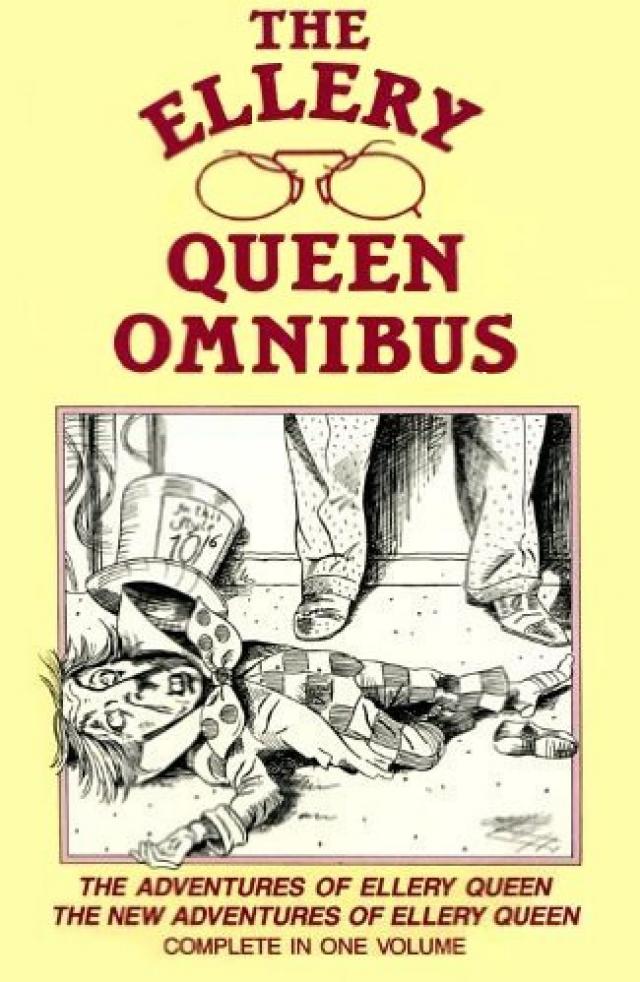


To Mr. Ellery Queen it was a painful, puzzling, and irritatingly evil time. He prowled the rambling mansion, a lost soul, smoking tasteless cigarets and thinking….That a blanket of menace hung over this house his nerves convinced him. It took all his willpower to keep his body from springing about at unheard sounds; moreover, his mind was distracted and he could not think clearly. A murderer was abroad; and this was a house of violent people.
He shivered and darted a look over his shoulder and shrugged and bent his mind fiercely to the problem at hand….And after hours his thoughts grew calmer and began to range themselves in orderly rows, until it was evident that there was a beginning and an end. He grew quiet.
He smiled a little as he stopped a tiptoeing maid and inquired the location of Miss Agatha Shaw’s room. Miss Shaw had wrapped herself thus far in a mantle of invisibility. It was most curious. A sense of rising drama excited him a little….
A tinny female voice responded to his knock, and he opened the door to find a feminine Shaw as bony and unlovely as the masculine edition curled in a hard knot on a chaise-longue, staring balefully out the window. Her négligé was adorned with boa feathers and there were varicose veins on her swollen naked legs.
“Well,” she said acidly, without turning. “What do you want?”
“My name,” murmured Ellery, “is Queen, and Mr. Mason has called me in to help settle your—ah—difficulties.”
She twisted her skinny neck slowly. “I’ve heard all about you, What do you want me to do, kiss you? I suppose it was you who instigated John’s arrest. You’re fools, the pack of you!”
“To the contrary, it was your worthy Captain Murch’s exclusive idea to take your brother in custody, Miss Shaw. He’s not formally arrested, you know. Even so, I advised strongly against it.”
She sniffed, but she uncoiled the knot and drew her shapeless legs beneath her wrapper in a sudden consciousness of femininity. “Then sit down, Mr. Queen. I’ll help all lean.”
“On the other hand,” smiled Ellery, seating himself in a gilt and Gallic atrocity, “don’t blame Murch overly, Miss Shaw. There’s a powerful case against your brother, you know.”
“And me!”
“And,” said Ellery regretfully, “you.”
She raised her thin arms and cried: “Oh, how I hate this damned, damned house, that damned woman! She’s the cause of all our trouble. Some day she’s likely to get—”
“I suppose you’re referring to Mrs. Royce. But aren’t you being unfair? From Mason’s story it’s quite evident that there was no ghost of coercion when your stepmother willed your father’s fortune to Mrs. Royce. They had never met, never corresponded, and your cousin was three thousand miles away. It’s awkward for you, no doubt, but scarcely Mrs. Royce’s fault.”
“Fair! Who cares about fairness? She’s taken our money away from us. And now we’ve got to stay here and—and be fed by her. It’s intolerable, I tell you! She’ll be here at least two years—trust her for that, the painted old hussy!—and all that time…”
“I’m afraid I don’t understand. Two years?”
“That woman’s will,” snarled Miss Shaw, “provided that this precious cousin of ours come to live here and preside as mistress for a minimum of two years. That was her revenge, the despicable old witch! Whatever father saw in her…To ‘provide a home for John and Agatha,’ she said in the will, ‘until they find a permanent solution of their problems.’ How d’ye like that? I’ll never forget those words. Our ‘problems’! Oh, every time I think—” She bit her lip, eyeing him sidewise with a sudden caution.
Ellery sighed and went to the door. “Indeed? And if something should—er—drive, Mrs. Royce from the house before the expiration of the required period?”
“We’d get the money, of course,” she flashed with bitter triumph; her thin dark skin was greenish. “If something should happen—”
“I trust,” said Ellery dryly, “that nothing will.” He closed the door and stood for a moment gnawing his fingers, and then he smiled rather grimly and went downstairs to a telephone.
John Shaw returned with his escort at ten that night. His chest was hollower, his fingers shakier, his eyes bloodier; and he was sober. Murch looked like a thundercloud. The cadaverous man went into the living-room and made for a full decanter. He drank alone, with steady mechanical determination. No one disturbed him.
“Nothing,” growled Murch to Ellery and Mason.
At twelve the house was asleep.
The first alarm was sounded by Miss Krutch. It was almost one when she ran down the upper corridor screaming at the top of her voice: “Fire! Fire! Fire!” Thick smoke was curling about her slender ankles and the moonlight shining through the corridor-window behind her silhouetted her long plump trembling shanks through the thin nightgown.
The corridor erupted, boiled over. Doors crashed open, dishevelled heads protruded, questions were shrieked, dry throats choked over the bitter smoke. Mr. Phineas Mason, looking a thousand years old without his teeth, fled in a cotton nightshirt toward the staircase. Murch came pounding up the stairs, followed by a bleary, bewildered John Shaw. Scrawny Agatha in silk pajamas staggered down the hall with Peter, howling at the top of his lusty voice, in her arms. Two servants scuttled downstairs like frantic rats.
But Mr. Ellery Queen stood still outside the door of his room and looked quietly about, as if searching for some one.
“Murch,” he said in a calm, penetrating voice. The detective ran up. “The fire!” he cried wildly. “Where the hell’s the fire?”
“Have you seen Mrs. Royce?”
“Mrs. Royce? Hell, no!” He ran back up the hall, and Ellery followed on his heels, thoughtfully. Murch tried the knob of a door; the door was locked. “God, she may be asleep, or overcome by—”
“Well, then,” said Ellery through his teeth as he stepped back, “stop yowling and help me break this door down. We don’t want her frying in her own lard, you know.”
In the darkness, in the evil smoke, they hurled themselves at the door….At the fourth assault it splintered off its hinges and Ellery sprang through. An electric torch in his hand flung its powerful beam about the room, wavered….Something struck it from Ellery’s hand, and it splintered on the floor. The next moment Ellery was fighting for his life.
His adversary was a brawny, panting demon with muscular fingers that sought his throat. He wriggled about, coolly, seeking an armhold. Behind him Murch was yelling: “Mrs. Royce! It’s only us!”
Something sharp and cold flicked over Ellery’s cheek and left a burning line. Ellery found a naked arm. He twisted, hard, and there was a clatter as steel fell to the floor. Then Murch came to his senses and jumped in. A county trooper blundered in, fumbling with his electric torch….Ellery’s fist drove in, hard, to a fat stomach. Fingers relaxed from his throat. The trooper found the electric switch….
Mrs. Royce, trembling violently, lay on the floor beneath the two men. On a chair nearby lay, in a mountain of Victorian clothing, a very odd and solid-looking contraption that might have been a rubber brassière. And something was wrong with her hair; she seemed to have been partially scalped.
Ellery cursed softly and yanked. Her scalp came away in a piece, revealing a pink gray-fringed skull.
“She’s a man!” screamed Murch.
“Thus,” said Ellery grimly, holding Mrs. Royce’s throat firmly with one hand and with the other dabbing at his bloody cheek, “vindicating the powers of thought.”
“I still don’t understand,” complained Mason the next morning, as the chauffeur drove him and Ellery back to the city, “how you guessed, Queen.”
Ellery raised his eyebrows. “Guessed? My dear Mason, that’s considered an insult at the Queen Hearth. There was no guesswork whatever involved. Matter of pure reasoning. And a neat job, too,” he added reflectively, touching the thin scar on his cheek.
“Come, come, Queen,” smiled the lawyer, “I’ve never really believed McC.’s panegyrics on what he calls your uncanny ability to put two and two together; and though I’m not unintelligent and my legal training gives me a mental advantage over the layman and I’ve just been treated presumably to a demonstration of your—er—powers, I’ll be blessed if I yet believe.”
“A skeptic, eh?” said Ellery, wincing at the pain in his cheek. “Well, then, let’s start where I started—with the beard Dr. Arlen painted on the face of Rembrandt’s wife just before he was attacked. We’ve agreed that he deliberately painted in the beard to leave a clue to his murderer. What could he have meant? He was not pointing to a specific woman, using the beard just as an attention-getter; for the woman in the painting was the wife of Rembrandt, a historical figure and as far as our personæ went an utter unknown. Nor could Arlen have meant to point to a woman with a beard literally; for this would have meant a freak, and there were no freaks involved. Nor was he pointing to a bearded man, for there was a man’s face on the painting which he left untouched; had he meant to point to a bearded man as his murderer that is, to John Shaw—he would have painted the beard on Rembrandt’s beardless face. Besides, Shaw’s is a vandyke, a pointed beard; and the beard Arlen painted was squarish in shape….You see how exhaustive it is possible to be, Mason.”
“Go on,” said the lawyer intently.
“The only possible conclusion, then, all others having been eliminated, was that Arlen meant the beard merely to indicate masculinity, since facial hair is one of the few exclusively masculine characteristics left to our sex by dear, dear Woman. In other words, by painting a beard on a woman’s face—any woman’s face, mark—Dr. Arlen was virtually saying: ‘My murderer is a person who seems to be a woman but is really a man.’ ”
“Well, I’ll be damned!” gasped Mason.
“No doubt,” nodded Ellery. “Now, ‘a person who seems to be a woman but is really a man’ suggests, surely, impersonation. The only actual stranger at the house was Mrs. Royce. Neither John nor Agatha could be impersonators, since they were both well-known to Dr. Arlen as well as to you; Arlen had examined them periodically, in fact, for years as the personal physician of the household. As for Miss Krutch, aside from her unquestionable femininity—a ravishing young woman, my dear Mason—she could not possibly have had motive to be an impersonator.
“Now, since Mrs. Royce seemed the likeliest possibility, I thought over the infinitesimal phenomena I had observed connected with her person—that is, appearance and movements. I was amazed to find a vast number of remarkable confirmations!”
“Confirmations?” echoed Mason, frowning.
“Ah, Mason, that’s the trouble with skeptics: they’re so easily confounded. Of course! lips constitute a strong difference between the sexes: Mrs. Royce’s were shaped meticulously into a perfect Cupid’s-bow with lipstick. Suspicious in an old woman. The general overuse of cosmetics, particularly the heavy application of face powder: very suspicious, when you consider that overpowdering is not common among genteel old ladies and also that a man’s skin, no matter how closely and frequently shaved, is undisguisably coarser.
“Clothes? Really potent confirmation. Why on earth that outlandish Victorian get-up? Here was presumably a woman who had been on the stage, presumably a woman of the world, a sophisticate. And yet she wore those horrible doodads of the ’90s. Why? Obviously, to swathe and disguise a padded figure—impossible with woman’s thin, scanty, and clinging modern garments. And the collar—ah, the collar! That was his inspiration. A choker, you’ll recall, concealing the entire neck? But since a prominent Adam’s-apple is an inescapable heritage of the male, a choker-collar becomes virtually a necessity in a female impersonation. Then the baritone voice, the vigorous movements, the mannish stride, the flat shoes….The shoes were especially illuminating. Not only were they flat, but they showed signs of great bunions—and a man wearing woman’s shoes, no matter how large, might well be expected to grow those painful excrescences.”
“Even if I grant all that,” objected Mason, “still they’re generalities at best, might even be coincidences when you’re arguing from a conclusion. Is that all?” He seemed disappointed.
“By no means,” drawled Ellery. “These were, as you say, the generalities. But your cunning Mrs. Royce was addicted to three habits which are exclusively masculine, without argument. For one thing, when she sat down on my second sight of her she elevated her skirts at the knees with both hands; that is, one to each knee. Now that’s precisely what a man does when he sits down: raises his trousers; to prevent, I suppose, their bagging at the knees.”
“But—”
“Wait. Did you notice the way she screwed up her right eyebrow constantly, raising it far up and then drawing it far down? What could this have been motivated by except the lifelong use of a monocle? And a monocle is masculine….And finally, her peculiar habit, in removing a cigaret from her lips, of cupping her hand about it rather than withdrawing it between the forefinger and middle finger, as most cigaret-smokers do. But the cupping gesture is precisely the result of pipe-smoking, for a man cups his hands about the bowl of a pipe in taking it out of his mouth. Man again. When I balanced these three specific factors on the same side of the scale as those generalities, I felt certain Mrs. Royce was a male.
“What male? Well that was simplest of all. You had told me, for one thing, that when you and your partner Collidge quizzed her she had shown a minute knowledge of Shaw history and specifically of Edith Shaw’s history. On top of that, it took histrionic ability to carry off this female impersonation. Then there was the monocle deduction—England, surely? And the strong family resemblance. So I knew that ‘Mrs. Royce,’ being a Shaw undoubtedly, and an English Shaw to boot, was the other Shaw of the Morton side of the family—that is, Edith Shaw’s brother Percy!”
“But she—he, I mean,” cried Mason, “had told me Percy Shaw died a few months ago in Europe in an automobile accident!”
“Dear, dear,” said Ellery sadly, “and a lawyer, too. She lied, that’s all!—I mean ‘he,’ confound it. Your legal letter was addressed to Edith Shaw, and Percy received it, since they probably shared the same establishment. If he received it, it was rather obvious, wasn’t it, that it was Edith Shaw who must have died shortly before; and that Percy had seized the opportunity to gain a fortune for himself by impersonating her?”
“But why,” demanded Mason, puzzled, “did he kill Dr. Arlen? He had nothing to gain—Arlen’s money was destined for Shaw’s cousins, not for Percy Shaw. Do you mean there was some past connection—”
“Not at all,” murmured Ellery. “Why look for past connections when the motive’s slick and shiny at hand? If Mrs. Royce was a man, the motive was at once apparent. Under the terms of Mrs. Shaw’s will Arlen was periodically to examine the family, with particular attention to Mrs. Royce. And Agatha Shaw told me yesterday that Mrs. Royce was constrained by will to remain in the house for two years. Obviously, then, the only way Percy Shaw could avert the cataclysm of being examined by Dr. Arlen and his disguise penetrated—for a doctor would have seen the truth instantly on examination, of course—was to kill Arlen. Simple, nein?”
“But the beard Arlen drew—that meant he had seen through it?”
“Not unaided. What probably happened was that the impostor, knowing the first physical examination impended, went to Dr. Arlen the other night to strike a bargain, revealing himself as a man. Arlen, an honest man, refused to be bribed. He must have been painting at the time and, thinking fast, unable to rouse the house because he was so far away from the others, unable to paint his assailant’s name because ‘Mrs. Royce’ would see it and destroy it, thought of Peter’s beard, made the lightning connection, and calmly painted it while ‘Mrs. Royce’ talked to him. Then he was stabbed.”
“And the previous poisoning attempt on Mrs. Shaw?”
“That,” said Ellery, “undoubtedly lies between John and Agatha.”
Mason was silent, and for some time they rode in peace. Then the lawyer stirred, and sighed, and said: “Well, all things considered, I suppose you should thank Providence. Without concrete evidence—your reasoning was unsupported by legal evidence, you realize that, of course, Queen—you could scarcely have accused Mrs. Royce of being a man, could you? Had you been wrong, what a beautiful suit she could have brought against you! That fire last night was an act of God.”
“I am,” said Ellery calmly, “above all, my dear Mason, a man of free will. I appreciate acts of God when they occur, but I don’t sit around waiting for them. Consequently…”
“You mean—” gasped Mason, opening his mouth wide.
“A telephone call, a hurried trip by Sergeant Velie, and smoke-bombs were the materia for breaking into Mrs. Royce’s room in the dead of night,” said Ellery comfortably. “By the way, you don’t by any chance know the permanent address of—ah—Miss Krutch?”
The Adventure of THE THREE LAME MEN
WHEN ELLERY QUEEN WALKED into the bedroom, with its low ash-gray bed and its tinted walls and angular furniture and chromium gewgaws, he found his father the Inspector yammering at a frightened colored girl whose face looked like liverwurst with two red-brown marbles stuck into it.
Sergeant Velie leaned his impossible shoulders against the delicate gray door and said: “Look out for that rug, Mr. Queen.”
It was a pastel-gray rug, unbordered; all around it lay a gleaming frame of polished hardwood floor. The rug was tracked with muddy footprints and on the waxed hardwood between the rug and an open window across the room there was a straight scratchy bruise tapering from a wide scab to a thin vanishing line, like a furrow on ice.
He clucked and shook his head. “Shocking, Velie, really revolting. Tramping mud and snow all over this feminine fairyland!”


