

Ellery queen omnibus, p.21
Ellery Queen Omnibus,
p.21
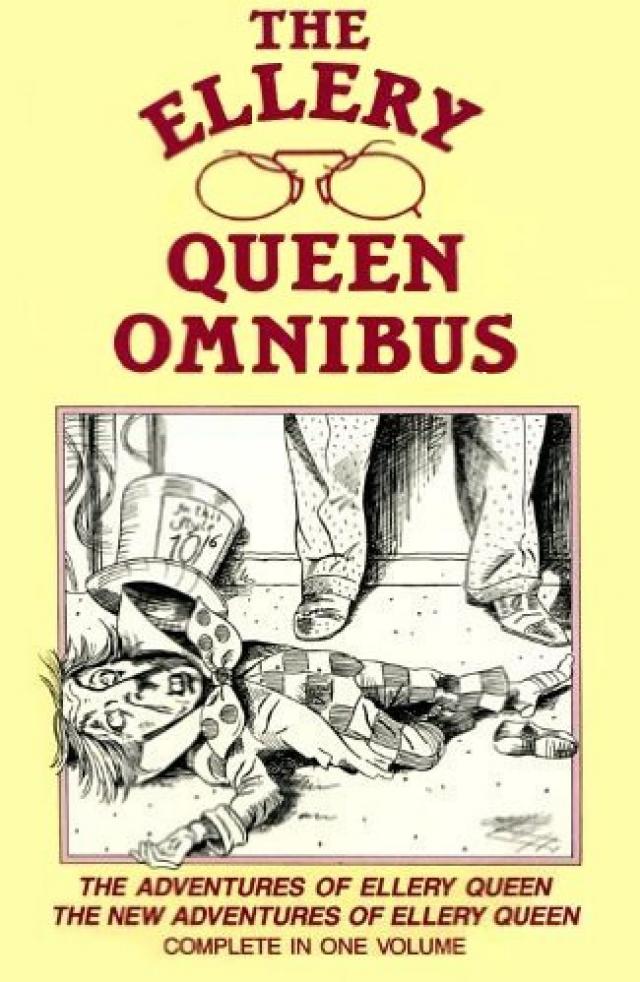


“Who found the body?” demanded Ellery, puffing at his first cigaret of the day.
“His Nibs here,” said Sergeant Velie, hunching his colossal shoulders. “And the lady. Seems like the Dook or whatever he is has been workin’ a racket—been a kind of stooge for the old duck that was murdered. Orr used to give him commissions on the customers he brought in—and I understand he brought in plenty. Anyway, Mrs. Orr here got sort of worried when her hubby didn’t come home last night from the poker game….”
“Poker game?”
The Russian’s dark face lighted up. “Yuss. Yuss. It is remarkable game. I have learned it since my sojourn in your so amazing country. Meester Orr, myself, and some others here play each week. Yuss.” His face fell, and some of his fright returned. He looked fleetingly at the corpse and Began to edge away.
“You played last night?” asked Ellery in a savage voice.
The Russian nodded. Inspector Queen said: “We’re rounding ’em up: It seems that Orr, the Duke, and four other men had a sort of poker club, and met in Orr’s back room there every Saturday night and played till all hours. Looked over that back room, but there’s nothing there except the cards and chips. When Orr didn’t come home Mrs. Orr got frightened and called up the Duke—he lives at some squirty little hotel in the Forties—the Duke called for her, they came down here this morning….This is what they found.” The Inspector eyed Martin Orr’s corpse and the debris of glass surrounding him with gloom, almost with resentment. “Crazy, isn’t it?”
Ellery glanced at Mrs. Orr; she was leaning against a counter, frozen-faced, tearless, staring down at her husband’s body as if she could not believe her eyes. Actually, there was little to see: for Dr. Prouty had flung outspread sheets of a Sunday newspaper over the body, and only the left hand—still clutching the amethyst—was visible.
“Unbelievably so,” said Ellery dryly. “I suppose there’s a desk in the back room where Orr kept his accounts?”
“Sure.”
“Any paper on Orr’s body?”
“Paper?” repeated the Inspector in bewilderment. “Why, no.”
“Pencil or pen?”
“No. Why, for heaven’s sake?”
Before Ellery could reply, a little old man with a face like wrinkled brown papyrus pushed past a detective at the front door; he walked like a man in a dream. His gaze fixed on the shapeless bulk and the bloodstains. Then, incredibly, he blinked four times and began to cry. His weazened frame jerked with sobs. Mrs. Orr awoke from her trance; she cried: “Oh, Sam, Sam!” and, putting her arms around the newcomer’s racked shoulders, began to weep with him.
Ellery and the Inspector looked at each other, and Sergeant Velie belched his disgust. Then the Inspector grasped the crying man’s little arm and shook him. “Here, stop that!” he said gruffly. “Who are you?”
The man raised his tear-stained face from Mrs. Orr’s shoulder; he blubbered: “S-Sam Mingo, S-Sam Mingo, Mr. Orr’s assistant. Who—who—Oh, I can’t believe it!” and he buried his face in Mrs. Orr’s shoulder again.
“Got to let him cry himself out, I guess,” said the Inspector, shrugging. “Ellery, what the deuce do you make of it? I’m stymied.”
Ellery raised his eyebrows eloquently. A detective appeared in the street-door escorting a pale, trembling man. “Here’s Arnold Pike, Chief. Dug him out of bed just now.”
Pike was a man of powerful physique and jutting jaw; but he was thoroughly unnerved and, somehow, bewildered. He fastened his eyes on the heap which represented Martin Orr’s mortal remains and kept mechanically buttoning and unbuttoning his overcoat. The Inspector said: “I understand you and a few others played poker in the back room here last night. With Orr. What time did you break up?”
“Twelve-thirty.” Pike’s voice wabbled drunkenly.
“What time did you start?”
“Around eleven.”
“Cripes,” said Inspector Queen, “that’s not a poker game, that’s a game of tiddledywinks….Who killed Orr, Mr. Pike?”
Arnold Pike tore his eyes from the corpse. “God, sir, I don’t know.”
“You don’t, hey? All friends, were you?”
“Yes. Oh, yes.”
“What’s your business, Mr. Pike?”
“I’m a stock-broker.”
“Why—” began Ellery, and stopped. Under the urging of two detectives, three men advanced into the shop—all frightened, all exhibiting evidences of hasty awakening and hasty dressing, all fixing their eyes at once on the paper-covered bundle on the floor, the streaks of blood, the shattered glass. The three, like the incredible ex-Duke Paul, who was straight and stiff and somehow ridiculous, seemed petrified; men crushed by a sudden blow.
A small fat man with brilliant eyes muttered that he was Stanley Oxman, jeweler. Martin Orr’s oldest, closest friend. He could not believe it. It was frightful, unheard of. Martin murdered! No, he could offer no explanation. Martin had been a peculiar man, perhaps, but as far as he, Oxman, knew the curio dealer had not had an enemy in the world. And so on, and so on, as the other two stood by, frozen, waiting their turn.
One was a lean, debauched fellow with the mark of the ex-athlete about him. His slight paunch and yellowed eyeballs could not conceal the signs of a vigorous prime. This was, said Oxman, their mutual friend, Leo Gurney, the newspaper feature-writer. The other was J. D. Vincent, said Oxman—developing an unexpected streak of talkativeness which the Inspector fanned gently—who, like Arnold Pike, was in Wall Street—“a manipulator,” whatever that was. Vincent, a stocky man with the gambler’s tight face, seemed incapable of speech; as for Gurney, he seemed glad that Oxman had constituted himself spokesman and kept staring at the body on the cement floor.
Ellery sighed, thought of his warm bed, put down the rebellion in his breakfastless stomach, and went to work—keeping an ear cocked for the Inspector’s sharp questions and the halting replies. Ellery followed the streaks of blood to the spot where Orr had ravished the case of gems. The case, its glass front smashed, little frazzled splinters framing the orifice, contained more than a dozen metal trays floored with black velvet, set in two rows. Each held scores of gems—a brilliant array of semi-precious and precious stones beautifully variegated in color. Two trays in the center of the front row attracted his eye particularly—one containing highly polished stones of red, brown, yellow, and green; the other a single variety, all of a sub-translucent quality, leek-green in color, and covered with small red spots. Ellery noted that both these trays were in direct line with the place where Orr’s hand had smashed the glass case.
He went over to the trembling little assistant, Sam Mingo, who had quieted down and was standing by Mrs. Orr, clutching her hand like a child. “Mingo,” he said, touching the man. Mingo started with a leap of his stringy muscles. “Don’t be alarmed, Mingo. Just step over here with me for a moment.” Ellery smiled reassuringly, took the man’s arm, and led him to the shattered case.
And Ellery said: “How is it that Martin Orr bothered with such trifles as these? I see rubies here, and emeralds, but the others….Was he a jeweler as well as a curio dealer?”
Orr’s assistant mumbled: “No. N-no, he was not. But he always liked the baubles. The baubles, he called them. Kept them for love. Most of them are birth-stones. He sold a few. This is a complete line.”
“What are those green stones with the red spots?”
“Bloodstones.”
“And this tray of red, brown, yellow, and green ones?”
“All jaspers. The common ones are red, brown, and yellow. The few green ones in the tray are more valuable….The bloodstone is itself a variety of jasper. Beautiful! And…”
“Yes, yes,” said Ellery hastily. “From which tray did the amethyst in Orr’s hand come, Mingo?”
Mingo shivered and pointed a crinkled forefinger to a tray in the rear row, at the corner of the case.
“All the amethysts are kept in this one tray?”
“Yes. You can see for yourself—”
“Here!” growled the Inspector, approaching. “Mingo! I want you to look over the stock. Check everything. See if anything’s been stolen.”
“Yes, sir,” said Orr’s assistant timidly, and began to potter about the shop with lagging steps. Ellery looked about. The door to the back room was twenty-five feet from the spot where Orr had been assaulted. No desk in the shop itself, he observed, no paper about….
“Well, son,” said the Inspector in troubled tones, “it looks as if we’re on the trail of something. I don’t like it….Finally dragged it out of these birds. I thought it was funny, this business of breaking up a weekly Saturday night poker game at half-past twelve. They had a fight!”
“Who engaged in fisticuffs with whom?”
“Oh, don’t be funny. It’s this Pike feller, the stockbroker. Seems they all had something to drink during the game. They played stud, and Orr, with an ace-king-queen-jack showing, raised the roof off the play. Everybody dropped out except Pike; he had three sixes. Well, Orr gave it everything he had and when Pike threw his cards away on a big over-raise, Orr cackled, showed his hole-card—a deuce!—and raked in the pot. Pike, who’d lost his pile on the hand, began to grumble; he and Orr had words—you know how those things start. They were all pie-eyed, anyway, says the Duke. Almost a fist-fight. The others interfered, but it broke up the game.”
“They all left together?”
“Yes. Orr stayed behind to clean up the mess in the back room. The five others went out together and separated a few blocks away. Any one of ’em could have come back and pulled off the job before Orr shut up shop!”
“And what does Pike say?”
“What the deuce would you expect him to say? That he went right home and to bed, of course.”
“The others?”
“They deny any knowledge of what happened after they left here last night….Well, Mingo? Anything missing?”
Mingo said helplessly: “Everything seems all right.”
“I thought so,” said the Inspector with satisfaction. “This is a grudge kill, son. Well, I want to talk to these fellers some more….What’s eating you?”
Ellery lighted a cigaret. “A few random thoughts. Have you decided in your own mind why Orr dragged himself about the shop when he was three-quarters dead, broke the glass-domed clock, pulled an amethyst out of the gem-case?”
“That,” said the Inspector, the troubled look returning, “is what I’m all foggy about. I can’t—’Scuse me.” He returned hastily to the waiting group of men.
Ellery took Mingo’s lax arm. “Get a grip on yourself, man. I want you to look at that smashed clock for a moment. Don’t be afraid of Orr—dead men don’t bite, Mingo.” He pushed the little assistant toward the paper-covered corpse. “Now tell me something about that clock. Has it a history?”
“Not much of one. It’s a h-hundred and sixty-nine years old. Not especially valuable. Curious piece because of the glass dome over it. Happens to be the only glass-domed clock we have. That’s all.”
Ellery polished the lenses of his pince-nez, set the glasses firmly on his nose, and bent over to examine the fallen clock. It had a black wooden base, circular, about nine inches deep, and scarified with age. On this the clock was set—ticking away cosily. The dome of glass had fitted into a groove around the top of the black base, sheathing the clock completely. With the dome unshattered, the entire piece must have stood about two feet high.
Ellery rose, and his lean face was thoughtful. Mingo looked at him in a sort of stupid anxiety. “Did Pike, Oxman, Vincent, Gurney, or Paul ever own this piece?”
Mingo shook his head. “No, sir. We’ve had it for many years. We couldn’t get rid of it. Certainly those gentlemen didn’t want it.”
“Then none of the five ever tried to purchase the clock?”
“Of course not.”
“Admirable,” said Ellery. “Thank you.” Mingo felt that he had been dismissed; he hesitated, shuffled his feet, and finally went over to the silent widow and stood by her side. Ellery knelt on the cement floor and with difficulty loosened the grip of the dead man’s fingers about the amethyst. He saw that the stone was a clear glowing purple in color, shook his head as if in perplexity, and rose.
Vincent, the stocky Wall Street gambler with the tight face, was saying to the Inspector in a rusty voice: “—can’t see why you suspect any of us. Pike particularly. What’s in a little quarrel? We’ve always been good friends, all of us. Last night we were pickled—”
“Sure,” said the Inspector gently. “Last night you were pickled. A drunk sort of forgets himself at times, Vincent. Liquor affects a man’s morals as well as his head.”
“Nuts!” said the yellow-eyeballed Gurney suddenly. “Stop sleuthing, Inspector. You’re barking up the wrong tree. Vincent’s right. We’re all friends. It was Pike’s birthday last week.” Ellery stood very still. “We all sent him gifts. Had a celebration, and Orr was the cockiest of us all. Does that look like the preparation for a pay-off?”
Ellery stepped forward, and his eyes were shining. All his temper had fled by now, and his nostrils were quivering with the scent of the chase. “And when was this celebration held, gentlemen?” he asked softly.
Stanley Oxman puffed out his cheeks. “Now they’re going to suspect a birthday blowout! Last Monday, mister. This past Monday. What of it?”
“This past Monday,” said Ellery. “How nice. Mr. Pike, your gifts—”
“For God’s sake….” Pike’s eyes were tortured.
“When did you receive them?”
“After the party, during the week. Boys sent them up to me. I didn’t see any of them until last night, at the poker game.”
The others nodded their heads in concert; the Inspector was looking at Ellery with puzzlement. Ellery grinned, adjusted his pince-nez, and spoke to his father aside. The weight of the Inspector’s puzzlement, if his face was a scale, increased. But he said quietly to the white-haired broker: “Mr. Pike, you’re going to take a little trip with Mr. Queen and Sergeant Velie. Just for a few moments. The others of you stay here with me. Mr. Pike, please remember not to try anything—foolish.”
Pike was incapable of speech; his head twitched side-wise and he buttoned his coat for the twentieth time. Nobody said anything. Sergeant Velie took Pike’s arm, and Ellery preceded them into the early-morning peace of Fifth Avenue. On the sidewalk he asked Pike his address, the broker dreamily gave him a street-and-number, Ellery hailed a taxicab, and the three men were driven in silence to an apartment-building a mile farther uptown. They took a self-service elevator to the seventh floor, marched a few steps to a door, Pike fumbled with a key, and they went into his apartment.
“Let me see your gifts, please,” said Ellery without expression—the first words uttered since they had stepped into the taxicab. Pike led them to a den-like room. On a table stood four boxes of different shapes, and a handsome silver cup. “There,” he said in a cracked voice.
Ellery went swiftly to the table. He picked up the silver cup. On it was engraved the sentimental legend:
To a True Friend
ARNOLD PIKE
March 1, 1876——
J. D. Vincent
“Rather macabre humor, Mr. Pike,” said Ellery, setting the cup down, “since Vincent has had space left for the date of your demise.” Pike began to speak, then shivered and clamped his pale lips together.
Ellery removed the lid of a tiny black box. Inside, imbedded in a cleft between two pieces of purple velvet, there was a man’s signet-ring, a magnificent and heavy circlet the signet of which revealed the coat-of-arms of royalist Russia. “The tattered old eagle,” murmured Ellery. “Let’s see what our friend the ex-Duke has to say.” On a card in the box, inscribed in minute script, the following was written in French:
To my good friend Arnold Pike on his 50th birthday. March the first ever makes me sad. I remember that day in 1917—two weeks before the Czar’s abdication—the quiet, then the storm….But be merry, Arnold! Accept this signet-ring, given to me by my royal Cousin, as a token of my esteem. Long life!
Paul
Ellery did not comment. He restored ring and card to the box, and picked up another, a large flat packet. Inside there was a gold-tipped Morocco-leather wallet. The card tucked into one of the pockets said:
“Twenty-one years of life’s rattle
And men are no longer boys,
They gird their loins for the battle
And throw away their toys—
“But here’s a cheerful plaything
For a white-haired old mooncalf,
Who may act like any May-thing
For nine years more and a half!”
“Charming verse,” chuckled Ellery. “Another misbegotten poet. Only a newspaper man would indite such nonsense. This is Gurney’s?”
“Yes,” muttered Pike. “It’s nice, isn’t it?”
“If you’ll pardon me,” said Ellery, “it’s rotten.” He threw aside the wallet and seized a larger carton. Inside there was a glittering pair of patent-leather carpet slippers; the card attached read:
Happy Birthday, Arnold! May We Be All Together On as Pleasant a March First to Celebrate Your 100th Anniversary!
Martin
“A poor prophet,” said Ellery dryly. “And what’s this?” He laid the shoebox down and picked up a small flat box. In it he saw a gold-plated cigaret-case, with the initials A. P. engraved on the lid. The accompanying card read:
Good luck on your fiftieth birthday. I look forward to your sixtieth on March first, 1936, for another bout of whoopee!


