

Ellery queen omnibus, p.4
Ellery Queen Omnibus,
p.4
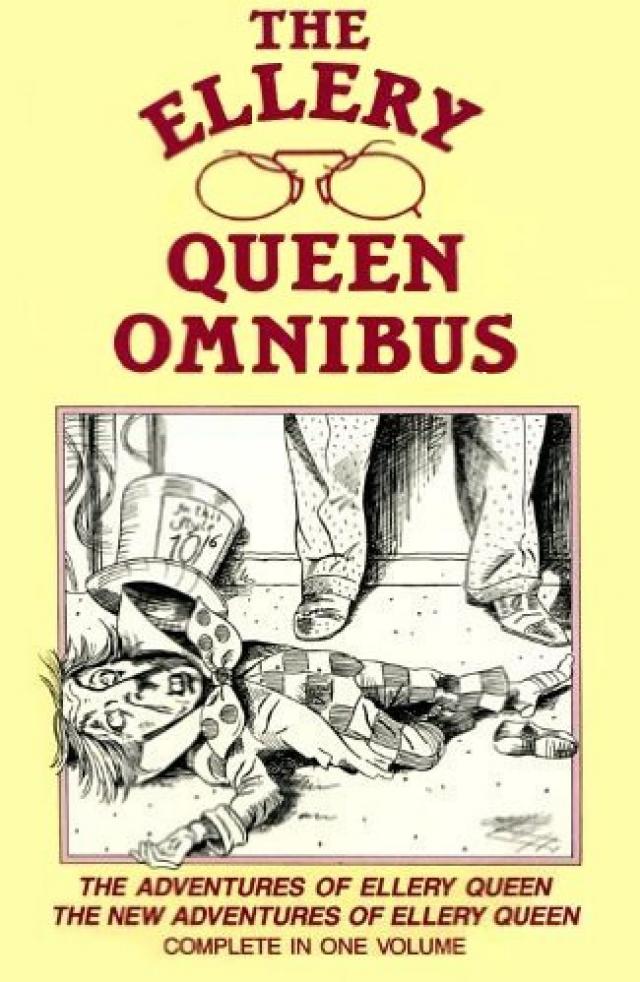


Nobody said anything. The tall Texan’s fingers whitened as he glared at the drunken man, and Gordi the magician did nothing at all but breathe. Then the door opened and two men came in—Dr. Prouty, Assistant Medical Examiner, and a big shambling man with a seared face.
Everybody relaxed. The Inspector said: “High time, Doc. Don’t touch her, though, till Bradford can take a look at that knot up there. Go on, Braddy; on the pipe. Use the ladder.”
The shambling man took the stepladder and set it up and climbed beside the dangling body and looked at the knot behind the woman’s ear and the knot at the top of the pipe. Dr. Prouty pinched the woman’s legs.
Ellery sighed and began to prowl. Nobody paid any attention to him; they were all pallidly intent upon the two men near the body.
Something disturbed him; he did not know what, could not put his finger precisely upon the root of the disturbance. Perhaps it was a feeling in the air, an aura of tension about the silent dangling woman in tights. But it made him restless. He had the feeling…
He found the loaded revolver in the top drawer of the woman’s dressing-table—a shiny little pearl-handled .22 with the initials MB on the butt. And his eyes narrowed and he glanced at his father, and his father nodded. So he prowled some more. And then he stopped short, his gray eyes suspicious.
On the rickety wooden table in the center of the room lay a long sharp nickel-plated letter-opener among a clutter of odds and ends. He picked it up carefully and squinted along its glittering length in the light. But there was no sign of blood.
He put it down and continued to prowl.
And the very next thing he noticed was the cheap battered gas-burner on the floor at the other side of the room. Its pipe fitted snugly over a gas outlet in the wall, but the gas-tap had been turned off. He felt the little burner; it was stone-cold.
So he went to the closet with the oddest feeling of inevitability. And sure enough, just inside the open door of the closet lay a wooden box full of carpenter’s tools, with a heavy steel hammer prominently on top. There was a mess of shavings on the floor near the box, and the edge of the closet-door was unpainted and virgin-fresh from a plane.
His eyes were very sharp now, and deeply concerned. He went quickly to the Inspector’s side and murmured: “The revolver. The woman’s?”
“Yes.”
“Recent acquisition?”
“No. Brinkerhof bought it for her soon after they were married. For protection, he said.”
“Poor protection, I should say,” shrugged Ellery, glancing at the Headquarters men. The shambling red-faced man had just lumbered off the ladder with an expression of immense surprise. Sergeant Velie, who had returned, was mounting the ladder with a pen-knife clutched in his big fingers. Dr. Prouty waited expectantly below. The Sergeant began sawing at the rope tied to the sprinkler-pipe.
“What’s that box of tools doing in the closet?” continued Ellery, without removing his gaze from the dead woman.
“Stage carpenter was in here yesterday fixing the door—it had warped or something. Union rules are strict, so he quit the job unfinished. What of it?”
“Everything,” said Ellery, “of it.” The Great Gordi was quietly watching his mouth; Ellery seemed not to notice. The little comedian, Sam, was shrunken in a corner, eyes popping at the Sergeant. And the Texan was smoking without enjoyment, not looking at any one or anything. “Simply everything. It’s one of the most remarkable things I’ve ever run across.”
The Inspector looked bewildered. “But, El, for cripe’s sake—remarkable? I don’t see—”
“You should,” said Ellery impatiently. “A child should. And yet it’s astounding, when you come to think of it. Here’s a room with four dandy weapons in it—a loaded revolver, a letter-cutter, a gas-burner, and a hammer. And yet the murderer deliberately trussed the woman with the towels, deliberately left this room, deliberately crossed the stage to the property room, unwound that rusty old rope from a worthless trunk discarded years ago by some nameless actor, carried the rope and the ladder from beside the switchboard back to this room, used the ladder to sling the rope over the pipe and fasten the knot, and strung the woman up.”
“Well, but—”
“Well, but why?” cried Ellery. “Why? Why did the murderer ignore the four simple, easy, handy methods of murder here—shooting, stabbing, asphyxiation, bludgeoning—and go to all that extra trouble to hang her?”
Dr. Prouty was kneeling beside the dead woman, whom the Sergeant had deposited with a thump on the dirty floor.
The red-faced man shambled over and said: “It’s got me, Inspector.”
“What’s got you?” snapped Inspector Queen.
“This knot.” His thick red fingers held a length of knotted rope. “The one behind her ear is just ordinary; even clumsy for the job of breakin’ her neck.” He shook his head. “But this one, the one that was tied around the pipe—well, sir, it’s got me.”
“An unfamiliar knot?” said Ellery slowly, puzzling over its complicated convolutions.
“New to me, Mr. Queen. All the years I been expertin’ on knots for the Department I never seen one like that. Ain’t a sailor’s knot, I can tell you that; and it ain’t Western.”
“Might be the work of an amateur,” muttered the Inspector, pulling the rope through his fingers. “A knot that just happened.”
The expert shook his head. “No, sir, I wouldn’t say that at all. It’s some kind of variation. Not an accident. Whoever tied that knew his knots.”
Bradford shambled off and Dr. Prouty looked up from his work. “Hell, I can’t do anything here,” he snapped. “I’ll have to take this body over to the Morgue and work on it there. The boys are waiting outside.”
“When’d she kick off, Doc?” demanded the Inspector, frowning.
“About midnight last night. Can’t tell closer than that. She died, of course, of suffocation.”
“Well, give us a report. Probably nothing, but it never hurts. Thomas, get that doorman in here.”
When Dr. Prouty and the Morgue men had gone with the body and Sergeant Velie had hauled in old Perk, the stagedoor man and watchman, the Inspector growled: “What time’d you lock up last night, Mister?”
Old Perk was hoarse with nervousness. “Honest t’ Gawd, Inspector, I didn’t mean nothin’ by it. On’y Mr. Kelly here’d fire me if he knew. I was that sleepy—”
“What’s this?” said the Inspector softly.
“Myra told me after the last show last night she an’ Atlas were gonna rehearse a new stunt. I didn’t wanna wait aroun’, y’see,” the old man whined, “so seein’ as nob’dy else was in the house that late, the cleanin’ women gone an’ all, I locked up everything but the stage door an’ I say to Myra an’ Atlas, I says: ‘When ye leave, folks,’ I says, ‘jest slam the stage door.’ An’ I went home.”
“Rats,” said the Inspector irritably. “Now we’ll never know who could have come in and who didn’t. Anybody could have sneaked back without being seen or waited around in hiding until—” He bit his lip. “You men there, where’d you all go after the show last night?”
The three actors started simultaneously. It was the Great Gordi who spoke first, in his soft smooth voice that was now uneasy. “I went directly to my rooming house and to bed.”
“Anybody see you come in? You live in the same hole as Brinkerhof?”
The magician shrugged, “No one saw me. Yes, I do.”
“You, Texas?”
The cowboy drawled: “I moseyed round to a speak somewhere an’ got drunk.”
“What speak?”
“Dunno. I was primed. Woke up in my room this mornin’ with a head.”
“You boys sure are in a tough spot,” said the Inspector sarcastically. “Can’t even fix good alibis for yourself. Well, how about you, Mr. Comedian?”
The comic said eagerly: “Oh, I can prove where I was, Inspector. I went around to a joint I know an’ can get twenny people to swear to it.”
“What time?”
“Round midnight.”
The Inspector snorted and said: “Beat it. But hang around. I’ll be wanting you boys, maybe. Take ’em away, Thomas, before I lose my temper.”
Long, long ago—when, it will be recalled, Megatherium roamed the trees—the same lop-eared impresario who said: “The acrobat shall be first,” also laid down the dictum that: “The show must go on,” and for as little reason. Accidents might happen, the juvenile might run off with the female lion-tamer, the ingénue might be howling drunk, the lady in the fifth row, right, might have chosen the theatre to be the scene of her monthly attack of epilepsy, fire might break out in Dressing Room A, but the show must go on. Not even a rare juicy homicide may annul the sacred dictum. The show must go on despite hell, high water, drunken managers named Kelly, and The Fantastic Affair of the Hanging Acrobat.
So it was not strange that when the Metropole began to fill with its dribble of early patrons there was no sign that a woman had been slain the night before within its gaudy walls and that police and detectives roved its backstage with suspicious, if baffled, eyes.
The murder was just an incident to Show Business. It would rate two columns in Variety.
Inspector Richard Queen chafed in the hard seat in the fifteenth row while Ellery sat beside him sunk in thought. Stranger than everything had been Ellery’s insistence that they remain to witness the performance. There was a motion picture to sit through—a film which, bitterly, the Inspector pointed out he had seen—a newsreel, an animated cartoon….
It was while “Coming Attractions” were flitting over the screen that Ellery rose and said: “Let’s go backstage. There’s something—” He did not finish.
They passed behind the dusty boxes on the right and went backstage through the iron door guarded by a uniformed officer. The vast bare reaches of the stage and wings were oppressed with an unusual silence. Manager Kelly, rather the worse for wear, sat on a broken chair near the light panel and gnawed his unsteady fingers. None of the vaudeville actors was in evidence.
“Kelly,” said Ellery abruptly, “is there anything like a pair of field glasses in the house?”
The Irishman gaped. “What the hell would you be wantin’ them for?”
“Please.”
Kelly fingered a passing stagehand, who vanished and reappeared shortly with the desired binoculars. The Inspector grunted: “So what?”
Ellery adjusted them to his eyes. “I don’t know,” he said, shrugging. “It’s just a hunch.”
There was a burst of music from the pit: the Overture.
“Poet and Peasant,” snarled the Inspector. “Don’t they ever get anything new?”
But Ellery said nothing. He merely waited, binoculars ready, eyes fixed on the now footlighted stage. And it was only when the last blare had died away, and grudging splatters of applause came from the orchestra, and the announcement cards read: “Atlas & Co.,” that the Inspector lost something of his irritability and even became interested. For when the curtains slithered up there was Atlas himself, bowing and smiling, his immense body impressive in flesh tights; and there beside him stood a tall smiling woman with golden hair and at least one golden tooth which flashed in the footlights. And she too wore flesh tights. For Brinkerhof with the mildness and resilience of all acrobats had insisted on taking his regular turn, and Bregman the booker had sent him another partner, and the two strangers had spent an hour rehearsing their intimate embraces and clutches and swingings and nuzzlings before the first performance. The show must go on.
Atlas and the golden woman went through an intricate series of tumbles and equilibristic maneuvers. The orchestra played brassy music. Trapezes dived stageward. Simple swings. Somersaults in the air. The drummer rolled and smashed his cymbal.
Ellery made no move to use the binoculars. He and the Inspector and Kelly stood in the wings, and none of them said anything, although Kelly was breathing hard like a man who has just come out of deep water for air. A queer little figure materialized beside them; Ellery turned his head slowly. But it was only Sailor Sam, the low comic, rigged out in a naval uniform three sizes too large for his skinny little frame, his face daubed liberally with greasepaint. He kept watching Atlas & Co. without expression.
“Good, ain’t he?” he said at last in a small voice.
No one replied. But Ellery turned to the manager and whispered: “Kelly, keep your eyes open for—” and his voice sank so low neither the comedian nor Inspector Queen could hear what he said. Kelly looked puzzled; his bloodshot eyes opened a little wider; but he nodded and swallowed, riveting his gaze upon the whirling figures on the stage.
And when it was all over and the orchestra was executing the usual crescendo sustenuto and Atlas was bowing and smiling and the woman was curtseying and showing her gold tooth and the curtain dropped swiftly, Ellery glanced at Kelly. But Kelly shook his head.
The announcement cards changed. “Sailor Sam.” There was a burst of fresh fast music, and the little man in the oversize naval uniform grinned three times, as if trying it out, drew a deep breath, and scuttled out upon the stage to sprawl full-length with his gnomish face jutting over the footlights to the accompaniment of surprised laughter from the darkness below.
They watched from the wings, silent.
The comedian had a clever routine. Not only was he a travesty upon all sailormen, but he was a travesty upon all sailormen in their cups. He drooled and staggered and was silent and then chattered suddenly, and he described a mythical voyage and fell all over himself climbing an imaginary mast and fell silent again to go into a pantomime that rocked the house.
The Inspector said grudgingly: “Why, he’s as good as Jimmy Barton any day, with that drunk routine of his.”
“Just a slob,” said Kelly out of the corner of his mouth.
Sailor Sam made his exit by the complicated expedient of swimming off the stage. He stood in the wings, panting, his face streaming perspiration. He ran out for a bow. They thundered for more. He vanished. He reappeared. He vanished again. There was a stubborn look on his pixie face.
“Sam!” hissed Kelly. “F’r cripe’s sake, Sam, give ’em ’at encore rope number. F’r cripe’s sake, Sam—”
“Rope number?” said Ellery quietly.
The comedian licked his lips. Then his shoulders drooped and he slithered out onto the stage again. There was a shout of laughter and the house quieted at once. Sam scrambled to his feet, weaving and blinking blearily.
“’Hoy there!” he howled suddenly. “Gimme rope!”
A papier-mâché cigar three feet long dropped to the stage from the opposite wings. Laughter. “Naw! Rope! Rope!” the little man screamed, dancing up and down.
A blackish rope snaked down from the flies. Miraculously it coiled over his scrawny shoulders. He struggled with it. He scrambled after its tarred ends. He executed fantastic flying leaps. And always the tarred ends eluded him, and constantly he became more and more enmeshed in the black coils as he wrestled with the rope.
The gallery broke down. The man was funny; even Kelly’s dour face lightened, and the Inspector was frankly grinning. Then it was over and two stagehands darted out of the wings and pulled the comedian off the stage, now a helpless bundle trussed in rope. His face under the paint was chalk-white. He extricated himself easily enough from the coils.
“Good boy,” chuckled the Inspector. “That was fine!”
Sam muttered something and trudged away to his dressing-room. The black rope lay where it had fallen. Ellery glanced at it once, and then turned his attention back to the stage. The music had changed. A startlingly beautiful tenor voice rang through the theatre. The orchestra was playing softly Home on the Range. The curtain rose on Tex Crosby.
The tall thin man was dressed in gaudiest stage-cowboy costume. And yet he wore it with an air of authority. The pearl-butted six-shooters protruding from his holsters did not seem out of place. His big white sombrero shaded a gaunt Western face. His legs were a little bowed. The man was real.
He sang Western songs, told a few funny stories in his soft Texan drawl, and all the while his long-fingered hands were busy with a lariat. He made the lariat live. From the moment the curtain rose upon his lanky figure the lariat was in motion, and it did not subside through the jokes; the patter, even the final song, which was inevitably The Last Round-Up.
“Tinhorn Will Rogers,” sneered Kelly, blinking his bloodshot eyes.
For the first time Ellery raised the binoculars. When the Texan had taken his last bow Ellery glanced inquiringly at the manager. Kelly shook his head.
The Great Gordi made his entrance in a clap of thunder, a flash of lightning, and a black Satanic cloak, faced with red. There was something impressive about his very charlatanism. His black eyes glittered and his mustache-points quivered above his lips and his beak jutted like an eagle’s; and meanwhile neither his hands nor his mouth kept still.
The magician had a smooth effortless patter which kept his audience amused and diverted their attention from the fluent mysteries of his hands. There was nothing startling in his routine, but it was a polished performance that fascinated. He performed seeming miracles with cards. His sleight-of-hand with coins and handkerchiefs was, to the layman, amazing. His evening clothes apparently concealed scores of wonders.
They watched with a mounting tension while he went through his bag of tricks. For the first time Ellery noticed, with a faint start, that Brinkerhof, still in tights, was crouched in the opposite wings. The big man’s eyes were fixed upon the magician’s face. They ignored the flashing fingers, the swift movements of the black-clad body. Only the face…In Brinkerhof’s eyes was neither rage nor venom; just watchfulness. What was the matter with the man? Ellery reflected that it was just as well that Gordi was unconscious of the acrobat’s scrutiny; those subtle hands might not operate so fluidly.
Despite the tension the magician’s act seemed interminable. There were tricks with odd-looking pieces of apparatus manipulated from backstage by assistants. The house was with him, completely in his grasp.
“Good show,” said the Inspector in a surprised voice. “This is darned good vaudeville.”


