

Ellery queen omnibus, p.29
Ellery Queen Omnibus,
p.29


No one replied.
Ellery went swiftly to the mirror, stood on tiptoe, touched something, and something happened to the whole glass. It moved forward as if on hinges. He hooked his fingers in the crack and pulled. The mirror, like a door, swung out and away, revealing a shallow closet-like cavity.
The women with one breath screamed and covered their eyes.
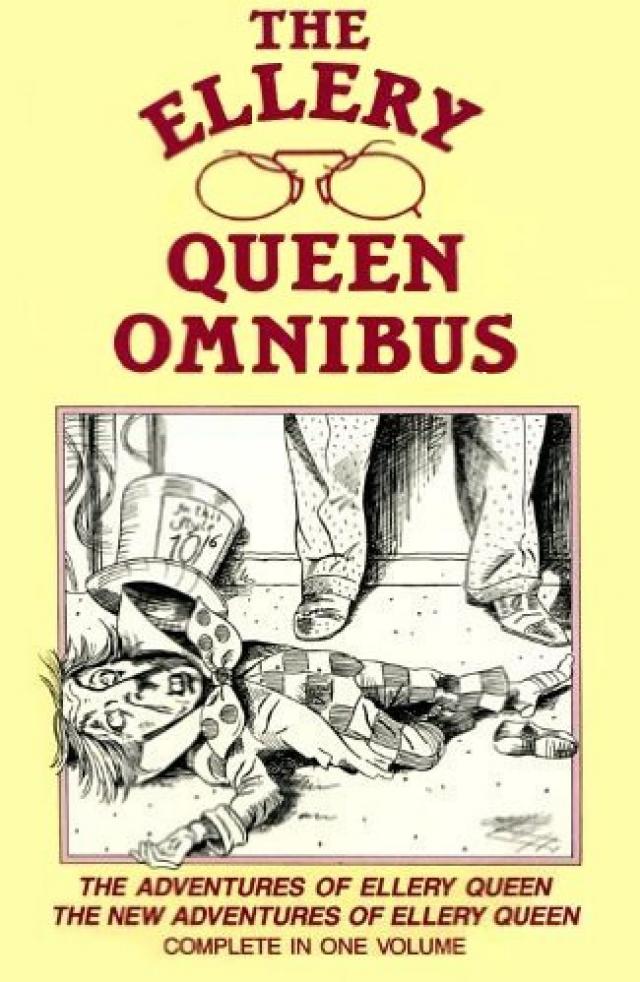
The stiff figure of the Mad Hatter, with Richard Owen’s unmistakable features, glared out at them—a dead, horrible, baleful glare.
Paul Gardner stumbled to his feet, choking and jerking at his collar. His eyes bugged out of his head. “O-O-Owen,” he gasped. “Owen. He can’t be here. I b-b-buried him myself under the big rock behind the house in the woods. Oh, my God.” And he smiled a dreadful smile and his eyes turned over and he collapsed in a faint on the floor.
Ellery sighed. “It’s all right now, De Vere,” and the Mad Hatter moved and his features ceased to resemble Richard Owen’s magically. “You may come out now. Admirable bit of statuary histrionics. And it turned the trick, as I thought it would. There’s your man, Mr. Naughton. And if you’ll question Mrs. Gardner, I believe you’ll find that she’s been Owen’s mistress for some time. Gardner obviously found it out and killed him. Look out—there she goes, too!”
“What I can’t understand,” murmured Emmy Willowes after a long silence late that night, as she and Mr. Ellery Queen sat side by side in the local bound for Jamaica and the express for Pennsylvania Station, “is—” She stopped helplessly. “I can’t understand so many things, Mr. Queen.”
“It was simple enough,” said Ellery wearily, staring out the window at the rushing dark countryside.
“But who is that man—that De Vere?”
“Oh, he! A Thespian acquaintance of mine temporarily ‘at liberty.’ He’s an actor—does character bits. You wouldn’t know him, I suppose. You see, when my deductions had led me to the looking glass and I examined it and finally discovered its secret and opened it, I found Owen’s body lying there in the Hatter costume—”
She shuddered. “Much too realistic drama to my taste. Why didn’t you announce your discovery at once?”
“And gain what? There wasn’t a shred of evidence against the murderer. I wanted time to think out a plan to make the murderer give himself away. I left the body there—”
You mean to sit there and say you knew Gardner did it all the time?” she demanded, frankly skeptical.
He shrugged. “Of course. The Owens had lived in that house barely a month. The spring on that compartment is remarkably well concealed; it probably would never be discovered unless you knew it existed and were looking for it. But I recalled that Owen himself remarked Friday night that Gardner had designed ‘this development.’ I had it then, naturally. Who more likely than the architect to know the secret of such a hidden closet? Why he designed and had built a secret panel I don’t know; I suppose it fitted into some architectural whim of his. So it had to be Gardner, you see.” He gazed thoughtfully at the dusty ceiling of the car. “I reconstructed the crime easily enough. After we retired Friday night Gardner came down to have it out with Owen about Mrs. Gardner—a lusty wench, if I ever saw one. They had words; Gardner killed him. It must have been an unpremeditated crime. His first impulse was to hide the body. He couldn’t take it out Friday night in that awful rain without leaving traces on his night-clothes. Then he remembered the panel behind the mirror. The body would be safe enough there, he felt, until he could remove it when the rain stopped and the ground dried to a permanent hiding-place; dig a grave, or whatnot….He was stowing the body away in the closet when I opened the door of the den; that was why I didn’t see the reflection of the clock. Then, while I was in the library, he closed the mirror-door and dodged upstairs. I came out quickly, though, and he decided to brazen it out; even pretended he thought I might be ‘Owen’ coming up.
“At any rate, Saturday night he drugged us all, took the body out, buried it, and came back and dosed himself with the drug to make his part as natural as possible. He didn’t know I had found the body behind the mirror Saturday afternoon. When, Sunday morning, I found the body gone, I knew of course the reason for the drugging. Gardner by burying the body in a place unknown to anyone—without leaving, as far as he knew, even a clue to the fact that murder had been committed at all—was naturally doing away with the primary piece of evidence in any murder-case…the corpus delicti….Well, I found the opportunity to telephone De Vere and instruct him in what he had to do. He dug up the Hatter’s costume somewhere, managed to get a photo of Owen from a theatrical office, came down here….We put him in the closet while Naughton’s man was detaining you people in the library. You see, I had to build up suspense, make Gardner give himself away, break down his moral resistance. He had to be forced to disclose where he had buried the body; and he was the only one who could tell us. It worked.”
The actress regarded him sidewise out of her clever eyes. Ellery sighed moodily, glancing away from her slim legs outstretched to the opposite seat. “But the most puzzling thing of all,” she said with a pretty frown. “Those perfectly fiendish and fantastic packages. Who sent them, for heaven’s sake?”
Ellery did not reply for a long time. Then he said drowsily, barely audible above the clatter of the train: “You did, really.”
“I?” She was so startled that her mouth flew open.
“Only in a manner of speaking,” murmured Ellery, closing his eyes. “Your idea about running a mad tea-party out of Alice for Master Jonathan’s delectation—the whole pervading spirit of the Reverend Dodgson—started a chain of fantasy in my own brain, you see. Just opening the closet and saying that Owen’s body had been there, or even getting De Vere to act as Owen, wasn’t enough. I had to prepare Gardner’s mind psychologically, fill him with puzzlement first, get him to realize after a while where the gifts with their implications were leading….Had to torture him, I suppose. It’s a weakness of mine. At any rate, it was an easy matter to telephone my father, the Inspector; and he sent Sergeant Velie down and I managed to smuggle all those things I’d filched from the house out into the woods behind and hand good Velie what I had….He did the rest, packaging and all.”
She sat up and measured him with a severe glance. “Mr. Queen! Is that cricket in the best detective circles?”
He grinned sleepily. “I had to do it, you see. Drama, Miss Willowes. You ought to be able to understand that. Surround a murderer with things he doesn’t understand, bewilder him, get him mentally punch-drunk, and then spring the knock-out blow, the crusher….Oh, it was devilish clever of me, I admit.”
She regarded him for so long and in such silence and with such supple twisting of her boyish figure that he stirred uncomfortably, feeling an unwilling flush come to his cheeks. “And what, if I may ask,” he said lightly, “brings that positively lewd expression to your Peter Pannish face, my dear? Feel all right? Anything wrong? By George, how do you feel?”
“As Alice would say,” she said softly, leaning a little toward him, “curiouser and curiouser.”
THE END
ACKNOWLEDGMENTS
THE AUTHOR WISHES TO express his gratitude to Red Book, Mystery, Great Detective and Mystery League for permission to include certain stories which appeared in their publications.
All rights reserved under International and Pan-American Copyright Conventions. By payment of the required fees, you have been granted the non-exclusive, non-transferable right to access and read the text of this ebook onscreen. No part of this text may be reproduced, transmitted, downloaded, decompiled, reverse engineered, or stored in or introduced into any information storage and retrieval system, in any form or by any means, whether electronic or mechanical, now known or hereinafter invented, without the express written permission of the publisher.
This is a work of fiction. Names, characters, places, and incidents either are the product of the author’s imagination or are used fictitiously. Any resemblance to actual persons, living or dead, businesses, companies, events, or locales is entirely coincidental.
Copyright © 1934, 1935 by Ellery Queen
Copyright renewed by Ellery Queen
Cover design by Jim Tierney
978-1-4532-8966-2
This 2013 edition distributed by MysteriousPress.com/Open Road Integrated Media
180 Varick Street
New York, NY 10014
www.mysteriouspress.com
www.openroadmedia.com
EBOOKS BY
ELLERY QUEEN
FROM MYSTERIOUSPRESS.COM
FROM OPEN ROAD MEDIA
These and more available wherever ebooks are sold
Otto Penzler, owner of the Mysterious Bookshop in Manhattan, founded the Mysterious Press in 1975. Penzler quickly became known for his outstanding selection of mystery, crime, and suspense books, both from his imprint and in his store. The imprint was devoted to printing the best books in these genres, using fine paper and top dust-jacket artists, as well as offering many limited, signed editions.
Now the Mysterious Press has gone digital, publishing ebooks through MysteriousPress.com.
MysteriousPress.com offers readers essential noir and suspense fiction, hard-boiled crime novels, and the latest thrillers from both debut authors and mystery masters. Discover classics and new voices, all from one legendary source.
FIND OUT MORE AT
WWW.MYSTERIOUSPRESS.COM
FOLLOW US:
@emysteries and Facebook.com/MysteriousPressCom
MysteriousPress.com is one of a select group of publishing partners of Open Road Integrated Media, Inc.
Open Road Integrated Media is a digital publisher and multimedia content company. Open Road creates connections between authors and their audiences by marketing its ebooks through a new proprietary online platform, which uses premium video content and social media.
Videos, Archival Documents, and New Releases
Sign up for the Open Road Media newsletter and get news delivered straight to your inbox.
Sign up now at
www.openroadmedia.com/newsletters
FIND OUT MORE AT
WWW.OPENROADMEDIA.COM
FOLLOW US:
@openroadmedia and
Facebook.com/OpenRoadMedia
The New Adventures of Ellery Queen
Ellery Queen
MYSTERIOUSPRESS.COM
Contents
The Lamp of God
The Adventure of the Treasure Hunt
The Adventure of the Hollow Dragon
The Adventure of the House of Darkness
The Adventure of the Bleeding Portrait
Man Bites Dog
Long Shot
Mind Over Matter
Trojan Horse
The Lamp of God
A Short Novel
I
If a story began: “Once upon a time in a house cowering in wilderness there lived an old and eremitical creature named Mayhew, a crazy man who had buried two wives and lived a life of death; and this house was known as ‘The Black House’”—if a story began in this fashion, it would strike no one as especially remarkable. There are people like that who live in houses like that, and very often mysteries materialize like ectoplasm about their wild-eyed heads.
Now however disorderly Mr. Ellery Queen may be by habit, mentally he is an orderly person. His neckties and shoes may be strewn about his bedroom helter-skelter, but inside his skull hums a perfectly oiled machine, functioning as neatly and inexorably as the planetary system. So if there was a mystery about one Sylvester Mayhew, deceased, and his buried wives and gloomy dwelling, you may be sure the Queen brain would seize upon it and worry it and pick it apart and get it all laid out in neat and shiny rows. Rationality, that was it. No esoteric mumbo-jumbo could fool that fellow. Lord, no! His two feet were planted solidly on God’s good earth, and one and one made two—always—and that’s all there was to that.
Of course, Macbeth had said that stones have been known to move and trees to speak; but, pshaw! for these literary fancies. In this day and age, with its Cominforms, its wars of peace and its rocketry experiments? Nonsense! The truth is, Mr. Queen would have said, there is something about the harsh, cruel world we live in that’s very rough on miracles. Miracles just don’t happen any more, unless they are miracles of stupidity or miracles of national avarice. Everyone with a grain of intelligence knows that.
“Oh, yes,” Mr. Queen would have said; “there are yogis, voodoos, fakirs, shamans, and other tricksters from the effete East and primitive Africa, but nobody pays any attention to such pitiful monkeyshines—I mean, nobody with sense. This is a reasonable world and everything that happens in it must have a reasonable explanation.”
You couldn’t expect a sane person to believe, for example, that a three-dimensional, flesh-and-blood, veritable human being could suddenly stoop, grab his shoelaces, and fly away. Or that a water-buffalo could change into a golden-haired little boy before your eyes. Or that a man dead one hundred and thirty-seven years could push aside his tombstone, step out of his grave, yawn, and then sing three verses of Mademoiselle from Armentières. Or even, for that matter, that a stone could move or a tree speak—yea, though it were in the language of Atlantis or Mu.
Or … could you?
The tale of Sylvester Mayhew’s house is a strange tale. When what happened happened, proper minds tottered on their foundations and porcelain beliefs threatened to shiver into shards. Before the whole fantastic and incomprehensible business was done, God Himself came into it. Yes, God came into the story of Sylvester Mayhew’s house, and that is what makes it quite the most remarkable adventure in which Mr. Ellery Queen, that lean and indefatigable agnostic, has ever become involved.
The early mysteries in the Mayhew case were trivial—mysteries merely because certain pertinent facts were lacking; pleasantly provocative mysteries, but scarcely savorous of the supernatural.
Ellery was sprawled on the hearthrug before the hissing fire that raw January morning, debating with himself whether it was more desirable to brave the slippery streets and biting wind on a trip to Centre Street in quest of amusement, or to remain where he was in idleness but comfort, when the telephone rang.
It was Thorne on the wire. Ellery, who never thought of Thorne without perforce visualizing a human monolith—a long-limbed, gray-thatched male figure with marbled cheeks and agate eyes, the whole man coated with a veneer of ebony, was rather startled. Thorne was excited; every crack and blur in his voice spoke eloquently of emotion. It was the first time, to Ellery’s recollection, that Thorne had betrayed the least evidence of human feeling.
“What’s the matter?” Ellery demanded. “Nothing’s wrong with Ann, I hope?” Ann was Thorne’s wife.
“No, no.” Thorne spoke hoarsely and rapidly, as if he had been running.
“Where the deuce have you been? I saw Ann only yesterday and she said she hadn’t heard from you for almost a week. Of course, your wife’s used to your preoccupation with those interminable legal affairs, but an absence of six days—”
“Listen to me, Queen, and don’t hold me up. I must have your help. Can you meet me at Pier 54 in half an hour? That’s North River.”
“Of course.”
Thorne mumbled something that sounded absurdly like: “Thank God!” and hurried on: “Pack a bag. For a couple of days. And a revolver. Especially a revolver, Queen.”
“I see,” said Ellery, not seeing at all.
“I’m meeting the Cunarder Caronia. Docking this morning. I’m with a man by the name of Reinach, Dr. Reinach. You’re my colleague; get that? Act stern and omnipotent. Don’t be friendly. Don’t ask him—or me—questions. And don’t allow yourself to be pumped. Understood?”
“Understood,” said Ellery, “but not exactly clear. Anything else?”
“Call Ann for me. Give her my love and tell her I shan’t be home for days yet, but that you’re with me and that I’m all right. And ask her to telephone my office and explain matters to Crawford.”
“Do you mean to say that not even your partner knows what you’ve been doing?”
But Thorne had hung up.
Ellery replaced the receiver, frowning. It was stranger than strange. Thorne had always been a solid citizen, a successful attorney who led an impeccable private life and whose legal practice was dry and unexciting. To find old Thorne entangled in a web of mystery …
Ellery drew a happy breath, telephoned Mrs. Thorne, tried to sound reassuring, yelled for Djuna, hurled some clothes into a bag, loaded his .38 police revolver with a grimace, scribbled a note for Inspector Queen, dashed downstairs and jumped into the cab Djuna had summoned, and landed on Pier 54 with thirty seconds to spare.
There was something terribly wrong with Thorne, Ellery saw at once, even before he turned his attention to the vast fat man by the lawyer’s side. Thorne was shrunken within his Scotch-plaid greatcoat like a pupa which had died prematurely in its cocoon. He had aged years in the few weeks since Ellery had last seen him. His ordinarily sleek cobalt cheeks were covered with a straggly stubble. Even his clothing looked tired and uncared-for. And there was a glitter of furtive relief in his bloodshot eyes as he pressed Ellery’s hand that was, to one who knew Thorne’s self-sufficiency and aplomb, almost pathetic.
But he merely remarked: “Oh, hello, there, Queen. We’ve a longer wait than we anticipated, I’m afraid. Want you to shake hands with Dr. Herbert Reinach. Doctor, this is Ellery Queen.”
“’D’you do,” said Ellery curtly, touching the man’s immense gloved hand. If he was to be omnipotent, he thought, he might as well be rude, too.


