

The last word an autobio.., p.1
The Last Word: An Autobiography,
p.1
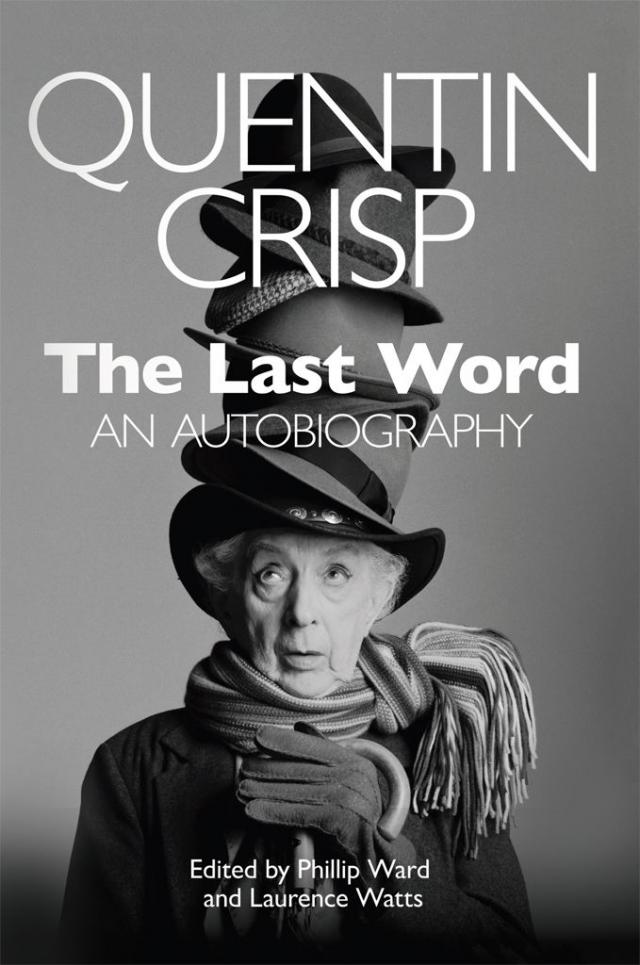


The Last Word
The Last Word
AN AUTOBIOGRAPHY
Quentin Crisp
Edited by Phillip Ward
and
Laurence Watts
© 2017 Phillip Ward
All rights reserved.
Front cover photograph by Joseph Mulligan
ISBN-13: 9780692968482
ISBN-10: 0692968482
CONTENTS
Foreword
CHAPTER 1: Sex, Sexuality and Identity
CHAPTER 2: Influence
CHAPTER 3: London and Hooliganism
CHAPTER 4: My Life in New York
CHAPTER 5: My Family
CHAPTER 6: Being a Tramp
CHAPTER 7: Living a Long Life
CHAPTER 8: The Twenty-First Century
CHAPTER 9: The Trappings of Notoriety
CHAPTER 10: Plays, Musicals and Operas
CHAPTER 11: My So-called Career
CHAPTER 12: My One-man Show
CHAPTER 13: The Naked Civil Servant
CHAPTER 14: The Lower East Side
CHAPTER 15: Daily Life
CHAPTER 16: On Being Ninety
CHAPTER 17: My Significant Death
AFTERWORD
Foreword
The Last Word is the third installment of Quentin Crisp’s autobiography. Let’s start there. What kind of a man gets to write three autobiographies? Most of us will never get to write one. Moreover, what kind of man achieves fame, or infamy as Quentin would say, in his sixties?
The answer is a man who was universally shunned and who became famous for revealing his society-enforced exile to the world. It took Quentin the vast majority of his life to generate the kind of “life experience” that would eventually fill the pages of The Naked Civil Servant. Was it time well spent? Hardly. But Quentin was, in more ways than one, very much a victim of the time in which he lived.
Homosexuality was illegal in the United Kingdom until 1967, by which time Quentin was 58 years old, ten years after the Wolfendon report had recommended that homosexual behavior between consenting adults in private should no longer be a criminal offence. Quentin’s seminal radio interview with Phillip O’Connor may have been broadcast in 1964, but the first installment of his autobiography, The Naked Civil Servant, was not published until 1968. Public interest in the book’s subject matter would surely have been key to Jonathan Cape’s decision to commission the work.
A year later the Stonewall riots took place in New York, followed over the next several years by the state by state repeal of the majority of America’s sodomy laws. The Naked Civil Servant rode this wave of liberalism, becoming a television documentary in 1971 and a film in 1975 starring John Hurt as Quentin, a performance for which he won the 1976 British Academy of Film and Television Arts (BAFTA) Award for Best Actor.
The Naked Civil Servant elevated Quentin Crisp to the status of gay icon, detailing as it did Quentin’s pioneering existence and persecution as an openly gay man in the 1930s, 40s, 50s and 60s. It was very much a first of its kind. Was Quentin the kind of gay icon that the emerging global gay community wanted or needed? Perhaps not, but who else was there? Initially at least, options were few. Gay men may not have looked at Quentin and seen themselves, but they related to his isolation and oppression.
What Quentin did next however was perpetuate his celebrity through an eccentricity and constant accessibility that kept him on the fringes of the art and entertainment worlds for the next twenty-four years. To be fair, he never achieved Hollywood-level fame, but the suffering of his early life gave him a credibility that endeared him to the gay community and a number of influential people.
One of Crisp’s fans was Sting who wrote his 1987 hit Englishman in New York about him. Another was Calvin Klein who cast Quentin in a commercial for one of his colognes. The list goes on and meant that the pain of Quentin’s early years was at least partially compensated for in the twilight of his life. Shear longevity on Crisp’s part meant that he was able to enjoy this cult status for years more than a typical actor or writer. In fact, by the time he died in 1999 Quentin had published 14 books and starred in more than 20 films despite no specific training in either craft.
The Last Word reads differently from Quentin’s earlier books, especially The Naked Civil Servant. This owes less to how it has been edited and more to when and how it was written. Quentin lost the use of his left hand in the early 1990s when he was in his eighties and became unable to use his typewriter. Subsequent works of his were dictated; The Last Word was recorded by his best friend Phillip Ward. As such, The Last Word reads more like a monologue and less like a written text. We have tried to alter the content and style of The Last Word as little as possible in the hope that the end result provides a more reliable and intimate portrait of Quentin in the last year of his life. Yes, he grandstands and repeats and contradicts himself, but what ninety-year-old that you know doesn’t? The important thing is that he is speaking directly to you because as you read this you are the most important person in the world to him.
This final installment of his autobiography was finished in 1999, the year of Quentin’s death. As you’ll see from reading this book, Quentin had begun to put his affairs in order knowing that, aged ninety and with an enlarged heart and prostate cancer, his long life was finally nearing its end. He didn’t know exactly how much longer he had, but The Last Word was written to share his untold stories and to reflect for the last time on an extraordinary life.
Why has it taken so long to be published? Well, perhaps that’s what happens when you leave your best friend in charge of your literary estate. As I mentioned, Quentin dictated this book to Phillip. When one listens to the recordings as I have, Quentin does not sound in good health. Frequently he can be heard coughing or furiously scratching at his cracked and brittle skin. After Quentin’s death it was too painful for Phillip to hear Quentin’s voice, let alone take in and transcribe what he had said. Time is the only remedy for such pain and that alone explains the delay in getting this book to you.
I first met Phillip when I interviewed him for Pink News in 2011. Once our interview had been published he enlisted me to help him with The Last Word and our combined efforts have produced the text you are about to read. One of my regrets is that we were unable to finish it before John Hurt’s death earlier this year. Another issue is that, with so much time having passed since Quentin’s death, there is the very real question of just how many people now remember who Quentin was. It is with this in mind, not to mention the generational collapse in reading that we are currently witnessing, that I have sought to provide as much detail on Quentin’s life, observations and quotes in the form of footnotes. I have assumed little to no knowledge of Quentin’s reference points on the part of the reader.
Quentin, as I have said, was a victim of his time in more ways than one. This is particularly true when it comes to his transgenderism which he talks about at length in The Last Word. That Quentin lived his life believing himself to be gay is because our understanding of what it means to be transgender is relatively new. The term itself only acquired its current meaning in the 1990s, the last decade of Quentin’s life. He mistook being transgender for being homosexual in the same way that Chaz Bono, the erstwhile daughter of Cher, first believed he was lesbian. The gay men who couldn’t associate with Quentin’s femininity or his pronouncements about gay life were right to be confused. He inaccurately believed his own feelings were the same as theirs. It turns out they weren’t.
Crisp’s other altercations with the gay community arguably came about because of his assumed later-in-life role of quotable contrarian, which kept his name in the news and no doubt kept the dinner invitations rolling in. Quentin had two strings to his public commentary bow. When it came to talking about himself he told you what you wanted to hear: that he was unloved, that England was horrible, that everyone and everything in America was wonderful, and that he had never worked a day in his life. When it came to talking about other people, topics or events, he erred towards sensationalism. This made sure that his was the quote the journalists printed. Even if it wasn’t actually his opinion. Thus, “Princess Diana was a disgrace who got what she deserved” and “AIDS was a fad.” These so-called “opinions” of Quentin’s became problems for him that were further complicated by his refusal to publicly recant anything he had previously said. Doing so, he thought, would cost him credibility.
It is true of course that Quentin was surrounded by love, and he expressed his own love to those close to him. Despite his earlier condemnation of England, he was grateful to it for giving him fame. He fully realized that America is as littered with pockets of bigotry and homophobia as other developed nations are. He ended his life with more acting credits than most actors have, more books published than most writers achieve, and with more than a million dollars in the bank. Quentin however never let the facts get in the way of a good anecdote.
Phillip Ward has kindly provided an afterword to The Last Word which serves as the final chapter to this book. He was the person closest to Quentin and hence is most able to recount Crisp’s last days.
Finally, let me turn to Quentin’s legacy. The Naked Civil Servant remains Quentin’s most important work and in it he details for future generations what it was like to be openly gay during a time when homosexuality was considered immoral and was in fact illegal. The book and film of the same name provided hope for those living in an age of now legal homosexuality, but who wer
e still subject to discrimination because of society’s prejudices.
Quentin’s story is one of triumph over adversity, though Crisp can be said to have outlasted his foes rather than having directly fought them. His may not have been a life that you wanted to emulate, his may not have been a look that you wanted to copy, but in the latter part of his life he was an openly gay man who hadn’t been imprisoned and broken like Oscar Wilde, who didn’t take his life like Alan Turing, who wasn’t associated with “boys” like Bill Tilden, who didn’t remain closeted like E. M. Forster or John Maynard Keynes, who wasn’t disgraced like John Gielgud and who didn’t succumb to AIDS like Rock Hudson.
Here was an openly gay man who put up with what the world threw at him, lived to a grand old age and who found relative fame and eventually fortune at the age of sixty, seventy, eighty and even ninety. His sheer existence told gay men in Britain, America and throughout the world that they were not alone and that there is always hope.
Laurence Watts
August 2017
CHAPTER 1
Sex, Sexuality and Identity
This will be the last book that I write. What little I can say and do is almost done because, at the end of the day, I am nobody and I am nothing.
Most of my life is contained within the pages of The Naked Civil Servant and How To Become A Virgin. The former deals with my so-called life in England and the latter with my rebirth here in America. I only have a few more stories left to share before my well runs dry. I know and hope that the end is near. This book will be my swan song. A chance for me to have the last word.
It is my opinion that everyone should write at least one book in their lifetime and that if a person writes just one book then it should be a book about themselves and in it they should tell the truth. He or she should not be held back by the fact that they can’t write or that they can’t make the subject matter picturesque. That’s a mistake. Miss Stein1 said, “The way to say it is to say it.” And she spoke the truth.
Where then should I begin? I’ll begin with my truth, at the very beginning.
When I was writing The Naked Civil Servant I remember Mr. Carroll2 saying to me, “Don’t say too much about your childhood. I’m bored with people’s childhoods.” I have to say that I failed him. The truth is I had to try and understand why I had been such a wretched child. I was a terrible nuisance and wanted attention more than anything.
Later, I met a woman to whom I said, “If all my family had stood around me as a child and said, ‘You’re wonderful. You’re wonderful. You’re wonderful.’ after an hour I would have complained, ‘You’re not saying it loud enough.’”
And quick as a flash she told me, “My son’s like that.”
I don’t feel uncomfortable about my early life, but it’s almost like speaking about another person. It was so long ago it feels like another reality, as if it didn’t happen. I can’t recall precise feelings that I had, but I can recall facts and sometimes the look of places and people. This lack of sentimentality when remembering the past is one of the few masculine traits I believe I possess.
I don’t think there was a single event or thought in my life which shaped who I am today, but there was one long daydream that I lived in, up until at least the age of eleven or twelve. So let us begin this book with that daydream.
I can remember my mother alternately trying to jolt me out of my dream and pandering to my being in it. She even bought me ballet shoes. Now, I regard this fact as remarkable because I’ve never since heard of a man wearing blocked toe shoes. I went to a dance class once, in my ballet shoes, and walked up and down the room on my points. I don’t remember the mistresses stopping me, or laughing, or anything like that, but looking back it was clearly a sign of things to come.
In my early years I attended a school for boys and girls. Every day the boys would march out onto the field to play football. I refused to play. They would kick the football at me and I would dodge it. I never once tried to kick it in any way. I was preoccupied with my daydream. I suppose my mother must have given up and thought, “Well, that’s just the way it is.”
When I was very young, my mother read romantic poems to me. She recited Idylls of the King by Mr. Tennyson3 and the narrative poems of Mr. Scott,4 which very few have heard of. Scott’s poems included tales like The Lady of the Lake and Marmion which inspired me to dream about fair ladies and brave knights, fostering my romantic inner life and shaping my daydream.
I began writing my own poetry. One day my sister and my mother found it and read it. Despite knowing it wasn’t for public reading they nevertheless laughed at it, which hurt me a great deal. My sister was malicious. She would say of me, “Oh, he likes to be different.”
She never thought, “What is his problem? What can be done about it?” She just thought I was showing off. Of course, I was showing off, but at the same time I was in a terrible bind about who and what I was, something she didn’t recognize or bother to think about.
My daydream as a child was of growing up to be a very worldly, very beautiful woman. Those were my only daydreams. I played games of make believe with very little girls in the neighborhood. I had no male friends at all. I only had girl friends who could be ruled and made to play parts in my daydreams.
Of course, I never thought I was gay. I never heard the word homosexual until I was about nineteen or twenty, but I knew I was different from other people because they made it perfectly obvious to me. I wasn’t worried by it nor did I think, “What shall I do to seem more like a real person?” Somehow, I accepted my fate.
I remember playing a game of make-believe when I was nine or ten with a girl and one of her friends. One of the girls said, “You can be a great, dark prince.”
The girl next to her who knew better said, “Oh, Denis5 never plays the parts of real men.”
And I remember thinking, “No, I never do.”
And the first girl continued excitedly, “Oh. Well then, I will be the great dark prince.” It didn’t matter to her whether she played a male or female part, it was only a game. To me it was more serious than a game however, though I didn’t comprehend it at the time.
I never had boy friends because boys wanted to play rough games and sports and I was never any good at those things, so I never was with them. I don’t remember ever meeting boys or men and falling in love with them and them kissing my hand or anything like that. I was just always this beautiful creature.
Had I been born a woman, none of my life would have happened and I could have been happy. Well, perhaps that’s stretching a point. Let’s just say I might not have been quite as unhappy. And of course when you’re on the outside looking in, it always seems that other people are happier than you are anyway.
At the age of ninety, it has finally been explained to me that I am not really homosexual, I’m transgender. I now accept that. All my life, I have wanted to be part of society without having to alter my daydream, my own reality. When it comes to sex, these days I’m asexual. Nevertheless, I’m now convinced that it has been my view of myself and not my view of men that has been my trouble.
I no longer see myself as homosexual, though it is a word I have used to describe myself and which others have understandably used to describe me. I don’t actually see myself as a man though, of course, I know I’m not physically a woman.
To start, I don’t dress like a woman. I did know a man once who worked as a waitress for at least six months and who changed into his uniform in a room where other women were changing and was never detected. That’s pretty amazing to me. I don’t think I could have done that though. I think my body is too like a man’s body to have lived as a woman with any kind of success.
I have also only ever worn drag once. I suppose you could say it was a success in that nothing happened. I put on women’s clothes, I left the place where I lived, I got on a bus and went to the Regent Palace Hotel, had a drink there with my friend, got on another bus and came back. It was uneventful, but I think I did it to prove to myself that I could live the life of a woman albeit only for a few hours. I don’t really know what I expected.


