

On wholeness, p.1
On Wholeness,
p.1
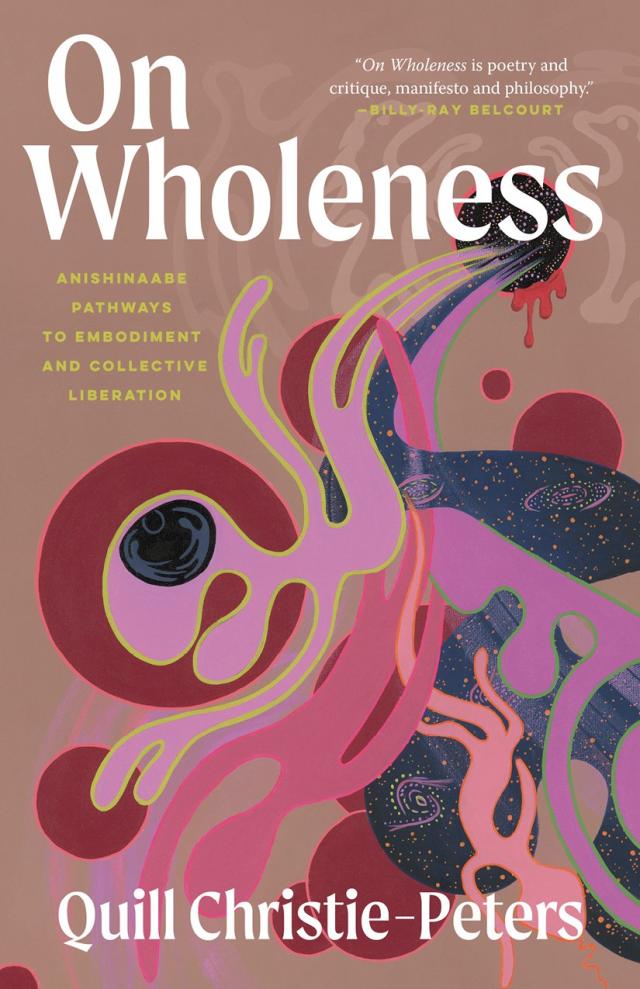


On
Wholeness
Anishinaabe Pathways to Embodiment and Collective Liberation
Quill Christie-Peters
Copyright © 2025 Quill Christie-Peters
Published in Canada and the USA in 2025 by House of Anansi Press Inc.
houseofanansi.com
* * *
All rights reserved. No part of this publication may be reproduced or transmitted in any form or by any means, electronic or mechanical, including photocopying, recording, or any information storage and retrieval system, without permission in writing from the publisher.
* * *
House of Anansi Press is a Global Certified Accessible™ (GCA by Benetech) publisher. The ebook version of this book meets stringent accessibility standards and is available to readers with print disabilities.
* * *
29 28 27 26 25 1 2 3 4 5
* * *
Library and Archives Canada Cataloguing in Publication
Title: On wholeness : Anishinaabe pathways to embodiment and collective liberation / Quill Christie-Peters.
Names: Christie-Peters, Quill, author
Identifiers: Canadiana (print) 20250252988 | Canadiana (ebook) 20250253224 |
ISBN 9781487013257 (softcover) | ISBN 9781487013264 (EPUB)
Subjects: LCSH: Mind and body. | LCSH: Human body (Philosophy) | LCSH: Human body—Social aspects. | LCSH: Settler colonialism. | LCSH: Decolonization.
Classification: LCC BF161 .C57 2025 | DDC 128/.2—dc23
Cover design: Alysia Shewchuk
Cover artwork: Quill Christie-Peters
Interior design and typesetting: Lucia Kim
Ebook development: Nicole Lambe
* * *
House of Anansi Press is grateful for the privilege to work on and create from the Traditional Territory of many Nations, including the Anishinabeg, the Wendat, and the Haudenosaunee, as well as the Treaty Lands of the Mississaugas of the Credit.
* * *
* * *
We acknowledge for their financial support of our publishing program the Canada Council for the Arts, the Ontario Arts Council, and the Government of Canada.
For my late Grandpa Harry, and all the futures of wholeness that will descend from him
And for my daughter, Giizik, who holds us in
the certainty of those beautiful futures
Introduction
She is full like the moon, rupturing
like a galaxy and dancing with her ancestors
like smoke rising to the sky
I am sitting in a bustling café with my back pressed firmly against a hard bench. I am only thirty-one years old, yet it feels so hard to keep my back upright in this weighted world. The bench beneath me is hard and angular against my soft flesh—the juxtaposition of my tender Anishinaabe existence against the unforgiving settler colonial world. I have worked so hard to stay soft. We have worked so hard to stay soft—generations upon generations of Anishinaabeg working to stay soft like the moss bogs of our homelands that seep water to rupture the concrete roads that traverse us. Under the gentle moonlight, I have kneaded my body like warm dough in order to retain its supple roundness—my edge is infinite.
A healer once told me that my shoulders want to round in order to protect my heart, and I imagine my centre like a whirlpool, pulling my body into the sacred smoke of my swirling chest so that I might become a magenta eddy of stardust and cosmic dust. If I close my eyes tight enough, I can feel myself floating softly through pink galaxies. If I focus hard enough, I can recede so far into my own body that I emerge in the great beyond, the place where my ancestors dance omnipresently and with an absolution unbounded by time and space. If I take a slow breath, my eyes closed, I can feel the swirling smoke inside my body, the low moan of creation expelling the expansive, dancing universe in each steady breath.
Our Anishinaabe bodies, wild and shifting with the pulse of the universe, flicker between many states. Sometimes, we are simply human beings delighting in our earthly experiences. Sometimes, we are joined by ancestors who sing through our flesh. Sometimes our feet are planted firmly on earth, and sometimes our feet dance upon stars. We are always everything all at once, a reality incomprehensible to the linearity of the settler colonial world. Even as a child I carried this inherent knowing, a seed planted deep into bone and watered tenderly by generations of Anishinaabeg fighting to persist, with softness.
Despite the swirling smoke deep within my chest, I have not always been present enough to receive it. My body has not always been soft enough to feel its discrepancy against a hard surface. At times, my body has been so hardened that its edges would meet the angular container of this bench with absolution, contained in its grasp. I have not always been able to tend to the wounds of my flesh, nor feel the embrace of the moon’s light shining lovingly on my figure. It is during these times that my ancestors gather at the lip of the great beyond, where stardust begins to take shape into skin and bone, to sing me a simple song that calls me back into my body. It is during these times that they work tirelessly to warm my body, kneading my flesh back into supple flexibility so that the swirling smoke inside of my chest can ripple through my skin once again with the perpetual motion of creation. Here, creation is the throbbing pulse of existence, the infinite great mystery and the totality of the universe, earthbound and beyond. Creation loves our bodies so. My ancestors tend to my softness when I cannot. Our persistence has always been a collective endurance, even when enacted by our individual bodies.
My bones are timeless. They throb with the ethereal moans of my ancestors who congregate in their farthest corners, a dull and faint drumming. My bones are enduring. When my body one day decays, my bones will sink deep into the earth, returning to join the scaffolding of our mother, her primordial heartbeat pulsing with creation.
This book is an embodiment of Anishinaabe reality in all its fullness and complexity. I welcome you into my world, where my palms shimmer with stardust and my body dissolves back into the waterways and starscapes that birthed me. I welcome you into our world, which spans not only our earthly existence but far out into the great beyond, accessed through our beautiful, complex, wild, and shifting bodies. As Anishinaabe people, we use metaphor to communicate, teach, and relate to the world around us precisely because we live out these metaphors in our real and tangible lives. Much of the imagery in this book that describes what it means to exist beyond our physical bodies is not metaphor but lived reality for Anishinaabeg. When I write, “She was full like the moon, rupturing like a galaxy and dancing with her ancestors like smoke rising to the sky,” I mean it, literally and wholly. When I paint my ancestors gathering at the edge of my skin to build a fire that will call me back into my body despite the fragments, wounds, and losses, they are materially doing so.
To be Anishinaabe is to have the love of our ancestors viscerally transmitted to us in real time from the great beyond, through the body. To be Anishinaabe is to have stardust in our bones that echoes from the place in the sky that we come from and have responsibilities to. To be Anishinaabe is to be a drop of water in the flowing river of creation, held so tenderly by all our relations.
My blood is unbroken from the flow of the waterways I come from. Like a steady stream of water trickling over rock, the dark red hues of my mortality dance with the reverent rivers who birthed me. My blood is unbounded from the veins and channels that hold it. It also paints the starry night sky, red globular spheres floating through the constellations who breathed me into being.
I am a cisgender and able-bodied Anishinaabekwe with Scottish and Irish ancestors, visibly Native but not nearly as dark as many of my relatives. I grew up painting and writing. From the time I could hold a paintbrush, I envisioned futures informed by my ancestors’ breath on a cold winter night, the mist of their voices rising to meet the stars. From the time I could write, my words traversed the place beyond time, the place before birth, the swirling smoke inside my own body, and the great beyond. Despite growing up with fragmented cultural immersion, I have always been irrevocably grounded in my identity as an Anishinaabe person through my worldview and the ways I have been resourced by my ancestors, the ways I have always danced with the swirling smoke inside me. When I received my Anishinaabe name, it all made so much sense. Kakekayatahseekobiik—never-ending light, that which we feel is lost resides in me. We are everything they can never contain. We are everything they can never reach. In a world of relentless settler colonial violence where so many Anishinaabe bodies are battered, bruised, and contorted under the weight of our intended destruction, we remain everything they can never be and everything they can never have. Our wild and flickering bodies innately evade their grasp from this world to the next. I have always known this.
Here on Turtle Island, settler colonialism has always been deeply terrified of Anishinaabe bodies and the swirling smoke inside of them. The settler colonial world, governed by the compartmentalization of life into discrete parts, which can then be used to generate hierarchy, seeks to solidify the structures of power that bolster colonial domination. Our bodies inherently evade these compartmentalizations. We flicker among many forms under the beating sun and shift into a smoke that is undefinable, incomprehensible, and untouchable to the colonial world, existentially and materially threatening the colonial project. As such, our bodies have always been the explicit target of the settler colonial state in both literal and metaphysical ways.
/>
In the most literal sense, our bodies are removed from the land through genocide and violence to ensure settler expansion and occupation. Here on Turtle Island, the older global settler colonies of Canada and the United States established themselves in the generations before us through widespread strategies of genocide such as massacres and forced starvation. Although these settler states work hard to frame these strategies as events that happened in the past, they are deeply rooted structures that persist in the present day, albeit obscured and enacted through more insidious forms of genocide cloaked in the discourse of reconciliation and inclusion. The settler state would have us believe that the attempted extermination of Indigenous peoples was a thing of the very distant past, but I only have to look to my father’s generation for examples of this. The settler state would have us believe that they are working hard to take accountability for the mistakes of the past, but the collective experience of Indigenous peoples across Turtle Island says otherwise. We continue to experience forms of genocide that are intended to maintain an Indigenous population that is not threatening to the settler state and that destroy Indigenous bodies in a way that is not only tolerated but consented to by the larger population. They continue to do everything they can to remove our bodies from the land.
Our bodies are also targeted metaphysically as a way to weaken the ability of Indigenous peoples to resist our dispossession. This category of violence accounts for the otherwise unexplainably grotesque, perverted, and evil dimensions of settler colonial violence that explicitly target the relationship Indigenous peoples have with their own bodies and sense of self. On Turtle Island, Indigenous relationships to the body have been targeted as a central colonial strategy—from widespread sexual violence enacted on generations of Indigenous peoples to the horrors of the residential school system enacted on the bodies of our babies and children, they have always tried to keep us from dancing with the swirling smoke inside of us. Our bodies, and everything they are capable of, terrify them so.
My hair is celestial. Like the strands of web from a spider weaving worlds, my hair tethers me to the galaxies that swirl in the sky and in my heart. My hair is elusive. Its many strands rise to the sky effortlessly and without gravity, the web of body woven to the great beyond.
Settler colonial disembodiment is one of the central impacts of colonialism that Indigenous peoples must grapple with in older settler colonies after generations of sustained genocide. We experience disembodiment in multidirectional ways that are birthed from places of both non-consent and agency, but always through violence. Disembodiment exists as both a violent orchestration by the settler colonial state in order to dispossess us and as a self-emanating survival strategy that allows us to persist against all odds. I speak back to the former. Not just the consequential harms of our failed extermination, settler colonial disembodiment is an intentional, sustained, and strategic limb of colonial strategy that exists to suppress the ontological and material resistance of Indigenous embodiment. Settler colonial disembodiment is the attempt to distance Indigenous self from body, harming our bodies in such complex ways that we must travel far away from them for our own survival and persistence. This disembodiment is multi-scalar—on the one end we might struggle to be present in our bodies to varying degrees, and on the other end we might walk away from our bodies permanently, leaving the earth to join our ancestors in the stars.
In an Anishinaabe worldview, disembodiment is much more than being removed from our physical bodies. By virtue of the swirling smoke inside of us and the ways we are woven into the web of creation around us, our bodies refuse to be compartmentalized to the physical realm. Our bodies are everything beyond the physical, traversing galaxy and earth, past and present—they are the holy containers of that beautiful swirling smoke that paints the universe around us. In alignment with our worldview that honours the expansive relationality that makes us whole, our bodies also encompass ancestor, homeland, star, and moon, forever flickering between many states. My body is the waterways of my homelands in Nezaadiikaang humming with the sounds of frogs and crickets, the pink galaxies that expelled me into body, and the way I access living ancestral archives. This is what Anishinaabeg have always celebrated—all our relations, embodied in the hub of our electric bodies that are rocked gently by the moon and held by the land.
Our wholeness requires us to experience presence within our bodies, but the ability to exist in a truly embodied state as an Indigenous person feels nearly impossible in a settler colonial world intent on the destruction of Indigenous life. Many of us do not live in a constant state of wholeness like our ancestors did but rather within varying degrees of disembodiment. Many of us will continue to live in disembodiment. Many of us will continue to disembody ourselves as a survival strategy. Disembodiment, the creation of space between self and spirit from the body; sometimes it is all we can do so that we can breathe. Disembodiment, a result of incomplete genocide in which settler colonialism still attempts to remove our spirits from our bodies when it cannot physically remove our bodies from the earth itself. Disembodiment, the attempt to keep us from being whole, from swirling like smoke with our endless ancestors in the great beyond.
Importantly, to be whole is not some idealistic state of being that is free of pain and suffering. To be whole is simply to have access to all that we are and to be present enough, even if just momentarily, within our bodies so that we can feel our ancestors, homelands, and the great beyond pulsing within us. To be whole is a uniquely individual experience, and our bodies are so brilliant that they continue to find ways for us to be whole despite, and alongside, our disembodiment. I reject the binary of embodied/disembodied that would posit embodiment as an absolute end goal for wholeness and liberation, and disembodiment as a non-liberatory state of being. I reject the binary of embodied/disembodied that would discredit the ferocious swirling smoke within my relatives who rely on their disembodiment for survival. I instead embrace a nuanced understanding of what it means to experience presence within the Indigenous body that is wild, flickering, strategic, and celestial. To reclaim Anishinaabe embodiment is to find moments along the spectrum of disembodiment to dance with the swirling smoke inside of us—it is not absolute. To reclaim Anishinaabe embodiment in the settler colonial world is to strategize how to grow closer to our inherent wholeness.
To be whole is our inherent right. It is also a vital part of our struggles for liberation from settler colonialism and imperialism. When we are whole, we are tethered firmly to our celestial responsibilities to build a more just world; we are resourced by our ancestors’ care and knowledge; and we are able to materially fight for land, love, and body. Our collective liberation calls loudly for our wholeness.
Liberation is a large and lofty term. I define liberation as being complexly connected to my larger web of creation, which includes not only Anishinaabe people but all people, lands, and beings that are touched by the clutches of empire and imperialism that currently encase the globe. Liberation is nothing short of the full and total dismantling of this rusty and rotting structure of imperialism such that Indigenous peoples globally at last have the right to life. But if I narrow my scope to be more specific to the contents of this book, then liberation is also the right of all people, lands, and beings across the globe to be whole.
Whole, first and foremost, as in alive and here. Whole, then, as in able to experience presence within the body, perhaps delighting in the love and care their ancestors exude to them. Whole, as in not broken into disembodied pieces through relentless colonial and imperial violence. Whole, as in no parts of us have fallen off because they are too much to bear and too much to look at. Whole, as in no parts of us have been ripped off by the clutches of imperialism. Whole, as in soft, with no hardened edges sharpened by the acute violence on Indigenous bodies, lands, and waters.
Soft, as in flowing tenderly with the stream of creation that rocks our bodies in the tides of justice and goodness and purpose and joy. Soft, as in we can soften because we know we will live to watch our children grow up free and whole.


