The lost library, p.1
The Lost Library,
p.1


Begin Reading
Table of Contents
About the Authors
Copyright Page
Thank you for buying this
Feiwel and Friends ebook.
To receive special offers, bonus content,
and info on new releases and other great reads,
sign up for our newsletters.
Or visit us online at
us.macmillan.com/newslettersignup
For email updates on Rebecca Stead, click here.
For email updates on Wendy Mass, click here.
The author and publisher have provided this e-book to you for your personal use only. You may not make this e-book publicly available in any way. Copyright infringement is against the law. If you believe the copy of this e-book you are reading infringes on the author’s copyright, please notify the publisher at: us.macmillanusa.com/piracy.
FOR THE LIBRARIANS OF THE PAST, PRESENT, AND FUTURE
Chapter One
MORTIMER
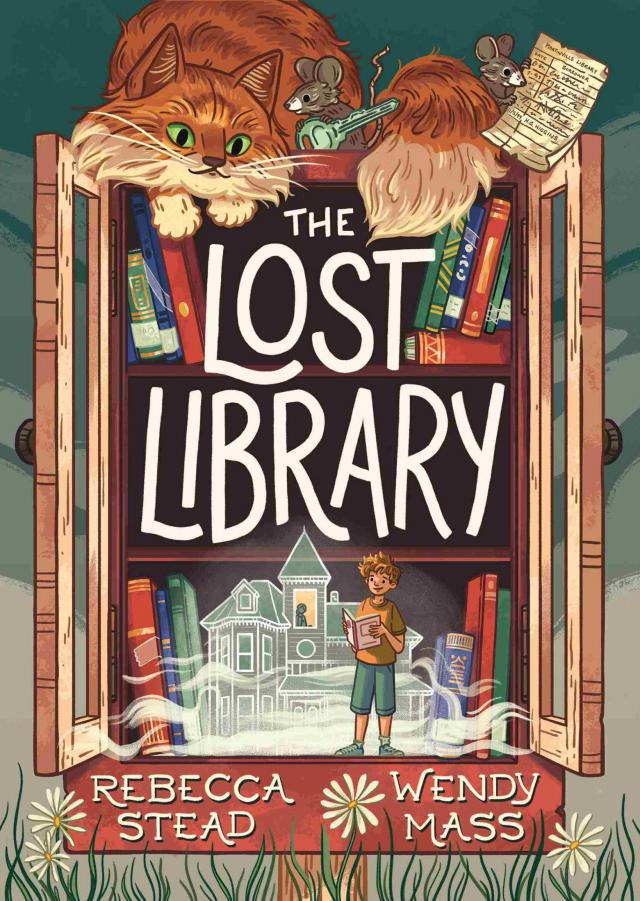
Mortimer waited on the cool stone basement floor in front of mouse door number four, his fluffy orange body covering as much territory as it could. His paws were spread in front of him, as if he were about to catch a watermelon.
Books, in Mortimer’s opinion, got it wrong about cats. In books, cats were usually stuck-up, sometimes even uncaring. As if cats had no feelings at all.
Cats had hearts, too.
Feelings, his heart said.
Mortimer had a lot of feelings. What he didn’t have were a lot of words.
Mice were better with words than he was. Mice talked a lot.
* * *
The bell on top of Martinville Town Hall began to ring, as it did at 6:00 P.M. every day. The scratching behind the door was getting louder. A mouse would be coming through any second now.
“Apples!” he heard a small voice say. “I smell apples!” And behind the voice there were murmurs of excitement.
Here they come, Mortimer thought. He put on what he hoped was a gentle smile just as the first of the mice emerged, shaking off little bits of dirt and sawdust and, as usual, talking.
“Is that a … cat?”
A second mouse appeared. “What sort of terrible place is this, with a heartless cat standing by the door? This must be a bad dream!”
A third mouse popped through the hole. Mice, Mortimer knew, rarely traveled alone.
“Welcome!” Mortimer said. He glanced nervously at the potato bin. Last week, a mouse had managed to jump into it. Mortimer had had to wait for him, remaining perfectly still under the stairs, for almost three hours.
“Please follow me, mice.” Mortimer tried to sound cheerful. “This way to outside!”
“But we just got inside!” one of them whined.
Using his outstretched arms like windshield wipers, Mortimer herded them to a small mouse hole in another corner of the basement (also known as mouse door number three). Mice, he’d learned, never liked to go out the same way they had come in.
“That horrible cat has six-toed feet! How terrifying!”
“Wait a minute. Could this cat be the Six-Toed Grouch?”
The exit, which was not far from the old library book cart, led outdoors, away from Ms. Scoggin, the apples, and Mr. Brock’s cheese. And the potato bin.
“And now I suppose we are expected to go straight out into the cold again?”
In fact, seeing Mortimer and his sizable paws, the three of them were already crowding around the mouse hole, trying to leave.
“Not cold,” Mortimer said. “It’s summertime. Be careful, though—there’s a road on the other side of this door. Cars. But everything is fine!”
“Oh, great,” one of them said. “Thanks for nothing, Six-Toed Grouch.” And he disappeared through the hole.
“And by the way, everything is NOT fine,” the last mouse added. “I’m VERY hungry.” But, keeping her eyes on Mortimer’s paws (he actually did have six toes on each), the mouse squeezed herself through the hole, backward.
“Sorry,” Mortimer said. “Keep moving, please. Sorry!”
“Cats are never sorry,” said the mouse, just before vanishing into the night. “Everyone knows that cats have no feelings.”
Mortimer didn’t say anything. There was no point, because they were gone. He pressed his eye to the small hole, looking to see that they had made it safely across the road. “Goodbye,” he whispered. “Goodbye and good luck.”
Ms. Scoggin did not tolerate mice. By now, Mortimer knew that he couldn’t stop them from coming in through the mouse holes (he’d carefully numbered them, mouse doors one through five). The mice had been coming for all the years he’d lived in the house, and there wasn’t much he could do about it, other than gently guide them back outside again. He’d learned to hear their scritching and scratching and was always ready to meet them at a door and point them to the nearest exit.
Mortimer did not think of himself as good with words, but his hearing was excellent.
* * *
He tried to straighten up the basement. As usual, rushing around the way they did, the mice had banged into things. Tonight, three apples had fallen from a tall wobbly shelf. Even with twenty-four toes, Mortimer could not pick up apples. But he could roll them to a spot near the stairs, where Al would be sure to see them right away. He lined them up for her.
Maybe they were not too bruised. Or she could make applesauce. Again.
When the basement was neat and quiet, he took a deep breath, savoring the smell of apple muffins that floated down the kitchen stairs. Al was baking, as she did most Sundays. Through one of the small, high basement windows, he saw the day’s light fading. He exhaled, and felt happy.
Then his eye fell upon the cart of old library books. His happiness went quiet, and a guilty feeling wrapped around him like one of Al’s hugs, which were always a little too tight.
My fault, his heart said, for the millionth time. All my fault.
He looked away.
Chapter Two
MORTIMER
Not long after the mice left, Al came downstairs. Ignoring the apples he’d lined up for her, she sat herself down on the basement floor, where she did not move for almost an hour.
She was staring at the library cart.
In twenty years, Al had never done that before.
Mortimer wondered if she needed a hug and went over to stand on one of her feet.
“Oh, dear cat!” she said, and reached for him.
Little too tight, Mortimer thought. But he allowed it.
* * *
When Al began to take the books off the cart, stacking them on the floor all around him, Mortimer closed his eyes.
That delicious book smell, his heart said.
He let himself think about the library and his kitten days.
Mortimer and his sister Petunia had loved their games. “Boss of the library” was Petunia’s favorite. The rules were simple: Whoever climbed to the highest place was the winner. Mortimer, with his twenty-four toes, was a good climber, but he rarely won. Petunia climbed higher. She had six toes on every paw, just like he did. He could still remember her face, smiling down at him from the highest bookshelves in the old library stacks.
Once, she’d somehow made it up on top of the library’s big blue doors! His eyes still closed, Mortimer remembered. Petunia was like a beautiful and triumphant snowball, way up near the ceiling. A stuck snowball.
Ms. Scoggin had stood on a chair to get her down.
Ms. Scoggin was Mortimer’s favorite. Her hugs were never too tight.
* * *
These happy thoughts were interrupted by Al.
“Dear cat!” Al was clutching her notebook. He saw that she had drawn lot of marks on the library cart, and piled all the books onto it again. Messily.
Her cheeks were flushed. “We must wake Ms. Scoggin,” she told him. “There is no time to lose.”
He followed her upstairs and then right back down to the basement, now with Ms. Scoggin floating sleepily behind them. “I was having the most delightful dream,” Ms. Scoggin told Al. “I dreamed I was at the movies! I believe it was the theater in Grantville. They have superior popcorn, my dear. You must go there. Please do.”
Al shoved a plate of apple muffins at her and said, “I have a plan. And I need a lookout.”
* * *
It was almost dawn when Mortimer realized that Al and Ms. Scoggin intended to push the library cart outside.
Outside! he told himself.
They are taking it away, his heart said.
This was a terrible idea, in Mortimer’s opinion, and he told them so, until Ms. Scoggin pointed at him and said to Al, “Did you remember to feed the dear cat his dinner? He is meowing quite a bit!”
And Al said, “I did feed him. Maybe he’s just feeling conversational.” She leaned toward Mortimer and said, “Are you saying very important things, dear cat?”
How tiring, Mortimer thought. There must be another way. Because he did not want that library cart to go anywhere. And then, before he could make an actual plan, Al was pushing it toward the cellar door, and Ms. Scoggin was right behind her.
What should he do? This cart of old books was all that was left of his first home, his library. It was all that was left of his happy memories of kittenhood, and his Petunia.
All my fault, his heart said.
And now they were almost at the door.
He cried, “Stop!” and leapt from the floor to the top of the library cart.
But the cart kept moving. Mortimer’s b
ulk was mostly fur. He only weighed about nine pounds.
Al laughed. “And away we go!”
Mortimer had never felt so misunderstood in his life. But he faced forward and stayed where he was.
My library! his heart said.
What is left of it, he reminded himself.
* * *
Outside, in the dark, Mortimer watched Al kneel in the grass and dismantle the library cart.
His library was in pieces. He had not been able to protect it after all.
Al sawed. She hammered. She glued.
Mortimer was getting a stomachache.
Then she pointed at a towel-wrapped bundle a few steps away. “Guess what’s in there?” she asked Mortimer.
“Do not break the books,” he told her. “Please do not hurt any books.”
“Meow to you, too!” Al said, pulling the towel bundle toward them.
He looked at her. It did annoy him sometimes, the way she assumed he had no idea what she was saying, when in fact she was the one who could not understand him.
“Doors!” she said, lifting a small square of wood and glass out of the towel bundle.
The thing in her hands looked very familiar. Then he realized: It belonged to the little cabinet over the sink at home. The cheese cupboard doors! She had taken them both off their hinges!
Correction: She had taken the hinges, too.
And now, from one of her dress pockets, she produced a screwdriver.
He went to sit with Ms. Scoggin. “Oh good,” she said. “You can help me be lookout. Meow twice if you see anyone coming.”
Mortimer sighed. He hoped they could go home soon.
* * *
There was just a bit of light growing in the sky when Al finished her little-library-with-stolen-cheese-cupboard-doors.
Mortimer was tired. He trailed home after Ms. Scoggin and Al. But when he reached their porch, Mortimer realized that he could not go inside.
Not with my library outside, his heart said.
What is left of it, he reminded himself.
Mortimer turned around. He walked down the steps and away.
My library, his heart said, still needs me.
Chapter Three
EVAN
On the absolute last Monday morning of fifth grade, Evan climbed the dirt road that led from his house to the Martinville town green, where his school was.
“Climbed,” because it was mostly one long hill.
Chapter Four
AL
Hold on, now. (I would say “take my hand,” but we both know that this is impossible.)
The eye of the story has moved—the eye has left Mortimer the six-toed cat, and now it’s looking at Evan the fifth grader.
Some people really hate that.
But Evan and Mortimer live in the same town. In fact, they are about to cross paths. Briefly.
I live in Martinville, too. That’s where all of this is happening.
It will make sense. Soon.
Chapter Five
EVAN AGAIN
Just ahead, Evan saw the magnolia tree that meant he was three quarters of the way to school. He checked his watch. By running a little bit, he had earned himself five free minutes. Evan loved making free time and then spending it however he wanted.
His back against the tree trunk, he looked down the hill he had just climbed. It was the “less fancy” part of Martinville: dirt road, no sidewalks or streetlights. To Evan, it was the most beautiful part of town: lots of trees and sky, and now that it was almost summer, everything was covered in a bright new green. (In the spring, Evan’s road was usually muddy, and he loved it slightly less.)
He took two apples and his journal out of his backpack. The apples were not “store apples.” They didn’t really get shiny, no matter how much he rubbed them. They were from the apple trees planted behind their house by his father’s great-grandmother, or someone like that. The un-shiny apples were lumpy shaped and kind of small, which was why Evan had two of them.
Sometimes in the cafeteria, kids said “ew” to Evan’s apples, which was why he liked to eat them before school. They tasted perfectly great.
Evan found his pen, opened to a new journal page, and waited for an idea to bubble up. Mr. O’Neal said they could write about anything at all. But they were supposed to write something every day.
He waited. But no ideas bubbled up.
Instead, he thought about how, early that same morning, Mr. Vanderbilt, who was some kind of businessman, had shown up on Evan’s front porch before breakfast, demanding a refund from his dad.
“What did you do, send them away for a long weekend?” he’d called through the screen door between the porch and the kitchen. “You were supposed to kill them!”
The mice in his house had come back just three days after Evan’s dad had supposedly “exterminated” them, and now, Mr. Vanderbilt said, he was going to have to hire a “real exterminator” to do the job.
“Refund!” he shouted through the screen door.
Evan’s father had sat down at the table and written Mr. Vanderbilt a check.
In fact, Evan knew that his dad did not kill any mice. He trapped them instead, in small cages, and then he drove them over the mountain, where he released them into some woods.
“I don’t know why they can’t stay put—it’s a perfectly nice little forest,” Evan’s dad muttered after Mr. Vanderbilt left with his refund. “Plenty of berries and things.”
“Too many owls?” Evan’s mother guessed.
“Hmm,” said his father. And he stomped down the cellar steps to his office.
His parents had had this conversation many times before.
A lot of people came for refunds.
Evan pressed his back against the tree trunk, swallowed the last of his apple, and watched the clouds traveling across the soft blue sky. They were the feathery kind. Evan’s dad had taught him some things about clouds on their campouts.
He braced the journal on his bent knees and started writing: Cirrus clouds are always high up, never low down. To me, they look like feathers, taste like hot chocolate, and smell like bug spray. Cirrus clouds can move really fast.
He knew he couldn’t smell the clouds. But they reminded him of camping out with his dad, sitting cross-legged on their sleeping bags and drinking hot chocolate for breakfast. There were always little bubbles of dry hot-chocolate powder floating on top, which Evan loved. When they finished their hot chocolate, they would make instant oatmeal in the same cups. And then his dad would say, “Let’s go find a trail.”
He didn’t write all of that. Instead, he tossed both apple cores down the hill (not littering, his dad always said, because they would be eaten by grateful animals), stuffed his journal into his backpack, stood up, and put on his imaginary cape.
No one knew about the cape. His dad had “given” it to Evan way back in kindergarten, when Evan was having trouble saying goodbye at the classroom door in the mornings the way everyone was supposed to.
Evan had kept the imaginary cape all these years. In his mind, he knew exactly what it would look like, if it were real: a red felt triangle, with two strings to tie it on. Too small now, for sure. Evan was actually the tallest kid in his grade. And he really liked school. But he also liked his cape.
He checked his watch again, turned himself around, and marched toward school.
* * *
He was very close to town when he saw the little free library for the first time. It rose up ahead of him, little by little, as he climbed the last bit of hill. Evan didn’t know right away that it was a library. All he saw was the back of it: a wooden rectangle, sitting on a pole. A new sign? Or maybe someone’s art project?
As he got closer, he understood that he was looking at a box. He crossed the street, stepped onto the grassy town green, and walked all the way around it.
Aha.
It was not just a box on a pole. It was a box on a pole with a set of small glass doors on one side.