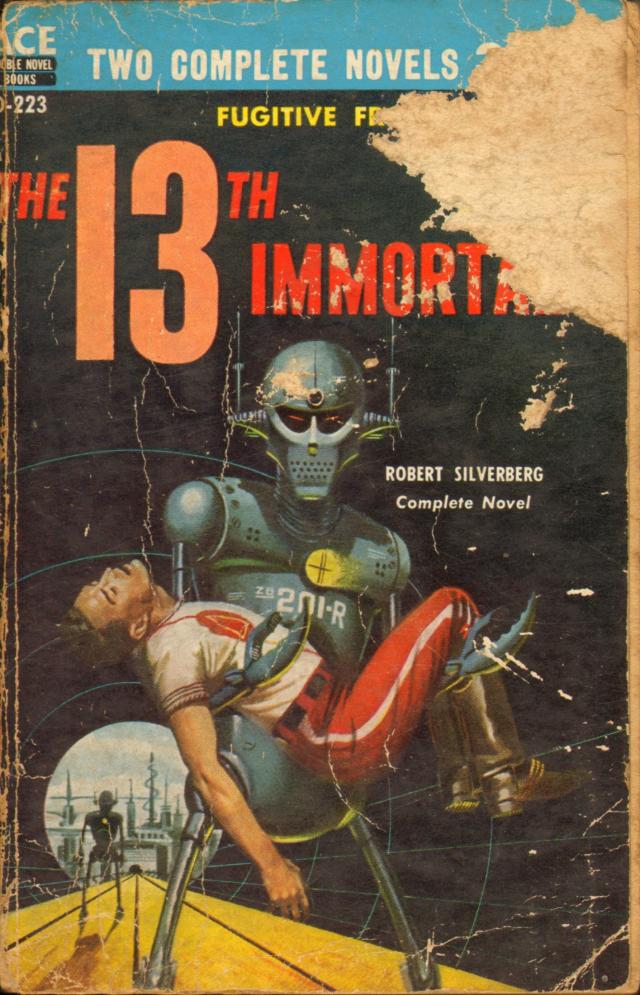
The 13th immortal, p.2
The 13th Immortal,
p.2


Loren was watching the scene in utter horror, and Kesley noticed a couple of the farm girls standing a short distance away, watching, too. The stranger stood with arms folded.
“Let’s go inside,” he suggested. “We can talk better in there.”
Kesley remained rooted, unable to think, unable to move. “This is my farm,” he said out loud, after a moment. “Isn’t it?” It was nearly a whimper.
The harshness vanished abruptly from the stranger’s face. Kesley watched uncomprehendingly as hard lines melted, sharp cheekbones no longer seemed so austere. It was the eyes, he thought curiously. They controlled the expression of the face. And now the cold eyes seemed to radiate warmth.
“Of course this is your farm,” the stranger said. He gripped Kesley’s arm. “They really did a job on you, didn’t they?”
“They?”
“Never mind. I don't want to hurt you any more than I have already. Let’s go inside, and we can talk about it in there.”
Word had somehow travelled rapidly around the farm, and within minutes the farmhouse living room was crowded with curious people. Kesley looked around. He saw Loren, and toothless old Lester, who had owned the farm once and sold it to Loren and Kesley. There were Lester’s three daughters, brawny, tanned girls who did the women’s work on the farm. There was Tim, the slow-witted hired hand.
And there was the stranger in the gilt-bordered red cloak. The stranger glanced from one face to another, then at Kesley. "Can we talk in privacy?”
"You heard what he said,” Kesley snapped to the others. "Get about your jobs.”
’ "You sure you want us to leave you alone?” Loren asked. “You looked pretty wobbly a minute ago out there, and—” "Don't cross me, Loren!”
The older man shrugged. "You're the boss, Dale. Come on, Tim, let's leave them alone.”
"Pretty nice city clothes he's got,” old Lester cackled. Tina, Lester's oldest daughter, nudged him scornfully. "Let's get moving, Lester. The men want to talk.” She indicated with a smirk her disapproval of the exclusion order.
When the others were gone, Kesley turned to the stranger. "Were alone. Now tell me who you are and what you want with me.”
The stranger tugged at his stiff red beard for a moment, "I'm Dryle van Alen. Does that enlighten you?”
"Not at all. Where are you from?”
"The Dukedom of Antarctica,” van Alen said.
For the second time in half an hour, Kesley did a double take. The words sank in slowly, burrowed into his mind—and then exploded into pinwheeling brilliance.
"Antarctica"
“Why the surprise?” van Alen asked mildly. “There are people in Antarctica too, you know. You'd think I had said Mars, or some other impossible place.”
“If this is a joke, van Alen, I'm going to feed you to the hogs with tomorrow's swill.”
"It's no joke. I'm attached to the court of the Duke of Antarctica.”
"So they've got a Duke, too,” Kesley said. He smiled. "I never thought that they'd have one just like us. And I suspect the Twelve Dukes don't even know that. But this is crazy! If you're from Antarctica, what do you want with me?”
"All in good time,” van Alen said calmly. "First: the Twelve Dukes are very much aware of the existence of their
Antarctic confrere. He is, like them, an immortal. Unlike them, he is not interested in striving for power.”
“Why does Antarctica cut itself off from the rest of the
world?”
“A matter of choice,” van Alen said. “Our Duke doesn't care for the company of his twelve colleagues, nor for that of their subjects. But you're leading me astray with your questions. You're not letting me explain why I came here to you.
“Go ahead, then.” Kesley sat back, trying to conceal his tenseness.
It made no sense at all. The Twelve Dukes had ruled the world four hundred years, and in that time no contact between men of the Twelve Empires and the people of the continent of Antarctica had ever taken place. A barrier had always surrounded that continent. Antarctica was as unapproachable as frozen Pluto, or one of the stars.
And now the barrier had lowered long enough to let this Dryle van Alen out into the world of the Twelve Dukes. Van Alen had made his way to America, to Duke Winslow's land—merely to see Dale Kesley? It was impossible.
Van Alen peered at Kesley. “You have lived in Iowa Province for four years—is that right?”
Kesley nodded.
“And before that, where?”
“Kansas Province. I was a farmer there, too.”
One of van Alen's heavy eyebrows twitched skeptically. “Oh? How long did you live in Kansas Province, then?”
“All my life. I was born there. I lived there twenty-one years. I came here four years ago.”
Van Alen chuckled. “You cling to that story the way you would a straw in a maelstrom.” He leaned forward; his voice deepened. “Suppose you try to tell me why you left Kansas Province to come here.”
“Why, I-”
Kesley paused. A muscle began to throb painfully in one cheek, and he looked down at his heavy work-boots in confusion. He had no answer. He did not know.
Once again, the same malaise that had spread over him
outside hit him. He sucked in a deep breath, but said nothing.
“You don't know why you left Kansas?" van Alen asked gently. “Think, Dale. Try to remember.”
Kesley clenched his fists, fighting to keep back a cry of rage and frustration and fear. Finally he said, “I don't know. I don't remember. That's it—I don't remember.” His voice was glacially calm.
“Very good. You don't remember.” Van Alen tugged at his beard again, as if to signify that he had won a telling point. “Next question: describe in detail your life in Kansas Province. What your farm was like, what your mother looked like, how tall your father was—little things like that. Eh?”
The questions poured down on Kesley like an unstoppable torrent; they seemed to wash his feet out from under him and leave him struggling helplessly and impotently to regain his footing.
“My mother? My father? I—”
Again he stopped. The room was blurred; only the smiling, diabolical face of the Antarctican seemed to be fixed, and all else was whirling. Kesley elbowed himself up from his chair and crossed the room in two quick bounds.
“Damn you, I don't remember! I don't remember!”
He grabbed van Alen roughly by the scruff of his cloak and hauled him to his feet.
“Let go of me, Dale.”
The sharp command was all but impossible not to obey, but Kesley, shaking hysterically, continued to hold tight. He clutched for the Antarctican's throat, burning to choke the life out of this torturer before he could ask any more questions.
His hands touched the skin of the Antarctican's throat and then, quite coolly, van Alen broke Kesley's grip. He did it easily, simply grasping the wrists with his own long fingers and lifting.
Kesley struggled, but to no avail. The Antarctican was fantastically strong. Kesley writhed in his grip, but could not break loose. Slowly, without apparent effort, van Alen forced him to his knees and let go.
Kesley made no attempt to rise. He was beaten—physically and mentally. Van Alen stooped, lifted him, eased him to the couch. Drawing forth a scented handkerchief, he mopped perspiration first from Kesley's forehead, then from his own.
“That was unpleasant,” van Alen remarked.
Kesley remained slumped on the couch. “You shouldn't have tried to attack me, Dale. I'm here to help you.”
“How?” Kesley asked tonelessly.
“I'm here to show you the way back to your home.”
“My home's in Kansas Province.” Stubbornly.
“Your home is in Antarctica, Dale. You might as well
admit it to yourself now.”
Strangely, the words had little effect on Kesley. He had already been shocked past any point of surprise.
For four years, he had been persuading himself that he had come from Kansas Province. He had gone on thinking that, all the while subliminally aware that there was no rational reason for that belief, that he had no memories of his earlier life whatever.
Kansas Province had seemed as likely a homeland as any, and he had clung to the idea. As each year passed, it had seemed more and more the truth to him—until van Alen came.
Now he was ready to believe anything. The barriers were down.
“Antarctica?” he repeated.
Van Alen nodded. “You've been the subject of the most intensive manhunt in the history of humanity.” That seemed to amuse him; he stopped, chuckled. “A history, to be sure, that stretches back all of four hundred years—but a history, nevertheless. Dale, we've searched through every one of the Twelve Empires for you. You were finally located here, in Iowa Province. The search is over; it took four years.”
“I'm happy for you,” Kesley said. “You must be pleased to have found me.” His voice was restrained, matter-of-fact. “So the search is over?”
“Partially,” van Alen said. “We have the treasure, now; we lack only the key to the box. Daveen the Singer, the blind man. The search for him continues.”
Kesley frowned impatiently. “What the hell is this all about, van Alen?”
Van Alen smiled warmly. “I'm sorry, Dale. I can’t tell you anything, not until Daveen has been found. But that can’t take long, now that we’ve located you.”
“Who’s this Daveen?”
“A poet,” van Alen said. “Also a remarkably skilled hypnotist. We’ll find him soon, and then the search will really be over.” The Antarctican seemed to be gazing through Kesley, as if he were staring all the way to his distant homeland. His eyes had turned cold again; his face had hardened.
“Suppose I tell you you’re a lunatic?” Kesley asked.
“Suppose you do,” van Alen said animatedly. “You’d have every right to the opinion. Care to join me in lunacy?”
“Eh?”
“Will you come with me—to Antarctica?”
“I’m not that crazy,” Kesley said. He laughed. “You want me to drop everything—the farm, my whole life, just to go off with you to—to Antarctica?"
“This is not your life,” van Alen said. “Antarctica is. Will you come?”
Kesley laughed contemptuously, but said nothing.
There was a knock on the door.
“Come on,” he said roughly. “Enter.”
Tina came in and looked defiantly at both of them. She was a tall, red-haired girl in her late twenties, wide-shouldered and high-bosomed, and her eyes held the flash and fire that must have belonged to old Lester once. She and Kesley had been sharing a room for six months.
“Still talking?” Tina asked.
“Is there anything special you want?” Kesley snapped.
“Just wanted to tell you lunch is getting cold, that’s all. And you left your plough standing in the field. That crazy mutie horse of yours looks like it’s asleep on its feet.”
Kesley frowned. “Tell Tim to go down there and finish the furrow, will you? I’ll be in for lunch in a couple of minutes.”
Tina glanced curiously toward van Alen and said, “With or without company?”
"I’ll be leaving in a few minutes," van Alen told her. “You needn’t prepare anything for me."
“Sorry to hear that," Tina said acidly. “We were looking forward to feeding you." She turned and flounced out.
“Who’s that?" van Alen asked.
“Lester’s daughter—Lester’s the old man. Her name’s Tina. She lives with me."
There was a visible stiffening of van Alen’s manner. Leaning forward anxiously, he said, “You—have no children yet, have you?"
“You kidding? That’s all I need. Things are complicated enough around here without—’’
Van Alen rose abruptly. “I see. Well, I’ll have to be leaving now, Dale.” He wrapped his cloak around his shoulders tightly and walked across the living room. “It’s going to be a long hard journey to the Pole; I must begin at once."
He put his hand to the door. Kesley watched him open it.
ii
Hold it van Alen. Don’t go
Why?
Kesley shook his head without replying. Van Alen looked at him for a moment, shrugged, and turned a second time to leave.
Tina!"
Without really knowing why he was doing what he was about to do, Kesley cupped his hands.
The girl reappeared and confronted him quizzically.
“Get upstairs and pack my things," Kesley ordered her.
"I'm leaving."
"Leaving?"
“Right this minute," he said. “I’m leaving with him" He pointed squarely at van Alen.
II
City noises—the dizzying chaos of the metropolis. Kesley and van Alen reined in their mounts at the gates of the
city of Galveston, capital of Texas Province and a main bastion of Duke Winslow of North America.
It seemed to Kesley that they had been riding for months. Actually, it had been only a matter of weeks for the long ride through the farmlands, down through Texas to die Gulf.
They moved along now at a slow canter, guiding their horses into a line that disappeared between the heavy copper gates surrounding the walled city. Galveston was an encircled peninsula, guarded by land, open to the sea.
Men in the green and gold uniforms of Duke Winslow's guard rode alongside the line, keeping the jostling crowd in order.
“Better get your coins ready,” van Alen muttered, as they drew near the gate.
“Coins?”
“This is a fee city. A dollar a head to enter the gate.”
Kesley made a face and dug a golden dollar from his pocket. He looked at the tiny, well-worn coin almost wistfully. “The good Duke takes care that his subjects are never weighted with overmuch coinage,” he observed. “The Duke's men relieve us of it joyfully.”
They rode past the gate. A sleepy-eyed toll-keeper sat, impassively watching, as each newcomer to the city deposited his dollar in the till.
As Kesley passed the tollbox, he flipped the coin in casually. It clinked against several of the others, spun, and bounced out, rolling some ten feet away. Kesley shrugged apologetically and continued ahead.
“Hey there!” The guard's voice was loud and harsh. “Get down there and—”
The voice of the toll-keeper died away. Kesley looked around and saw van Alen down on his knees in the well-trampled mud, rooting in the filth for the coin. The nobleman seemed to show no compunction about crawling before the toll-keeper.
“Here you are, sir.” Van Alen obsequiously deposited Kesley*s dollar in the tollbox, added one of his own, and handed a third coin to the toll-keeper.
"The boy is sick,” van Alen murmured, gesturing significantly. "He does not know what he does.”
The toll-keeper nodded curtly and pocketed the dollar. "Get moving, both of you,” he snapped.
Kesley, who had trotted a few feet further, halted to let van Alen catch up with him.
"That's a good way to assure a short life,” the Antarctican said. "Toll-keepers are notorious for their quick triggers. Don't make needless trouble for yourself, boy.”
"Sorry,” Kesley said. "It riled me to see him sitting there so smug and taking our money. I didn't really mean to throw the coin on the ground.”
Van Alen shook his head sadly. "It riled you,” he repeated, his voice mocking. "You've been lucky so far—each time you've lost your temper, you've survived. But better learn to curb it. These people are your superiors, whether you like it or not, and if a Duke wants a dollar to enter his city, you put down your dollar or you ride the other way.”
"Superiors, hell! They've got no right—”
“You're just so much dirt, Kesley,” the Antarctican said with sudden force. Oddly, the words did not stir Kesley to anger. "Learn that lesson now. Whatever you may think you are, that doesn't alter the fact that you're nothing more than dirt.”
Kesley swallowed hard, but said nothing. Van Alen was right, he was forced to admit. The Twelve Dukes ruled supreme, and beneath them came a complex and sharply-defined hierarchy in which, as a farmer, Kesley was close to the bottom. He had no call to flare up at toll-keepers.
But yet—
He shook his head. The fact of his insignificance was one he could accept intellectually, but he couldn't believe in it. And he never would. He had never been able to master the trick of lying to himself.
“What's on the schedule in Galveston?” Kesley asked, as they rode into the town. They entered a wide, crowded thoroughfare; mechanical transportation was forbidden in most parts of North America, but there were plenty of horse-carts and carriages—most of them drawn by variegated mutants of one sort or another, but a few by authentic horses of the Old Kind.
“We'll stay here overnight,'' van Alen said. “Tomorrow we pick up the steamer for South America. From there it's straight down to Antarctica.”
“And then?" Kesley prodded.
“And then you'll be in Antarctica.”
That was all the information van Alen would ever give. From time to time on the trip down from Iowa, Kesley had found himself wondering just why he had pulled up roots and struck off with van Alen.
It was probably a combination of factors. Curiosity, certainly. Antarctica was the world's great mystery, keeping itself utterly aloof from the doings of the Twelve Empires. And then there was the vague unease he had felt during his stay 1n Iowa, the knowledge that he belonged somewhere else. And there was a third factor, too—a kind of randomness, a compulsive but seemingly unmotivated action whose nature he did not understand. He had agreed to come—that was all. Why never entered into it for long.
He was being led. Well, he would follow, and wait for the threads to untangle themselves.
Right now he was in a city for, supposedly, the third time in his life. He had the biographical data down pat: three years ago he had gone to market in Des Moines for his horse, and a year later he had made the trek down to St. Louis to sell grain. Both times he had been repelled by the bigness and squalor of the city. He felt the same emotion now.